Structuring Opinions of Counsel in Real Estate Finance Transactions - - PowerPoint PPT Presentation

structuring opinions of counsel in real estate finance
SMART_READER_LITE
LIVE PREVIEW

Structuring Opinions of Counsel in Real Estate Finance Transactions - - PowerPoint PPT Presentation

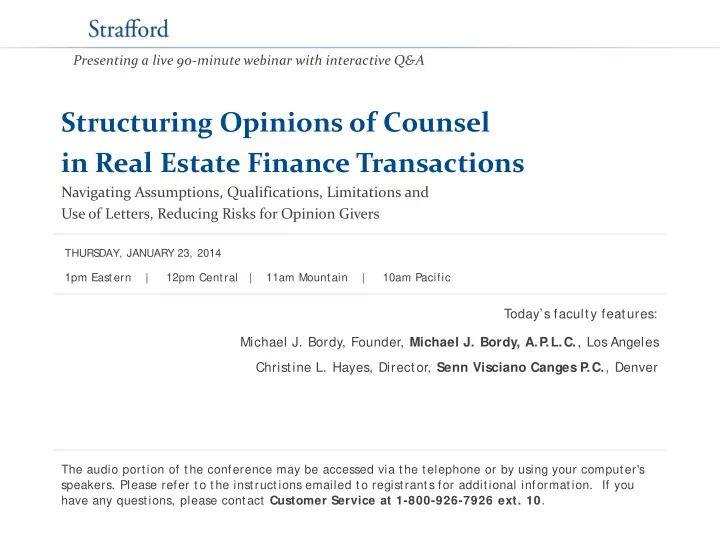
Presenting a live 90-minute webinar with interactive Q&A Structuring Opinions of Counsel in Real Estate Finance Transactions Navigating Assumptions, Qualifications, Limitations and Use of Letters, Reducing Risks for Opinion Givers THURS


slide-1
SLIDE 1

Structuring Opinions of Counsel in Real Estate Finance Transactions

Navigating Assumptions, Qualifications, Limitations and Use of Letters, Reducing Risks for Opinion Givers

Today’s faculty features:

1pm East ern | 12pm Cent ral | 11am Mount ain | 10am Pacific

The audio portion of the conference may be accessed via the telephone or by using your computer's

  • speakers. Please refer to the instructions emailed to registrants for additional information. If you

have any questions, please contact Customer Service at 1-800-926-7926 ext. 10.

THURS DAY, JANUARY 23, 2014

Presenting a live 90-minute webinar with interactive Q&A

Michael J. Bordy, Founder, Michael J. Bordy, A.P .L.C., Los Angeles Christine L. Hayes, Director, Senn Visciano Canges P .C., Denver

slide-2
SLIDE 2

Tips for Optimal Quality

S

  • und Qualit y

If you are listening via your computer speakers, please note that the quality

  • f your sound will vary depending on the speed and quality of your internet

connection. If the sound quality is not satisfactory, you may listen via the phone: dial 1-866-961-9091 and enter your PIN when prompted. Otherwise, please send us a chat or e-mail sound@ straffordpub.com immediately so we can address the problem. If you dialed in and have any difficulties during the call, press *0 for assistance. Viewing Qualit y To maximize your screen, press the F11 key on your keyboard. To exit full screen, press the F11 key again.

FOR LIVE EVENT ONLY

slide-3
SLIDE 3

Continuing Education Credits

For CLE purposes, please let us know how many people are listening at your location by completing each of the following steps:

  • In the chat box, type (1) your company name and (2) the number of

attendees at your location

  • Click the S

END button beside the box If you have purchased S trafford CLE processing services, you must confirm your participation by completing and submitting an Official Record of Attendance (CLE Form). Y

  • u may obtain your CLE form by going to the program page and selecting the

appropriate form in the PROGRAM MATERIALS box at the top right corner. If you'd like to purchase CLE credit processing, it is available for a fee. For additional information about CLE credit processing, go to our website or call us at 1-800-926-7926 ext. 35.

FOR LIVE EVENT ONLY

slide-4
SLIDE 4

Program Materials

If you have not printed the conference materials for this program, please complete the following steps:

  • Click on the ^ symbol next to “ Conference Materials” in the middle of the left -

hand column on your screen.

  • Click on the tab labeled “ Handouts” that appears, and there you will see a

PDF of the slides for today's program.

  • Double click on the PDF and a separate page will open.
  • Print the slides by clicking on the printer icon.

FOR LIVE EVENT ONLY

slide-5
SLIDE 5

Structuring Opinions of Counsel in Real Estate Finance Transactions

Navigating Assumptions, Qualifications, Limitations and Use of Letters, Reducing Risks for Opinion Givers

Presented by: Michael Bordy

slide-6
SLIDE 6

Michael J. Bordy

 Principal  Michael J. Bordy, a Professional Law Corporation  10250 Constellation Boulevard, Suite 2900  Los Angeles, CA 90067  Telephone: (310) 881-6800 x 212  Facsimile: (310) 881-6801  E-mail: Michael@bordylaw.com

6

slide-7
SLIDE 7

Preparing commercial real estate finance

  • pinions

 A. Range of opinions  B. Assumptions  C. Qualifications  D. Limitations  D. Use of the opinion letter  E. The Real Estate Finance Opinion Report of 2012

7

slide-8
SLIDE 8

Range of Opinions

 Introduction  1. A lender in a secured real estate financing transaction

will generally require an opinion of counsel from borrower’s counsel.

 2. Borrower’s counsel provides an opinion of counsel

letter in conjunction with its representation of the Borrower.

8

slide-9
SLIDE 9

Real Estate Financing Documents

 3. A secured real estate financing transaction includes:

 i. A promissory note demonstrating the sum of funds to be

repaid;

 ii. A loan agreement describing the loan being made, the terms

and conditions and detailing the agreements included in the loan package.

 iii. A mortgage or a deed of trust, indicating the amount of the

loan and the describing the real property securing the loan

9

slide-10
SLIDE 10

Loan Documents (continued)

 iv. An assignment of rents;  v. An environmental indemnity agreement;  vi. Guaranty;  vii. Miscellaneous documents

 1. UCC-1 Financing Statement  2. Closing Certificate

10

slide-11
SLIDE 11
  • A. Range of Opinions

 1. Borrower is a

(type of business entity), duly

  • rganized and validly existing and in good standing under

the laws of the State of (state where real property is located).

 2. Each loan document has been properly authorized,

executed, acknowledge and delivered by Borrower.

11

slide-12
SLIDE 12

Range of Opinions (continued)

 3. Each loan document constitutes the legal, valid and

binding obligation of the Borrower, enforceable against the Borrower in accordance with its terms.

 4. The choice of law of the State of

to govern the loan documents is legal, valid, binding and enforceable under the laws of such State.

12

slide-13
SLIDE 13

Range of Opinions (continued)

 5. The payment by the Borrower and receipt by the

Lender of all principal and interest and other payments required to be paid pursuant to the terms of the Note and the other loan documents will not violate the usury laws of the State of

  • r otherwise constitute

unlawful interest.

 6. Borrower has all the requisite power and authority to

execute and deliver each of the loan documents.

13

slide-14
SLIDE 14

Range of Opinions (continued)

 7. Borrower has the legal power and authority to borrow

money and to own and encumber its property and assets located in , .

 8. No order, consent, approval, license or authorization

  • f, or filing, recording or registration with, any

governmental or public body or authority of the United States is required in connection with the execution and delivery of the loan documents.

14

slide-15
SLIDE 15

Range of Opinions (continued)

 9. The execution and delivery of the loan documents and

the performance of the terms and conditions contained in the loan documents will not conflict with, or constitute a default with any laws, statutes or regulations.

15

slide-16
SLIDE 16
  • B. Assumptions

 1. The actual intent of the borrower and the lender is

accurately set forth in the loan documents.

 2. All terms and conditions of, or relating to the

transactions contemplated by the loan documents are correctly and completely embodied in the loan documents.

16

slide-17
SLIDE 17

Assumptions (continued)

 3. The Mortgage (Deed of Trust) will be properly

recorded in the office of the County Recorder of County, .

 4. The consideration recited in the loan documents will

be advanced pursuant to the terms of the loan documents.

 5. All signatures not witnessed by us are genuine.

17

slide-18
SLIDE 18

Assumptions (continued)

 6. All documents submitted to us as originals are

authentic.

 7. All documents submitted to us as copies are accurate

and complete copies of the originals thereof.

 8. The loan documents and the transactions evidenced by

the loan documents are valid, binding and enforceable with regard to lender.

18

slide-19
SLIDE 19
  • C. Qualifications

 1. The enforceability of the loan documents may be

limited by statutory and case law pertaining to bankruptcy, insolvency, reorganization, moratorium, fraudulent conveyance, equitable subordination, marshaling, lender’s fiduciary duty and lender’s bad faith.

 2. The enforceability of the loan documents may be

limited by general principles of equity.

19

slide-20
SLIDE 20

Qualifications (continued)

 3. The enforceability of certain rights and remedies

provided in the loan documents are limited or may be unavailable by certain laws and judicial opinions and decisions.

 4. The enforceability of certain rights and remedies

provided in the loan documents may be limited by public policy.

20

slide-21
SLIDE 21
  • D. Limitations

 1. We have not made or undertaken to make any

investigation of the state of title to the real property described in the loan documents.

 2. We express no opinion with respect to title thereto or

the priority or perfection of any liens on the real property to any security interests.

21

slide-22
SLIDE 22

Limitations (continued)

 3. We are licensed to practice law only in the State of

.

 4. We express no opinion with respect to the effect of

any laws other than the laws of the State of and the laws of the United States of general application to transactions in the State of .

22

slide-23
SLIDE 23

Limitations (continued)

5.

We undertake no obligation to advise you of facts or changes in the law occurring after the date of this

  • pinion letter which might affect the opinions

expressed in this opinion letter.

23

slide-24
SLIDE 24
  • E. Use of Opinion Letter

 1. This opinion is being rendered for the benefit of

lender and the benefit of lender’s successors and assigns under the loan documents.

 2. This opinion may not be used or relied upon by, nor

may copies be delivered to, any other person or entity without our prior written consent.

 3. The opinions set forth in this opinion letter are limited

to the matters expressly stated in this opinion letter and no opinion is implied or may be inferred beyond the matters expressly so stated.

24

slide-25
SLIDE 25

Real Estate Finance Opinion Report of 2012

 Chapter One: Introduction  Chapter Two: Practitioner’s Guide  Chapter Three: Illustrative Language of Opinion Letter

25

slide-26
SLIDE 26

Chapter One: Introduction

 1. Background: This report updates and expands the

Inclusive Real Estate Secured Transaction Opinion (1998).

 2. Professional Responsibility Issues.

 i. Need to obtain consent of client to deliver an opinion

letter (see Model Rule 2.3(a));

 ii. Protection of client confidences (see Model Rule 1.6);  iii. Identification, appreciation and resolution of conflicts of

interest (see Model Rule 1.7); and

 iv. Duties of third parties

26

slide-27
SLIDE 27

Chapter One: Introduction (continued) Model Rule 2.3

 Model Rule 2.3(a) allows a lawyer to provide an

evaluation of a matter affecting a client for the use of another person if the lawyer “reasonably believes that making the evaluation is compatible with other aspects of the lawyer’s relationship with the client.”

 Model Rule 2.3(b) requires the lawyer to obtain the

client’s informed consent if the lawyer “knows or reasonably should know” providing such opinion would materially and adversely affect the client’s interests.

27

slide-28
SLIDE 28

Chapter One: Introduction (continued) Model Rule 1.6

 Model Rule 1.6 provides that the disclosure of

confidential information requires client consent unless the disclosure is impliedly authorized to carry out the representation.

28

slide-29
SLIDE 29

Chapter One: Introduction (continued) Model Rule 1.7

 Conflicts of interest among clients involved in a given

transaction may give rise to a requirement under Model Rule 1.7 that the lawyer obtain informed consent of each client involved in the transaction.

29

slide-30
SLIDE 30

Chapter One (continued)

 3. Customary Practice: Under customary practice the

meaning of words used in an opinion letter and the diligence required to provide an opinion letter are determined by the customary practice of lawyers who give and receive such opinion letters.

30

slide-31
SLIDE 31

Chapter Two: A Practitioner’s Guide

 1. The lawyer writing the opinion should:

 i. Describe its limited or special role in the transaction;  ii. Identify the loan documents (in the report referred to as

“Transaction Documents”);

 iii. Identify each of the organizational and other specified

authority documents reviewed (in the report referred to as “Authority Documents”);

31

slide-32
SLIDE 32

Chapter Two: A Practitioner’s Guide (continued)

 iv. Identify or specify the state or federal law it covers as well

as the state or federal laws it excludes;

 v. Identify possible application of law of multiple jurisdictions

(choice of law provisions)

 vi. Indicate the scope of review;  vii. Identify reliance on other sources without investigation

32

slide-33
SLIDE 33

Chapter Two: A Practitioner’s Guide (Continued)

 2. Opinion letters usually identify assumptions that

support the opinions given.

 i. Most assumptions are self-explanatory.  ii. Assumptions are made without investigation.

33

slide-34
SLIDE 34

Chapter Two: A Practitioner’s Guide (Continued)

 3. Opinions—notes on opinions to be given

 i. Good Standing—when given, an opinion of good standing is

given in reliance on public authority documents (e.g., certificate

  • f good standing);

 ii. Qualified to do business—requested if borrower is not

formed in that state; also is given in reliance on public authority documents (e.g., certificate of qualification to do business);

34

slide-35
SLIDE 35

Chapter Two: A Practitioner’s Guide (continued)

 4. Limitations generally relate to contract formation and

enforceability.

 i. Bankruptcy exception;  ii. Equitable considerations;  iii. Generic enforceability qualifications;  iv. Discussion of relevant case law.

35

slide-36
SLIDE 36

Potential risks of liability and protections for opinion preparer

SVC

Senn Visciano Canges P.C. Christine Hayes CHayes@SennLaw.com

slide-37
SLIDE 37

Duties of opinion giver

  • Client
  • Nonclient

37

slide-38
SLIDE 38

Client

Opinion giver represents the borrower and guarantor

38

slide-39
SLIDE 39

Is a client required to consent to the issuance of the opinion letter?

Model Rules of Professional Conduct

39

slide-40
SLIDE 40

Cou

  • unselor
  • r

Rule 2.3 Evaluation For Use By Third Persons (a) A lawyer may provide an evaluation of a matter affecting a client for the use of someone

  • ther than the client if the lawyer reasonably

believes that making the evaluation is compatible with other aspects of the lawyer's relationship with the client. (b) When the lawyer knows or reasonably should know that the evaluation is likely to affect the client's interests materially and adversely, the lawyer shall not provide the evaluation unless the client gives informed consent. (c) Except as disclosure is authorized in connection with a report of an evaluation, information relating to the evaluation is

  • therwise protected by Rule 1.6.

40

slide-41
SLIDE 41

Cli lient-Lawyer R Relations nshi hip Rule 1.6 Confidentiality Of Information (a) A lawyer shall not reveal information relating to the representation of a client unless the client gives informed consent, the disclosure is impliedly authorized in order to carry out the representation or the disclosure is permitted by paragraph (b). (c) A lawyer shall make reasonable efforts to prevent the inadvertent or unauthorized disclosure of, or unauthorized access to, information relating to the representation of a client

41

slide-42
SLIDE 42

Cli lient-Lawyer R Relations nshi hip Rule 1.7 Conflict Of Interest: Current Clients (a) Except as provided in paragraph (b), a lawyer shall not represent a client if the representation involves a concurrent conflict of interest. A concurrent conflict of interest exists if: (1) the representation of one client will be directly adverse to another client; or (2) there is a significant risk that the representation of one or more clients will be materially limited by the lawyer's responsibilities to another client, a former client or a third person or by a personal interest of the lawyer. (b) Notwithstanding the existence of a concurrent conflict of interest under paragraph (a), a lawyer may represent a client if: (4) each affected client gives informed consent, confirmed in writing.

42

slide-43
SLIDE 43

Privity

“The relationship between the parties to a contract, allowing them to sue each other but preventing a third party from doing so.” Black’s Law Dictionary 1199 (9th ed., West 2009)

43

slide-44
SLIDE 44

Nonclient

NO PRIVITY; IS “NEAR PRIVITY” IS SUFFICIENT?

44

slide-45
SLIDE 45

Under New York law, an attorney representing a borrower may have liability to a lender in connection with an opinion letter issued in a loan transaction. Prudential Insurance Company of America v. Dewey, Ballantine, Bushby, Palmer & Wood, 80 N.Y.2d 377, 605 N.E.2d 318, 590 N.Y.S.2d 831 (1992)

45

slide-46
SLIDE 46

Purpose of the opinion letter was to aid the lender in deciding whether to make the loan Fortress Credit Corp. v. Dechert LLP, 89 A.D.3d 615, 934 N.Y.S.2d 119 (2011)

46

slide-47
SLIDE 47

Nonclient

THIRD PARTY BENEFICIARY RULE

47

slide-48
SLIDE 48

“To establish a duty owed by the attorney to the nonclient the latter must allege and prove that the intent of the client to benefit the nonclient was a direct purpose of the transaction or relationship.” Flaherty v. Weinberg, 303 MD. 116, 492 A.2d 618 (1985)

48

slide-49
SLIDE 49

Misrepresentations/mistakes

  • Negligent misrepresentation
  • Fraud

49

slide-50
SLIDE 50

Negligent Misrepresentation

For a nonclient to succeed in a negligence action against an attorney, it must prove that the primary purpose and intent of the attorney-client relationship itself was to benefit or influence the third party. Greycas, Inc. v. Proud, 826 F.2d 1560 (7th Cir. 1987)

50

slide-51
SLIDE 51

Negligent Misrepresentation

Attorney who issued a misleading opinion letter liable to a nonclient based on negligent misrepresentation. Mehaffy, Rider, Windholz & Wilson v. Central Bank of Denver, N.A., 892 P.2d 230 (1995)

51

slide-52
SLIDE 52

Fraud

Model Rules of Professional Conduct

52

slide-53
SLIDE 53

Trans nsactions ns W With P h Persons ns Othe her Tha han n Clients Rule 4.1 Truthfulness In Statements To Others In the course of representing a client a lawyer shall not knowingly: (a) make a false statement of material fact or law to a third person; or (b) fail to disclose a material fact to a third person when disclosure is necessary to avoid assisting a criminal or fraudulent act by a client, unless disclosure is prohibited by Rule 1.6

53

slide-54
SLIDE 54

Cli lient-Lawyer R Relations nshi hip Rule 1.2 Scope Of Representation And Allocation Of Authority Between Client And Lawyer (d) A lawyer shall not counsel a client to engage,

  • r assist a client, in conduct that the lawyer

knows is criminal or fraudulent, but a lawyer may discuss the legal consequences of any proposed course of conduct with a client and may counsel

  • r assist a client to make a good faith effort to

determine the validity, scope, meaning or application of the law.

54

slide-55
SLIDE 55

Cost/benefit analysis

  • Indemnity
  • Liability
  • Defense Costs
  • Managing financial exposure

55

slide-56
SLIDE 56

Indemnity

New York State Bar Association Committee on Professional Ethics issued an opinion allowing an attorney to ask a client to indemnity the attorney against potential malpractice or other claims by a third-party addressee of an opinion letter to the client. See New York State Bar Association Committee on Professional Ethics, Op. 969 (June 12, 2013).

56

slide-57
SLIDE 57

Liability

Opinion giver (i.e., the law firm) could be liable for the entire loss or personal liability may attach to the individual attorney who prepared and signed the opinion letter

57

slide-58
SLIDE 58

Defense Costs

Opinion givers are exposed to defense costs of potentially tens of millions of dollars and damages claims that far exceed what they can afford to lose. Glazer and Lipson, “Courting the Suicide King,” 17 Business Law Today 59, 60 (March/April 2008).

58

slide-59
SLIDE 59

Managing Financial Exposure

Limit financial exposure to a manageable and predictable amount (e.g., amount of professional liability insurance coverage)

59

slide-60
SLIDE 60

Consequences

  • Liability
  • Disciplinary Action

60

slide-61
SLIDE 61

Liability

A third party addressee of an opinion in a business transaction will be able to recover against the opinion giver if the addressee can establish that it reasonably relied on the

  • pinion, that it suffered a loss proximately caused thereby, and that the opinion giver was
  • negligent. 2007 Report on Lawyers’ Opinions in Business Transactions by the Special

Joint Committee of the Section of Business Law and the Section of Real Property, Planning and Zoning of the Maryland State Bar Association, Inc., revised as of October 6, 2009

61

slide-62
SLIDE 62

Disciplinary Action

Model Rules of Professional Conduct

62

slide-63
SLIDE 63

1700 LINCOLN STREET, SUITE 4500, DENVER, COLORADO 80203 TELEPHONE (303) 298-1122 | FACSIMILE (303) 296-9101 | www.SennLaw.com

63

SVC

Senn Visciano Canges P.C.