Structuring Equity Compensation for Partnerships and LLCs - - PowerPoint PPT Presentation

structuring equity compensation for partnerships and llcs
SMART_READER_LITE
LIVE PREVIEW

Structuring Equity Compensation for Partnerships and LLCs - - PowerPoint PPT Presentation

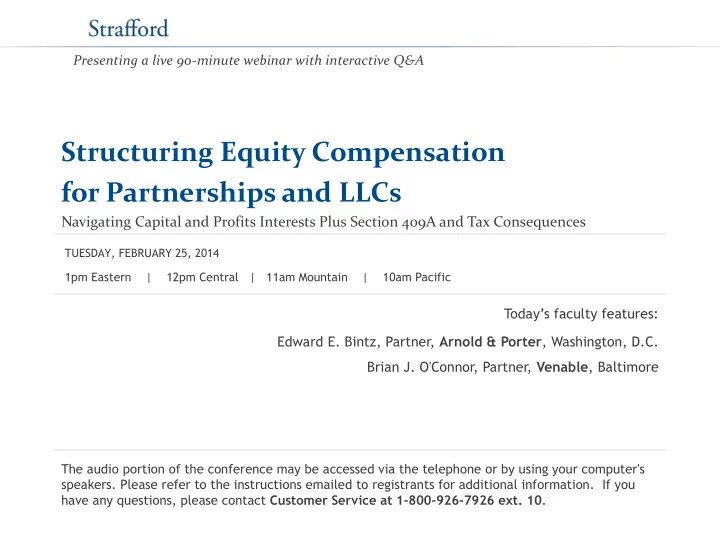
Presenting a live 90-minute webinar with interactive Q&A Structuring Equity Compensation for Partnerships and LLCs Navigating Capital and Profits Interests Plus Section 409A and Tax Consequences TUESDAY, FEBRUARY 25, 2014 1pm Eastern |


slide-1
SLIDE 1

Structuring Equity Compensation for Partnerships and LLCs

Navigating Capital and Profits Interests Plus Section 409A and Tax Consequences

Today’s faculty features:

1pm Eastern | 12pm Central | 11am Mountain | 10am Pacific

The audio portion of the conference may be accessed via the telephone or by using your computer's

  • speakers. Please refer to the instructions emailed to registrants for additional information. If you

have any questions, please contact Customer Service at 1-800-926-7926 ext. 10.

TUESDAY, FEBRUARY 25, 2014

Presenting a live 90-minute webinar with interactive Q&A Edward E. Bintz, Partner, Arnold & Porter, Washington, D.C. Brian J. O'Connor, Partner, Venable, Baltimore

slide-2
SLIDE 2

Sound Quality If you are listening via your computer speakers, please note that the quality

  • f your sound will vary depending on the speed and quality of your internet

connection. If the sound quality is not satisfactory, you may listen via the phone: dial 1-888-601-3873 and enter your PIN when prompted. Otherwise, please send us a chat or e-mail sound@straffordpub.com immediately so we can address the problem. If you dialed in and have any difficulties during the call, press *0 for assistance. Viewing Quality To maximize your screen, press the F11 key on your keyboard. To exit full screen, press the F11 key again.

FOR LIVE EVENT ONLY

slide-3
SLIDE 3

For CLE purposes, please let us know how many people are listening at your location by completing each of the following steps:

  • In the chat box, type (1) your company name and (2) the number of

attendees at your location

  • Click the word balloon button to send

FOR LIVE EVENT ONLY

slide-4
SLIDE 4

Structuring Equity Compensation for Partnerships and LLCs

February 25, 2014

  • Edward E. Bintz (202) 942-5045

Edward.Bintz@aporter.com

  • Brian O’Connor (410) 244-7863

bjoconnor@venable.com

66327790.1

slide-5
SLIDE 5

Overview – Discussion Topics

  • Partnerships and LLCs – Core Principles
  • Profits interests
  • Capital interests
  • Options
  • Phantom arrangements
  • Partner/employee status
  • Section 409A considerations
  • Corporate conversions

5

slide-6
SLIDE 6

Partnerships and LLCs – Core Principles

  • Classification Issues – LLCs generally taxed as

partnerships unless elections are made to treat them as corporations

  • Consequences of Pass-through Tax Treatment – No

entity level tax and income, gain, loss and deduction flow-through to entity owners regardless of distributions by the entity

6

slide-7
SLIDE 7

Partnerships and LLCs – Core Principles (cont.)

  • Allocation and Distribution Provisions

– Section 704(b) safe harbor – Capital account maintenance – Book-ups – Liquidating or not liquidating with capital accounts – Treatment of partnership distributions – Differences between distributions made with regard to income and distributions made without regard to income

7

slide-8
SLIDE 8

Equity Compensation Alternatives – Profits Interests

  • What is a profits interest?
  • Case law

– Diamond v. Com’r, 56 T.C. 530 (1971), aff’d, 492 F.2d 286 (7th

  • Cir. 1974).

– St. John v. U.S., 84-1, USTC ¶ 9158 (C.D. Ill 1983). – Kenroy Inc. v. Com’r, 47 T.C.M. 1749 (1984). – Campbell v. Com’r, 59 T.C.M. 236 (1990), aff’d in part and rev’d in part, 943 F.2d 815 (8th Cir. 1991).

8

slide-9
SLIDE 9

Equity Compensation Alternatives – Profits Interests (cont.)

  • Rev. Proc. 93-27

– Provides guidance on what constitutes a profits interest and tax consequences associated with profits interests – Profits interest defined as an interest other than a capital

  • interest. A capital interest is an interest that gives holder a share
  • f proceeds if partnership’s assets sold at FMV and proceeds

distributed in liquidation – If Rev. Proc. 93-27 applies, grant of profits interest not a taxable event for service provider or partnership

  • Applies if profits interest is granted to person for provision of

services to (or for the benefit) of a partnership in partner capacity or in anticipation of being a partner

9

slide-10
SLIDE 10

Equity Compensation Alternatives – Profits Interests (cont.)

– Does not apply if:

  • Profits interest relates to substantially certain stream of income from

partnership assets (such as high grade debt security or net lease)

  • Profits interest is disposed of within two years
  • Profits interest is an LP interest in a publicly traded partnership

10

slide-11
SLIDE 11

Equity Compensation Alternatives – Profits Interests (cont.)

  • Rev. Proc. 2001-43

– Provides guidance on treatment on profits interests subject to vesting requirements – Provides that Rev. Proc. 93-27 applies at the time of grant of a profits interest even if not vested if:

  • Service provider treated as owner of the partnership interest from the

date of grant and takes into account allocations of income, loss, etc. in determining tax liability

  • Neither partnership nor partners claim a deduction upon grant or vesting
  • f the profits interests
  • 83(b) elections
  • Importance of book-ups; valuations
  • Effect of forfeiture

11

slide-12
SLIDE 12

Equity Compensation Alternatives – Profits Interests (cont.)

  • Is it a profits interest or a bonus arrangement?
  • Current proposed regulations and other proposed

guidance

  • Common structural approaches for profits interests
  • Carried interest legislation and the President’s budget

12

slide-13
SLIDE 13

Equity Compensation Alternatives – Capital Interests

  • What is a capital interest?

– As of date of grant entitles holder to share of liquidation proceeds if partnership liquidated – Also entitles holder to share of future profits

  • Tax treatment of capital interests

– Similar to tax consequences associated with compensatory transfers of stock – Service provider recognizes income equal to FMV value of interest at time vested (less any amount paid). Basis equal to income recognized – 83(b) elections – Partnership (and therefore partners) get compensation deduction equal to FMV included in service provider’s income (subject to Sections 162 and 212)

13

slide-14
SLIDE 14

Equity Compensation Alternatives – Capital Interests (cont.)

– Capital shift issues – Valuation of capital interest – liquidation value or arm’s length sale price for capital interest – Effect of forfeiture

  • Is a “fill-up” a profits interest or a capital interest?

14

slide-15
SLIDE 15

Equity Compensation Alternatives – Options on Partnership and LLC Interests

  • Options to acquire capital interests

– Similar to stock options – Upon exercise service provider and partnership have same tax treatment as grant of capital interest (taking into account payment of exercise price)

  • Options to acquire profits interests

– No income to service provider at time of exercise and no deduction for partnership – Generally not attractive to service providers from economic perspective

15

slide-16
SLIDE 16

Equity Compensation Alternatives – Phantom Interests

  • Similar to phantom stock
  • Service provider recognizes ordinary income at

time of payment

  • Partnership gets deduction equal to amount paid
  • Can be subject to Section 409A if not eligible for

short-term deferral exception or other exceptions

16

slide-17
SLIDE 17

Equity Compensation Alternatives – Phantom Interests (cont.)

  • Section 409A structuring challenges if phantom interest

holders are intended to share in event-based partnership distributions

– Example: Real estate partnership ABC holds multiple parcels of real estate. The partnership agreement provides for the distribution

  • f profits upon the sale of a parcel. ABC would like to grant fully

vested phantom interests to employees that provide for distributions to be made to phantom holders upon the sale of a parcel. Doing so would, however, present Section 409A compliance issues because the sale of a parcel of real estate is not a Section 409A-permitted payment event. – Possible design solutions include requiring the holder to be providing services at the time of distribution, imposing performance goal conditions on the right to payment, and providing for fixed payment date(s) on which payment is made in respect of all prior

  • sales. Each can have significant drawbacks.

17

slide-18
SLIDE 18

Partner/Employee Status

  • Can a partner be an employee?

– Case law – Armstrong v. Phinney, 394 F.2d 661 (5th Cir. 1968) – IRS pronouncements – Rev. Rul. 69-184; GCM 34001 (Dec. 23, 1969); GCM 34173 (July 25, 1969) – Practical considerations

  • Income tax consequences of non-employee treatment

– Withholding issues – Employment taxes – Employee deductions – State tax considerations – Compliance burdens

18

slide-19
SLIDE 19

Partner/Employee Status (cont.)

  • Employee benefit consequences of Non-employee

status

– Not eligible to participate in cafeteria plans – Health benefits not excluded from income, but deduction for premiums paid by self-employed – No group term life insurance exclusion – Qualified transportation and qualified moving expense reimbursements not available – Can still participate in qualified retirement plans

19

slide-20
SLIDE 20

Applicability of Section 409A To Grants of Partnership Equity Interests

  • Final regulations do not address partnership equity compensation
  • Preamble says that until guidance issued can rely on Notice 2005-1
  • Under Notice 2005-1:

– May treat issuance of a partnership interest or an option to acquire a partnership interest in connection with performance of services under same principles as govern issuance of stock

  • Service provider stock requirement for options
  • Option modification/extension rules

– If profits interest is treated under applicable guidance as not resulting in inclusion of income by service provider, then not Section 409A deferred compensation – May treat issuance of capital interest in same manner as issuance

  • f stock

20

slide-21
SLIDE 21

Applicability of Section 409A to Partnership Allocations and Partner Service Provider Payments

  • Guaranteed Payments Under Section 707(c)

– In general, guaranteed payments are payments made to a partner (in his capacity as a partner) without regard to the partnership’s income – The preambles to the proposed final regulations provide that “Section 409A applies to guaranteed payments described in Section 707(c) (and the rights to receive such payments in the future), only in cases where the guaranteed payment is for services and the partner providing the services does not include the payment in income [within the applicable short-term deferral period]”

21

slide-22
SLIDE 22

Applicability of Section 409A to Partnership Allocations and Partner Service Provider Payments (cont.)

– Example: A joins an accounting firm as a partner on January 1, 2014. As a part of terms of his joining the firm, he is entitled to a $50,000 bonus payment regardless of partnership profits, on April 15, 2015, provided that he remains as a partner through the end

  • f 2014. The $50,000 payment would be a

guaranteed payment that constitutes deferred compensation subject to Section 409A.

22

slide-23
SLIDE 23

Applicability of Section 409A to Partnership Allocations and Partner Service Provider Payments (cont.)

  • Payments Made to a Partner for Services Rendered

Other Than in His Capacity as a Partner Under Section 707(a)

– Generally should be subject to Section 409A as if no partnership involved. – Example: A is a one-third partner in a partnership ABC that

  • perates a multiple printing shops. A is also a professional

architect and pursuant to a contract with the partnership provides architectural services to ABC during 2014 in connection with the

  • pening a new print shop. Under the terms of the contract, A is

entitled to a payment of $15,000 on December 15, 2014 and a payment of $15,000 on April 15, 2015. The payments are Section 707(a) payments, and the $15,000 payment on April 15, 2015 would be deferred compensation subject to Section 409A.

23

slide-24
SLIDE 24

Applicability of Section 409A to Partnership Allocations and Partner Service Provider Payments (cont.)

  • Partner’s Distributive Share of Partnership Income Under

Sections 702 and 704

– Not addressed by Section 409A regulations or other Section 409A guidance – Although not addressed by the IRS, a partner’s distributive share

  • f income under Sections 702 and 704 from a partnership for

which the partner provides services should not be treated as compensation for the partner’s services to the partnership for purposes of applying Section 409A – Note that the character of some or all of the income that flows through the partnership to the partner could be compensation income subject to Section 409A to the extent that the partnership has compensation income for services performed by the partnership

24

slide-25
SLIDE 25

– As result, Section 409A generally should not apply to the partner’s distributive share of the partnerships income (except to the extent that Section 409A applies to income received by the partnership for services provided by the partnership). – Example: A and B are partners in an auto parts business and share profits equally. A expects to have an increased need for cash during for a three year period. To accommodate A, A and B amend the partnership agreement so that profits will be shared 60%-40% for the three year period after the amendment, with the split flipping to 40%-60% for the next succeeding three year period, and then equally thereafter. B should not be treated as having any Section 409A deferred compensation.

Applicability of Section 409A to Partnership Allocations and Partner Service Provider Payments (cont.)

25

slide-26
SLIDE 26
  • Payments to Retiring Partners Under Section

736 Payments

– The preamble to the final regulations provides that these payments may be treated as not subject to Section 409A, unless the payments meet the requirements for being exempt from SECA taxes under Section 1402(a)(10). – Section 1402(a)(10) exempts payments to a retired partner if certain conditions are met, including that the payments be made on account of retirement and continue until the partner’s death.

Applicability of Section 409A to Partnership Allocations and Partner Service Provider Payments (cont.)

26

slide-27
SLIDE 27

Equity Compensation Alternatives – What is the Best Choice?

  • Profits interests generally preferred
  • Liquidity/exit considerations
  • Partner/employee issues
  • Complexity

27

slide-28
SLIDE 28

Corporate Conversions

  • General rules applicable when partnerships convert to

corporations

  • Treatment of corporate conversions to holders of profits

interests

– Possibility of compensation treatment – Valuation considerations

  • Treatment of corporate conversions to holders of capital

interests

  • Treatment of corporate conversions to holders of

compensatory options

  • Treatment of corporate conversions to beneficiaries of

phantom arrangements

28

slide-29
SLIDE 29

Contact Information

Edward Bintz Brian O’Connor Arnold & Porter LLP Venable LLP 555 Twelfth Street 750 E. Pratt Street Washington, DC 20004 Baltimore, MD 21202 (202) 942-5045 (410) 244-7863 edward.bintz@aporter.com bjoconnor@venable.com

29

slide-30
SLIDE 30

Disclaimer Pursuant to IRS Circular 230, please be advised that, to the extent this communication contains any tax advice, it is not intended to be, was not written to be and cannot be, used by any taxpayer for the purpose of avoiding penalties under U.S. federal tax law.

30