Stress psychological problems? People have persistent behaviors - - PDF document

stress
SMART_READER_LITE
LIVE PREVIEW

Stress psychological problems? People have persistent behaviors - - PDF document

Focus of Presentation What is Cognitive Behavioral Therapy? A Review of the B-A-T-H-E Technique and the 15 Minute Hour Review, discuss and practice the BATHE Technique Define Cognitive Therapy and its application in Family Practice


slide-1
SLIDE 1

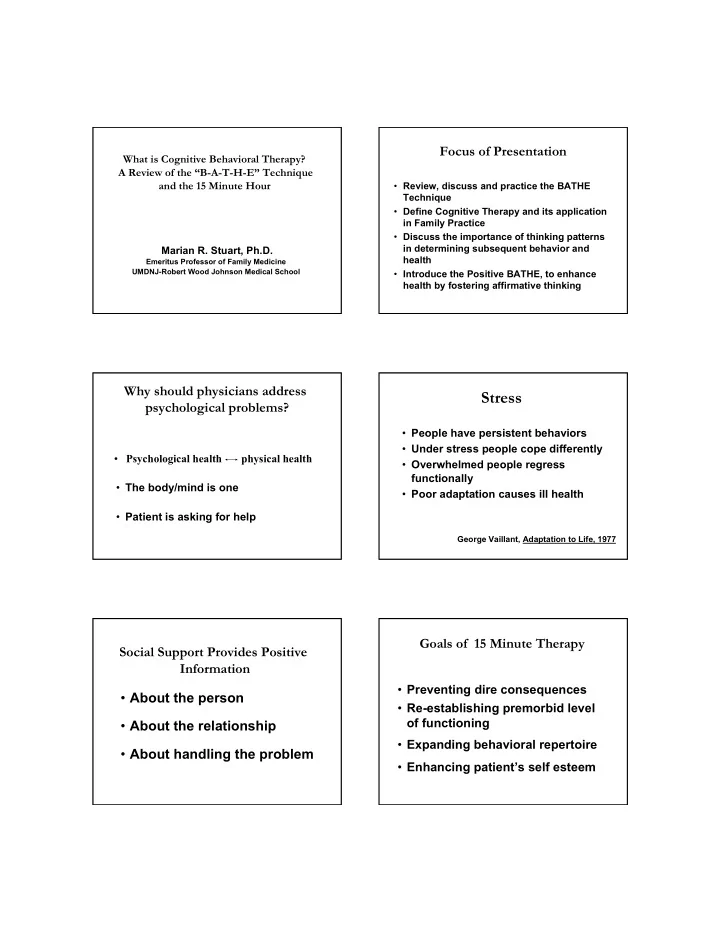
What is Cognitive Behavioral Therapy? A Review of the “B-A-T-H-E” Technique and the 15 Minute Hour

Marian R. Stuart, Ph.D. Emeritus Professor of Family Medicine UMDNJ-Robert Wood Johnson Medical School

Focus of Presentation

  • Review, discuss and practice the BATHE

Technique

  • Define Cognitive Therapy and its application

in Family Practice

  • Discuss the importance of thinking patterns

in determining subsequent behavior and health

  • Introduce the Positive BATHE, to enhance

health by fostering affirmative thinking

Why should physicians address psychological problems?

  • The body/mind is one
  • Patient is asking for help
  • Psychological health physical health

Stress

  • People have persistent behaviors
  • Under stress people cope differently
  • Overwhelmed people regress

functionally

  • Poor adaptation causes ill health

George Vaillant, Adaptation to Life, 1977

Social Support Provides Positive Information

  • About the person
  • About the relationship
  • About handling the problem

Goals of 15 Minute Therapy

  • Preventing dire consequences
  • Re-establishing premorbid level
  • f functioning
  • Expanding behavioral repertoire
  • Enhancing patient’s self esteem
slide-2
SLIDE 2

The BATHE Technique

Background Affect/Feeling Trouble Handling Empathy

How to BATHE your Patients as you SOAP Them:

Background: What is going on in your life? Affect: How does that make you feel? Trouble: What about it troubles you most? Handling: How are you handling that? Empathy: That must be very difficult.

Basics of CBT Therapy

  • 1. CBT is based on the cognitive model
  • f emotional response
  • 2. CBT Is brief and time-limited

(Elements can be included into a 15 minute visit)

  • 3. A therapeutic relationship is required
  • 4. It’s a collaborative effort

More Basics

  • 5. CBT uses the Socratic method
  • 6. CBT is structured and directive
  • 7. CBT is based on an educational model
  • 8. CBT theory and techniques rely on

rational thinking

  • 9. Homework is a central feature of CBT.

Cognitive-Behavioral Therapy (CBT) Demystified

  • We constantly tell ourselves, as

well as others, stories

  • These stories create our reality

and affect our experience

Understanding the Impact of Our Stories

  • Our stories reflect our view of who

we are

  • Our stories determine what we think

we are capable of doing

  • Our stories determine how much

effort we will make to change

slide-3
SLIDE 3

Cognitive Therapy Edits the Story

  • First:

The story must be heard

  • Second: The story must be reflected

back with empathy

  • Third:

Limits must be challenged

Challenging Absolutes

  • Always
  • Never
  • Everyone
  • No-one

Challenging Imposed Limits

  • Can’t
  • Must
  • Should
  • It’s

impossible

The Amazing Power of the Word “YET”

  • YET implies it is possible
  • YET implies impending change
  • YET empowers people to

contemplate changes

Y E T

YOU EMPOWER THEM Expected Outcome

  • When the patient uses the word

YET the story is being edited

  • The patient is in the

contemplative stage

  • Behavioral change will follow
slide-4
SLIDE 4

Strategies for Helping Patients

  • Focusing on options
  • Looking at consequences
  • Applying tincture of time
  • Choosing not to choose

Four Options for a Bad Situation

  • Leave it
  • Change it
  • Accept it
  • Reframe it

Three-Step Problem Solving for Bad Situations

  • 1. What is the patient feeling?
  • 2. What does the patient want?
  • 3. What can the patient do about

it?

Positive Psychology: The Science of Happiness There is a substantial cognitive component to happiness “It is not just who we are that matters, but how we think about our lives”

MEP Seligman Handbook of Positive Psychology

Core Foci of Positive Psychology

  • Understand who we are and how we cope

with adversity

  • Study populations to understand what makes

some people more resilient than others

  • Recognize that optimism and other resilient

thoughts and behaviors are learned behaviors

  • Teach resilience and help individuals tap into

their already existing core strengths and virtues

  • Study and promote happiness despite

circumstances

Confirmatory Research

  • Recent studies highlight the striking effects of positive

thoughts

  • They enhance the ability of the immune system to

protect the body

  • They help overcome depression
  • They promote both physical and mental health

(Psychological Bull 2005:131(6)925-971)

slide-5
SLIDE 5

Positive vs. Negative Thoughts

  • Positive thoughts or attitudes release

endorphins and have a tonic effect on

  • rgans
  • Negative thoughts are adverse stimuli that

release adrenaline and cause weakness and enervation of specific organs

The Positive Bathe

  • B: Best What’s the best thing that’s happened to you this

week? Or since I saw you?

  • A: Affect or Account: How did that make you feel? Or

How to you account for that?

  • T: Thankfulness: For what are you most grateful?
  • H : Happen: How can you make things like that happen

more frequently?

  • E: Empathy or Empowerment: That sounds fantastic. I

believe that you can do that.

Benefits of Accenting the Positive

  • Studies overwhelmingly connect life satisfaction with

increased health and longevity

  • Physicians’ ability to promote positive affect in their

patients becomes an important skill

  • The Positive BATHE can also be used among by

physicians and staff to overcome negativity related to circumstances that can’t be changed

To Bathe or Positive Bathe That is the Question

  • With a new patient or new complaint use the standard

BATHE

  • When you haven’t seen a patient for several months,

use the standard BATHE

  • In follow up visits try using the Positive BATHE
  • With routine visits for chronic conditions use the

Positive BATHE on a regular basis to focus patients on the good things in their lives

Summary

  • The BATHE Technique can be used to

efficiently obtain relevant psychosocial data while improving patient satisfaction

  • Simple cognitive interventions can help

patients to feel competent and connected while enhancing the therapeutic process

  • Empirical evidence supports the benefit of

focusing on the positive aspects of life

  • The Positive BATHE may enhance patient

health by fostering affirmative thinking

The 2008 Edition of the Text

Now available as a kindle www.marianstuart.com www.15minutehour.com