StreamStats- Approaches for Estimating Basin and Streamflow - - PowerPoint PPT Presentation

streamstats
SMART_READER_LITE
LIVE PREVIEW

StreamStats- Approaches for Estimating Basin and Streamflow - - PowerPoint PPT Presentation

Swiftcurrent Creek at Many Glacier, MT-2006 StreamStats- Approaches for Estimating Basin and Streamflow Characteristics for Montana In cooperation with Montana Department of Natural Resources and Conservation, Montana Department of


slide-1
SLIDE 1

U.S. Department of the Interior U.S. Geological Survey

StreamStats-

Approaches for Estimating Basin and Streamflow Characteristics for Montana

In cooperation with Montana Department of Natural Resources and Conservation, Montana Department of Transportation, and Montana Department

  • f Environmental Quality

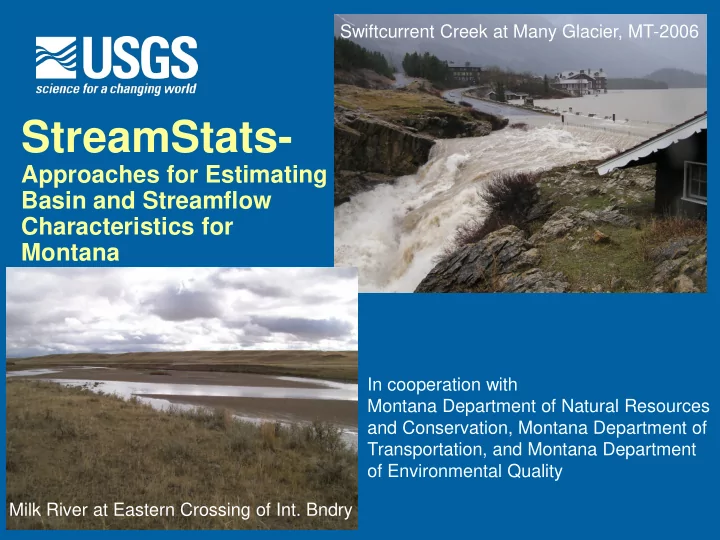
Swiftcurrent Creek at Many Glacier, MT-2006 Milk River at Eastern Crossing of Int. Bndry

slide-2
SLIDE 2

StreamStats - Web Application

  • Nationally standardized web tool developed by USGS

Office of Surface Water

  • For gaged sites: provides published streamflow

statistics and basin characteristics

  • For ungaged sites: solves previously published

regression equations to estimate streamflow statistics using basin characteristic data

  • User access via an interactive map
slide-3
SLIDE 3

StreamStats Coverage for MT

slide-4
SLIDE 4

What are Streamflow Characteristics and why are they important?

  • Ways to summarize streamflow data
  • Basic summary statistics
  • Range (e.g. max, min)
  • Mean (e.g. daily, monthly)
  • Flow-duration analyses (e.g.

exceedance flows)

  • Frequency analyses (e.g. 100-year

flood)

  • Intended use determines type of

analyses and data period

slide-5
SLIDE 5

Steps for developing StreamStats

  • 1. Compute streamflow characteristics for

discontinued and active gages in Montana and surrounding areas.

  • Compute flood

frequencies

  • Compute low

flow and median flow characteristics

2 10 100 500

Pryor Creek at Huntley

1978 2011

slide-6
SLIDE 6

Low Flow Statistics

slide-7
SLIDE 7

Flood Frequencies

2 10 100 500 2 10 100 500

Yellowstone River at Miles City Pre-regulation 1923-1964 Post-regulation 1965-2011

1978 2011 1944

slide-8
SLIDE 8

Steps for developing StreamStats

  • 2. Prepare GIS data for computing basin

characteristics (BCs)

  • Drainage area
  • Slope
  • Elevation
  • Shape
  • Climatic characteristics,

e.g. precipitation, evaporation, air temperature

  • Land-cover/use
  • Soils/geology
slide-9
SLIDE 9

Basin Characteristics

Green- currently avail. Grey- most will be avail. Blue-data covering MT only Red-data covering US only

slide-10
SLIDE 10

Steps for developing StreamStats

  • 3. Develop regional regression equations using

computed streamflow characteristics and BCs.

  • Regression equations might take the form:

Q100 = 0.352*CA0.960*S1.25

  • r

Q100 = 362*CA0.521*PII4.47

where:

Q100

is the 100-year flood CA is contributing drainage area, in square miles S is main-channel slope, in feet per mile PII is precipitation intensity index, in inches

slide-11
SLIDE 11

Regression Equations

  • Flood Frequency Data
  • Low Flow Data

http://www.huntleyproject.net/pryor-creek-flooding/

slide-12
SLIDE 12

Steps for developing StreamStats

  • 4. Deploy StreamStats with GIS data and

regression equations.

  • National StreamStats

page: http://water.usgs.gov/osw /streamstats/index.html

  • http://streamstats09.cr.us

gs.gov/mt_ss/index.htm

slide-13
SLIDE 13
slide-14
SLIDE 14
slide-15
SLIDE 15
slide-16
SLIDE 16
slide-17
SLIDE 17

Coming soon to Streamstats

  • Streamgages
  • Parrett WRIR 03-4308
  • McCarthy SIR 2004-

5266

  • Dams
  • Additional basin

characteristics

Prickly Pear Creek nr. Clancy, MT-1981

slide-18
SLIDE 18

Coming next fall to Streamstats

  • New flood

frequencies

  • New low flow stats
  • New regression

equations

Photograph taken by George F. Roskie, Lewis and Clark National Forest

Gibson Dam on the Sun River June, 1964 – crest length 960 feet