STRATOSPHERIC OZONE, SOLAR UV RADIATION AND HUMAN HEALTH Caradee Y - - PowerPoint PPT Presentation

stratospheric ozone solar uv radiation and human health
SMART_READER_LITE
LIVE PREVIEW

STRATOSPHERIC OZONE, SOLAR UV RADIATION AND HUMAN HEALTH Caradee Y - - PowerPoint PPT Presentation

STRATOSPHERIC OZONE, SOLAR UV RADIATION AND HUMAN HEALTH Caradee Y Wright 1 1 Environment and Health Research Unit, South African Medical Research Council (MRC), and Department of Geography, Geoinformatics and Meteorology, University of Pretoria,


slide-1
SLIDE 1

Partner logo

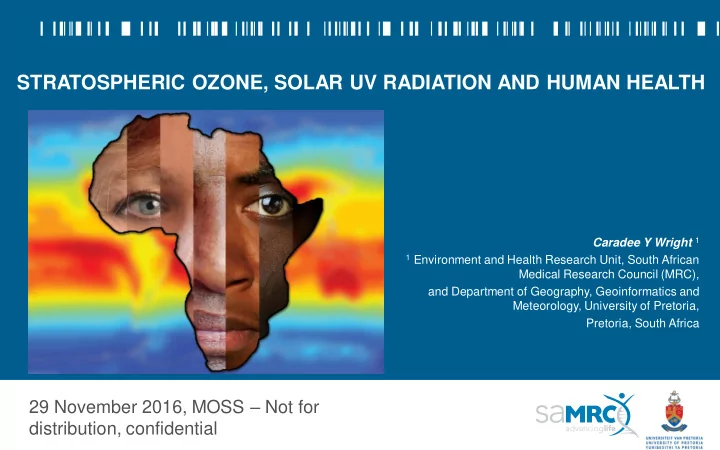
STRATOSPHERIC OZONE, SOLAR UV RADIATION AND HUMAN HEALTH

Caradee Y Wright 1

1 Environment and Health Research Unit, South African

Medical Research Council (MRC), and Department of Geography, Geoinformatics and Meteorology, University of Pretoria, Pretoria, South Africa

29 November 2016, MOSS – Not for distribution, confidential

slide-2
SLIDE 2
slide-3
SLIDE 3
slide-4
SLIDE 4

The largest increases in UV (shown in white, red, orange, and yellow) have occurred in the southern hemisphere during April, May and June. In the tropics, increases in UV have been minimal (shown in blue). Though the size of UV wavelengths ranges from 290 to 400 nanometers, 305 nanometer UV is

  • ne of the most damaging types for

humans.Credit: NASA's Goddard Space Flight Center/Jay Herman

slide-5
SLIDE 5

[Source: Lucas, Norval, Wright. Photochem & Photobiol Sci 2016; 15(1): 10-23]

Mean UV-B levels across Africa

slide-6
SLIDE 6

1 2 3 4 5 6 7 Factoring influencing solar UV radiation ????

  • Solar zenith angle
  • Ozone concentration
  • Cloud cover
  • Season
  • Altitude
  • Albedo, or surface reflection
  • Presence of aerosols
  • Geographical latitude

8

slide-7
SLIDE 7

Partner logo

slide-8
SLIDE 8

Investigating the anti-correlation between Ozone and Ultraviolet radiation over Cape Point and a possible association with Antarctic ozone hole events

Jean du Preez – University of Pretoria Supervisor: Dr. C. Wright - Medical Research Council

slide-9
SLIDE 9
slide-10
SLIDE 10

ATMOS MOSPHERIC HERIC SCIE CIENCE NCE PUBLIC H PUBLIC HEAL EALTH TH

slide-11
SLIDE 11
slide-12
SLIDE 12

The largest increases in UV (shown in white, red, orange, and yellow) have occurred in the southern hemisphere during April, May and June. In the tropics, increases in UV have been minimal (shown in blue). Though the size of UV wavelengths ranges from 290 to 400 nanometers, 305 nanometer UV is

  • ne of the most damaging types for

humans.Credit: NASA's Goddard Space Flight Center/Jay Herman

slide-13
SLIDE 13

French engineer, Louis Réard, introduced the modern bikini on 5 July 1946, borrowing the name for his design from the Bikini Atoll where post-war testing

  • n the atomic bomb was taking place.
slide-14
SLIDE 14

Continuous UV exposure estimated to elicit sunburn on un-tanned skin

Skin type Description of skin type & phenotypic characteristics UV exposure (SED) * V-VI Brown or black skin, dark hair, brown eyes, rarely burns 6-20 IV Light brown skin, brown eyes, burns rarely 4.5-6 III White or light brown skin, brown hair, may burn 3-5 II Fair skin, fair/red hair, freckles, burns very readily 2.5-3 I Fair skin, fair/red hair, light eyes, freckles, always burns on minimal sun exposure 2-3

(Fitzpatrick, 1988) * SED = standard erythemal dose, 1 SED = 100 Jm-2

slide-15
SLIDE 15

Population groups are categorised due to historical segregation as

  • Black African (80.2% of the 2014 population),
  • Coloured (8.8%; defined as mixed European [white] and African

[black] or Asian/Indian ancestry with skin colour ranging from pale to dark brown)

  • White (8.4%) and
  • Indian/Asian (2.5%)

South African population

slide-16
SLIDE 16

There is a range in skin phototypes /colours so sun protection advice needs to be relevant

[Figures from Wright, Wilkes, du Plessis, Reeder. Self-reported skin colour and erythemal sensitivity versus objectively measured constitutive skin colour in an African population with predominantly dark skin. Photodermatol Photoimmunol Photomed 2015; 31: 315-324]

Self-report biases in under- and over- estimation of skin colour were evident. Many participants with ‘dark brown’ and ‘black’ skin had difficulty in classifying erythemal sensitivity. Sample: 556 adults, 70% Black Africans 95% of Black African participants acknowledged that they were photosensitive

[Wilkes, Wright, du Plessis, Reeder. JAMA Dermatol 2015; DOI: 10.1001/jamadermato

  • l. 2015.0351]
slide-17
SLIDE 17

Partner logo

[Source: http://www.iol.co.za/lifestyle/skin-cancer-does-not-discriminate-1974076]

“After her initial diagnosis, Seboni said it took her a couple of months to go back to the hospital because she feared what it meant for her life.”

slide-18
SLIDE 18

Melanoma NMSC

slide-19
SLIDE 19

An increased risk of melanoma was seen with increasing number of sunburns for all time-periods (childhood, adolescence, adulthood and lifetime). A melanoma risk factor: blistering sunburn Other risk factors are skin type, family history, sun exposure etc.

slide-20
SLIDE 20

Partner logo

Mean age-standardised annual incidence of reported squamous cell carcinoma of the skin (SSCC), basal cell carcinoma (BCC) and cutaneous melanoma (CM) per 100,000 persons in the Black, Asian, Coloured and White populations of South Africa, 2000-2004 Black Asian Coloured White All BCC: Male Female 3.0 1.7 7.7 5.3 59.2 26.5 198.3 112.8 51.3 25.4 SCC: Male Female 3.0 1.6 4.3 2.7 26.1 15.4 69.5 31.8 20.8 8.5 CM: Male Female 1.0 1.2 0.7 1.1 5.9 4.1 20.5 16.5 5.3 3.9

[Table from Norval, Kellett, Wright. The incidence and body site

  • f skin cancers in the population groups of South Africa.

Photodermatol Photoimmunol Photomed 2014; 30: 262-265.]

Skin cancer is common among Black Africans with oculocutaneous albinism. SCC is becoming increasingly more common among Black Africans living with HIV/AIDS.

[www.melanoma.co.za/D_MFS.asp] [Stein et al Int J Cancer 2008; 122: 2260-2265; Nthumba et al Ann Plast Surg 2011; 66: 1267-1274 York et al, accepted in SAMJ; Diffey et al, accepted in SAMJ]

The South African Melanoma Advisory Board estimated an incidence in 2009 of 69 cases of CM per 100,000 White people living in the Western Cape.

slide-21
SLIDE 21

Age-standardised incidence rates per 100 000 (National Cancer Registry data) Cancer ranking by N(OBS) among all other cancers listed (National Cancer Registry data) Male BCC is always ranked No 1. Marked change in 2011 data. Skin cancer morbidity in South Africa

[CY Wright, unpublished data]

slide-22
SLIDE 22

Partner logo

[Gordon et al., BMC Health Services Research 2016]

slide-23
SLIDE 23

Melanoma mortality rates per 100 000 in South Africa

South Africa England [England data from BL Diffey] The number of deaths from melanoma skin cancer doubled from 319 in 1997 to 623 in 2014.

[Research underway – not for distribution

  • r citing]
slide-24
SLIDE 24

Nurse, V, Wright CY, Allen M and McKenzie, RL. 2015. Solar ultraviolet radiation exposure of South African marathon runners during competition marathon runs and training sessions: a feasibility

  • study. Photochemistry and Photobiology, 91(4): 971-979. DOI: 10.1111/php.12461

Personal solar UV radiation dosimetry – personal dosimeters

slide-25
SLIDE 25

OCCUPATIONAL SUN EXPOSURE

  • Outdoor workers > twofold risk for NMSC
  • Solar UVR dosimetric measurements high (SA?)
  • Define country-specific exposure limits for outdoor workers (WHO; ICNIRP; ARPANSA)

– The Australian Radiation Protection and Nuclear Safety Agency (ARPANSA) provides the maximum exposure guidelines for occupational exposures - the occupational exposure limit is 30 Jm-2 per day but this has a different weighting function from that of the CIE erythemal action spectrum (Radiation Protection Series No 12).

  • Skin cancer is recognized as an occupational cancer in several countries around the

world

  • Challenges

– Lack of sun risk knowledge among workers (skin and eyes) – Higher risk behavior – Low health literacy – Rarely health surveillance by employer – Seldom organization changes at worksite – Poor instructions from employer

slide-26
SLIDE 26

International Labour Organization has published its latest ILO List of Occupational Diseases in 2010, in which it lists “diseases caused by optical (UV, visible light, infrared) radiations including laser”.

slide-27
SLIDE 27

Results of meta-analysis shows the OR values for SCC in individuals with

  • utdoor versus indoor occupations

[Schmitt J, Seidler A, Diepgen TL et al. Occupational ultraviolet light exposure increases the risk for the development of cutaneous squamous cell carcinoma: a systematic review and meta-analysis. Br J Dermatol 2011; 164: 291-307.]

slide-28
SLIDE 28

Partner logo

SA 001 Prevention SA 002 Workers’ education SA 003 Early detection SA 004 Treatment SA 005 Compensation Delayed Cancelled Cancelled Delayed Cancelled Occupational skin cancer

slide-29
SLIDE 29

CAREX Canada model applied and adapted for South Africa SA population: 51 770 560 (2011) Total working population: ~13 204 496 Total working population exposed: ~1 156 000 (8.7% of working population)

[Research currently underway in collaboration with CAREX; Data analysis courtesy of Cheryl Peters, Canada]

slide-30
SLIDE 30

[Data analysis by Cheryl Peters, Canada and Peters et al., Can J Public Health 2012]

Number exposed (n=1 156 000) in South Africa by Occupation sub-group (Using Statistics SA 2011 data)

slide-31
SLIDE 31

Partner logo

Examples of countries/territories (in Canada) with NMSC as a recognized occupational disease State legislation / Media Compensable disease Strong labour unions

Acknowledging NMSC as an occupational disease opened the door for prevention

[Wright et al., manuscript in preparation]

slide-32
SLIDE 32

Partner logo

6800 in 2015 reported Germany

[Source: John SM. The EADV global call for action. 2016]

Reporting, notifications and recognition

slide-33
SLIDE 33
  • The UVI is a measure of the level of UV radiation.
  • The values of the index range from zero upward - the higher the UVI, the greater the

potential for damage to the skin and eye, and the less time it takes for harm to occur.

  • The UVI is an important vehicle to alert people about the need to use sun protection.

UV Index

slide-34
SLIDE 34

Known UVR / UVI networks in Africa

Tamarassett, Algeria (Brewer spectrometer) South African Biometer Network Egyptian UVR Network

slide-35
SLIDE 35

South Africa

Maximum UV Index values by station and year

Plot produced by K. Ncongwane, SAWS

slide-36
SLIDE 36
slide-37
SLIDE 37

How, when and by whom is the UV Index provided in South Africa? UVI forecasts were made by the South African Weather Service and publicized through media weather broadcasts between 1990 and 2001. The UVI appeared on the TV (SABC), in radio announcements and in the newspapers. They were discontinued due to poor uptake by broadcasting companies (the number didn’t change for weeks at a time) and lack of sponsorship (sunscreen companies did sponsor for a while). Some radio stations, e.g. Classic FM (a Gauteng Province radio station in South Africa), still give the UVI midday forecast in its weather reports. Despite some countries monitoring ambient solar UV radiation, only Namibia provides a UVI forecast but whether it is broadcast on the news is unknown.

SAWS does give forecasts during summer for major centres (with biometers) and they include cloud effects.

Plots produced by S Landman, SAWS

slide-38
SLIDE 38

Grade 7 schoolchildren (n = 707) from 24 schools across all 9 Provinces 62% of children had NOT seen or heard about the UVI (mostly on the TV or at school)

[Wright, Albers, Reeder, S Afr Med J, December 2015]

512 Science Council employees (n = 2 254) in Pretoria 77% HAD heard about the UVI (response bias likely high as well as respondent bias)

[Wright, Albers, SASAS Conference paper, September 2011]

What do we know about people’s knowledge and understanding of the UV Index in South Africa? What do we know about people’s use of sun protection in South Africa?

Use of umbrellas, clothing, hats, shade more common than sunscreen (except possibly among White population group). “Turning one’s back to the sun” is also common. Sunscreen is made available free of charge to South Africans with

  • culocutaneous albinism but not well taken up.

Use of clays and ochre among some Black Africans is popular and culturally-acceptable. They may have an SPF between 3 and 10 and

  • ffer broad-spectrum protection.

[Dlova et al Photodermatol Photoimmunol Photomed 2013; 29: 164-169. Rifkin et al PLOS ONE 2015; DOI: 10.1371/journal.pone.0136090] [Wright et al Photochem Photobiol 2015; 91: 27-32]
slide-39
SLIDE 39

Finally…..

  • UVI forecasts are not (widely) broadcast
  • The UVI is likely not well understood (more evidence needed)
  • A single simple protection message per UVI category is unlikely to be helpful in

some countries due to range in skin phototypes and lack of understanding of terminology (UVI needs to be tested locally)

  • Children, people with fair skin, those with compromised immunity and people with
  • culocutaneous albinism (up to 1 in 1 000 in some communities) require special

attention

slide-40
SLIDE 40

Partner logo

[Source: http://www.mhs.mil.za/]

slide-41
SLIDE 41

Partner logo

ACKNOWLEDGEMENTS

GDRI / ARSAIO; NRF; LACY South African Institute of Occupational Health South African Medical Research Council National Research Foundation Cheryl Peters, Carleton University, Canada Marc Wittlich, IFA DGUV, Germany Swen Malte John, University of Osnabruek, Germany Brian Koster, Danish Cancer Society, Denmark Peter Gies, ARPANSA, Australia Joanne Turner, University of Southern Queensland, Australia Tony Reeder, University of Otago, New Zealand Emilie van Deventer, WHO, Switzerland