Strangles: clinical disease and practical steps to its control Josh - - PDF document

strangles clinical disease and practical steps to its
SMART_READER_LITE
LIVE PREVIEW

Strangles: clinical disease and practical steps to its control Josh - - PDF document

Intervet symposium om Kvarka. Lund 2005-03-16. Stockholm 2005-03-17. Frelsare: Josh Slater, Royal Veterinary College, University of London Strangles: clinical disease and practical steps to its control Josh Slater Royal Veterinary College


slide-1
SLIDE 1

Intervet symposium om Kvarka. Lund 2005-03-16. Stockholm 2005-03-17. Föreläsare: Josh Slater, Royal Veterinary College, University of London

1

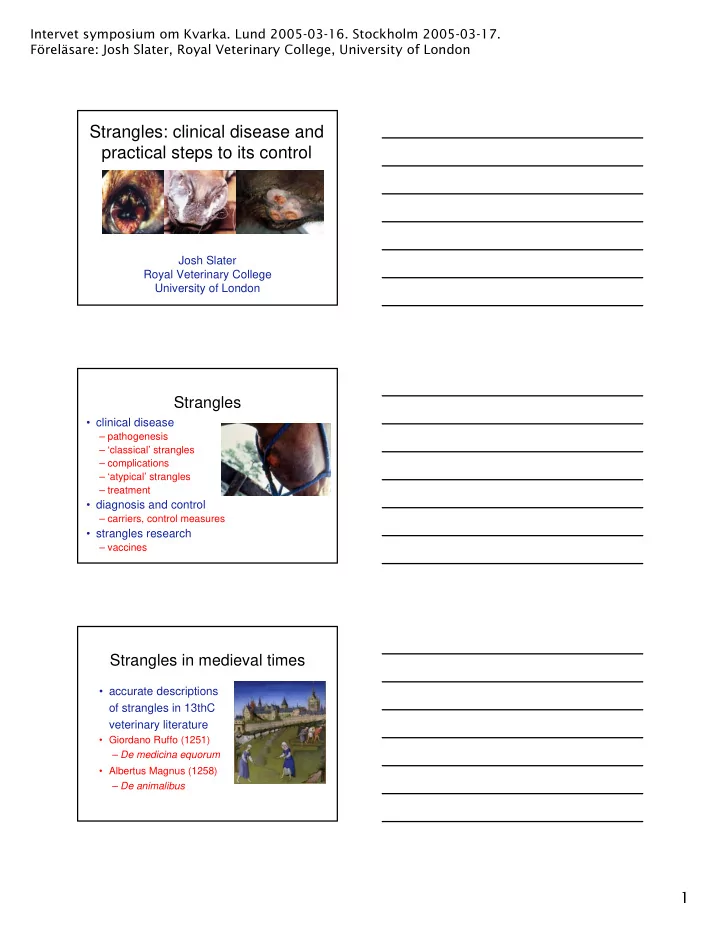
Strangles: clinical disease and practical steps to its control

Josh Slater Royal Veterinary College University of London

Strangles

  • clinical disease

– pathogenesis – ‘classical’ strangles – complications – ‘atypical’ strangles – treatment

  • diagnosis and control

– carriers, control measures

  • strangles research

– vaccines

Strangles in medieval times

  • accurate descriptions
  • f strangles in 13thC

veterinary literature

  • Giordano Ruffo (1251)

– De medicina equorum

  • Albertus Magnus (1258)

– De animalibus

slide-2
SLIDE 2

Intervet symposium om Kvarka. Lund 2005-03-16. Stockholm 2005-03-17. Föreläsare: Josh Slater, Royal Veterinary College, University of London

2

Strangles in more modern times

  • clinical disease thoroughly

understood, including carriers

  • strangles an increasing problem in

military horses, especially at the end

  • f the 19thC and WW1

Strangles today

  • clinical disease has changed little over the last

800 years

– endemic infection cycles in herds – ‘atypical’ disease may be more prevalent – carrier horses are the main reservoir of infection

  • the first purely veterinary pathogen to be

sequenced (WT Sanger Institute & Home of Rest for Horses)

Strangles bacterium

  • Streptococcus equi subsp equi (S. equi) - Gram

positive, Lancefield group C, chain forming cocci (shorter chains in abscesses, longer in culture)

  • wide zones of beta haemolysis on blood agar
  • most isolates are capsulated (mucoid colonies);

some are less capsulated or acapsular (matt)

slide-3
SLIDE 3

Intervet symposium om Kvarka. Lund 2005-03-16. Stockholm 2005-03-17. Föreläsare: Josh Slater, Royal Veterinary College, University of London

3

S.equi structure

M protein hyaluronic acid capsule cell wall cytoplasm lipoprotein

Strangles disease profile

  • highly contagious

– infects up to 100% of horses in a yard – deaths uncommon (typically 1-3%) but can reach 10% – disease mainly in young or naïve horses

  • transmission via droplets

– direct horse to horse – indirect via food/water troughs, personnel

  • respiratory disease followed by dissemination of

bacteria causing abscesses (‘classical strangles’)

  • often have mild disease without abscesses

(‘atypical strangles’)

Key stages in pathogenesis

epithelial invasion and entry to lamina propria entry into lymphatics ± circulation persistence despite neutrophil chemotaxis and phagocytosis abscessation (LN and other organs) colonisation of URT epithelium

slide-4
SLIDE 4

Intervet symposium om Kvarka. Lund 2005-03-16. Stockholm 2005-03-17. Föreläsare: Josh Slater, Royal Veterinary College, University of London

4

Virulence mechanisms

  • colonisation

– surface proteins adhere to epithelium – bacterial metabolic pathways use host nutrients for biosynthesis and growth

  • epithelial invasion

– cytolytic and proteolytic enzymes (toxins) degrade epithelial integrity and allow entry

  • evasion of phagocytosis

– capsule and M protein prevent opsonisation

Classical strangles

  • highly contagious, attack rates >80%

– susceptibility and disease severity mainly relate to previous exposure

  • associated with capsulated bacteria

– isolates with less or no capsule are less pathogenic (Anzai, 1999)

  • apparent decrease in prevalence

(compared to ‘atypical’ strangles) noted in UK since 1960’s (Mafferty, 1962; Woolcock, 1975)

Clinical signs

0 2 4 6 8 10 12 14 16 18 20 22 4 weeks 5 weeks 6 weeks 7 weeks

bacteria discharge abscesses leucocytosis neutrophilia pyrexia

slide-5
SLIDE 5

Intervet symposium om Kvarka. Lund 2005-03-16. Stockholm 2005-03-17. Föreläsare: Josh Slater, Royal Veterinary College, University of London

5

‘Classical strangles’ abscesses

  • mainly SMLN and RPLN
  • occasionally parotid LN

Other strangles complications:

  • 2. Metastatic abscessation
  • haematogenous and lymphatic spread to lymph

nodes and other organs (Bartlett, 1777; Haycock, 1838;

Blakeway, 1881; Ford, 1980; Sweeney, 1987)

– abdomen: mesenteric LN abscess, abscesses in abdominal viscera (liver, spleen, kidney), peritonitis – thorax: mesenteric and tracheobronchial LN, lung – CNS: brain and spinal cord – eye: panophthalmitis – joints and tendon sheaths – heart: myocarditis and endocarditis – skeletal muscle: rhabdomyolysis

  • laryngeal paralysis
  • purpura haemorrhagica
  • death (<10%)

Other strangles complications

slide-6
SLIDE 6

Intervet symposium om Kvarka. Lund 2005-03-16. Stockholm 2005-03-17. Föreläsare: Josh Slater, Royal Veterinary College, University of London

6

‘Atypical’ strangles

  • most common clinical presentation?

– under-diagnosed because not investigated

  • mild disease (Woolcock, 1975; Prescott, 1982; Timoney, 1993)

– pyrexia, depression, cough, purulent nasal discharge, self-limiting lymphadenopathy – no abscesses or associated complications

  • genetic basis of virulence poorly understood

– some cases associated with non-capsulated or less- capsulated isolates (Prescott, 1982; Anzai, 1999) or M protein attenuations (Chanter, 2001)

  • role of ‘atypical’ isolates in epidemiology unclear

Importance of atypical strangles

  • atypical disease is dangerous because it

does not look like strangles

– looks just like any other respiratory infection – samples not taken for bacterial culture – control and prevention not implemented

  • ‘atypical’ isolates important in disease spread

– bacteria from atypical cases can cause classical strangles in others – strangles outbreaks with atypical cases often go un-recognised until classical cases appear later

Your opinions: Management & Treatment

  • hygiene precautions
  • housing
  • nursing
  • antibiotics

– to use or not to use? – which antibiotic? – which animals?

  • other medical treatments
  • surgical treatments
slide-7
SLIDE 7

Intervet symposium om Kvarka. Lund 2005-03-16. Stockholm 2005-03-17. Föreläsare: Josh Slater, Royal Veterinary College, University of London

7

Treatment

  • no consensus but deeply held beliefs
  • long-standing concern that antibiotic treatment may:

– impair development of immunity (Piche, 1983) – prolong the course of disease (Timoney, 1993) – encourage metastatic abscessation (Fitzwygram, 1886)

  • isolates generally sensitive to the pencillins
  • also tetracyclines and TMS but penicillin is the

antibiotic of choice

Recommendations for antibiotic treatment

  • early cases showing pyrexia only
  • sick horse, especially foals, with marked anorexia,

depression ± persistent pyrexia

  • horses with complications

– airway compression – suspected metastatic disease – purpura haemorrhagica

  • in contacts - treat and move or continue treatment

until the outbreak ends

  • NOT be used cases with abscesses

Transmission of S.equi

  • environment reservoir less important than carriers:

– S.equi survives for < 1 week if dessicated, but – survives at least 4 weeks in drinking water – survives up to 8 weeks in water, pus or blood droplets on wood or tack (Jorm, 1991) – easily killed by pevidine, chlorhexidine, Virkon and glutaraldehyde

  • no evidence for wind-borne aerosol transmission
  • direct and indirect (via personnel) horse-horse

droplet transmission important

  • main reservoir of infection clinical cases and carriers
slide-8
SLIDE 8

Intervet symposium om Kvarka. Lund 2005-03-16. Stockholm 2005-03-17. Föreläsare: Josh Slater, Royal Veterinary College, University of London

8

Risk factors

  • attack rates increase with (Jorm, 1990):

– increasing group size – increased movement of horses – increased mixing of horses – communal feeders and drinkers – younger horses

  • but apparent age-related immunity is almost

certainly due to previous exposure: older naïve horses are susceptible (Sweeney, 1987)

Low and medium risk groups

  • Closed populations

– individual horses and small groups kept at in private yards and fields – horses that don’t travel or mix with others

  • Race horses in training

– closed populations - mixing within the population but not with other groups

  • Closed populations that travel and mix

– events, shows, competitions

High risk groups

  • Livery yards and studs, ‘feral’ herds

– open populations – mixing of age groups – frequent mixing of new horses, often with wide geographical distribution – background of new arrivals often uncertain – disease status of new arrivals uncertain – housing allows contact between horses – communal feeding and drinking areas

slide-9
SLIDE 9

Intervet symposium om Kvarka. Lund 2005-03-16. Stockholm 2005-03-17. Föreläsare: Josh Slater, Royal Veterinary College, University of London

9

Controlling strangles

Principles of disease control

  • Safeguard yard/herd biosecurity (HBLB Code of

Practice) – isolate new arrivals and screen for S.equi – investigate and isolate suspected cases promptly

  • maintain strict barrier housing, monitor closely

– identify, isolate and treat carriers

  • Maximise individual/group immunity

– vaccination

Preventing new infections

  • Isolate all new arrivals

– physical separation from rest of yard – isolate to make sure they are not incubating disease – confirm healthy by bacterial culture tests (better) or if still appear healthy after 3 weeks isolation (less good)

  • the second approach will miss carriers

  • nly allow new arrivals to mix after confirmed clear
  • Maximise yard immunity

– vaccinate (Equilis StrepE)

Controlling strangles: chronic carriers

  • some (< 1% - 10%) recovered horses become

chronic carriers (> 1 month after end of clinical signs)

  • carriers are asymptomatic reservoir of infection
  • carriage may continue for long periods

– in one yard (n=6/1,500) mean carriage time was 19 months, range 7-39 months (Newton et al., 1997; 2000)

  • carriage predominantly in guttural pouches, ± with

endoscopic pouch abnormalities, but also sinuses

  • carriage strains may have truncated M proteins

(Chanter et al., 2000) but retain virulence

slide-10
SLIDE 10

Intervet symposium om Kvarka. Lund 2005-03-16. Stockholm 2005-03-17. Föreläsare: Josh Slater, Royal Veterinary College, University of London

10

Identifying carriers

  • 1. Serology
  • serum antibody mainly directed against the M

protein (Timoney & Trachman, 1985)

  • titres fall to background in carriers
  • possibility of cross reaction with other

streptococci, especially S. zooepidemicus

  • not sufficiently reliable for identification of

carriers (Chanter et al., 1998)

  • no role for serology

Identifying carriers

  • 2. Nasopharyngeal swabs
  • wait at least 30 days after end of clinical signs
  • nasal swabs are NOT adequate

– small sample volume – overgrowth of other bacteria, esp S. zooepidemicus

  • large, unguarded, gauze nasopharyngeal

swabs provide a good sample (Newton et al., 2000)

– adequate volume of secretion – suitable for culture and DNA detection

Identifying carriers

  • 3. Guttural pouch lavage
  • more difficult and expensive to perform than n/p

swabs, less suitable for group investigations

  • usually collected endoscopically although

percutaneous collection described (Chiesa et al., 1999)

– lavage with 30- 50ml PBS into each pouch – transfer into sterile plain container – requires same day delivery to laboratory – can be used for culture and PCR

  • don’t forget other possible sites of carriage: sinuses
slide-11
SLIDE 11

Intervet symposium om Kvarka. Lund 2005-03-16. Stockholm 2005-03-17. Föreläsare: Josh Slater, Royal Veterinary College, University of London

11

Which test?

  • Culture

– ‘gold standard’ for diagnosis – unequivocal evidence of live bacteria – but requires sufficient live bacteria in the submitted sample to produce colonies in culture

  • Polymerase chain reaction (PCR)

– exponential amplification of bacterial DNA (M protein sequences) gives increased sensitivity over culture, but – requires sufficient quantity and quality of bacterial DNA – inhibitors of polymerase enzyme – does not distinguish live from dead bacteria

Which sample?

  • no single sample (or test) will detect carriers with

100% sensitivity or specificity

  • for n/p swabs (Newton et al., 1997; 2000):

– predicted sensitivity for culture of single swab = 45%

– predicted sensitivity for culture of 3 consecutive swabs = 85%

  • in established carriers (n=3)

– 18/61 (30%) swabs were culture positive; 34/61 (56%) swabs were PCR positive – sensitivity of single n/p swabs in established carriers:

  • 32% for culture only; 50% for PCR only
  • 53% for culture and PCR combined

Which sample?

  • guttural pouch lavages are superior to n/p swabs

– predicted sensitivity for culture of single lavage = 88%

  • for guttural pouch lavages in established carriers:

– 41/70 lavages (60%) were culture positive – 53/70 lavages (76%) were PCR positive – 56/70 lavages (80%) were positive by either PCR or culture

  • both culture and PCR produce false negatives
  • predicted probability of carrier detection

– 3 n/p swabs: 60% for culture, 90% for culture + PCR – 1 guttural pouch lavage: 90% for culture and PCR

slide-12
SLIDE 12

Intervet symposium om Kvarka. Lund 2005-03-16. Stockholm 2005-03-17. Föreläsare: Josh Slater, Royal Veterinary College, University of London

12

Dealing with S. equi carriers

  • segregation, careful hygiene
  • check other sites
  • systemic antibiotic treatment

alone often ineffective

  • remove chondroids endoscopically
  • lavage (1-5 L saline) followed

by benzyl penicillin (5MU)

  • repeated lavage or single

lavage followed by i.m. procaine penicillin (Verheyen et al., 2000)

  • confirm bacterial cure by culture only (not PCR)

Limitations of control measures

  • control measures currently revolve around

management measures (HBLB Code of Practice)

– isolate new arrivals and screen for S.equi – investigate and isolate suspected cases promptly – identify and treat carriers

  • relatively easy to apply to low and medium risk

groups but difficult to apply to high risk groups (livery yards and studs)

– quarantining new arrivals impractical – screening large numbers of animals expensive

  • vaccination important for high risk groups

Strangles research: vaccine development

  • S.equi vaccines (bacterin, M protein and a chemically

attenuated MLV) are used in the USA and Australia but not Europe

  • a genetically defined live attenuated vaccine is about

to be launched in Europe (Equilis StrepE - Intervet)

slide-13
SLIDE 13

Intervet symposium om Kvarka. Lund 2005-03-16. Stockholm 2005-03-17. Föreläsare: Josh Slater, Royal Veterinary College, University of London

13

Summary

  • S. equi infections remain common (AHT ICC data) and are

probably under-diagnosed (‘atypical’ disease)

  • carriers are the main reservoir of infection
  • carriage site is mainly guttural pouch; ± empyaema
  • identification of carriers is not easy, cheap or reliable:

– 3 n/p swabs at weekly intervals tested by culture and PCR – single guttural pouch lavage tested by culture and PCR

  • carriers can be successfully treated
  • control programmes, especially for high risk groups,

are likely to be improved by vaccination

Acknowledgements

  • University of Cambridge
  • Duncan Maskell, James May, Caray Walker
  • Animal Health Trust
  • Richard Newton, James Wood, Carl Robinson
  • University of Sunderland
  • Iain Sutcliffe and Dean Harrington
  • Gluck Equine Research Centre, University of Kentucky
  • John Timoney
  • Imperial College, London
  • Rob Wilson