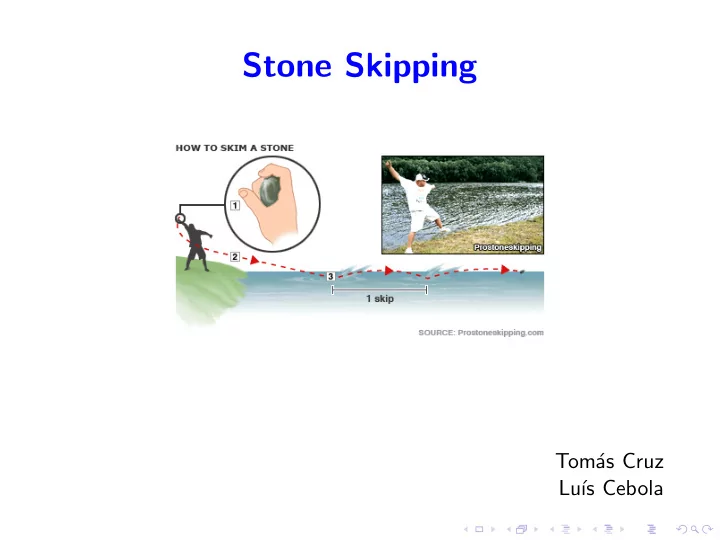
SLIDE 1
Stone Skipping
Tom´ as Cruz Lu´ ıs Cebola
SLIDE 2
Stone Shape
SLIDE 3
Angle With Water
SLIDE 4
Spin
SLIDE 5
Children’s Game?
SLIDE 6
Children’s Game?
SLIDE 7 Physics of Everyday Life
“Physicists have figured out some extremely fine details of the universe, from the radius of black holes to the behavior of subatomic particles - neither of which we can even see. It may surprise you to learn, then, that they lack explanations (or have
- nly recently stumbled upon them) for many common phenomena
we observe in daily life.” − Natalie Wolchover
SLIDE 8 Physics of Everyday Life
“Physicists have figured out some extremely fine details of the universe, from the radius of black holes to the behavior of subatomic particles - neither of which we can even see. It may surprise you to learn, then, that they lack explanations (or have
- nly recently stumbled upon them) for many common phenomena
we observe in daily life.” − Natalie Wolchover
The Cheerios Effect
Why your breakfast cereal tends to clump together or cling to the sides of a bowl of milk? - See Vella and Mahadevan, The ’Cheerios effect’.
SLIDE 9
Getting a Kick From Water
SLIDE 10
Getting a Kick From Water
SLIDE 11 A Simple Model 1
Reaction Force
◮ Re = aV
ν ∼ 105 ⇒ Inertial regime.
◮ We = ρV 2z
σ
∼ 100 ⇒ Neglect surface tension.
◮ Fr = V 2
zg ≫ 1 ⇒ Neglect buoyancy.
F = 1 2ClρwV 2Simf (θ, β)n
+1 2CdρwV 2Simf (θ, β)t
1Based on: Rosellini et al, 2005 e Boqcuet L, 2002.
SLIDE 12 A Simple Model 1
Reaction Force
◮ Re = aV
ν ∼ 105 ⇒ Inertial regime.
◮ We = ρV 2z
σ
∼ 100 ⇒ Neglect surface tension.
◮ Fr = V 2
zg ≫ 1 ⇒ Neglect buoyancy.
F = 1 2ClρwV 2Simf (θ, β)n
+1 2CdρwV 2Simf (θ, β)t
Stone Shape: Immersed Surface
Sim = R2
R
R 1 −
R 2
sin θ
SLIDE 13
A Simple Model
Spin?:
What is the effect of spinning?
SLIDE 14 A Simple Model
Spin?:
What is the effect of spinning?
- 1. Lift force is applied in the
immersed surface - destabilizing torque;
- 2. Only a specific range of θ is
favourable to skipping;
- 3. Gyroscopic effect - Stabilizing
torque;
¨ θ + In − It It ˙ φ 2 (θ − θ0) = Mθ It (θ − θ0) ∼ MθIt ˙ φ2(In − It)2 To work ˙ φ 20Hz.
SLIDE 15 A Simple Model
To address the problem of the angle we need to go deeper in the model
x = − 1
2ρ(˙
x2 + ˙ z2)Sim(z) sin(θ + β)(Cl sin θ + Cd cos θ) M¨ z = −Mg + 1
2ρ(˙
x2 + ˙ z2)Sim(z) sin(θ + β)(Cl cos θ − Cd sin θ) Notice that: β = arctan −˙
z ˙ x
SLIDE 16 A Simple Model
To address the problem of the angle we need to go deeper in the model
x = − 1
2ρ(˙
x2 + ˙ z2)Sim(z) sin(θ + β)(Cl sin θ + Cd cos θ) M¨ z = −Mg + 1
2ρ(˙
x2 + ˙ z2)Sim(z) sin(θ + β)(Cl cos θ − Cd sin θ) Notice that: β = arctan −˙
z ˙ x
SLIDE 17 Model expansion and simulation
Cd ≪ Cl ≃ 1
On water: (z < 0)
x = − 1
2ρ(˙
x2 + ˙ z2)Sim(z) sin(θ + β) sin θ M¨ z = −Mg + 1
2ρ(˙
x2 + ˙ z2)Sim(z) sin(θ + β) cos θ
On air: (z > 0)
x = 0 M¨ z = −Mg
Immersed Area
Sim = R2
R
R
1 −
R
2
πR2 z < 0 & |z| > 2R sin θ 0, z > 0
M = 0.1 kg ρ = 1 g/cm3 g = 9.8 m/s2 R = 0.025 m
SLIDE 18
Simulation: Stone Position
SLIDE 19
Simulation: Stone Position
SLIDE 20 Simulation: Energy Loss
◮ We can try a little analytical trick:
∆E ≃ 1
2M ˙
x2
f − 1 2M ˙
x2
0 =
tcoll Fx ˙ xdt ≃ −1.4NMg2π
CρR
≃ −1.928 J But in the end the most precise result come from the model:
SLIDE 21 Simulation: Best Angle
Angle With Water:
◮ ’Magic angle’
≃ 20o
◮ Best angle
≃ 15o
SLIDE 22
Experiment 1 - Rosellini
Set up: Results:
SLIDE 23
Experiment 1 - Rosellini
Set up: Results:
SLIDE 24
Experiment 2 - Hewitt
SLIDE 25 Contests and curiosities
A little bit of history
◮ Record of stone skipping as a sport goes back at least to 1583. ◮ Tradition holds that the sport was begun by an English king
who skipped stones across the Thames.
◮ Nowadays there are tens of tournaments and championships
Stones manufactured for skipping
The current record for stone skipping is Russ Byars with a throw of 51 skips.
SLIDE 26
Feeling Lucky?
SLIDE 27
51 skips
SLIDE 28
Simulation: Mass
SLIDE 29
Simulation: Radius