Stochastic Models of an Uncertain World x = F ( x , u ) x = F ( - - PDF document

stochastic models of an uncertain world
SMART_READER_LITE
LIVE PREVIEW

Stochastic Models of an Uncertain World x = F ( x , u ) x = F ( - - PDF document

Stochastic Models of an Uncertain World x = F ( x , u ) x = F ( x , u , 1 ) Lecture 9: y G ( x ) y G ( x , 2 ) = = Observers and Kalman Filters Actions are uncertain. CS 344R/393R: Robotics Observations are


slide-1
SLIDE 1

1

Lecture 9: Observers and Kalman Filters

CS 344R/393R: Robotics Benjamin Kuipers

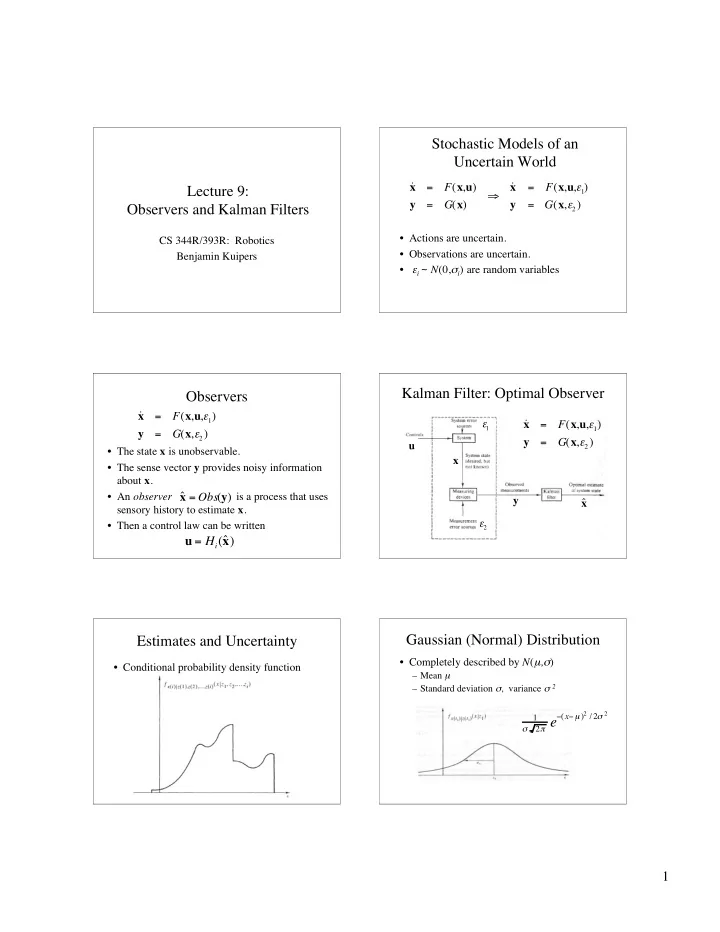
Stochastic Models of an Uncertain World

  • Actions are uncertain.
  • Observations are uncertain.
  • εi ~ N(0,σi) are random variables

˙ x = F(x,u) y = G(x)

  • ˙

x = F(x,u,1) y = G(x,2)

Observers

  • The state x is unobservable.
  • The sense vector y provides noisy information

about x.

  • An observer is a process that uses

sensory history to estimate x.

  • Then a control law can be written

u = Hi(ˆ x )

˙ x = F(x,u,1) y = G(x,2) ˆ x = Obs(y)

Kalman Filter: Optimal Observer

u x y ˆ x 2

  • 1

˙ x = F(x,u,1) y = G(x,2)

Estimates and Uncertainty

  • Conditional probability density function

Gaussian (Normal) Distribution

  • Completely described by N(µ,σ)

– Mean µ – Standard deviation σ, variance σ 2

1

  • 2 e

(xµ)2 / 2 2

slide-2
SLIDE 2

2

Estimating a Value

  • Suppose there is a constant value x.

– Distance to wall; angle to wall; etc.

  • At time t1, observe value z1 with variance
  • The optimal estimate is with

variance 1

2

ˆ x (t1) = z

1

1

2

A Second Observation

  • At time t2, observe value z2 with variance 2

2

Merged Evidence Update Mean and Variance

  • Weighted average of estimates.
  • The weights come from the variances.

– Smaller variance = more certainty

ˆ x (t2) = Az1 + Bz2

ˆ x (t2) = 2

2

1

2 + 2 2

  • z1 +

1

2

1

2 + 2 2

  • z2

1

  • 2(t2) = 1

1

2 + 1

2

2

A + B =1

From Weighted Average to Predictor-Corrector

  • Weighted average:
  • Predictor-corrector:

– This version can be applied “recursively”.

ˆ x (t2) = Az1 + Bz2 = (1 K)z1 + Kz2 ˆ x (t2) = z1 + K(z2 z1) = ˆ x (t1) + K(z2 ˆ x (t

1))

Predictor-Corrector

  • Update best estimate given new data
  • Update variance:

ˆ x (t2) = ˆ x (t

1) + K(t2)(z2 ˆ

x (t

1))

K(t2) = 1

2

1

2 + 2 2

  • 2(t2) =

2(t 1) K(t2) 2(t 1)

= (1K(t2))

2(t 1)

slide-3
SLIDE 3

3

Static to Dynamic

  • Now suppose x changes according to

˙ x = F(x,u,) = u + (N (0, ))

Dynamic Prediction

  • At t2 we know
  • At t3 after the change, before an observation.
  • Next, we correct this prediction with the
  • bservation at time t3.

ˆ x (t3

) = ˆ

x (t2) + u[t3 t2]

  • 2(t3

) = 2(t2) + 2[t3 t2]

ˆ x (t2)

  • 2(t2)

Dynamic Correction

  • At time t3 we observe z3 with variance
  • Combine prediction with observation.

3

2

ˆ x (t3) = ˆ x (t3

) + K(t3)(z3 ˆ

x (t3

))

K(t3) = 2(t3

)

  • 2(t3

) + 3 2

  • 2(t3) = (

1 K(t3))

2(t3 )

Qualitative Properties

  • Suppose measurement noise is large.

– Then K(t3) approaches 0, and the measurement will be mostly ignored.

  • Suppose prediction noise is large.

– Then K(t3) approaches 1, and the measurement will dominate the estimate.

K(t3) = 2(t3

)

  • 2(t3

) + 3 2

ˆ x (t3) = ˆ x (t3

) + K(t3)(z3 ˆ

x (t3

))

3

2

  • 2(t3

)

Kalman Filter

  • Takes a stream of observations, and a

dynamical model.

  • At each step, a weighted average between

– prediction from the dynamical model – correction from the observation.

  • The Kalman gain K(t) is the weighting,

– based on the variances and

  • With time, K(t) and tend to stabilize.
  • 2(t)
  • 2
  • 2(t)

Simplifications

  • We have only discussed a one-dimensional

system.

– Most applications are higher dimensional.

  • We have assumed the state variable is
  • bservable.

– In general, sense data give indirect evidence.

  • We will discuss the more complex case next.

˙ x = F(x,u,1) = u +1 z = G(x,2) = x +2