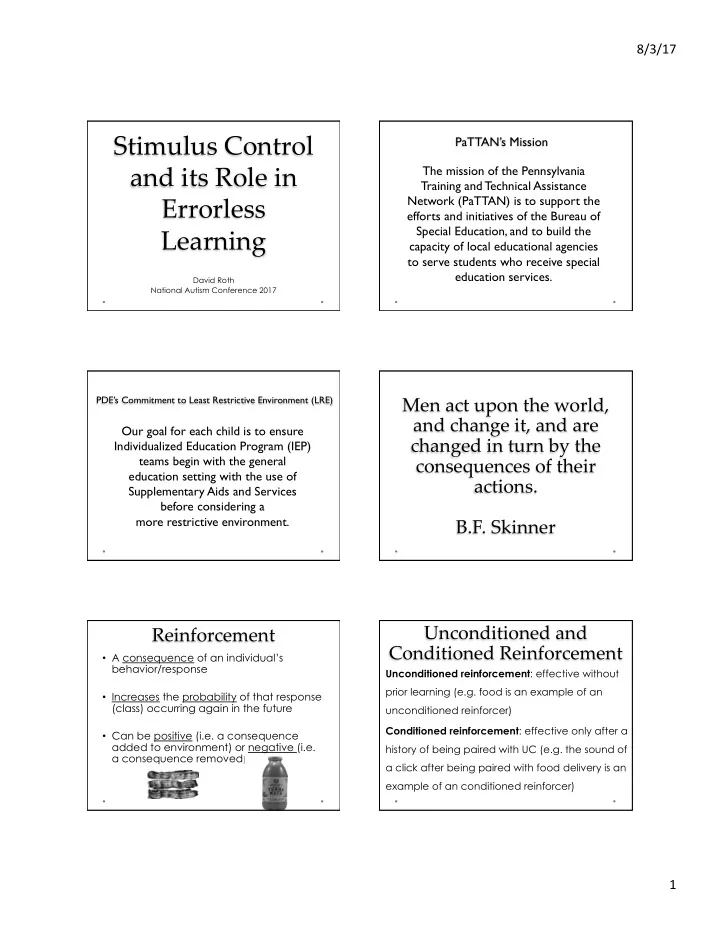
Stimulus Control PaTTANs Mission and its Role in The mission of - - PDF document

stimulus control
SMART_READER_LITE
LIVE PREVIEW

Stimulus Control PaTTANs Mission and its Role in The mission of - - PDF document

8/3/17 Stimulus Control PaTTANs Mission and its Role in The mission of the Pennsylvania Training and Technical Assistance Errorless Network (PaTTAN) is to support the efforts and initiatives of the Bureau of Learning Special Education,


slide-1
SLIDE 1

8/3/17 1

Stimulus Control and its Role in Errorless Learning

David Roth National Autism Conference 2017

PaTTAN’s Mission The mission of the Pennsylvania Training and Technical Assistance Network (PaTTAN) is to support the efforts and initiatives of the Bureau of Special Education, and to build the capacity of local educational agencies to serve students who receive special education services.

PDE’s Commitment to Least Restrictive Environment (LRE)

Our goal for each child is to ensure Individualized Education Program (IEP) teams begin with the general education setting with the use of Supplementary Aids and Services before considering a more restrictive environment.

Men act upon the world, and change it, and are changed in turn by the consequences of their actions. B.F. Skinner Reinforcement

  • A consequence of an individual’s

behavior/response

  • Increases the probability of that response

(class) occurring again in the future

  • Can be positive (i.e. a consequence

added to environment) or negative (i.e. a consequence removed)

Unconditioned and Conditioned Reinforcement

Unconditioned reinforcement: effective without prior learning (e.g. food is an example of an unconditioned reinforcer) Conditioned reinforcement: effective only after a history of being paired with UC (e.g. the sound of a click after being paired with food delivery is an example of an conditioned reinforcer)

slide-2
SLIDE 2

8/3/17 2 What Does Animal Research Have to Do with Human Behavior?

The Operant

Antecedent Behavior Consequence

Anything an individual does that is

  • bservable

and measurable

Some event that immediately follows the response and alters the future probability of that type of response Something that happens immediately before a response that changes the likelihood of the response

  • ccurring

Note: the operant and the first instance

The “Facts in the Bag”

Antecedent Behavior Consequence Motivating Operation (MO) Response Specific Reinforcement Discriminative Stimulus (SD) Response Generalized Conditioned Reinforcement Stimulus Delta (S∆) Response (Extinction) Neutral Stimulus (S+, S0, or S-) n/a n/a Discriminative Stimulus for Punishment (SDp) Response Punishment

Non-Verbal Behavior

Behavior in which the reinforcement is not mediated by other individuals

Verbal Behavior

Behavior in which the reinforcement is mediated by

  • ther individuals

(i.e. listeners) who had been trained to do so

See Palmer (2008) for more in-depth discussion on Skinner’s definition

slide-3
SLIDE 3

8/3/17 3

The Beauty of Skinner’s Definition

  • Functional vs. Formal
  • Includes all forms of “communication”
  • Talking
  • Signing
  • Writing
  • Gesturing
  • Morse Code
  • Smoke Signals

The Verbal Operants

Antecedent Behavior Consequence

Motivating Operation MAND Specific Reinforcement Mediated by a Listener Non-Verbal Discriminative Stimulus TACT Generalized Conditioned Reinforcement Mediated by a Listener Verbal Discriminative Stimulus ECHOIC SIGNED IMITATION INTRAVERBAL Generalized Conditioned Reinforcement Mediated by a Listener

Motivational Control

Antecedent Behavior Consequence Motivating Operation (MO) Response Specific Reinforcement

Motivational Control

Antecedent Behavior Consequence

Response

Motivating Operation (MO): An environmental event that alters the value of something else as a reinforcer and alters the probability of any behavior that, in the past, has produced that reinforcement

Specific Reinforcement: The reinforcing item/event whose value has been specifically altered by the MO

Meet Ebby

Artwork by: Simon Carlucci (Age 16)

Motivational Control for Turning

Food Deprivation

“Click”

slide-4
SLIDE 4

8/3/17 4

Definitions Revisited

Antecedent Behavior Consequence Motivating Operation (MO):

Food deprivation establishes the value

  • f bacon as a

reinforcer and evokes/strengthens the behavior of turning around, since that behavior has been specifically reinforced with bacon

Turning Around

Specific Reinforcement: Bacon, whose value has been specifically increased by food deprivation

Motivational Control for Pecking

Yerba Mate Deprivation

“Click”

Definitions Revisited

Antecedent Behavior Consequence Motivating Operation (MO):

Yerba mate deprivation establishes the value

  • f yerba mate as a

reinforcer and increases the probability of pecking behavior, since it has been specifically reinforced with yerba mate

Pecking

Specific Reinforcement: Yerba mate, whose value has been specifically increased by the yerba mate deprivation

Motivational Control and Verbal Behavior

Antecedent Behavior Consequence Motivating Operation MAND Specific Reinforcement Mediated by a Listener

The Mand

  • SPECIFIES to a listener the reinforcement that is

currently valuable to the speaker

  • Types of consequences that are specified by

manders:

  • Items present
  • Actions
  • Assistance
  • Removal of unpleasant stimuli
  • Missing items
  • The attention of another
  • Items with specific properties
  • Items in specific locations
  • Information

Stimulus Control

slide-5
SLIDE 5

8/3/17 5

What is a stimulus?

An item or event in

  • ne’s environment

that directly affects his or her senses.

What is Stimulus Control?

Antecedent Behavior Consequence

Discriminative Stimulus (SD) Response Generalized

Conditioned Reinforcement

Stimulus Delta (S∆) Response Extinction Neutral Stimulus (S+, S0, or S-) n/a n/a Discriminative Stimulus for Punishment (SDp) Response Punishment

Thought Experiment

“What’s the kanux, man!”

Antecedent Behavior Consequence Discriminative Stimulus (SD) “What’s the kanux, man!” Generalized Conditioned Reinforcement Stimulus Delta (S∆) “What’s the kanux, man!” Extinction Neutral Stimulus (S+, S0, or S-) n/a n/a Discriminative Stimulus for Punishment (SDp) “What’s the kanux, man!” Punishment Antecedent Behavior Consequence Discriminative Stimulus (SD) “What’s the kanux, man!” Generalized Conditioned Reinforcement

“The Will Smith Effect”

slide-6
SLIDE 6

8/3/17 6

Discriminative Stimulus (SD) Control

Antecedent Behavior Consequence Discriminative Stimulus (SD) Response Generalized Conditioned Reinforcement

Discriminative Stimulus Control

Antecedent Behavior Consequence

Response

Discriminative Stimulus (SD):

An antecedent stimulus that has been historically correlated to the availability of reinforcement and evokes (or at least strengthens) any behavior that in the past has led to the reinforcing consequences Generalized Conditioned Reinforcement: A consequence that increases the future probability of the behavior it follows as a result of its previous pairings with many

  • ther forms of

reinforcement and its effectiveness is relatively independent

  • f current states of MO

Discriminative Stimulus (SD) Control for Turning

“Click” Etc.

Definitions Revisited

Antecedent Behavior Consequence

Discriminative Stimulus (SD):

The red disk has been historically correlated to the availability of generalized conditioned reinforcement and evokes or strengthens the behavior of turning around

Turning Around

Generalized Conditioned Reinforcement: The sound of the click

increases the future probability of turning around in the presence

  • f the red disk as a

result of its previous pairings with bacon, girlfriends, yerba mate tea, etc. and is still effective regardless of the current MO.

Conditioned Reinforcement Generalized Conditioned Reinforcement

  • When a conditioned reinforcer (e.g. “click”) is paired with
  • nly one type of unconditioned reinforcer (e.g. food

pellet), its effectiveness depends on motivation for the unconditioned reinforcer

  • If that conditioned reinforcer is paired with many types of
  • ther reinforcers, then its reinforcing effectiveness is

relatively independent of certain types of motivations

slide-7
SLIDE 7

8/3/17 7

In other words…

When the sound of the click was only paired with bacon, it’s reinforcing value depended on Ebby’s motivation for bacon, but when the click is paired with many different kinds of reinforcers (e.g. bacon, Yerba Mate, girlfriends, praise, money, etc.), it becomes a generalized conditioned reinforcer and its effectiveness does not depend on any momentary motivation for a particular reinforcer.

Generalized Conditioned Reinforcement and Stimulus Control

The more reinforcers that are paired with a conditioned reinforcer, the stronger the antecedent stimulus control will be in evoking the behavior. For example, look at, but don’t read, the following slide…

Weren’t you asked not to read this?

Generalized Conditioned Reinforcement

Stimulus Delta (S∆) Control

Antecedent Behavior Consequence Stimulus Delta (S∆) Response Extinction Eventual result is a weakening of that response in the presence of the S∆ Antecedent Behavior Consequence Stimulus Delta (S∆) “What’s the kanux, man!” Extinction

“The Cillian Murphy Effect”

slide-8
SLIDE 8

8/3/17 8

Stimulus Delta Control

Antecedent Behavior Consequence

Response

Stimulus Delta (S∆): An antecedent stimulus that has been historically correlated to the UNavailability of reinforcement and weakens any behavior that in the past has led to extinction

Extinction: The absence of reinforcement following a previously reinforced behavior and leads to an

  • verall

weakening of the behavior

Stimulus Delta (S∆) Control for Turning

No Bacon, Yerba Mate, or Lady- Pigeons

Definitions Revisited

Antecedent Behavior Consequence

Stimulus Delta (S∆):

The blank disk has been historically correlated to the unavailability of reinforcement following turning behavior and weakens the behavior as a result

  • f extinction.

Turning Around

Extinction: The absence of bacon, yerba mate, and lady- pigeons following turning behavior has led to an overall weakening of the behavior.

Stimulus Control Discriminative Stimulus (SD) Control for Pecking

“Click” Etc.

Stimulus Delta (S∆) Control for Pecking

No Bacon, Yerba Mate, or Lady- Pigeons

slide-9
SLIDE 9

8/3/17 9

Definitions Revisited

Antecedent Behavior Consequence

Discriminative Stimulus (SD):

The green disk has been historically correlated to the availability of generalized conditioned reinforcement and evokes or strengthens pecking behavior

Pecking

Generalized Conditioned Reinforcement: The sound of the click increases the future probability of pecking in the presence of the green disk as a result of its previous pairings with bacon, girlfriends, yerba mate tea, etc.

Definitions Revisited

Antecedent Behavior Consequence

Stimulus Delta (S∆):

The blank disk has been historically correlated to the UNavailability of reinforcement following pecking and weakens the behavior as a result

  • f extinction

Pecking

Extinction: The absence of bacon, yerba mate, and lady- pigeons following pecking has led to an

  • verall

weakening of the pecking behavior

Stimulus Control

Turn Around Peck

Stimulus Control Outside the Skinner Box

Behavior: Approaching your boss at work

Behavior: Approaching the instructor

Stimulus Control In the Classroom

slide-10
SLIDE 10

8/3/17 10

Stimulus Control and Verbal Behavior

Antecedent Behavior Consequence

Non-Verbal Discriminative Stimulus TACT Generalized Conditioned Reinforcement Mediated by a Listener Verbal Discriminative Stimulus ECHOIC SIGNED IMITATION INTRAVERBAL Generalized Conditioned Reinforcement Mediated by a Listener

Non-Verbal vs. Verbal Stimulus Control

Response vs. Response Produced Stimulus

  • Response: Any action performed

by an individual

  • Response Produced Stimulus: The

sensory product (i.e. sound or sight)

  • f that action

Verbal Response vs. Verbal Stimulus

  • Verbal Response: Any action of an organism that is

the result of and maintained by reinforcement mediated by a listener

  • Vocally manding “water” to a host
  • Manding by sign “candy”
  • Knocking on a door to be let in
  • Verbal Stimulus: The sensory product of a verbal

response

  • The sound of the vocal mand “water”
  • The sight of the signed mand “candy”
  • The sound of someone knocking on the door

Verbal Stimulus vs. Non-Verbal Stimulus

  • Verbal Stimulus: The sensory product of a verbal

response

  • The sound of the vocal mand “water”
  • The sight of the signed mand “candy”
  • The sound of someone knocking on the door
  • Non-Verbal Stimulus: The sensory product of a non-

verbal response and other properties of the non- verbal environment

  • The sight of a glass of water
  • The taste of a candy bar
  • The sight of a door
  • The sound of someone’s footsteps
slide-11
SLIDE 11

8/3/17 11

Verbal Stimulus Control

  • Verbal Stimulus Control: When a verbal stimulus

evokes or strengthens a response Antecedent Behavior Consequence Hearing someone ask for “water” Geging the Water GCR Seeing someone mand “candy” Geging “candy” GCR Feeling the braille pagern for the word CAR Saying “car” GCR Hearing someone knock on the door Opening the door GCR

Non-Verbal Stimulus Control

Non-Verbal Stimulus Control: When a non-verbal stimulus controls a response. Antecedent Behavior Consequence Seeing a glass of water Bringing the water to

  • ne’s lips

GCR Seeing your favorite wrapped candy bar Unwrapping the wrapper GCR Hearing a truck drive by Saying “truck” GCR Seeing a keyhole in your door knob Inserting and turning the key GCR

Non-Verbal Stimulus Control and the Tact

Antecedent Verbal Behavior Consequence Non-Verbal Discriminative Stimulus TACT Generalized Conditioned Reinforcement Mediated by a Listener

Non-Verbal Stimulus Control and the Tact

  • SPECIFIES for a listener the discriminative stimulus

that controls the response (as opposed to the mand that specifies the reinforcer)

Stimuli that are Tacted

  • Items
  • Others’ Actions
  • Our Own Actions
  • Properties of Items (parts, features)
  • Stimuli in different sense modes
  • Private Events

Verbal Stimulus Control and the Echoic

Antecedent Verbal Behavior Consequence Auditory Verbal Discriminative Stimulus ECHOIC (vocal response whose form matches antecedent) Generalized Conditioned Reinforcement Mediated by a Listener

slide-12
SLIDE 12

8/3/17 12

Echoic Skills

  • Simple Sounds
  • Words
  • Phrases
  • Novel Arrangements of Words
  • Rehearsal of Complex Utterances
  • Volume
  • Tone/Pitch/Prosody

Verbal Stimulus Control and the Intraverbal

Antecedent Verbal Behavior Consequence Verbal Discriminative Stimulus INTRAVERBAL (verbal response whose form does NOT match antecedent) Generalized Conditioned Reinforcement Mediated by a Listener

Intraverbal Skills

  • Simple Fill-Ins
  • Chains (Songs, Poems, Speeches)
  • Complex Intraverbal Control:
  • Conversation
  • Recalling Past Events
  • Telling Stories

Pure Stimulus Control?

  • Lying
  • Exaggerating
  • Misperceptions
  • Pseudo-Sciences
  • Ulterior Motives
  • Recall
  • Multiple Control

The Multiple Control of Verbal Behavior

“Skinner’s discussion of multiple control is easily

  • verlooked. Readers sometimes fail to recognize that

pure forms of the respective verbal operants are rare

  • utside the laboratory or instructional contexts, and a

common preoccupation of students is to try to classify utterances as one or another verbal operant on the assumption that the example must be exclusively one type.” (Michael, Palmer, and Sundberg, 2011)

Conditional Discrimination Defined

“In conditional discrimination, the effect

  • f a discriminative stimulus depends (or

is conditional upon) on other stimuli.” (Michael, Palmer, and Sundberg 2011)

slide-13
SLIDE 13

8/3/17 13

Conditional Discrimination for Turning

“Click” Etc.

Conditional Discrimination

In a simple discrimination, a green light is a discriminative stimulus for what behavior?

In a conditional discrimination, reinforcement for stepping on the gas is conditional upon a clear path in front of your car.

Verbal Conditional Discrimination

…. in a verbal conditional discrimination (VCD), the effect of a discriminative stimulus depends (or is conditional upon) on other VERBAL stimuli.

Verbal Conditional Discrimination

“Simon says, clap your hands”

Simon Says that “Clap Your Hands” is an SD

  • VCD: The effect of the verbal

stimulus “clap your hands” as an SD depends upon the verbal stimulus: “Simon Says”

Conditional Discrimination Simplified*

Simple Discrimination: If X-Then Y Conditional Discrimination: If X, and If Y - then Z

* Credit goes to Dr. Mark Sundberg for this description

slide-14
SLIDE 14

8/3/17 14

Simon Says

  • IF you hear someone say “Simon says” and
  • IF you hear him say “clap your hands,”
  • THEN clap your hands

Examples of Conditional Stimulus Control

  • Putting on a folded undershirt rather than one in the

dirty hamper

  • When you are at the gas station but you drive past

the pump with an orange cone in front of it, and pull up to the one without a cone

  • Tacting an item loudly for your grandfather who is

hard of hearing, but quietly for someone in a library

Instructional Verbal Conditional Discriminations

  • What is it?
  • What

color?

  • What

shape?

Other Multiple Control Topics

  • Joint Stimulus Control
  • Stimulus Equivalence
  • Understanding Literature
  • Listening to a Speaker (e.g. your behavior during this

talk)

  • Engaging in a Conversation
  • Recalling Events from Your Past

Multiple Control and Memory

Check out Dr. David Palmer’s session #49 this afternoon to see how these basic principles can explain the complex phenomena we call “memory”

Transfer of Stimulus Control

slide-15
SLIDE 15

8/3/17 15

Transfer of Stimulus Control

As a result of reinforcing a previously established response to a discriminative stimulus(SD ) in the presence of a neutral stimulus (S+), the S+ eventually acquires SD control over that response. à TURN à TURN à PECK à PECK

Transfer of Stimulus Control Revisit the Definition

As a result of reinforcing turning in response to the red color (SD), and in the presence of the neutral textual pattern TURN (S+), the textual pattern (S+) eventually acquires discriminative stimulus (SD) control over that response.

Transfer of Stimulus Control and Teaching Error-“less” Learning

slide-16
SLIDE 16

8/3/17 16

The History of Errorless Learning

Terrace (1963): Discrimination learning with and without “errors”

SD S∆

Trial-and-Error Learning

SD S∆

The History of Errorless Learning

“Tiere should be statues of Terrace’s pigeons in fsont of every school of educatjon.”

  • Murray Sidman

Errorless vs. Trial-and-Error Learning

Marsh and Johnson (1968): Discrimination reversal learning learning without “errors” Errorless Group Trial-and-Error Group

SD S∆ SD S∆

“Out with the Old and In with the New”

After discriminations were acquired, the researchers reversed the stimuli to measure rate of unlearning the “old” and learning the “new” discriminations Errorless Group Trial-and-Error Group

SD S∆ SD S∆

slide-17
SLIDE 17

8/3/17 17

Results

  • Errorless Learning Group: Persisted

in responding to the “old” SD despite extinction

  • Trial-and-Error Learning Group:

Rapidly adapted to changing conditions and learned new discriminations

Errorless vs. Trial-and-Error

  • Errorless Learning: Best for circumstances that

are relatively unchanging (e.g. 2+2 always equals 4, crossing the street)

  • Reinforcement occurs more frequently
  • Learning is more enjoyable
  • Best for developing foundational skills
  • Trial-and-Error Learning: Best for circumstances

that are relatively unstable and require problem-solving for accurate responding (e.g. finding items at a grocery store, complex social skills)

  • Necessarily involves extinction schedules
  • Learning can be more frustrating
  • Best for skills requiring problem solving

Bogom Line

When teaching basic foundational skills to learners, errorless learning will result in:

  • Faster rates of acquisition
  • Higher likelihood of independent instructional

settings and stimuli being paired with reinforcement

  • Stronger repertoires of building blocks toward

complex tasks that require problem-solving

Applied Research in Errorless Learning Applied Research in Errorless Learning

Roth (2002): Teaching dolphins to select pictures in response to recorded dolphin whistles with few errors Also, much of the research conducted by Karen Pryor

Applied Research in Errorless Learning

Touissant (2011): Teaching tactual discrimination of Braille characters to beginning Braille readers

slide-18
SLIDE 18

8/3/17 18

Applied Research in Errorless Learning

Benbassat and Abramson (2002): Errorless discrimination in simulated landing flares

Applied Research in Errorless Learning

De Werd, Boelen, Olde Rikkert, and Kessels (2013): Errorless learning of everyday tasks in people with dementia

Applied Research in Errorless Learning

Mueller, Palkovic, and Maynard (2007): Errorless learning: Review and practical application for teaching children with pervasive developmental disorders

Terms for Errorless Procedures

  • Neutral Stimulus (S+ or S0): Stimuli

targeted for SD or S∆

  • Prompt Stimulus: Discriminative

Stimuli used to pair with S+ and eventually fade out

Types of Errorless Learning

Meuller, Palkovic, and Maynard (2007):

  • Response Prevention
  • Delayed Prompting
  • Stimulus Shaping
  • Stimulus Fading

Response Prevention

Definition: In a discrimination procedure, blocking access to selecting the targeted S∆ (S0) and ensuring an undisrupted path only to the targeted SD (S+)

slide-19
SLIDE 19

8/3/17 19

Delayed Prompting

Definition: After presenting a targeted stimulus (S+), the prompt stimulus (SD) is presented at gradually increasing intervals allowing time for independent responding.

Targeted Time Interval: Example: 0 Seconds Picture of a leaf + “What is it?” + “Leaf” 1 Second Picture of a leaf + “What is it?” + 1 Second Pause + “Leaf” 2 Seconds Picture of a leaf + “What is it?” + 2 Second Pause + “Leaf” 3 Seconds Picture of a leaf + “What is it?” + 3 Second Pause + “Leaf”

Stimulus Shaping à

Definition: Systematically making changes to an established prompt stimulus SD until it is transformed into a targeted SD (S+). SD S+

Stimulus Shaping Stimulus Shaping: an App for That? à X Y Stimulus Fading

  • Definition: After reinforcing a response to

prompt stimulus (SD) that is paired with the neutral stimulus (S+), the prompt stimulus is systematically faded away.

Stimulus Fading and Intensive Teaching

  • Errorless Procedure:
  • PROMPT
  • TRANSFER
  • DISTRACTER
  • CHECK
slide-20
SLIDE 20

8/3/17 20

A great deal of the unrest among students today can be traced to a slow recognition that somehow or

  • ther they are not actually being
  • taught. They are simply held

responsible for learning.

  • B.F. Skinner-

Thank You.

References

  • Skinner, B. F. (1957). Verbal behavior. New York, NY: Appleton-Century-

Crofts.

  • Michael, J., Palmer, D. C., & Sundberg, M. L. (2011). The multiple control of

verbal behavior. The Analysis of Verbal Behavior, 27, 3-22.

  • Carbone, V.J., Morgenstern, B., Zecchin-Tirri G., & Kolberg, L. (2007). The

role of the reflexive conditioned motivating operation (cmo-r) during discrete trial instruction of children with autism. Journal of Early and Intensive Behavior Intervention, 25(2), 110-124

  • Roth, W.J. (2002). Teaching dolphins to select pictures in response to

recorded dolphin whistles with few errors. Dissertation Abstracts International: Section B: The Sciences & Engineering, 62 (10-B), No. 95008

  • Toussaint, K.A. (2011). Teaching tactual discrimination of Braille characters

to beginning Braille readers. Dissertation submitted to the Department of Psychology, Louisiana State University, Agricultural and Mechanical College

  • Benbassat, D., & Abramson, C.I. (2002). Errorless discrimination learning in

simulated landing flares. Human Factors and Aerospace Safety, 2, 319-338

  • De Werd M.M., Boelen, D., Rikkert M.G., Kessels R.P. (2013). Errorless

learning of everyday tasks in people with dementia. Clinical Interventions in Aging, 1177-1190

  • Mueller, M.M., Palkovich, C.M., & Maynard, C.S. (2007). Errorless learning:

Review and practical application for teaching children with pervasive developmental disorders. Psychology in the Schools, 44, 691-700

Contact Information www.pattan.net

David Roth C-droth@pattan.net

Commonwealth of Pennsylvania Tom Wolf, Governor