STFC Science Roadmap Challenges A) How did the Universe begin and - - PowerPoint PPT Presentation

stfc science roadmap challenges
SMART_READER_LITE
LIVE PREVIEW

STFC Science Roadmap Challenges A) How did the Universe begin and - - PowerPoint PPT Presentation

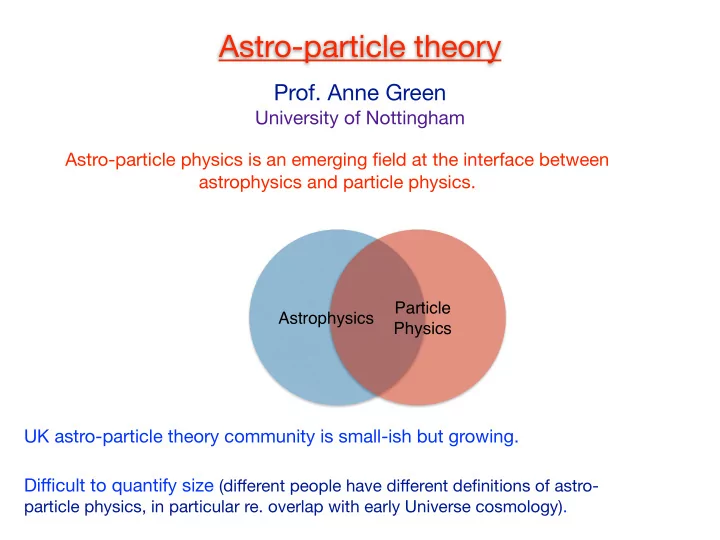
Astro-particle theory Prof. Anne Green University of Nottingham Astro-particle physics is an emerging field at the interface between astrophysics and particle physics. Particle Astrophysics Physics UK astro-particle theory community is


slide-1
SLIDE 1

Astro-particle theory

  • Prof. Anne Green

University of Nottingham

UK astro-particle theory community is small-ish but growing. Difficult to quantify size (different people have different definitions of astro-

particle physics, in particular re. overlap with early Universe cosmology). Astrophysics Particle Physics

Astro-particle physics is an emerging field at the interface between astrophysics and particle physics.

slide-2
SLIDE 2

A) How did the Universe begin and how is it evolving?

1) What is the physics of the early Universe? 2) How did structure first form? 3) What are the roles of dark matter and dark energy?

C) What are the fundamental constituents and fabric of the Universe and how do they interact?

4) What is the nature of dark matter? 5) What is the nature of dark energy?

Baryons 5% Dark energy 69% Dark matter 26%

STFC Science Roadmap Challenges

Planck

slide-3
SLIDE 3

Early Universe Cosmology

What generated the primordial fluctuations from which structures form?

Possibly inflation, a period of accelerated expansion in early Universe, driven by a scalar field. Planck constraints on the spectral index, ns, & tensor-to-scalar ratio, r, compared with model predictions: ns r model building constraints from future observations (B-mode polarisation) Also: formation, evolution & observational signatures of topological defects phase transitions

slide-4
SLIDE 4

Dark Matter

Weakly Interacting Massive Particles (WIMPs) are a well-motivated dark matter candidate. Also: signatures of Axions (& ALPs) in these & other experiments/observations. Can be detected directly in lab e.g. LZ, or indirectly via annihilation products (inc. gamma- rays) e.g. CTA. dark matter candidates theory/phenomenology signals & dependence on DM distribution σSI

(Green&ovals)&Asymmetric&DM&& (Violet&oval)&Magne7c&DM& (Blue&oval)&Extra&dimensions&& (Red&circle)&SUSY&MSSM& &&&&&MSSM:&Pure&Higgsino&& &&&&&MSSM:&A&funnel& &&&&&MSSM:&BinoEstop&coannihila7on& &&&&&MSSM:&BinoEsquark&coannihila7on& &

1 10 100 1000 104 1049 1048 1047 1046 1045 1044 1043 1042 1041 1040 1039 1013 1012 1011 1010 109 108 107 106 105 104 103 WIMP Mass GeVc2 WIMPnucleon cross section cm2 WIMPnucleon cross section pb

SuperCDMS Soudan S u p e r C D M S S u p e r C D M S S

  • u

d a n L

  • w

T h r e s h

  • l

d CDMS II Ge (2009) Xenon100 (2012)

DAMA CRESST CoGeNT (2012) CDMS Si (2013) SuperCDMS Soudan Low Threshold SuperCDMS Soudan CDMS-lite

EDELWEISS (2011) Xenon1T LZ LUX DarkSide G2 DarkSide 50

DAMA

S I M P L E ( 2 1 2 ) Z E P L I N

  • I

I I ( 2 1 2 )

XENON 10 S2 (2013) CDMS-II Ge Low Threshold (2011)

COUPP (2012)

8B

Neutrinos A t m

  • s

p h e r i c a n d D S N B N e u t r i n

  • s

DEAP3600 P I C O 2 5

  • C

F 3 I PICO250-C3F8 SNOLAB CNO Neutrinos G3 Sensitivity G3 Sensitivity

mass Direct detection gamma-rays mass σA

slide-5
SLIDE 5

Dark Energy

What is responsible for the present day accelerated expansion of the Universe? a scalar field? a modification of the laws of gravity? something else? Probe dark energy by measuring the expansion rate of the Universe & the growth of

  • perturbations. e.g. Euclid

model building parameterisations for data comparison

−2 −1 1

w0

−3 −2 −1 1 2

wa

Planck+BSH Planck+WL Planck+BAO/RSD Planck+WL+BAO/RSD

Constraints on simple DE equation of state (p=w ρ) parameterisation: w(a) = w0 + (1 − a)wa w0 wa

bz 1 z

1.2 1.1 1.0 0.9 0.8 0.7 0.5 0.0 0.5

w0 w1

w0 wa current Euclid projections

slide-6
SLIDE 6

Constraining the neutrino masses (& hierarchy) via their effects on the CMB and structure formation.

Neutrinos

Snowmass Dark Energy & CMB working group

Projected future constraints from DESI (dark energy spectroscopic instrument) + CMB polarisation:

mass of lightest neutrino sum of neutrino masses