Searching for Low Mass Dark Matter with the SuperCDMS SNOLAB - - PowerPoint PPT Presentation

searching for low mass dark matter with the supercdms
SMART_READER_LITE
LIVE PREVIEW

Searching for Low Mass Dark Matter with the SuperCDMS SNOLAB - - PowerPoint PPT Presentation

Searching for Low Mass Dark Matter with the SuperCDMS SNOLAB Detectors Bruno Serfass UC Berkeley PM2018 - 14th Pisa Meeting on Advanced Detectors SuperCDMS: Searching for Dark Matter For the past 25 years, the


slide-1
SLIDE 1

Bruno ¡Serfass ¡

UC ¡Berkeley ¡

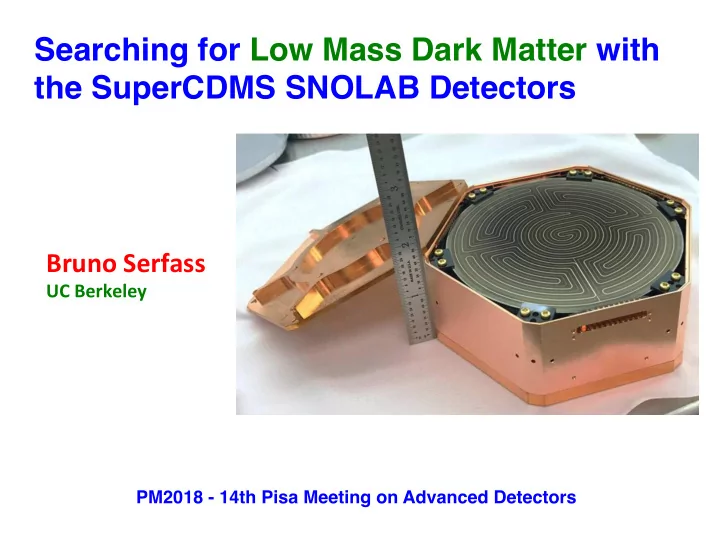
Searching for Low Mass Dark Matter with the SuperCDMS SNOLAB Detectors

PM2018 - 14th Pisa Meeting on Advanced Detectors

slide-2
SLIDE 2
  • [/]
  • σ []
  • σ []
  • SuperCDMS: Searching for Dark Matter

Ø For the past 25 years, the CDMS/SuperCDMS Collaboration has been searching for Dark Matter primarily in the form of WIMPs Ø SuperCDMS detectors were in operation at Soudan, Minnesota, until 2015. New detectors will run deeper, in SNOLAB, Canada (operation starting in 2020).

  • Low-Mass Dark Matter Search with
  • CDMSlite. Phys. Rev. D 97 (2018)
  • Results from the Super Cryogenic

Dark Matter Search Experiment at Soudan Phys.Rev.Lett. 120 (2018)

  • More results coming soon…

Recent SuperCDMS Limits on WIMP-Nucleon cross section:

2 ¡ LUX ¡ DAMIC ¡

slide-3
SLIDE 3

WIMPs not the only candidate, many well motivated DM models at light mass ¡

SuperCDMS: Searching for Dark Matter

(“US Cosmic Visions: New Ideas in Dark Matter”: 1707.04591)

3 ¡

slide-4
SLIDE 4

SuperCDMS: Searching for Dark Matter

  • SuperCDMS SNOLAB Science Goals: Search for DM at

lower Mass: 300 MeV < MDM < 10GeV

  • Can we probe for DM at even lower masses with SuperCDMS

detector technology? ~keV < MDM < 300 MeV

(“US Cosmic Visions: New Ideas in Dark Matter”: 1707.04591)

4 ¡

slide-5
SLIDE 5

χ0 ¡ γ ¡

Transfer of DM kinetic energy inefficient when Mn >> MDM for elastic scatters

∆E = ∆P 2 2MN . 2M 2

DMv2 DM

MN

<latexit sha1_base64="y7iQk91HX3K5CrB5gJXB4E/f2CU=">ACPHicbVC7SgNBFJ31bXxFLW0Gg2AVdhdBLYTgA2yUCIkRsjHMTu7qkNkHM7NCGPbHbPwHOzsbCxVbayfZLTxwMDhnHO5c4+fcCaVb9YU9Mzs3PzC4ulpeWV1bXy+sa1jFNBoUljHosbn0jgLIKmYorDTSKAhD6Hlt8/GfqtBxCSxVFDRLohOQuYgGjRBmpW254p8AVwWf4CHuBIFQXQv1Wu1mXzR1ZdZhj0OUkoW4iI2Mk4vsmHsIWdupvNwt1yxq/YIeJI4BamgAvVu+dnrxTQNIVKUEynbjp2ojiZCMcohK3mphITQPrmDtqERCUF29Oj6DO8YpYeDWJgXKTxSf09oEko5CH2TDIm6l+PeUPzPa6cqOhoFiWpgojmi4KUYxXjYZW4xwRQxQeGECqY+Sum98SUo0zhJVOCM37yJGm61cOqc7VXqR0XbSygLbSNdpGD9lENnaM6aiKHtErekcf1pP1Zn1aX3l0yipmNtEfWN8/f7it7A=</latexit><latexit sha1_base64="y7iQk91HX3K5CrB5gJXB4E/f2CU=">ACPHicbVC7SgNBFJ31bXxFLW0Gg2AVdhdBLYTgA2yUCIkRsjHMTu7qkNkHM7NCGPbHbPwHOzsbCxVbayfZLTxwMDhnHO5c4+fcCaVb9YU9Mzs3PzC4ulpeWV1bXy+sa1jFNBoUljHosbn0jgLIKmYorDTSKAhD6Hlt8/GfqtBxCSxVFDRLohOQuYgGjRBmpW254p8AVwWf4CHuBIFQXQv1Wu1mXzR1ZdZhj0OUkoW4iI2Mk4vsmHsIWdupvNwt1yxq/YIeJI4BamgAvVu+dnrxTQNIVKUEynbjp2ojiZCMcohK3mphITQPrmDtqERCUF29Oj6DO8YpYeDWJgXKTxSf09oEko5CH2TDIm6l+PeUPzPa6cqOhoFiWpgojmi4KUYxXjYZW4xwRQxQeGECqY+Sum98SUo0zhJVOCM37yJGm61cOqc7VXqR0XbSygLbSNdpGD9lENnaM6aiKHtErekcf1pP1Zn1aX3l0yipmNtEfWN8/f7it7A=</latexit><latexit sha1_base64="y7iQk91HX3K5CrB5gJXB4E/f2CU=">ACPHicbVC7SgNBFJ31bXxFLW0Gg2AVdhdBLYTgA2yUCIkRsjHMTu7qkNkHM7NCGPbHbPwHOzsbCxVbayfZLTxwMDhnHO5c4+fcCaVb9YU9Mzs3PzC4ulpeWV1bXy+sa1jFNBoUljHosbn0jgLIKmYorDTSKAhD6Hlt8/GfqtBxCSxVFDRLohOQuYgGjRBmpW254p8AVwWf4CHuBIFQXQv1Wu1mXzR1ZdZhj0OUkoW4iI2Mk4vsmHsIWdupvNwt1yxq/YIeJI4BamgAvVu+dnrxTQNIVKUEynbjp2ojiZCMcohK3mphITQPrmDtqERCUF29Oj6DO8YpYeDWJgXKTxSf09oEko5CH2TDIm6l+PeUPzPa6cqOhoFiWpgojmi4KUYxXjYZW4xwRQxQeGECqY+Sum98SUo0zhJVOCM37yJGm61cOqc7VXqR0XbSygLbSNdpGD9lENnaM6aiKHtErekcf1pP1Zn1aX3l0yipmNtEfWN8/f7it7A=</latexit><latexit sha1_base64="y7iQk91HX3K5CrB5gJXB4E/f2CU=">ACPHicbVC7SgNBFJ31bXxFLW0Gg2AVdhdBLYTgA2yUCIkRsjHMTu7qkNkHM7NCGPbHbPwHOzsbCxVbayfZLTxwMDhnHO5c4+fcCaVb9YU9Mzs3PzC4ulpeWV1bXy+sa1jFNBoUljHosbn0jgLIKmYorDTSKAhD6Hlt8/GfqtBxCSxVFDRLohOQuYgGjRBmpW254p8AVwWf4CHuBIFQXQv1Wu1mXzR1ZdZhj0OUkoW4iI2Mk4vsmHsIWdupvNwt1yxq/YIeJI4BamgAvVu+dnrxTQNIVKUEynbjp2ojiZCMcohK3mphITQPrmDtqERCUF29Oj6DO8YpYeDWJgXKTxSf09oEko5CH2TDIm6l+PeUPzPa6cqOhoFiWpgojmi4KUYxXjYZW4xwRQxQeGECqY+Sum98SUo0zhJVOCM37yJGm61cOqc7VXqR0XbSygLbSNdpGD9lENnaM6aiKHtErekcf1pP1Zn1aX3l0yipmNtEfWN8/f7it7A=</latexit>

Elastic Nuclear Scattering

Searching for dark matter with MDM>300MeV: Nuclear recoils

5 ¡

slide-6
SLIDE 6

Searching for dark matter with MDM>300MeV: Nuclear recoils

χ0 ¡ γ ¡

Elastic Nuclear Scattering

Ø The primary design driver for SuperCDMS and all Light Mass experiments is Energy Sensitivity

¡

6 ¡

slide-7
SLIDE 7

Ø To probe MDM<300MeV, we need to look for DM interactions with more efficiently transfer kinetic energy to the target è è Electron recoils Ø The inelastic electron recoil DM scattering rate depends strongly the size of the target material's band gap è è Ge preferable

Inelastic Electron Scattering

DM DM e- e-

kinetic mixing photon hidden! photon

1 10 102 103 10-43 10-42 10-41 10-40 10-39 10-38 10-37 10-36 10-35 10-34 10-33 10-32 mDM @MeVD se @cm2D FDM µ 1êq2 XENON10 ER He Ar Xe Ge

Freeze-In

Ultra-light Dark Photon (Essig ¡et ¡al ¡1108.5383) ¡

Ø Sensitivity depends on threshold ¡ è è Design driver: semiconductor detector with sensitivity to single electron-hole pairs ¡

slide-8
SLIDE 8

Ø To probe MDM<300MeV, we need to look for DM interactions with more efficiently transfer kinetic energy to the target è è Electron recoils Ø The inelastic electron recoil DM scattering rate depends strongly the size of the target material's band gap è è Ge preferable

Inelastic Electron Scattering

DM DM e- e-

kinetic mixing photon hidden! photon

Ø Sensitivity depends on threshold ¡ è è Design driver: semiconductor detector with sensitivity to single electron-hole pairs ¡

(Essig ¡et ¡al ¡ ¡1509.01598) ¡

slide-9
SLIDE 9

Dark Photon Absorption

9 ¡

Ø Analogous to photoelectric absorption, but with a dark photon A' being absorbed Ø Detected through emission of phonons in semiconductor (ensures momentum conservation) Ø Expected signal: Peak at electron recoil energy corresponding to mA' ¡

Momentum ¡ ¡ ¡

Energy ¡[eV] ¡ Band ¡Diagram ¡for ¡Si ¡

slide-10
SLIDE 10

Ø High-purity Ge and Si crystals operated at 10’s of mK Ø Measure athermal phonon signal via transition edge sensor Ø Multiple channels give position information Ø Two types of detectors:

  • Interleaved Z-dependent Ionization and Phonon (iZIP): higher mass DM, optimized

for background rejection

  • High-Voltage (CDMS-HV): lower mass DM, optimized for low threshold

SuperCDMS SNOLAB Detectors

10 ¡

100 ¡mm ¡ 33 ¡mm ¡

Ge: 1.39 kg, Si: 0.61 kg

100 ¡mm ¡ 33 ¡mm ¡

slide-11
SLIDE 11

iZIP Detectors

  • Simultaneously ¡measure ¡charge ¡and ¡phonon ¡

energy ¡from ¡dark ¡maCer ¡interacDons ¡ ¡ ¡

  • For an electron recoil in Ge, an e-/h+ pair is

produced for every 3.0 eV of recoil energy. Nuclear recoils are less efficient, by a factor

  • f 2 to 10 above 1 keVr

è è ER/NR discrimination via yield=Ionization E / Recoil E

¡

  • Reject ¡surface ¡events ¡via ¡asymmetric ¡charge ¡

signal ¡from ¡interleaved ¡electrodes ¡ ¡ ¡ ¡ ¡ ¡

(Soudan iZIP data) ¡ 11 ¡

surface-­‑event ¡misidenDcaDon ¡prob. ¡<10-­‑5 ¡

slide-12
SLIDE 12

HV Detectors: Neganov-Trofimov-Luke Phonon Amplification

12 ¡

  • Drifting charges release kinetic energy via NTL Phonon Production
  • Luke phonons drown out intrinsic recoil phonon signature, No yield

discrimination

  • ¡

Recoil ¡Phonons ¡ Luke ¡Phonons ¡ ΔV ¡

Etotal = Erecoil + ENT L = Erecoil + nehe∆V

<latexit sha1_base64="dtC+DTImeF2wyBa+0yQXTuaDKY=">ACPXicbVBNSyNBEO1R19W4atSjl8bgsiCEGRF29yCIH+BRMFRIROGnk7FNOnpHrprhDML/Pib/Dm0YsHFa9e7cQgGn3Q8OrVK6rJZkUFn3/1hsbn/gx+XNqujLza3ZuvrqweGp1bjiEXEtzhNmQoFIQqUcJ4ZYGki4Szp7vT7Z5dgrNDqBHsZNFN2oURbcIZOiqvhXlygRiZL+nuTusIA18JVa/3i8OSgpFUoe8YNam4gE5JgUa7IJHR04E9rtb8uj8A/UqCIamRIY7i6k3U0jxPQSGXzNpG4GfYLJhBwSWUlSi3kDHeZRfQcFSxFGyzGJxf0lWntGhbG/cU0oH6caJgqbW9NHOlGHjvb64ne9Ro7tf81CqCxHUPxtUTuXFDXtZ0lbwgWBsucI40a4v1LeYZxdIlXAjB6MlfSbhe/18PjdqW9vDNKbIMlkhf0hA/pItsk+OSEg4uSJ35IE8etfevfkPb9Zx7zhzBL5BO/lFVP9qWI=</latexit><latexit sha1_base64="dtC+DTImeF2wyBa+0yQXTuaDKY=">ACPXicbVBNSyNBEO1R19W4atSjl8bgsiCEGRF29yCIH+BRMFRIROGnk7FNOnpHrprhDML/Pib/Dm0YsHFa9e7cQgGn3Q8OrVK6rJZkUFn3/1hsbn/gx+XNqujLza3ZuvrqweGp1bjiEXEtzhNmQoFIQqUcJ4ZYGki4Szp7vT7Z5dgrNDqBHsZNFN2oURbcIZOiqvhXlygRiZL+nuTusIA18JVa/3i8OSgpFUoe8YNam4gE5JgUa7IJHR04E9rtb8uj8A/UqCIamRIY7i6k3U0jxPQSGXzNpG4GfYLJhBwSWUlSi3kDHeZRfQcFSxFGyzGJxf0lWntGhbG/cU0oH6caJgqbW9NHOlGHjvb64ne9Ro7tf81CqCxHUPxtUTuXFDXtZ0lbwgWBsucI40a4v1LeYZxdIlXAjB6MlfSbhe/18PjdqW9vDNKbIMlkhf0hA/pItsk+OSEg4uSJ35IE8etfevfkPb9Zx7zhzBL5BO/lFVP9qWI=</latexit><latexit sha1_base64="dtC+DTImeF2wyBa+0yQXTuaDKY=">ACPXicbVBNSyNBEO1R19W4atSjl8bgsiCEGRF29yCIH+BRMFRIROGnk7FNOnpHrprhDML/Pib/Dm0YsHFa9e7cQgGn3Q8OrVK6rJZkUFn3/1hsbn/gx+XNqujLza3ZuvrqweGp1bjiEXEtzhNmQoFIQqUcJ4ZYGki4Szp7vT7Z5dgrNDqBHsZNFN2oURbcIZOiqvhXlygRiZL+nuTusIA18JVa/3i8OSgpFUoe8YNam4gE5JgUa7IJHR04E9rtb8uj8A/UqCIamRIY7i6k3U0jxPQSGXzNpG4GfYLJhBwSWUlSi3kDHeZRfQcFSxFGyzGJxf0lWntGhbG/cU0oH6caJgqbW9NHOlGHjvb64ne9Ro7tf81CqCxHUPxtUTuXFDXtZ0lbwgWBsucI40a4v1LeYZxdIlXAjB6MlfSbhe/18PjdqW9vDNKbIMlkhf0hA/pItsk+OSEg4uSJ35IE8etfevfkPb9Zx7zhzBL5BO/lFVP9qWI=</latexit><latexit sha1_base64="dtC+DTImeF2wyBa+0yQXTuaDKY=">ACPXicbVBNSyNBEO1R19W4atSjl8bgsiCEGRF29yCIH+BRMFRIROGnk7FNOnpHrprhDML/Pib/Dm0YsHFa9e7cQgGn3Q8OrVK6rJZkUFn3/1hsbn/gx+XNqujLza3ZuvrqweGp1bjiEXEtzhNmQoFIQqUcJ4ZYGki4Szp7vT7Z5dgrNDqBHsZNFN2oURbcIZOiqvhXlygRiZL+nuTusIA18JVa/3i8OSgpFUoe8YNam4gE5JgUa7IJHR04E9rtb8uj8A/UqCIamRIY7i6k3U0jxPQSGXzNpG4GfYLJhBwSWUlSi3kDHeZRfQcFSxFGyzGJxf0lWntGhbG/cU0oH6caJgqbW9NHOlGHjvb64ne9Ro7tf81CqCxHUPxtUTuXFDXtZ0lbwgWBsucI40a4v1LeYZxdIlXAjB6MlfSbhe/18PjdqW9vDNKbIMlkhf0hA/pItsk+OSEg4uSJ35IE8etfevfkPb9Zx7zhzBL5BO/lFVP9qWI=</latexit>

P .N. Luke et al. NIM A289, 405 (1990)

slide-13
SLIDE 13

HV Detectors: Predicted background

13 ¡

Predicted background spectrum in Ge HV Detectors after fiducial cuts Total ¡ ¡ ¡

3H ¡and ¡Comptons ¡

¡Ge ¡acDvaDon ¡ ¡Surface ¡betas ¡ ¡Surface ¡206Pb ¡ ¡ neutrons ¡ ¡ ¡ ¡Coherent ¡neutrinos ¡

1 ¡GeV ¡ ¡WIMP ¡with ¡σ ¡= ¡10-­‑42 ¡cm2

¡ ¡

10 ¡GeV ¡ ¡

slide-14
SLIDE 14

14 ¡

SuperCDMS SNOLAB Performance Goals

Soudan ¡ SNOLAB ¡ Phonon ¡resoluDon, ¡eVt ¡ ~250 ¡ HV: ¡10, ¡iZIP: ¡50 ¡ HV ¡Bias ¡Voltage, ¡V ¡ 70 ¡ 100 ¡ iZIP ¡Charge ¡resoluDon, ¡eVee ¡ ~400 ¡ 160 ¡ HV ¡Threshold, ¡eVnr ¡ 300 ¡ 40 ¡

  • 4 tower initial payload
  • 2 HV (4 Ge, 2 Si each)
  • 2 iZIP (6 Ge in 1, 4/2 Ge/Si other)
  • SNOLAB Fridge, cryostat

capable of 31 towers, nominal 15 mK

  • Full operation will start in 2020
slide-15
SLIDE 15

15 ¡

CDMS HVeV: Prototype Single e-/h+ Device

Ø Single e-h pair sensitivity has been recently demonstrated in a 1 cm2 x 4 mm (0.93g) Si crystal Ø Device operated on surface at Stanford

R.K. ¡Romani ¡et ¡al., ¡Appl.Phys.LeC. ¡112 ¡(2018) ¡043501 ¡

slide-16
SLIDE 16

16 ¡

Ø Calibration data using a pulsed monochromatic 650 nm laser (1.91 eV photons)

CDMS HVeV: Prototype Single e-/h+ Device

slide-17
SLIDE 17

17 ¡

Charge Leakage Dependence on Voltage Bias

  • We chose to run at 140V: Maximum NTL Gain without increased

surface dark count rate

  • Pre-bias: Increase voltage by 10V for 5 min before taking data. This

improved performance (as seen in CDMSlite at Soudan)

  • @140V with Pre-bias: Average event rate of 2 Hz
slide-18
SLIDE 18

18 ¡

Dark Matter Search Event Rate Spectrum

An exposure of 12.6 hours passed the initial, trigger- and leakage- burst cuts ¡ è science exposure of 0.49 g-day for the 0.93 g detector è probe new parameter space from 500keV< MDM<5MeV ¡

slide-19
SLIDE 19

19 ¡

CDMS HVeV Dark Matter Limits

arXiv:1804.10697 ¡ ¡ ¡ (submiCed ¡to ¡Phys.Rev.LeC) ¡ ¡ light ¡mediator ¡ ¡ heavy ¡ ¡mediator ¡

Inelastic Electronic DM ¡

Dark Photon Absorption ¡

slide-20
SLIDE 20

Summary

20 ¡

Ø SuperCDMS is moving to SNOLAB after more than a decade of leading direct DM search in Soudan Ø SuperCDMS SNOLAB will focus on low-mass DM 300MeV < MDM < 10GeV using a combination of Ge/Si iZIP and HV detectors Ø Installation in SNOLAB starts next year, operation in 2020 Ø A small volume 0.93g SuperCDMS R&D detector has demonstrated the capability to measure single e-h+ energy depositions Ø An initial science run at the surface with 0.49 g-day of exposure, was able to probe new parameter space from 500keV< MDM<5MeV

slide-21
SLIDE 21

21 ¡

slide-22
SLIDE 22

22 ¡

Extra ¡

slide-23
SLIDE 23

Collect ¡and ¡Concentrate ¡ Phonon ¡Energy ¡into ¡W ¡TES ¡ (TransiDon ¡Edge ¡Sensor) ¡ ¡

R T

Athermal Phonon Sensor

23 ¡