
SLIDE 1
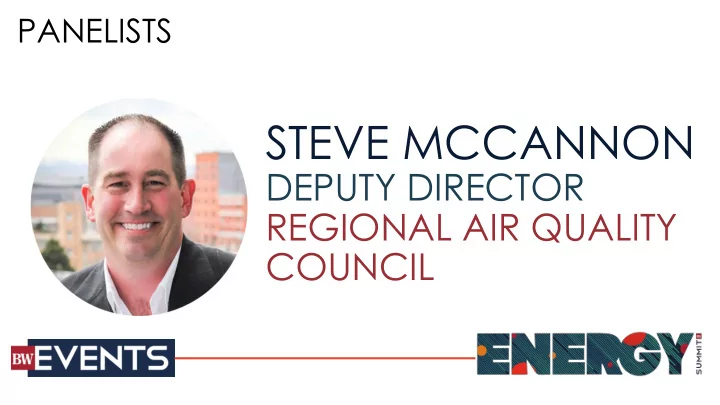
STEVE MCCANNON DEPUTY DIRECTOR REGIONAL AIR QUALITY COUNCIL Ozone - - PowerPoint PPT Presentation
PANELISTS STEVE MCCANNON DEPUTY DIRECTOR REGIONAL AIR QUALITY COUNCIL Ozone Planning Primer Colorado Energy Summit July 18, 2019 Steve McCannon Deputy Director Overview Very complicated situation changing rapidly so my goal is a high
Steve McCannon Deputy Director
February 6, 2019 3
level overview of the ozone situation, provide you with some take home materials and invite you to participate in our efforts.
February 6, 2019 4
Lead air quality planning agency for the 9 county Denver Metro/North Front Range created by EO of the Governor Primary responsibilities
standards (SIPs) and state standards
and awareness
reduce emissions and improve air quality
in the air quality planning process
February 6, 2019 6
8-Hr Avg. Ozone in parts per billion (ppb)
3-Year Design Values in the Denver Metro/North Front Range
8-Hour Ozone Standard: Based on a three-year average of the annual forth-highest daily 8-hour maximum ozone concentration. Current as of 9/30/18.
1997 Standard (revoked)
Marginal Moderate Serious Severe-15 Marginal Moderate Serious
2008 Standard 2015 Standard
Key Year
Max NRE L RF N CHA T
February 6, 2019 7
7
February 6, 2019 8
✔New car/truck standards ✔ Cleaner fuels/ Alternative fuels ✔ Inspection/maintenance programs ✔ Diesel retrofits ✔ New vehicle technologies ✔ Transportation/land use policies ✔ Travel reduction programs ✔ Power Plants
programs
✔Small engine standards ✔Non-road engine standards ✔Locomotive engine standards ✔ Emissions Standards for Large Engines and Boilers
February 6, 2019 9
✔New car/truck standards ✔ Cleaner fuels/ Alternative fuels ✔ Inspection/maintenance programs ✔ New vehicle technologies ✔ Transportation/land use policies ✔ Travel reduction programs ✔ Oil and Gas (O&G)
established by Air Quality Control Commission in Feb. 2014 ✔ Lawn and garden equipment change-out programs
February 6, 2019 10
2008 (75 ppb) Standard 2015 (70 ppb) Standard
201 9 202 5
Toda y Q1 Q3 Q1 202 Q3 Q1 202 1 Q3 Q1 202 2 Q3 Q1 202 3 Q3 Q1 202 4 Q3
Base Year Modeling Complete 6/30/201 9 Attainment Date - Moderate 7/20/201 9 2020 Attainment Modeling Complete 11/29/201 9 Reclassification from Moderate to Serious 12/31/201 9 Serious SIP Due 1/20/202 RAQC Endorsement 2/7/202 AQCC Public Hearing 5/21/202 Serious SIP Submitted to EPA (conditional) 7/1/202 Serious SIP Submitted to EPA 5/31/202 1 Attainment Date - Serious 7/20/202 1 2023 Attainment Modeling Complete 12/27/201 9 Reclassification from Marginal to Moderate 2/1/202 2 Base Year Emissions Inventory Due 8/3/202 Attainment Date - Marginal 8/3/202 1 RAQC Endorsement 7/1/202 2 AQCC Public Hearing 10/20/202 2 Moderate SIP Due 1/1/202 3 Moderate SIP Submitted to EPA 5/31/202 3 Attainment Date - Moderate 8/3/202 4 1/15/2021 - 5/21/2021
Strategy Analysis 6/1/2019 - 4/30/2023 Strategy Rulemaking/Implementation 1/15/2023 - 5/19/2023
1/1/2019 - 12/31/2019
Moderate Serious Marginal
February 6, 2019
February 6, 2019 12
Serious (75 ppb Std.) Moderate (70 ppb Std.)
Base Year 2016 – Modeling 2011/17 – Em. Inv. 2016 – Modeling 2017 – Em. Inv. Photochemical Modeling 2020 Future Year 2023 Future Year Reasonable Further Progress (RFP) +9% ↓ VOC or NOx 01/18-12/20 15% ↓ VOC or NOx 01/18-12/23 Reasonably Available Control Technology (RACT SIP) Major Source = 50 tpy (NOx or VOC) Major Source = 100 tpy (NOx or VOC) Reasonably Available Control Measures ✔ ✔ Inspection/Maintenance Program Enhanced Basic Nonattainment Area New Source Review (NANSR) - Emission offset ratio for VOC 1.2:1 1.15:1 Contingency Measures (3% ↓ VOC / NOx) ✔ ✔ Motor Vehicle Emissions Budgets ✔ ✔ Clean Fuel-Vehicle Programs ✔ Transportation Control ✔
February 6, 2019 13
▪ Federal On-Road and Non-Road Mobile Source Standards/Regulations ▪ Inspection and Maintenance Program ▪ Oil and Gas Regulations ▪ 7.8 Reid Vapor Pressure (RVP) with 1 PSI Ethanol Waiver (8.8 RVP) ▪ Stage I Vapor Recovery at Gas Stations ▪ Power Plant Emissions Reductions – Clean Air Clean Jobs & Regional Haze ▪ Other Stationary Source Regulations ▪ Reasonably Available Control Measures ▪ Non federally enforceable measures
▪ From energy efficiency programs, small business programs, expanding the use of electric vehicles, mower exchanges, and bicycle and pedestrian programs to name a few.
Control Measures in 2017 Inventory
February 6, 2019 15
non-U.S. anthropogenic sources
NFR and Colorado due to background ozone
February 6, 2019 17
influenced by exceptional events (EE)
wildfire smoke influence and submitted documentation to EPA in May 2018
February 6, 2019 19
Stationary/ Area Sources Mobile Sources/ Fuels Transportation/ Land Use/Outreach
Technology (RACT) for major point sources
generating units (EGU)
maintenance (AIM) coatings and consumer products
Regulation (CLEAR)
mandate
gasolines
equipment
vehicles/refueling/retrofit programs
mitigation plan
and garden equipment
strategies
encouraging behavior change
Currently investigating multiple strategies across sources including: Sign-up to receive notifications at: https://raqc.org/email-signup/
February 6, 2019 20
gone.
downwards.
Steve McCannon
Deputy Director smccannon@raqc.org (303) 629-5450 x 230