STERN PRODUCE : DEVELOPING SUSTAINABILITY METRICS FOR ARIZONA FRESH - - PowerPoint PPT Presentation

stern produce developing sustainability metrics for
SMART_READER_LITE
LIVE PREVIEW

STERN PRODUCE : DEVELOPING SUSTAINABILITY METRICS FOR ARIZONA FRESH - - PowerPoint PPT Presentation

STERN PRODUCE : DEVELOPING SUSTAINABILITY METRICS FOR ARIZONA FRESH TOGETHER LOCAL FOOD PROGRAM MSUS APPLIED PROJECT SALOMI PRADHAN PROJECT PARTNER KRISTEN OSGOOD INTRODUCTION Stern Produce Co . :A family owned food distribution


slide-1
SLIDE 1

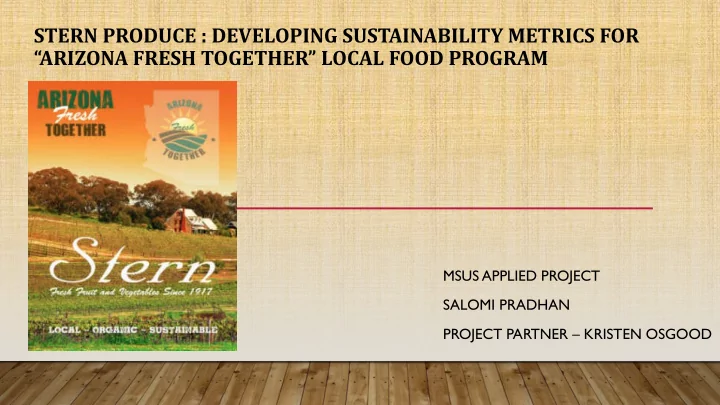
STERN PRODUCE : DEVELOPING SUSTAINABILITY METRICS FOR “ARIZONA FRESH TOGETHER” LOCAL FOOD PROGRAM

MSUS APPLIED PROJECT SALOMI PRADHAN PROJECT PARTNER – KRISTEN OSGOOD

slide-2
SLIDE 2

INTRODUCTION

  • Stern Produce Co. :A family owned food distribution business in Phoenix since 1917
  • Committed to building partnerships with local farms in Arizona to meet the wholesale demand for Arizona

grown food.

  • Embraced the responsibility to conduct business in a manner that invests in community wellness, fosters societal

resilience and environmental health.

  • ARIZONA FRESHTOGETHER (AFT) : Revolutionize Arizona with local food supply chain partnerships
slide-3
SLIDE 3

AFT : GOALS AND OBJECTIVES

ARIZONA FRESH TOGETHER

Preserve our valuable farmlands, unique biodiversity and celebrate it Stimulate our local food economy Help Stern Produce, as a company, to gain first mover advantage. Help protect

  • ur health as

well as the health of our communities Support local and often family run smaller farms in AZ

slide-4
SLIDE 4

AFT METRICS AND INDICATORS

Food Safety & Food Nutrition Ecosystem/ Biodiversity Stability Economic Resilience/ Stability Socio-cultural Well being

  • Farm Certification
  • Crop diversity
  • Crop Food
  • Pest Control
  • GMO/Non GMO
  • Food

storage/processing

  • Food taste and

enjoyment

  • Sustainable

farming practices

  • Water usability
  • C02 emissions
  • Pest control

methods

  • Soil health
  • Food affordability
  • Creation of local job
  • pportunities
  • Creation of secondary

economic opportunities

  • Stern local revenue

indicators/profitability margins in local food distribution

  • Human health & safety
  • Quality of life/wellbeing
  • Equity, Justice
  • Biological and cultural

diversity

  • Resiliency in the system
  • Happiness
slide-5
SLIDE 5

WHAT I DID …

Environmental

Researched and collected data of potential GHG emissions to compare the environmental implications of local VS conventional food sourcing.

Economic

  • Relied on survey questionnaires and informal

interviews with local Arizonian farmers

  • Extensive literature review and stakeholder

engagement

Social Human Health

slide-6
SLIDE 6

ENVIRONMENTAL IMPLICATIONS

CO2 emissions released in conventional sourcing of food produce from out of state of AZ CO2 emissions released in local sourcing of food produce from within the state of AZ

slide-7
SLIDE 7

CONTINUED…

  • Farms are certified either Organic, GHP (Good Handling Practices) / GAP (Good Agricultural Practices)

certified or Naturally Grown.

  • Strictly no use of any synthetic chemical inputs (e.g. fertilizers, pesticides, antibiotics, food additives)
  • None of the farms use genetically modified seeds
  • Use of sustainable farming practices like eliminating tillage, cover cropping, crop rotation, drip irrigation etc.
  • No chemical sprays for pest control
  • Water conservation strategies
  • Lesser environmental pollution
  • Greater accountability
slide-8
SLIDE 8

ECONOMIC IMPLICATIONS

572434, 88% 79182, 12%

No of Cases Sold

Conventional Farms Sales Local Farms Sales

  • Stern’s Direct dollar value spent to the local

providers/economy from 01/01/17 to 11/06/17 is appx 1.3 million

  • Local farms projected a local sales revenue

growth from in between 5% to 15% in the past 3-4 years

  • The farmers that I interviewed employ an

average of 30 to 50 people in their business in the peak season. (production side)

  • Currently, it is out of the farmers’ budget and

capacity to track how much are they contributing to the local economy of AZ.

Stern’s sales data for local vs conventional food distribution for 1-1-17 to 11-6-17

slide-9
SLIDE 9

SOCIAL IMPLICATIONS

  • Local farms GHP/GAP certified
  • Safety protocols priority, regular inspections and audits, rigorous employee trainings, instant reporting

and feedback assessments

  • Workers wages above the state’s average wage rate (community healthcare, community housing)
  • Impressive biological and cultural diversity ratio. On average, every farm employed 30% women and 50%

native Navajos and Latino workers

  • Strong community cohesion
  • Vulnerable and less resilient to shock strategies in case of natural calamities (hurricanes, floods,

droughts), market crashes, social upheavals

  • Happiness is the key!
slide-10
SLIDE 10

CONCLUSION

  • Local farms and farmers are not resilient enough
  • Need for Education, policies & Incentives to drive local food

systems.

  • Consumers must be willing to eat seasonally
  • Heavy disparity and inconsistency issue with the supply and

demand side in the markets for local produce

  • Uncertainties around social characteristics of sustainability
  • Lack of tracking or documentation of economic contribution
  • f local food systems to the local economy.

Benefits of AFT Scope for Improvement to make AFT a viable success

  • AFT is a sustainable and successful food program
  • The metrics created were well defined, meaningful,

measurable, motivational and easy to understand and communicate to all stakeholders

  • The metrics created will enable us to statistically

measure benefits of local food programs like the AFT

  • The project also provided a comprehensive assessment
  • f health, resilience, fairness and transparency that are

not generally used in a typical supply chain analysis

  • Social capital is as important as the economic capital!
slide-11
SLIDE 11

CALL FOR ACTION…

  • Scope to actually forecast, measure and compare the results of the indicators with time

as AFT program continues to generate more revenue and consequently affect lives of more people

  • The metrics I present can be used as a marketing tool for branding and marketing the

AFT program to demonstrate the importance of local food systems

slide-12
SLIDE 12

THANK YOU!