SLIDE 1 Query Processing 1
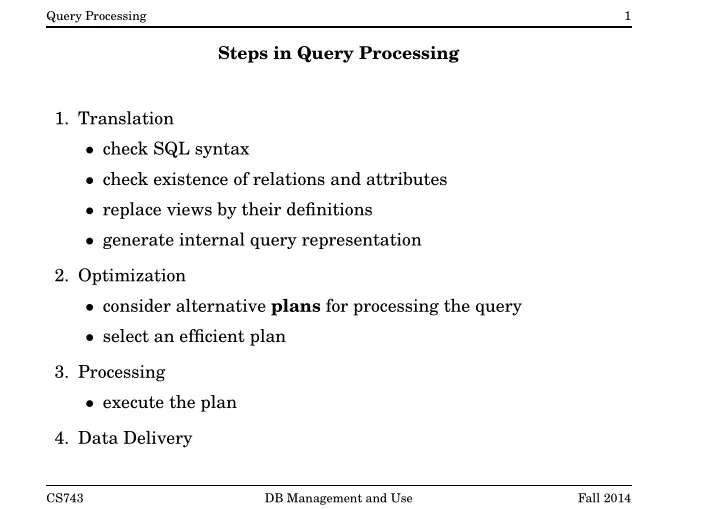
Steps in Query Processing
- 1. Translation
- check SQL syntax
- check existence of relations and attributes
- replace views by their definitions
- generate internal query representation
- 2. Optimization
- consider alternative plans for processing the query
- select an efficient plan
- 3. Processing
- execute the plan
- 4. Data Delivery
CS743 DB Management and Use Fall 2014
SLIDE 2
Query Processing 2
Example select DeptNo, Deptname, count(*), sum(Salary) from Employee, Department where WorkDept = DeptNo and DeptNo like ’D%’ group by DeptNo, Deptname having sum(Salary) > 1000000
CS743 DB Management and Use Fall 2014
SLIDE 3 Query Processing 3
An Execution Plan
- 1. Scan the Employee table, select all tuples for which WorkDept
starts with ’D’, call the result R1.
- 2. Join R1 and Department, eliminate attributes other than DeptNo,
Deptname, and Salary. Call the result R2. This may involve:
- sorting R1 on WorkDept
- sorting Department on Deptno
- joining the two sorted relations to produce R2
- 3. Group the tuples of R2. Call the result R3. This may involve:
- sorting R2 on DeptNo and Deptname
- group tuples with identical values of DeptNo and Deptname
- count tuples in each group, and add their Salaries
- 4. Scan R3, select all tuples with sum(Salary) > 1000000
CS743 DB Management and Use Fall 2014
SLIDE 4
Query Processing 4
Pictorial Access Plan
Join Grouping Select (Sum(Salary) > 100) Project Select R1 R3 R2 (DeptNo, Deptname) (DeptNo,Deptname,Salary) (DeptNo = WorkDept) (DeptNo LIKE ’D%’) Department Employee
CS743 DB Management and Use Fall 2014
SLIDE 5 Query Processing 5
Pipelined Plans and Iterators
- In a pipelined plan, each tuples stream from one operator to
another.
- Pipelining allows for parallel execution of operators, and avoids
unnecessary materialization of intermediate results. (Sometimes materialization may be necessary...)
- Iterators are a common model for plan operators:
– every operator is an iterator – an iterator provides the following interface: Open, GetNext, and Close – each iterator implements its interface, using calls to the interface functions of its child (or children)
CS743 DB Management and Use Fall 2014
SLIDE 6
Query Processing 6
DB2 Access Plan FILTER (having) | GRPBY (deptno,deptname) | MSJOIN / \ TBSCAN FILTER | | (deptno) SORT TBSCAN | | (like D%) TBSCAN SORT (workdept) | | DEPARTMENT TBSCAN (like D%) | EMPLOYEE
CS743 DB Management and Use Fall 2014
SLIDE 7
Query Processing 7
DB2 Access Plan with Index FILTER | GRPBY | TBSCAN | SORT | NLJOIN / \ TBSCAN FETCH | / \ EMPLOYEE IXSCAN DEPARTMENT | DEPTNOIND
CS743 DB Management and Use Fall 2014
SLIDE 8 Query Processing 8
Some Basic Query Processing Operations
- Data Access and Filtering
– Index scans – Table scans
– nested loop join – hash join – sort-merge join – and others . . .
- Sorting
- Grouping and Duplicate Elimination
– by sorting – by hashing
CS743 DB Management and Use Fall 2014
SLIDE 9 Query Processing 9
Joining Relations select DeptName, LastName from Department, Employee where DeptNo = WorkDept Conceptually, a nested-loop join works like this: foreach tuple d in Department do foreach tuple e in Employee do if d.DeptNo = e.WorkDept then
end end
CS743 DB Management and Use Fall 2014
SLIDE 10 Query Processing 10
Block Nested Loop Join select DeptName, LastName from Department, Employee where DeptNo = WorkDept Process outer relation a chunk at a time foreach chunk C of Department foreach tuple e in Employee do foreach tuple d in C if d.DeptNo = e.WorkDept then
end end end
CS743 DB Management and Use Fall 2014
SLIDE 11 Query Processing 11
Other Techniques for Join
- If there is an index on the WorkDept attribute of the Employee
relation, an index join can be used: foreach tuple d in Department do use the index to find Employee tuples where d.DeptNo = Wor for each such tuple e
end
- Examples of other join techniques:
– Sort-Merge Join: sort the tuples of Employee on WorkDept and the tuples of Department of DeptNo, then merge the sorted relations. – Hash Join: assign each tuple of Employee and of Department to a “bucket” by applying a hash function to its WorkDept (DeptNo)
- value. Within each bucket, look for Employee/Department tuple
pairs for which WorkDept = DeptNo.
CS743 DB Management and Use Fall 2014
SLIDE 12 Query Processing 12
Hash Join Example
Hash Join Operator disk memory result
inner 6,1,8,1,2,8,3,3,4,6,6,8,2,8,9,3 8,2,2,3,4,5,5,6,5,7,7,2,3,7,8,5
CS743 DB Management and Use Fall 2014
SLIDE 13 Query Processing 13
Hash Join Example (cont’d)
Hash Join Operator disk memory result
inner 6,1,8,1,2,8,3,3,4,6,6,8,2,8,9,3 8 4 8 5,5,5,5 2,2,6,2 3,7,7,3,7 8,2,2,3,4,5,5,6,5,7,7,2,3,7,8,5
CS743 DB Management and Use Fall 2014
SLIDE 14 Query Processing 14
Hash Join Example (cont’d)
Hash Join Operator disk memory result
inner 8 4 8 5,5,5,5 2,2,6,2 3,7,7,3,7 (8,8),(8,8),(8,8),(8,8),(4,4),(8,8),(8,8),(8,8),(8,8) 1,1,9 6,2,6,6,2 3,3,3 6,1,8,1,2,8,3,3,4,6,6,8,2,8,9,3
CS743 DB Management and Use Fall 2014
SLIDE 15 Query Processing 15
Hash Join Example (cont’d) Hash Join Operator disk memory result
inner 5,5,5,5 2,2,6,2 3,7,7,3,7 1,1,9 6,2,6,6,2 3,3,3 5 5 5 5
CS743 DB Management and Use Fall 2014
SLIDE 16 Query Processing 16
Hash Join Example (cont’d)
Hash Join Operator disk memory result
inner 2,2,6,2 3,7,7,3,7 1,1,9 6,2,6,6,2 3,3,3 5 5 5 5
CS743 DB Management and Use Fall 2014
SLIDE 17 Query Processing 17
Hash Join Example (cont’d)
Hash Join Operator disk memory result
inner 2,2,6,2 3,7,7,3,7 6,2,6,6,2 3,3,3 2 2 6 2 (6,6),(2,2),(2,2),(2,2),(6,6),(6,6),(2,2),(2,2),(2,2)
CS743 DB Management and Use Fall 2014
SLIDE 18 Query Processing 18
Hash Join Example (cont’d)
Hash Join Operator disk memory result
inner 3,7,7,3,7 3,3,3 3 7 7 3 7 (3,3),(3,3),(3,3),(3,3),(3,3),(3,3)
CS743 DB Management and Use Fall 2014
SLIDE 19
Query Processing 19
External Merge Sort: Run Formation
disk disk memory CS743 DB Management and Use Fall 2014
SLIDE 20
Query Processing 20
External Merge Sort: Run Formation (cont’d)
disk disk memory CS743 DB Management and Use Fall 2014
SLIDE 21
Query Processing 21
External Merge Sort: Run Formation (cont’d)
disk disk memory CS743 DB Management and Use Fall 2014
SLIDE 22
Query Processing 22
External Merge Sort: Merging Runs
disk memory disk CS743 DB Management and Use Fall 2014
SLIDE 23 Query Processing 23
Summary
- A plan describes how a query is executed, including:
– the sequence of basic operations (select, project, join, sort, etc.) used to process the query – how each operation will be implemented, e.g., which join method will be used, which indices will be used to perform a selection.
CS743 DB Management and Use Fall 2014