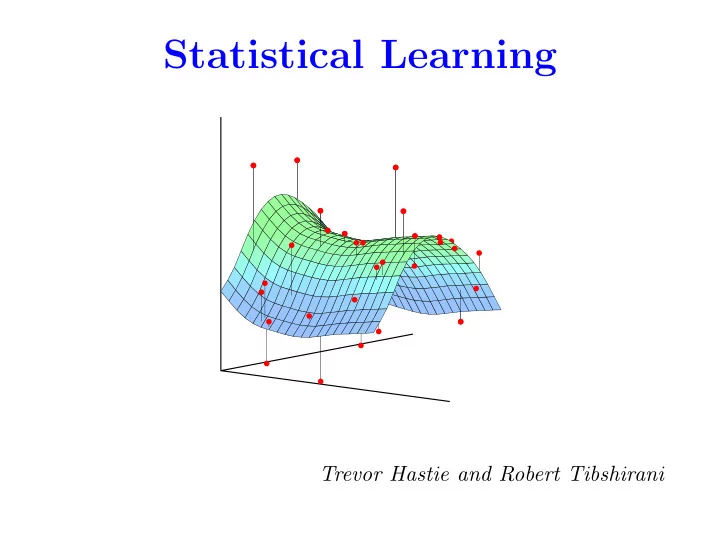
Statistical Learning - - PowerPoint PPT Presentation

statistical learning
SMART_READER_LITE
LIVE PREVIEW

Statistical Learning - - PowerPoint PPT Presentation

Statistical Learning


slide-1
SLIDE 1

Statistical Learning

  • Trevor Hastie and Robert Tibshirani
slide-2
SLIDE 2

Statistics in the news

How IBM built Watson, its Jeopardy-playing supercomputer by Dawn Kawamoto DailyFinance

02/08/2011 Learning from its mis- takes According to David Ferrucci (PI of Watson DeepQA technology for IBM Research), Watson’s software is wired for more that handling natural lan- guage processing. “It’s machine learning allows the computer to become smarter as it tries to answer questions — and to learn as it gets them right or wrong.”

2 / 29

slide-3
SLIDE 3

Enlarge This Image

Thor Swift for The New York Times

Carrie Grimes, senior staff engineer at Google, uses statistical analysis of data to help improve the company's search engine.

Multimedia

For TodayÕs Graduate, Just One Word: Statistics

By STEVE LOHR Published: August 5, 2009

MOUNTAIN VIEW, Calif. Ñ At Harvard, Carrie Grimes majored in anthropology and archaeology and ventured to places like Honduras, where she studied Mayan settlement patterns by mapping where artifacts were found. But she was drawn to what she calls Òall the computer and math stuffÓ that was part of the job. ÒPeople think of field archaeology as Indiana Jones, but much of what you really do is data analysis,Ó she said. Now Ms. Grimes does a different kind

  • f digging. She works at Google,

where she uses statistical analysis of mounds of data to come up with ways to improve its search engine.

  • Ms. Grimes is an Internet-age statistician, one of many

who are changing the image of the profession as a place for dronish number nerds. They are finding themselves increasingly in demand Ñ and even cool. ÒI keep saying that the sexy job in the next 10 years will be statisticians,Ó said Hal Varian, chief economist at Google. ÒAnd IÕm not kidding.Ó

N

Su

SIGN IN TO RECOMMEND SIGN IN TO E-MAIL PRINT REPRINTS SHARE

Quote of the Day, New York Times, August 5, 2009

”I keep saying that the sexy job in the next 10 years will be statisticians. And I’m not kidding.” — HAL VARIAN, chief economist at Google.

3 / 29

slide-4
SLIDE 4
  • 4 / 29
slide-5
SLIDE 5

Statistical Learning Problems

  • Identify the risk factors for prostate cancer.
  • Classify a recorded phoneme based on a log-periodogram.
  • Predict whether someone will have a heart attack on the basis
  • f demographic, diet and clinical measurements.
  • Customize an email spam detection system.
  • Identify the numbers in a handwritten zip code.
  • Classify a tissue sample into one of several cancer classes,

based on a gene expression profile.

  • Establish the relationship between salary and demographic

variables in population survey data.

  • Classify the pixels in a LANDSAT image, by usage.

5 / 29

slide-6
SLIDE 6

lpsa

−1 1 2 3 4

  • o
  • o
  • o
  • o
  • o
  • o
  • o
  • o
  • o
  • o
  • o
  • o
  • o
  • o
  • o
  • o
  • o
  • o
  • o
  • o o o
  • o
  • o
  • oo

40 50 60 70 80

  • o
  • o
  • o
  • o o
  • o
  • o
  • o
  • o
  • o
  • o
  • o o
  • o
  • oo
  • o o
  • o
  • 0.0

0.4 0.8

  • o
  • o
  • o
  • o
  • o
  • o
  • 6.0

7.0 8.0 9.0

  • −1

1 2 3 4

  • lcavol
  • o
  • o
  • o
  • o
  • o
  • o
  • o
  • o
  • o
  • o
  • o
  • oo
  • o
  • o
  • o
  • o

lweight

  • o
  • o
  • o o
  • o
  • o
  • o
  • o
  • o o
  • o
  • o
  • o
  • 40

50 60 70 80

  • o
  • o
  • o
  • o
  • o o
  • age
  • o
  • o
  • o
  • oo
  • o
  • o
  • o
  • o
  • o
  • o
  • o
  • o
  • o
  • lbph
  • o
  • 0.0

0.4 0.8

  • oo
  • o
  • o
  • o
  • o
  • o
  • o
  • o
  • o
  • o
  • o
  • o
  • o
  • o
  • o
  • o
  • o
  • o
  • o o o
  • oo
  • o
  • o
  • o
  • o o
  • o
  • o
  • o
  • o
  • o
  • o
  • o o
  • o
  • svi
  • o
  • o
  • o
  • o
  • o
  • oo
  • o
  • o
  • o
  • o
  • o
  • o
  • o
  • o
  • o
  • o
  • o
  • o
  • lcp
  • 6.0

7.0 8.0 9.0

  • oo
  • o
  • o
  • o
  • o
  • o
  • o
  • o
  • o
  • o
  • o
  • oo
  • o
  • o
  • o
  • o
  • o
  • o
  • o
  • o o
  • o
  • o o
  • o
  • o
  • o
  • gleason

1 2 3 4 5

  • oo
  • o
  • 2.5

3.5 4.5

  • o
  • o
  • o
  • o
  • o
  • o
  • −1

1 2

  • −1

1 2 3

  • o
  • o
  • o
  • 6 / 29
slide-7
SLIDE 7

lpsa

  • 1

1 3

  • o
  • o o o
  • o
  • o
  • o
  • o
  • o
  • o
  • o
  • o
  • o
  • o
  • o
  • o
  • o
  • o
  • o
  • o
  • o
  • o o
  • o
  • o
  • oo
  • o
  • o
  • o
  • o
  • o
  • o
  • o o
  • o
  • 40

60 80

  • o o
  • o
  • o
  • o
  • oo
  • o o
  • o
  • o o
  • o
  • 0.0

0.4 0.8

  • o
  • o
  • o
  • o
  • o
  • o
  • o
  • o o
  • oo
  • 6.0

7.5 9.0

  • 0 1 2 3 4 5
  • o
  • o
  • o
  • o
  • o o
  • o
  • o
  • o
  • o
  • 1 0 1 2 3

4

  • lcavol
  • o
  • o
  • oo
  • o
  • o
  • o
  • o
  • o
  • oo
  • o
  • o
  • o o
  • o
  • o
  • o
  • o
  • o
  • o o
  • o
  • o o
  • o
  • o
  • o
  • o
  • o
  • o

lweight

  • o o
  • oo
  • o
  • o
  • o o
  • o
  • o
  • o
  • o
  • o
  • o
  • 3

4 5 6

  • o
  • o o
  • o
  • o
  • 40 50 60 70 80
  • o
  • o
  • o
  • o
  • o
  • o o
  • oo
  • o
  • age
  • o
  • o
  • o
  • o
  • o
  • o
  • o
  • o
  • o
  • o
  • o
  • o
  • o
  • o
  • o
  • o
  • o
  • o
  • o
  • o
  • lbph
  • o
  • oo
  • 1

1 2

  • o
  • o
  • 0.0

0.4 0.8

  • o
  • o o o
  • o
  • o
  • o
  • o
  • o
  • o
  • o
  • o
  • o
  • o
  • o
  • o
  • o
  • o
  • o
  • o o
  • o
  • oo
  • o
  • o
  • o
  • o
  • o
  • o o
  • o
  • o
  • o
  • oo
  • o
  • o
  • o o
  • o
  • svi
  • o
  • o
  • o
  • o
  • o
  • o
  • o o
  • oo
  • o
  • o
  • o
  • o o
  • o
  • o
  • o
  • o
  • o o
  • o
  • o
  • o
  • o
  • o
  • o
  • o
  • o
  • o
  • o
  • o
  • o
  • lcp
  • 1

1 2 3

  • o
  • o o
  • o
  • 6.0

7.0 8.0 9.0

  • o
  • o o
  • o
  • o
  • o
  • o
  • o
  • o
  • o
  • o
  • o
  • o
  • o
  • o
  • o
  • o o
  • o
  • o
  • o
  • oo
  • o o
  • o
  • o o
  • o
  • o
  • o
  • oo
  • gleason
  • o
  • o
  • o
  • o
  • o
  • 2

4

  • o
  • o o
  • 3

4 5 6

  • o
  • o
  • o
  • o
  • o
  • o
  • o
  • o
  • 1

1 2

  • 1

1 2 3

  • o
  • o
  • o
  • 40

80 0 20 60 100

pgg45

7 / 29

slide-8
SLIDE 8

Statistical Learning Problems

  • Identify the risk factors for prostate cancer.
  • Classify a recorded phoneme based on a log-periodogram.
  • Predict whether someone will have a heart attack on the basis
  • f demographic, diet and clinical measurements.
  • Customize an email spam detection system.
  • Identify the numbers in a handwritten zip code.
  • Classify a tissue sample into one of several cancer classes,

based on a gene expression profile.

  • Establish the relationship between salary and demographic

variables in population survey data.

  • Classify the pixels in a LANDSAT image, by usage.

8 / 29

slide-9
SLIDE 9

Frequency Log-periodogram 50 100 150 200 250 5 10 15 20 25

Phoneme Examples

aa ao

Frequency Logistic Regression Coefficients 50 100 150 200 250

  • 0.4
  • 0.2

0.0 0.2 0.4

Phoneme Classification: Raw and Restricted Logistic Regression

9 / 29

slide-10
SLIDE 10

Statistical Learning Problems

  • Identify the risk factors for prostate cancer.
  • Classify a recorded phoneme based on a log-periodogram.
  • Predict whether someone will have a heart attack on the basis
  • f demographic, diet and clinical measurements.
  • Customize an email spam detection system.
  • Identify the numbers in a handwritten zip code.
  • Classify a tissue sample into one of several cancer classes,

based on a gene expression profile.

  • Establish the relationship between salary and demographic

variables in population survey data.

  • Classify the pixels in a LANDSAT image, by usage.

10 / 29

slide-11
SLIDE 11

sbp

10 20 30

  • o
  • o
  • o
  • o o
  • o
  • o
  • o
  • o
  • o
  • o o
  • o
  • o
  • o
  • o
  • o
  • o
  • o
  • o
  • o
  • o
  • o o
  • oo
  • o
  • o
  • oo
  • o
  • o
  • o
  • o
  • o o
  • o
  • o
  • o
  • o
  • o
  • o
  • o
  • o
  • o
  • o
  • o
  • o
  • o
  • o
  • o
  • o
  • o
  • o
  • 0.0

0.4 0.8

  • o
  • o
  • o
  • o o
  • o
  • o
  • o
  • o
  • o
  • o
  • o
  • o
  • o
  • o o
  • o
  • o
  • o
  • o o
  • o
  • o
  • o
  • o
  • o o
  • o
  • 50

100

  • o
  • o
  • o
  • o
  • o
  • o
  • o
  • o
  • o
  • o
  • o
  • o
  • o
  • o
  • o
  • o
  • o
  • o
  • 100

160 220

  • o
  • o
  • o
  • o
  • o
  • o
  • o
  • o
  • oo
  • o
  • o
  • o
  • o
  • o
  • o
  • o
  • 10

20 30

  • o
  • o
  • o o
  • o
  • o
  • o
  • o
  • o
  • o
  • o
  • o
  • o
  • o
  • o
  • o
  • o
  • o
  • o
  • o
  • o
  • o
  • o
  • o
  • oo
  • o
  • o
  • tobacco
  • o
  • o
  • o
  • o
  • o
  • o o
  • o
  • o
  • o
  • o
  • o
  • o
  • o
  • o o
  • o
  • o
  • o o
  • o
  • o
  • o
  • o
  • o
  • o
  • o
  • o
  • o
  • o
  • o
  • o
  • oo
  • o o
  • o
  • o
  • o
  • o
  • o
  • o
  • o
  • o
  • o
  • o o
  • o
  • o
  • o o
  • oo
  • o
  • o
  • o
  • o
  • o
  • oo
  • o
  • o
  • o
  • o
  • o
  • o o o
  • o
  • o
  • o
  • o
  • o
  • o
  • o
  • o
  • o o
  • o o
  • o
  • o
  • o
  • o
  • o
  • o o
  • o
  • o
  • o
  • o
  • o
  • o
  • o
  • o
  • o o
  • o
  • o
  • o
  • o
  • o
  • o
  • o o
  • o
  • o o
  • o
  • o
  • o
  • o
  • o
  • o
  • o
  • o
  • o
  • o
  • o
  • o o
  • o
  • o
  • o
  • o
  • o o
  • o
  • o
  • o
  • o
  • o
  • o
  • o oo
  • o
  • o
  • o
  • o
  • o
  • o
  • o
  • o
  • o
  • o
  • o
  • o
  • o
  • o
  • o
  • o
  • o
  • o
  • o
  • o
  • o
  • o
  • o
  • o
  • o
  • o
  • o
  • o
  • o
  • o
  • o
  • o
  • oo
  • o
  • o
  • o
  • o
  • o
  • o
  • o
  • o
  • o o
  • o
  • o o
  • o
  • ooo
  • o
  • o
  • o
  • o
  • o
  • o
  • o
  • o
  • o
  • o
  • ldl
  • o
  • o
  • o
  • o o
  • o
  • o
  • o
  • o
  • o
  • o
  • o
  • o
  • o
  • o
  • o
  • o
  • o
  • o
  • o
  • o
  • o
  • o
  • o
  • o
  • o
  • o
  • o
  • o
  • o
  • o
  • o
  • o
  • o
  • o
  • o
  • o
  • o
  • o
  • o
  • o o
  • o
  • o
  • o
  • o
  • o
  • o
  • o
  • o
  • o
  • o
  • o
  • o
  • o
  • o
  • o
  • o
  • o
  • o o
  • o
  • o
  • o
  • o
  • o
  • o
  • o
  • o
  • o
  • o
  • o
  • o
  • o
  • o
  • o
  • o
  • 2

6 10 14

  • o
  • o
  • o
  • o
  • o
  • o
  • o
  • o
  • o
  • o
  • o
  • o
  • o
  • o
  • o
  • o oo
  • o
  • o
  • 0.0

0.4 0.8

  • o
  • o
  • o
  • o
  • o
  • o
  • o
  • o
  • o
  • o
  • o
  • o
  • o o
  • o
  • o
  • o
  • o
  • o
  • o
  • o
  • o
  • o
  • o
  • o
  • o
  • o
  • o
  • o
  • o
  • o
  • o
  • o
  • o
  • o
  • o
  • o
  • o
  • o
  • o
  • o
  • o
  • o
  • o o
  • o
  • o
  • o
  • o
  • o
  • o
  • o
  • o
  • o
  • o
  • o
  • o o
  • o o
  • o
  • o
  • o
  • o
  • o
  • o
  • o
  • o
  • o
  • o
  • o
  • o
  • o
  • o
  • o
  • o
  • o
  • o
  • o
  • o
  • o
  • o
  • o
  • o
  • o o
  • o
  • o
  • o
  • o
  • o
  • oo
  • o
  • o
  • o
  • o
  • o
  • o
  • o
  • o
  • oo
  • o
  • o
  • o
  • o
  • o
  • o
  • o
  • o o
  • o
  • o
  • o o
  • famhist
  • o
  • o
  • o
  • o
  • o o
  • o
  • o
  • o
  • o
  • o
  • o
  • o
  • o o
  • o
  • ooo
  • o
  • o
  • o
  • o
  • o
  • o
  • o
  • o o
  • o
  • o
  • o
  • o
  • o
  • o
  • o
  • o
  • o
  • o
  • o
  • o
  • o
  • o
  • o o
  • o
  • o
  • o
  • o
  • o
  • o
  • o
  • o
  • o
  • oo o
  • o
  • o
  • o o
  • o
  • o
  • o
  • o
  • o
  • o
  • o
  • o
  • o
  • o
  • o
  • o
  • o
  • o
  • o
  • o
  • o
  • o o
  • o
  • o
  • o
  • o
  • o
  • o
  • o
  • o o
  • o
  • o
  • o o
  • o
  • o
  • o
  • o
  • o
  • o
  • o
  • o
  • o o
  • o
  • o
  • o
  • o
  • o
  • o
  • o o
  • o
  • o o
  • o
  • o
  • o
  • o
  • o
  • o o
  • o
  • o
  • o
  • o
  • o
  • o
  • o
  • o
  • o
  • o
  • o
  • o
  • o
  • o
  • o
  • o
  • oo
  • o o
  • o
  • o
  • o
  • o
  • o
  • o o
  • o
  • o
  • o
  • o
  • o
  • o o
  • o
  • o
  • o
  • o
  • o
  • o
  • o
  • o
  • o
  • o
  • o
  • o
  • o
  • o
  • o
  • o
  • o
  • o
  • o
  • o
  • o
  • o
  • o o
  • o
  • o
  • o
  • oo
  • o
  • o
  • o
  • o
  • o
  • o
  • o
  • besity
  • o
  • o
  • o
  • o
  • o
  • o
  • o
  • o
  • o
  • o
  • o
  • o
  • o
  • o o
  • o
  • o
  • o o
  • o
  • o
  • o
  • o
  • o
  • o
  • o
  • 15

25 35 45

  • o
  • o
  • o
  • o
  • o
  • o
  • o
  • o
  • o
  • o
  • o
  • o
  • o
  • o
  • o o
  • o
  • o
  • o
  • o
  • o
  • o
  • 50

100

  • o
  • o
  • o
  • o
  • o
  • o
  • o o
  • o
  • o
  • o
  • o
  • o
  • o
  • o o
  • o
  • o
  • o
  • o
  • o
  • o
  • o
  • o
  • o
  • o
  • o
  • o
  • o
  • o
  • oo
  • oo
  • o
  • o
  • o
  • o
  • o
  • o o
  • o
  • o
  • o
  • o
  • o
  • o
  • o
  • o
  • o
  • o
  • o o
  • o
  • o
  • o
  • o
  • o
  • o
  • o
  • o
  • o
  • o
  • o
  • o
  • o
  • o
  • o
  • o
  • o
  • o o
  • o
  • o
  • o
  • o
  • o
  • o
  • o
  • o
  • o
  • o
  • o
  • oo
  • o
  • o o o
  • o
  • o
  • o
  • o
  • o
  • oo o
  • o
  • o
  • o
  • o
  • o
  • o
  • o
  • o
  • o
  • o
  • o o
  • o
  • o
  • o
  • o
  • o
  • o
  • o
  • o
  • o
  • o
  • o
  • o
  • o
  • o
  • o
  • o
  • o
  • o
  • o
  • o
  • oo
  • o
  • o
  • o
  • o
  • o
  • o
  • o
  • o
  • o
  • o
  • o
  • o
  • o
  • o o
  • alcohol
  • o
  • o
  • o
  • o
  • o
  • o
  • o
  • o
  • o o
  • o
  • o
  • o
  • o
  • o
  • o
  • o
  • o
  • o
  • o
  • o
  • o
  • o
  • o
  • o
  • 100

160 220

  • o
  • o
  • o
  • o
  • o
  • o
  • o
  • o o
  • o
  • o
  • o
  • o
  • o
  • o
  • o
  • o
  • o
  • o
  • o
  • o
  • o
  • 2

6 10 14

  • o
  • o
  • o
  • o
  • o
  • o
  • o
  • o
  • o
  • o
  • o
  • o
  • o
  • o
  • o
  • o
  • o
  • o
  • o
  • 15

25 35 45

  • o
  • o
  • o
  • o
  • o
  • o
  • o
  • o
  • o
  • o
  • o
  • o
  • o
  • o
  • o
  • o
  • o o
  • o
  • o
  • o
  • o
  • o
  • o
  • o
  • o
  • o
  • o
  • o
  • o
  • o
  • 20

40 60 20 40 60

age 11 / 29

slide-12
SLIDE 12

Statistical Learning Problems

  • Identify the risk factors for prostate cancer.
  • Classify a recorded phoneme based on a log-periodogram.
  • Predict whether someone will have a heart attack on the basis
  • f demographic, diet and clinical measurements.
  • Customize an email spam detection system.
  • Identify the numbers in a handwritten zip code.
  • Classify a tissue sample into one of several cancer classes,

based on a gene expression profile.

  • Establish the relationship between salary and demographic

variables in population survey data.

  • Classify the pixels in a LANDSAT image, by usage.

12 / 29

slide-13
SLIDE 13

Spam Detection

  • data from 4601 emails sent to an individual (named George,

at HP labs, before 2000). Each is labeled as spam or email.

  • goal: build a customized spam filter.
  • input features: relative frequencies of 57 of the most

commonly occurring words and punctuation marks in these email messages. george you hp free ! edu remove spam 0.00 2.26 0.02 0.52 0.51 0.01 0.28 email 1.27 1.27 0.90 0.07 0.11 0.29 0.01

Average percentage of words or characters in an email message equal to the indicated word or character. We have chosen the words and characters showing the largest difference between spam and email.

13 / 29

slide-14
SLIDE 14

Statistical Learning Problems

  • Identify the risk factors for prostate cancer.
  • Classify a recorded phoneme based on a log-periodogram.
  • Predict whether someone will have a heart attack on the basis
  • f demographic, diet and clinical measurements.
  • Customize an email spam detection system.
  • Identify the numbers in a handwritten zip code.
  • Classify a tissue sample into one of several cancer classes,

based on a gene expression profile.

  • Establish the relationship between salary and demographic

variables in population survey data.

  • Classify the pixels in a LANDSAT image, by usage.

14 / 29

slide-15
SLIDE 15

15 / 29

slide-16
SLIDE 16

Statistical Learning Problems

  • Identify the risk factors for prostate cancer.
  • Classify a recorded phoneme based on a log-periodogram.
  • Predict whether someone will have a heart attack on the basis
  • f demographic, diet and clinical measurements.
  • Customize an email spam detection system.
  • Identify the numbers in a handwritten zip code.
  • Classify a tissue sample into one of several cancer classes,

based on a gene expression profile.

  • Establish the relationship between salary and demographic

variables in population survey data.

  • Classify the pixels in a LANDSAT image, by usage.

16 / 29

slide-17
SLIDE 17

17 / 29

slide-18
SLIDE 18

Statistical Learning Problems

  • Identify the risk factors for prostate cancer.
  • Classify a recorded phoneme based on a log-periodogram.
  • Predict whether someone will have a heart attack on the basis
  • f demographic, diet and clinical measurements.
  • Customize an email spam detection system.
  • Identify the numbers in a handwritten zip code.
  • Classify a tissue sample into one of several cancer classes,

based on a gene expression profile.

  • Establish the relationship between salary and demographic

variables in population survey data.

  • Classify the pixels in a LANDSAT image, by usage.

18 / 29

slide-19
SLIDE 19

20 40 60 80 50 100 200 300 Age Wage 2003 2006 2009 50 100 200 300 Year Wage 1 2 3 4 5 50 100 200 300 Education Level Wage

Income survey data for males from the central Atlantic region

  • f the USA in 2009.

19 / 29

slide-20
SLIDE 20

Statistical Learning Problems

  • Identify the risk factors for prostate cancer.
  • Classify a recorded phoneme based on a log-periodogram.
  • Predict whether someone will have a heart attack on the basis
  • f demographic, diet and clinical measurements.
  • Customize an email spam detection system.
  • Identify the numbers in a handwritten zip code.
  • Classify a tissue sample into one of several cancer classes,

based on a gene expression profile.

  • Establish the relationship between salary and demographic

variables in population survey data.

  • Classify the pixels in a LANDSAT image, by usage.

20 / 29

slide-21
SLIDE 21

Spectral Band 1 Spectral Band 2 Spectral Band 3 Spectral Band 4 Land Usage Predicted Land Usage

Usage ∈ {red soil, cotton, vegetation stubble, mixture, gray soil, damp gray soil}

21 / 29

slide-22
SLIDE 22

The Supervised Learning Problem

Starting point:

  • Outcome measurement Y (also called dependent variable,

response, target).

  • Vector of p predictor measurements X (also called inputs,

regressors, covariates, features, independent variables).

  • In the regression problem, Y is quantitative (e.g price,

blood pressure).

  • In the classification problem, Y takes values in a finite,

unordered set (survived/died, digit 0-9, cancer class of tissue sample).

  • We have training data (x1, y1), . . . , (xN, yN). These are
  • bservations (examples, instances) of these measurements.

22 / 29

slide-23
SLIDE 23

Objectives

On the basis of the training data we would like to:

  • Accurately predict unseen test cases.
  • Understand which inputs affect the outcome, and how.
  • Assess the quality of our predictions and inferences.

23 / 29

slide-24
SLIDE 24

Philosophy

  • It is important to understand the ideas behind the various

techniques, in order to know how and when to use them.

  • One has to understand the simpler methods first, in order

to grasp the more sophisticated ones.

  • It is important to accurately assess the performance of a

method, to know how well or how badly it is working [simpler methods often perform as well as fancier ones!]

  • This is an exciting research area, having important

applications in science, industry and finance.

  • Statistical learning is a fundamental ingredient in the

training of a modern data scientist.

24 / 29

slide-25
SLIDE 25

Unsupervised learning

  • No outcome variable, just a set of predictors (features)

measured on a set of samples.

  • objective is more fuzzy — find groups of samples that

behave similarly, find features that behave similarly, find linear combinations of features with the most variation.

  • difficult to know how well your are doing.
  • different from supervised learning, but can be useful as a

pre-processing step for supervised learning.

25 / 29

slide-26
SLIDE 26

The Netflix prize

  • competition started in October 2006. Training data is

ratings for 18, 000 movies by 400, 000 Netflix customers, each rating between 1 and 5.

  • training data is very sparse— about 98% missing.
  • objective is to predict the rating for a set of 1 million

customer-movie pairs that are missing in the training data.

  • Netflix’s original algorithm achieved a root MSE of 0.953.

The first team to achieve a 10% improvement wins one million dollars.

  • is this a supervised or unsupervised problem?

26 / 29

slide-27
SLIDE 27

BellKor’s Pragmatic Chaos wins, beating The Ensemble by a

narrow margin.

27 / 29

slide-28
SLIDE 28

Statistical Learning versus Machine Learning

  • Machine learning arose as a subfield of Artificial

Intelligence.

  • Statistical learning arose as a subfield of Statistics.
  • There is much overlap — both fields focus on supervised

and unsupervised problems:

  • Machine learning has a greater emphasis on large scale

applications and prediction accuracy.

  • Statistical learning emphasizes models and their

interpretability, and precision and uncertainty.

  • But the distinction has become more and more blurred,

and there is a great deal of “cross-fertilization”.

  • Machine learning has the upper hand in Marketing!

28 / 29

slide-29
SLIDE 29

Course Texts

1

Springer Texts in Statistics

An Introduction to Statistical Learning

Gareth James Daniela Witten Trevor Hastie Robert Tibshirani with Applications in R

The course will cover most of the material in this Springer book (ISLR) published in 2013, which the instructors coauthored with Gareth James and Daniela Witten. Each chapter ends with an R lab, in which examples are developed. By January 1st, 2014, an electronic version of this book will be available for free from the instructors’ websites.

Springer Series in Statistics

Trevor Hastie Robert Tibshirani Jerome Friedman

The Elements of Statistical Learning

Data Mining,Inference,and Prediction Second Edition

This Springer book (ESL) is more mathematically advanced than ISLR; the second edition was pub- lished in 2009, and coauthored by the instructors and Jerome Friedman. It covers a broader range

  • f topics. The book is available from Springer and

Amazon, a free electronic version is available from the instructors’ websites.

29 / 29