& Station Access Accommodating Growth in MTAs Suburban - - PowerPoint PPT Presentation

station access
SMART_READER_LITE
LIVE PREVIEW

& Station Access Accommodating Growth in MTAs Suburban - - PowerPoint PPT Presentation

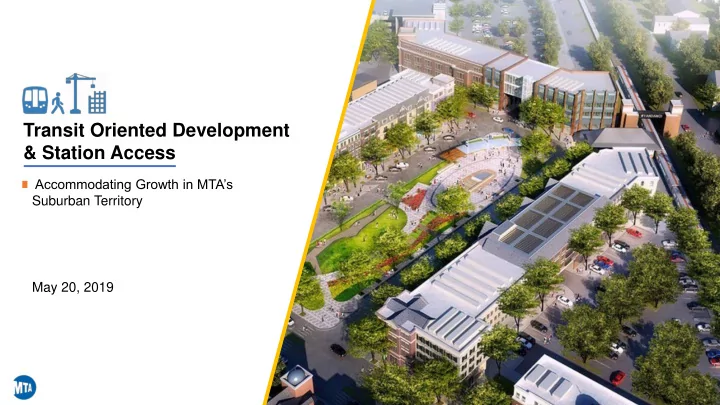
Transit Oriented Development & Station Access Accommodating Growth in MTAs Suburban Territory May 20, 2019 TOD: Supports Transit Use, Creates Housing and Property Value Transit-Oriented Development walkable, mixed-use development


slide-1
SLIDE 1

Accommodating Growth in MTA’s Suburban Territory May 20, 2019

Transit Oriented Development & Station Access

slide-2
SLIDE 2

2

Transit-Oriented Development – walkable, mixed-use development near MTA stations - will be the best means to accommodate future suburban growth. It does this in a sustainable fashion:

  • Increases transit use
  • Accommodates growth, minimizes sprawl
  • Creates real estate value
  • Benefits local communities
  • Reduces traffic on local streets
  • Meets required housing needs
  • Increases tax base
  • Improves station-area neighborhoods

TOD: Supports Transit Use, Creates Housing and Property Value

Rendering: Mineola downtown development

slide-3
SLIDE 3

Current Land Use Near Stations Emphasizes Parking

More than half of suburban commuters drive to station and park

0% 10% 20% 30% 40% 50% 60% Drove Alone Carpooled Walking Drop-Off Connecting Services

Parking Alternative Access

Drove Alone Carpool Walking Drop-off Connecting Service

MNR LIRR

50%

Current* AM Peak Access Modes

  • From 2017/2018 MNR Origin and Destination study and 2014 LIRR Origin

and Destination Study

3

slide-4
SLIDE 4

4

More Sprawl Creates New Parking Demand

Multifamily units

built, in construction, or proposed within ½ mile of MTA suburban stations since 2016 5,000 10,000 15,000 20,000 25,000 30,000 35,000

Total Units TOD Units

(53% of Total Units)

63% of all MNR units

are TOD units

26% of all LIRR units

are TOD units

  • Multi-family housing is now the

primary form of suburban housing development

  • Despite an increasing desire to live

near stations, not enough TOD housing is constructed

  • Risk of “high-density sprawl” which

creates new demand for station parking

MNR LIRR

slide-5
SLIDE 5

5

Most Commuter Parking is Municipally Controlled

10,000 20,000 30,000 40,000 50,000 60,000

Private MTA Municipal

Parking Spaces

The majority of lots are municipally controlled. MNR LIRR

slide-6
SLIDE 6

MTA TOD Opportunities are Limited

Middletown/ Town of Wallkill Beacon Port Chester, NY Mount Vernon East

Nanuet

Poughkeepsie Harriman New Hyde Park Port Jefferson Ronkonkoma Babylon Westbury

slide-7
SLIDE 7

7

MTA TOD at Harrison Station

  • Harrison Station development will create

apartments, retail shops and new commuter parking

  • 143 new apartments with residents who

don’t need dedicated station parking

  • Land value will finance additional

commuter parking

  • The station area will be improved with

retail shops, public space and station drop-

  • ff areas

Harrison Project: 143 new apartments, increase parking capacity, upgrade pedestrian environment

slide-8
SLIDE 8

Residential with mix of incomes Drop off area in front of station Public open space is focal point Retail street New Station Building with retail amenities Garage “Wrapped” with apartments

This is what TOD can look like

Parkers walk past retail

Town of Babylon replaced surface parking lots at Wyandanch station

8

slide-9
SLIDE 9

Wyandanch/Double Track Ribbon Cutting

slide-10
SLIDE 10

Encourage TOD at stations where MTA does not own land, promote joint development of parking and other uses and facilitate alternative modes of station access. Mineola: Mineola has advanced several large, multifamily developments in close proximity to Mineola Station. Farmingdale: Farmingdale has encouraged a large-scale redevelopment of the area around Farmingdale Station to facilitate a more walkable downtown. Village of Freeport: LIRR and Freeport will relocate commuter parking for a 250 unit TOD with 63 units of dedicated senior housing Nanuet (Town of Clarkstown): Metro-North actively participated in the Town’s TOD Plan for Nanuet station and continues to coordinate with the Town as they work towards reviewing impacts of their Draft TOD zoning Port Chester : The Village supports development near the station and has facilitated discussions concerning access improvements with Metro-North and developers

140 Old Country Rd, Mineola, a 275-unit development near station.

Regional TOD Leadership

10

slide-11
SLIDE 11

11

  • Physical and customer-related station area

improvements should encourage drop off and connecting services

“First/Last Mile” Initiatives Should Complement TOD

  • Counties and municipalities can encourage

first/last-mile solutions:

  • Ingress/egress Improvements
  • Kiss & Ride
  • Pedestrian enhancements
  • Mobility-as-a-Service
  • Enhanced bus/shuttle services
  • NYMTC grant to create toolkit; identify

local pilot project communities

slide-12
SLIDE 12

Key Takeaways

  • Park & Ride dominates today, but there are limitations and costs to continuing

this model and the reliance on parking lots constrains growth.

  • Development adjacent to stations accommodates regional smart growth and

generates local and MTA benefits

  • We need to partner with local governments to advance their land use policies
  • In working with local communities we need to encourage station access

improvements and a variety of first mile-last mile approaches