state. o Two of these homes are focused on moving people out of the - - PDF document

state
SMART_READER_LITE
LIVE PREVIEW

state. o Two of these homes are focused on moving people out of the - - PDF document

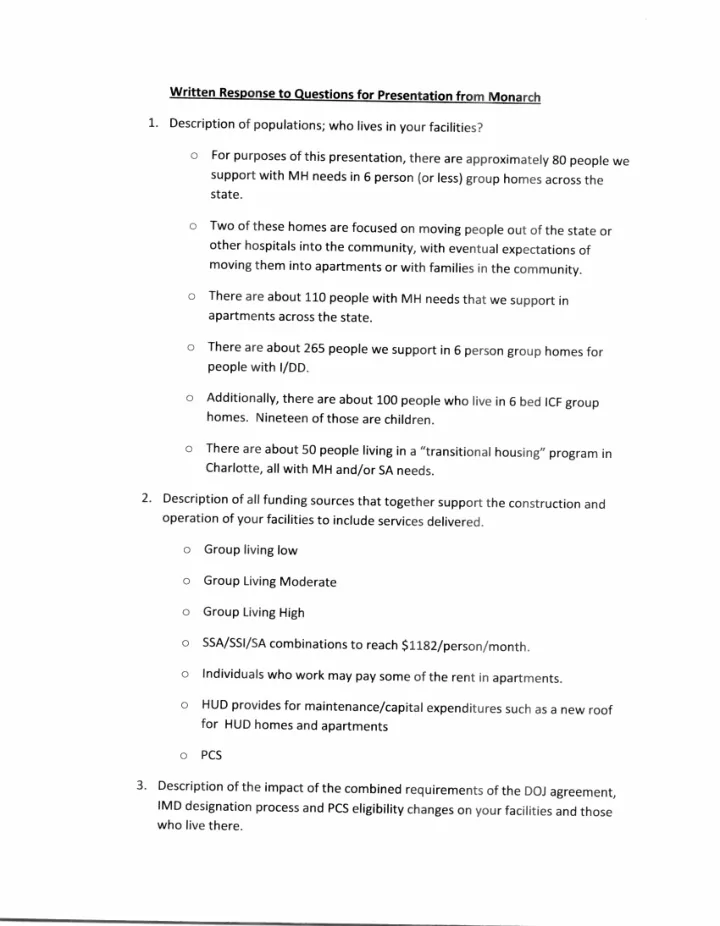
Written Response to Questions for Presentation from Monarch 1. Description of populations; who lives in your facilities? o For purposes of this presentation, there are approximately 80 people we support with MH needs in 6 person (or less) group


slide-1
SLIDE 1

Written Response to Questions for Presentation from Monarch

  • 1. Description of populations; who lives in your facilities?
  • For purposes of this presentation, there are approximately 80 people we

support with MH needs in 6 person (or less) group homes across the state.

  • Two of these homes are focused on moving people out of the state or
  • ther hospitals into the community, with eventual expectations of

moving them into apartments or with families in the community.

  • There are about 110 people with MH needs that we support in

apartments across the state.

  • There are about 265 people we support in 6 person group homes for

people with I/DD.

  • Additionally, there are about 100 people who live in 6 bed ICF group
  • homes. Nineteen of those are children.
  • There are about 50 people living in a "transitional housing" program in

Charlotte, all with MH and/or SA needs.

  • 2. Description of all funding sources that together support the construction and
  • peration of your facilities to include services delivered.
  • Group living low
  • Group Living Moderate
  • Group Living High
  • SSA/SSI/SA combinations to reach $1182/person/month.
  • Individuals who work may pay some of the rent in apartments.
  • HUD provides for maintenance/capital expenditures such as a new roof

for HUD homes and apartments

  • PCS
  • 3. Description of the impact of the combined requirements of the DOJ agreement,

IMD designation process and PCS eligibility changes on your facilities and those who live there.

slide-2
SLIDE 2
  • People who live in MH homes will all likely lose their Medicaid. This may

possibly result in a loss of SSI/SSA funds. They will also lose their PCS. They will be unable to pay for any doctor visits or medications, and we will not have the money either. Homes will be unable to provide housing, food, and supervision. Homes will close.

  • Many people with I/DD will lose their PCS. This means that many will not

have sufficient funds to access the level of staffing that they need, and may need to live with elderly parents or become institutionalized.

  • 96 people who currently have jobs performing personal care will be laid
  • ff.
  • Closing all MH group homes would result in 102 more staff being laid off.
  • ACTT services alone for this group of people would cost $625,000 before

housing or other costs.

  • HUD homes will be significantly affected: the subsidy averages 200 per

month for as long as the house is for people with disabilities. Of the DD HUD homes, 179 of the older properties are under one bond issue...meaning all are connected so what happens in one home will affect the rest. If the vacancy rates go too high, bond holders won't' be able to be paid, and all properties are will be in jeopardy regardless of the fiscal stability of the provider. For MH properties there are 6 separate groupings that were refinanced. This means that there are about 60- 70 units each all dependent on each other in the same way as the DD bond issue.

  • People with Mental Illness will lose the jobs and other community

connections that have been built, which will set back recovery. This may result in setbacks that may end in hospitalization, jail, or homelessness, putting additional burdens on those systems. They will also be eligible for food stamps and other low income programs that they are not eligible for living in group homes.

  • 4. From the facility representative perspective, a description of possible solutions

for the people who reside in the facilities and for the industry See additional handout.

slide-3
SLIDE 3

RECOMMENDATIONS

Issue: For thousands of North Carolina Citizens with Intellectual and developmental disabilities as well as people with mental illness the Medicaid State plan service Personal Care [PCS] has provided supplemental funding for housing supports in small licensed group homes. This service supplements State County Special Assistance [SA] and any other state or federal funding that may be available. When the General Assembly changed the standard to receive PCS to require three deficits in activities of daily living [adl's] for both in-home and facility based services, to achieve comparability, it was apparent that most individuals living in licensed group homes will no longer qualify. This change could reduce a group homes budget by up to 25% creating significant budget shortfalls for an already struggling community based option. Not only does this reduction affect the provider's ability to provide basic support services, in many cases it could lead to an inability to meet the debt obligations of the group homes. Many of these homes were financed using HUD funding streams and a significant number are tied together through HUD approved refinancing methods. If vacancy rates rise due to lack of support services well over 250 properties could be at risk of failing even if the provider is still able to provide the direct services.

Recommendations:

For most people living in these types of homes PCS was most likely not the service most

  • needed. Individuals living in these settings most often need support services to allow

them to live successfully in communities. People with IDD are most likely to require habilitative supports and people with mental illness require recovery based support services. For both populations there are Medicaid options that if designed correctly could support people in these settings and other community based options that should not increase the state funds needed to provide these supports. Unfortunately designing these service definitions and submitting for approval of CMS could not be accomplished by the December 31 end date of the current PCS definition.

With this in mind the following course of action is recommended.

1] Extend the state funds available to people living in Adult Care Homes established in the 2012-13 budget to people with IDD and Mental Illness living in licensed group

  • homes. The individuals with disabilities living in these homes require support to live in
  • communities. They most often will have more significant disabilities than the individuals

in adult care homes and deserve the same protection provided by the funds appropriated for adult care home residents.

slide-4
SLIDE 4

2] For people with IDD - Immediately begin the work of creating a specific 1915i option for services[s] that would support individuals living in community settings both licensed and non licensed. The 1915i option is a near perfect fit for this type of service. Not only can it provide the funding to offset the loss of PCS, but it could be designed to offset the state services dollars that are used in group homes and provide another meaningful Medicaid service for people living in other community settings. The match money for these services could come from the already appropriated community based state funds used in the IPRS system. Preliminary estimates by The Arc indicate that a carefully crafted 1915i option could support individuals in these homes and make a significant dent in the waiting list without any additional appropriation. To avoid a large influx of people that would be very costly, the "wood work effect" could be managed by delineating the severity of the disability, to ensure that this option could likely be almost cost neutral. 3] For people with Mental Illness —Although it is possible that the same type of 1915i

  • ption services may make sense for people with Mental Illness, it may be more difficult

to craft services definitions that assure cost neutrality. This option should be explored immediately, but a better option may be as follows: At the same time the state should review the possibility of creating a recovery based support service under Medicaid that could be used in non licensed community settings as well as licensed settings. Since Mental Health services are recovery based such service may be able to be created without the use of a 1915i. In both cases 1915i or state plan service funds already used for community services for people with mental illness could be used for match. This recovery based support service should consider the use of peer supports along with other staff Use of peer supports is a nationally recognized evidence based practice, used effectively (and cost effectively) in other states. These recommendations are straight forward solutions to what will become a significant crisis if we do not act. There may be other options but these are suggested because they have the potential to solve the problem in the short term as well as create a low cost solution for the long term that is consistent with evidence based and best practice. If we are able to follow this path we not only stabilize the licensed community based options but create good options for individuals who choose to live in less restrictive settings.

slide-5
SLIDE 5

The Consequences with a Human Face Following are some short vignettes of people. I have changed all names/initials to protect confidentiality. However, the lives these people have built are all a result of group home or transitional housing programs, and would not have happened if those programs were not available.

1.

Since we have been operating homes that move people out of the hospitals after stays of many years, many people have transitioned to less restrictive environments (on their own, group living low, back with family) Loss of this support will make it more difficult for people who have been institutionalized for a long time to re-enter the community.

2.

With stable housing and staff support, people obtain their GEDs, attend college, go to the local PSR, volunteer (Over 12,500 hours last year), access the local gym, hold jobs such as data entry clerk, radio announcer, truck driver, secretary, musician etc., as mental illness is no respecter of educational level or socioeconomic background. These community connections and natural supports will be lost, making the cost of serving people higher.

3.

We have had a number of people reunite with their families as a result of being in recovery and staff working on these connections. Many of the people we support have been rejected by families. We have found that once into recovery, we have been able to support people in rebuilding those relationships which adds natural supports to their life. This in turn often leads to better recovery, and opportunities to leave the residential component of the service system entirely.

4.

  • G. currently resides in his own apartment. He was diagnosed with a mental illness

in 2002, and became homeless at that time. G has been hospitalized multiple times at several hospitals, always returning to the streets. In 2011, he was able to link with Monarch's Transitional Housing Program. After working through the program, he was able to comply with his prescribed medication, maintained attending necessary physician appointments, and demonstrated both independent living skills and the capacity to build social supports. G was able to move into low income

  • housing. G continues his progress and is now a deacon in his church and maintains

a job. Without the ability to receive supports, people will continue to use higher cost services. G is on his way out of our systems, going from a tax user to a tax payer.

5.

K lives at New Foundations (Group Living Moderate). When he moved in he was able to perform most ADCs but was not able to manage his medications. With support of staff he has learned to self-medicate and perform all activities of daily living and will soon be transitioning to his own apartment. Although other options were attempted, the group home environment was the option that supported him to become independent.

6.

J lived with family. He was being exploited by his brother with whom he shared the

  • apartment. His brother took all of his SSI check, but put all of his own bills in J's
slide-6
SLIDE 6
  • name. He moved into a group home is thriving. He has access to his money, is given

choices, who to visit, when to visit, etc. He is gaining more independence in his life. He is working to be able to go back into an apartment with the skills to manage his money on his own, and wants a job.

7.

L was living in an institution for a long time. Upon being discharged to a group home which is closer to family, she has been able to improve her relationships with

  • family. Her mother now sees her weekly. She has developed a relationship with her
  • daughter. She even babysits her grandchildren on occasion. She is mending the

relationship with her siblings. The hope is that with natural supports, L will be able to be independent in the community. However, she needed the encouragement of her housemates to reach out to family. Family needed the support of staff.

8.

M, has mending relationships with family. He now will go on vacation with them. The family is also now educated on his diagnosis and symptoms so they can support him, rather than exacerbating his illness.

9.

We opened a new group home on on 8-28-12. Since opening, we have admitted 3 individuals from Central Regional Hospital. We are continuing to screen and tour. Central Regional is currently full, and people are waiting for many days to get in.

  • 10. R lived in a group home for several years. He worked to become independent and

became employed through the assistance of Vocational Rehab. He could independently manage his medication and personal care which was a great sign that he was in a position to move to a more independent level of care. He moved into an apartment, currently works part time and independently schedules his appointments and transportation. He works on goals of improving his ability to manage his finances.

  • 11. At TTH residents participate in many areas to assist with their transition back into

the community. Some residents attend programming onsite and offsite. Onsite residents attend classes held by staff and peers which range from budgeting, relapse prevention and coping skills. Off-site classes are attended at Meck Promise and also at Central Piedmont Community College. There are success stories on a daily basis.

  • 12. S was homeless prior to being admitted into Transitional Housing. After being there

for three months S enrolled into a Charlotte culinary school from which he graduated and is currently working as a cook at the culinary school.

  • 13. T was incarcerated prior to being admitted to Monarch residential services and

within two months found and has maintained a position as a flagger for the city of

Q.

  • 14. V was homeless for 11 years before residing with Monarch. She then became a

representative for Speak Up magazine. V has several magazine stands throughout the city and has been written about in an article with the magazine.

slide-7
SLIDE 7

15.

Many people attend PSRs, SACOT, Meck Promise classes, and also attend NA and AA meetings. Due to support of staff and consistent transportation assistance they have been able to regularly attend AA/NA meetings, and are now being sponsors or leading groups themselves, as they have made progress in their treatment and remained sober.

  • 16. The residents living in CC have utilized each other as supports and worked together

to accomplish goals such as volunteer together, share resources, and develop common goals to be able to be more integrated into the community, such as working at a community garden. By developing these relationships with others in a safe environment, they are now able to work with others in the community.

  • 17. Three of the people supported in group homes by Monarch have published books

sold on Amazon.com , and are earning royalties with every book sold.

  • 18. D had lost her children due to her mental illness. She was not allowed to see them
  • r talk to them. By residing in a group home, she was eventually able to obtain an

apartment, and develop a relationship with her children. Now that they are older, they are living with her again, no longer being supported financially through the DSS system.

  • 19. F was institutionalized for many years. The staff in the institution tried repeatedly

to move him into the community into an apartment, and he failed every time. He has moved into a Monarch group home, and is finally experiencing success. He soon plans to move to his own apartment.

  • 20. H is my personal favorite. She was hospitalized for 15 years prior to moving into a

group home. She was totally estranged from her family. Her dream was to spend time with her grandchildren, but her daughters flatly refused. Three years later, H lives in the community, babysits her grandchildren to so that her daughters can work, and has totally re-established relationships with her children.