Stark Law Amendments Navigating New Exceptions and Clarifications to - - PowerPoint PPT Presentation

stark law amendments
SMART_READER_LITE
LIVE PREVIEW

Stark Law Amendments Navigating New Exceptions and Clarifications to - - PowerPoint PPT Presentation

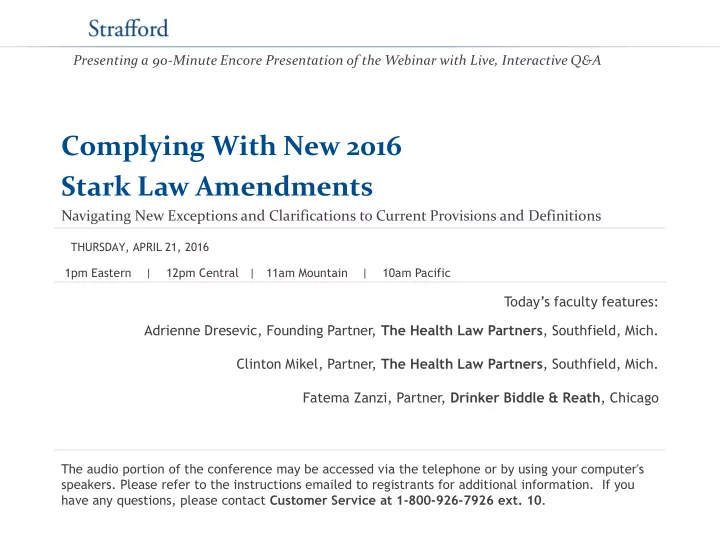
Presenting a 90-Minute Encore Presentation of the Webinar with Live, Interactive Q&A Complying With New 2016 Stark Law Amendments Navigating New Exceptions and Clarifications to Current Provisions and Definitions THURSDAY, APRIL 21, 2016


slide-1
SLIDE 1

The audio portion of the conference may be accessed via the telephone or by using your computer's

  • speakers. Please refer to the instructions emailed to registrants for additional information. If you

have any questions, please contact Customer Service at 1-800-926-7926 ext. 10.

Complying With New 2016 Stark Law Amendments

Navigating New Exceptions and Clarifications to Current Provisions and Definitions

Today’s faculty features:

1pm Eastern | 12pm Central | 11am Mountain | 10am Pacific THURSDAY, APRIL 21, 2016

Adrienne Dresevic, Founding Partner, The Health Law Partners, Southfield, Mich. Clinton Mikel, Partner, The Health Law Partners, Southfield, Mich. Fatema Zanzi, Partner, Drinker Biddle & Reath, Chicago Presenting a 90-Minute Encore Presentation of the Webinar with Live, Interactive Q&A

slide-2
SLIDE 2

Tips for Optimal Quality

Sound Quality If you are listening via your computer speakers, please note that the quality

  • f your sound will vary depending on the speed and quality of your internet

connection. If the sound quality is not satisfactory, you may listen via the phone: dial 1-866-927-5568 and enter your PIN when prompted. Otherwise, please send us a chat or e-mail sound@straffordpub.com immediately so we can address the problem. If you dialed in and have any difficulties during the call, press *0 for assistance. Viewing Quality To maximize your screen, press the F11 key on your keyboard. To exit full screen, press the F11 key again.

FOR LIVE EVENT ONLY

slide-3
SLIDE 3

Continuing Education Credits

In order for us to process your continuing education credit, you must confirm your participation in this webinar by completing and submitting the Attendance Affirmation/Evaluation after the webinar. A link to the Attendance Affirmation/Evaluation will be in the thank you email that you will receive immediately following the program. For additional information about continuing education, call us at 1-800-926-7926

  • ext. 35.

FOR LIVE EVENT ONLY

slide-4
SLIDE 4

Program Materials

If you have not printed the conference materials for this program, please complete the following steps:

  • Click on the ^ symbol next to “Conference Materials” in the middle of the left-

hand column on your screen.

  • Click on the tab labeled “Handouts” that appears, and there you will see a

PDF of the slides for today's program.

  • Double click on the PDF and a separate page will open.
  • Print the slides by clicking on the printer icon.

FOR LIVE EVENT ONLY

slide-5
SLIDE 5

Complying with Stark Law and the New Amendments: Navigating New Exceptions, Clarifications to Current Provisions and Definitions and More ADRIENNE DRESEVIC, CLINTON MIKEL & FATEMA ZANZI APRIL 21, 2016 1:00 P.M. EASTERN

slide-6
SLIDE 6

ABA STARK RESOURCES

  • Stark Redline – Final PFS CY 2016 Physician Self-Referral

(Stark) Changes:

– http://ow.ly/UfjCY

  • Stark Toolkit:

– http://ow.ly/UNXQu

  • eSource Article on Proposed Rule:

– http://ow.ly/UfjLL

  • Lengthy December Health Lawyer Article on Proposed/Final

Rule:

– http://ow.ly/XZJ4S

6

slide-7
SLIDE 7

PHYSICIAN SELF-REFERRAL LAW

  • Physician self-referral law (Section 1877 of the Social

Security Act)

– Unless an exception applies, the physician self-referral law prohibits:

  • a physician from making referrals for designated health

services (DHS) payable by Medicare to an entity with which the physician (or an immediate family member) has a financial relationship, and

  • the entity from filing claims with Medicare (or billing another

individual, entity, or third party payer) for those referred services

7

slide-8
SLIDE 8

CY 2016 MEDICARE PHYSICIAN FEE SCHEDULE FINAL RULE

80 Fed. Reg. 70886 Published on Nov. 16, 2015 Comments closed on December 29, 2015 https://www.federalregister.gov/articles/2015/11/16/2015- 28005/medicare-program-revisions-to-payment-policies- under-the-physician-fee-schedule-and-other-revisions

8

slide-9
SLIDE 9

CY 2016 MEDICARE PHYSICIAN FEE SCHEDULE FINAL RULE

  • Clarifications:

– Existing policy – Additional explanation where stakeholders would benefit from clarification

  • New exceptions:

– Assistance to a physician to compensate a non-physician practitioner – Timeshare arrangements

  • Revisions to existing definitions, exceptions, and other rules:

– Signature requirements – Holdover arrangements – Renewing arrangements that qualify for the exception for fair market value compensation

9

slide-10
SLIDE 10

PHYSICIAN SELF-REFERRAL LAW

  • Purpose of updating the physician self-referral regulations

in the Medicare Physician Fee Schedule for CY 2016 (the “Final Rule”):

– Accommodate reform to care delivery and payment systems – Reduce burden created by prior regulations – Facilitate compliance of the regulations

10

slide-11
SLIDE 11

CLARIFICATIONS

11

slide-12
SLIDE 12

WRITING REQUIREMENT

  • Many exceptions for compensation arrangements require

the arrangement be set out in writing. This includes the following exceptions:

– Rental of office space and equipment (§§ 411.357(a) & (b)) – Personal service arrangements (§ 411.357(d)) – Fair market value compensation (§ 411.357(l))

  • Current regulations: interchangeably use the term

“arrangement” and “agreement” in connection with the writing requirement

  • Final Rule: removes the term “agreement” from most

exceptions and clarifies the requirement that an arrangement be set out in writing

12

slide-13
SLIDE 13

WRITING REQUIREMENT

  • Single “formal contract” not required:

– A collection of documents may satisfy the writing requirement – A collection of documents may include “contemporaneous documents evidencing the course of conduct between the parties” (80 FR 71315)

  • A signed written contract is the best practice and the best

way to ensure compliance

  • Standard: “[T]he relevant inquiry is whether the available

contemporaneous documents (that is, documents that are contemporaneous with the arrangement) would permit a reasonable person to verify compliance with the applicable exception at the time that a referral is made.” (80 FR 71315)

13

slide-14
SLIDE 14

WRITING REQUIREMENT

  • Documents that may be considered as part of a collection of

documents when determining compliance with the writing requirement can include the following:

– Meeting minutes – Written authorization for payment for specific services – Written communication between the parties, including hard copy and electronic communications – Fee schedules for specified services – Check requests or invoices identifying items or services provided, relevant dates, and/or rate of compensation – Time sheets documenting services performed – Schedules or similar documents providing dates of services to be provided – Accounts payable or receivable records documenting the date and amount of payment and the reason for payment – Checks issued for items, services, or rent identifying reason for the payments

14

slide-15
SLIDE 15

WRITING REQUIREMENT

  • Relationship of documents in a collection:

– Documents in a collection must clearly relate to one another – Documents in a collection must clearly evidence the same arrangement between the parties

  • Signature requirement for a collection of documents:

– A signature is required on a contemporaneous writing that documents the arrangement – The signed writing must clearly relate to the other documents in the collection and to the underlying arrangement

15

slide-16
SLIDE 16

WRITING REQUIREMENT

  • Timing issues:

– Evidence of the arrangement: Contemporaneous documents evidencing a course of conduct between the parties are frequently generated after the arrangement has begun

  • Referrals are not protected by documents that have been created after

the referral was made (80 FR 71317)

  • Documents generated over the course of the arrangement can be used

to demonstrate compliance for referrals that have been made after the documents have been generated

– Set in advance issue: If documents setting forth compensation are created after the arrangement began, a party cannot meet the set in advance requirement from the start of the arrangement.

  • However, “depending on the facts and circumstances, if parties create

contemporaneous documents during the course of the arrangement, and the documents set the compensation out in writing, then parties may be able to satisfy the set in advance requirement for referrals made after the contemporaneous documents are created.” (80 FR 71317)

16

slide-17
SLIDE 17

WRITING REQUIREMENT

17

TIME Arrangement established First contemporaneous document produced Additional contemporaneous documents and records produced

Documents in chronological order: earliest on top, latest on bottom

ISSUE: At what point does the arrangement satisfy the requirements of an applicable exception?

slide-18
SLIDE 18

WRITING REQUIREMENT

  • Relation to State law

– Parties may look to state law to assist in the analysis of whether an arrangement is in writing and signed by the parties, but state law is not dispositive in determining compliance with the writing and signature requirements of the physician self-referral law

  • Clarification of existing policy

– Guidance regarding the writing requirement clarifies existing policy

  • Impact on submissions under the Self Referral Disclosure

Protocol (“SRDP”)

– Parties considering submissions regarding conduct that predates the proposed rule may rely on guidance provided in the proposed rule to determine compliance with the writing requirement – Parties that have submitted disclosures, but have not yet settled the same with CMS, can rely on guidance in the proposed rule regarding the writing requirement – parties may amend or withdraw previously submitted disclosures as appropriate

18

slide-19
SLIDE 19

1-YEAR TERM REQUIREMENT

  • Current regulations: Exceptions exist for:

– the rental of office space, – the rental of equipment, and – personal service arrangements with a term of at least 1 year.

  • Final rule clarification:

– Formal “term” provision in a contract is not required to satisfy the requirements – Arrangements that have, as a matter of fact, a duration of at least 1 year satisfy the requirements

  • Written documentation establishing the term or duration:

– Contemporaneous documents establishing that the arrangement lasted for at least 1 year, or – If the arrangement is terminated during the 1st year, a party must demonstrate that both parties did not enter into a new arrangement for the same space, equipment, or services during the 1st year of the original arrangement

19

slide-20
SLIDE 20

REMUNERATION AND “SPLIT BILL” ARRANGEMENTS

  • “Split bill” arrangements:

– DHS entity

  • Provides examination rooms, nursing personnel, and supplies, and

bills the appropriate payor for these resources and services provided to the patient.

– Physician

  • Provides professional services and only bills the appropriate payor

for professional fees.

– This arrangement does not involve “remuneration between the parties, because the physician and the DHS entity do not provide items, services, or other benefits to one another.” (80 FR 71321)

  • This statement in the preamble was not codified in the regulations
  • f this final rule.

20

slide-21
SLIDE 21

NEW EXCEPTIONS

21

slide-22
SLIDE 22

NEW EXCEPTION: ASSISTANCE TO COMPENSATE A NON- PHYSICIAN PRACTITIONER

  • New §411.357(x) establishes an exception for

remuneration from a hospital to a physician to assist the physician in compensating a non-physician practitioner (NPP) who will provide services to patients of the physician’s practice:

– The exception applies to federally qualified health centers (FQHCs) and rural health clinics (RHCs) in the same way that it applies to hospitals

  • Remuneration provided by a hospital to a physician
  • rganization is considered remuneration being provided to

each physician who stands in the shoes of the physician

  • rganization

– Thus, the exception is structured to protect remuneration provided to a physician.

22

slide-23
SLIDE 23

NPPs: REQUIREMENTS FOR THE NPP

  • For purposes of the exception, NPP includes the

following— – Physician assistant – Nurse practitioner – Clinical nurse specialist – Certified nurse midwife – Clinical social worker – Clinical psychologist

23

slide-24
SLIDE 24

NPPs: REQUIREMENTS FOR THE NPP

  • Substantially all (at least 75%) of the services furnished by

the NPP to patients of the physician’s practice must be:

– Primary care services, or – Mental health care services

  • There should not be an unreasonable restriction on the

NPP’s ability to provide patient care services in the geographic area served by the hospital, FQHC or RHC

24

slide-25
SLIDE 25

NPPs: THE ARRANGEMENT BETWEEN THE NPP AND THE PHYSICIAN (OR PHYSICIAN ORGANIZATION)

  • There must be a compensation arrangement:

– An employment, contractual, or other arrangement under which remuneration is paid to the NPP by the physician (or physician organization in whose shoes the physician stands under §411.354(c)) – The exception does not allow a hospital to provide remuneration to assist in conferring an ownership or investment interest in the physician’s practice

  • NPP can work full-time or part-time
  • This exception is not available where there is a

compensation arrangement between a physician (or physician organization) and a staffing company or other entity for the services of the NPP

– Arrangement must be directly between the physician (or physician organization) and the independent contractor NPP (80 FR 71305)

25

slide-26
SLIDE 26

NPPs: RELOCATION REQUIREMENTS

  • The NPP may not, within 1 year of the commencement of

the compensation arrangement with the physician (or the physician organization in whose shoes the physician stands under §411.354(c)):

– Have practiced in the hospital’s GSA, or – Have been employed or otherwise engaged to provide patient care services by a physician or physician organization that has a medical practice site located in the hospital’s GSA

  • This second prong applies regardless of whether the NPP

furnished services at the medical practice site located in the hospital’s GSA

26

slide-27
SLIDE 27

NPPs: COMPENSATION TO NPP

  • Compensation may not exceed fair market value for the

patient care services the NPP provides to patients

  • Physician may provide remuneration to the NPP other than,
  • r in addition to, compensation, signing bonus, and benefits
  • A hospital may not provide assistance for anything other

than compensation, signing bonus, and benefits

  • “Benefits” only includes health insurance, paid leave, and
  • ther routine non-cash benefits offered to similarly situated

employees or contractors of the physician’s practice (80 FR 71302)

– Hospital may assist the physician with providing relocation assistance to the NPP if the relocation assistance is included in the calculation of the NPP’s “compensation” (80 FR 71309)

  • Total compensation (including any relocation assistance) must not

exceed fair market value

27

slide-28
SLIDE 28

NPPs: THE ARRANGEMENT BETWEEN THE HOSPITAL AND THE PHYSICIAN (OR PHYSICIAN ORGANIZATION)

  • The arrangement must be in writing and signed by the

hospital, physician (or physician organization), and the NPP

  • The arrangement may not be conditioned on referrals to the

hospital from the physician or NPP

  • The arrangement may not violate the anti-kickback statute

(section 1128B(b) of the Social Security Act) or any Federal

  • r State law or regulation governing billing or claims

submission

  • The following must be maintained for at least 6 years and

made available to the Secretary upon request—

– The actual amount of remuneration paid to the physician (or physician organization) by the hospital – The actual amount of remuneration paid to the NPP by the physician (or physician organization)

28

slide-29
SLIDE 29

NPPs: THE ARRANGEMENT BETWEEN THE HOSPITAL AND THE PHYSICIAN (OR PHYSICIAN ORGANIZATION)

  • Frequency limitation

– May be used by a hospital once every 3 years for the same referring physician

  • Applying the “stand in the shoes” provisions limits the use
  • f the exception to once every 3 years with respect to the

same physician organization if the physician organization has more than one nontitular owner (80 FR 71333)

  • Exception: If the NPP is replacing a NPP who left the

physician’s practice within 1 year of the commencement of his or her employment or contractual arrangement the frequency limitation is waived

– The 2-year limit on assistance continues to apply and is measured from the commencement of the original NPP’s employment or contractual arrangement (80 FR 71310)

29

slide-30
SLIDE 30

NPPs: REMUNERATION FROM THE HOSPITAL TO THE PHYSICIAN (OR PHYSICIAN ORGANIZATION)

  • Remuneration from the hospital may not exceed 50% of the

actual compensation, signing bonus, and benefits paid to the NPP by the physician

  • Limited to the first 2 consecutive calendar years of the

employment or independent contractor arrangement between the NPP and the physician (or the physician

  • rganization in whose shoes the physician stands under

§411.354(c))

  • Remuneration may not be determined in a manner that

directly or indirectly takes into account the volume or value

  • f any actual or potential referrals by:

– The NPP – The physician – Any other NPP or physician in the physician’s practice

  • Remuneration may not take into account any business

generated between the parties

30

slide-31
SLIDE 31

NPPs: SPECIAL DEFINITIONS

  • Referral: a request by a NPP that includes the provision of any

DHS for which payment may be made under Medicare, the establishment of any plan of care by a NPP that includes the provision of such DHS, or the certifying or recertifying of the need for such DHS, but excludes DHS personally performed by the NPP

  • Geographic area served by the hospital, FQHC, or RHC: the

area composed of the lowest number of contiguous or noncontiguous zip codes from which the FQHC or RHC draws at least 90% of its patients

– The same meaning set forth in the exception for physician recruitment

  • Compensation arrangement between a physician (or the

physician organization in whose shoes the physician stands under §411.354(c)) and a NPP: an employment, contractual,

  • r other arrangement under which remuneration passes

(directly) between the parties, not including a NPP’s ownership

  • r investment interest in a physician organization

31

slide-32
SLIDE 32

NEW EXCEPTION: TIMESHARE ARRANGEMENTS

  • New §411.357(y) establishes an exception for timeshare

arrangements that include the use of premises, equipment, personnel, items, supplies, or services

  • Premises: covers “use” arrangements only

– Does not apply to traditional office space leases – The arrangement may not convey a possessory leasehold interest in the office space being used(§411.357(y)(9))

  • Equipment excluded from the exception:

– Advanced imaging equipment – Radiation therapy equipment – Clinical or pathology laboratory equipment

  • Exception: equipment used to perform CLIA-waived

laboratory tests

32

slide-33
SLIDE 33

TIMESHARES: THE ARRANGEMENT BETWEEN THE PARTIES

  • The arrangement must be in writing and signed by the parties

– Parties must be a physician (or the physician organization in whose shoes the physician stands under §411.354(c)) and—

  • A hospital or
  • A physician organization of which the physician is not an
  • wner, employee, or contractor

– Either party may be the grantor of permission to use the premises, equipment, personnel, items, supplies, and services

  • The arrangement must specify the premises, equipment,

personnel, items, supplies, and services covered.

  • The arrangement may not be conditioned on the referral of

patients by the physician to the hospital or physician organization that is the other party to the arrangement

  • The arrangement must be commercially reasonable even if no

referrals were made between the parties

  • The arrangement may not violate the anti-kickback statute or any

Federal/State law or regulation covering billing/claims submission

33

slide-34
SLIDE 34

TIMESHARES: THE USE OF THE PREMISES, EQUIPMENT, PERSONNEL, ITEMS, SUPPLIES, AND SERVICES

  • General requirements

– Predominantly for the provision of evaluation and management (E/M) services to patients – Must be used on the same schedule

  • Requirements specific to the use of the equipment

– The equipment must be located in the same building where the E/M services are provided to patients – The equipment may be used to furnish DHS incidental to E/M services and at the same time as the patient’s E/M visit

34

slide-35
SLIDE 35

TIMESHARES: COMPENSATION

  • Compensation must be set in advance
  • Compensation must be consistent with fair market value
  • Compensation must not be determined in a manner that

directly or indirectly takes into account the volume or value

  • f referrals or other business generated between the parties
  • Prohibited compensation arrangements include:

– Percentage based compensation – Per-unit of service fees

  • For example: per-patient or per-use of DHS equipment

rates – Exception: time-based compensation formulas (e.g., hourly rates or ½-day rates)

35

slide-36
SLIDE 36

REVISIONS

36

slide-37
SLIDE 37

TEMPORARY NONCOMPLIANCE WITH SIGNATURE REQUIREMENT (§ 411.353 (G))

  • Final Rule:

– All parties have 90 days to obtain missing signatures, regardless

  • f whether the failure to obtain the signatures was “inadvertent”.

– Temporary noncompliance rule can be used only once every 3 years with respect to the same referring physician.

  • Comments on the signature requirement:

– “[T]he signature of the parties creates a record of the fact that the parties to an arrangement were aware of and assented to the key terms and conditions of the arrangement.” (80 FR 71333) – State law principles do not determine compliance with the signature requirement, but “parties may look to State law and

  • ther bodies of relevant law, including Federal and State law

pertaining to electronic signatures, to inform the analysis of whether a writing is signed for the purposes of the physician self- referral law.” (80 FR 71334, emphasis added) – “[W]hether an arrangement is signed by the parties depends on the facts and circumstances of the arrangement and the writings that document the arrangement.” (80 FR 71334)

37

slide-38
SLIDE 38

STAND IN THE SHOES: SIGNATURE REQUIREMENTS

  • Phase III included provisions whereby all physicians would be

treated as standing in the shoes of their physician

  • rganizations,

– This applies to owners, employees, and independent contractors – Signature requirements in applicable compensation arrangement exceptions (i.e., the writing must be signed by the “parties”) are applied to all physicians in the physician organization – Prohibition on taking into account the volume or value of referrals

  • r other business generated “between the parties” when

determining compensation applies to all physicians in the physician organization

  • FY 2009 IPPS Final Rule amended the “stand in the shoes”

provisions to require that physicians with a nontitular

  • wnership or investment interest stand in the shoes of their

physician organizations

– There was no change to the regulation text applying the signature requirement and volume or value prohibition to all “parties” (i.e., all physicians in the physician organization)

38

slide-39
SLIDE 39

STAND IN THE SHOES: CLARIFYING THE PARTIES

  • CY 2016 PFS final rule limits the signature requirement to

physicians who stand in the shoes of their physician

  • rganization – relieving the burden on the PO
  • There is no change to the existing rule that relevant

referrals and other business generated “between the parties” are referrals and other business that is or was generated between the DHS entity and the physician

  • rganization (including all members, employees, and

independent contractor physicians).

– §411.354(c)(3)(i)

  • Revisions effective January 1, 2016

39

slide-40
SLIDE 40

INDEFINITE HOLDOVER PROVISIONS

  • Final Rule: Indefinite “holdover” arrangements are

permitted under the rental of office space and equipment exceptions (§§ 411.357(a) & (b)) and the personal service arrangements exception (§ 411.357(d)), provided:

– The expired arrangement satisfied all the requirements of the applicable exception when it expired; – The holdover arrangement continues on the same terms and conditions as the immediately preceding arrangement; and – The holdover arrangement continues to satisfy all the requirements of the applicable exception during the holdover.

40

slide-41
SLIDE 41

INDEFINITE HOLDOVER PROVISIONS

  • Fair market value requirement must be met during

the holdover: “[A]s soon as a holdover arrangement ceases to meet all the requirements of an applicable exception, including the fair market value requirement, referrals for DHS by the physician to the entity that is a party to the arrangement are no longer permissible.” (80 FR 71320)

41

slide-42
SLIDE 42

INDEFINITE HOLDOVER PROVISIONS

  • Amendments not permitted during the holdover: “If

parties were permitted to amend the terms and conditions of an arrangement in the course of the holdover, then parties would be able to frequently renegotiate the terms of the arrangement during the holdover in a manner that could take into account the volume or value of referrals.” (80 FR 71320)

42

slide-43
SLIDE 43

INDEFINITE HOLDOVER PROVISIONS

  • Application of Final Rule to current “holdover” arrangements:

– Arrangements in a valid holdover under the current 6- month holdover provisions on January 1, 2016 (effective date of final rule) may qualify for the indefinite holdover

  • Arrangements expiring by their own terms on or after

July 1, 2015 – Expired arrangements that are no longer in a valid holdover under the current 6-month holdover provisions may not make use of the indefinite holdover provisions

  • Arrangements that expired on their own terms prior to

July 1, 2015

43

slide-44
SLIDE 44

INDEFINITE HOLDOVER PROVISIONS

  • Intersection of writing requirement and holdover provisions:

– However, “even without a holdover provision, an arrangement that continued after a contract expired on its

  • wn terms could potentially satisfy the writing requirement
  • f an applicable exception, provided that the parties had

sufficient contemporaneous documentation of the arrangement.” (80 FR 71319)

44

slide-45
SLIDE 45

RENEWALS – EXCEPTION FOR FAIR MARKET VALUE COMPENSATION (§ 411.357 (I))

  • Final Rule: Arrangements with any timeframe may be

renewed any number of times under the exception for fair market value compensation, provided:

– The terms of the arrangement and the compensation for the same items or services are unchanged, and – The arrangement continues to satisfy all the requirements of the exception during the renewal period.

  • Renewal need not be in writing:

– “[N]othing in the exception requires parties to renew the arrangement in writing. However, the parties must have written documentation establishing that the renewed arrangement was on the same terms and conditions as the

  • riginal arrangement.” (80 FR 71320)

45

slide-46
SLIDE 46

PHYSICIAN-OWNED HOSPITALS

  • Preventing Conflicts of Interest: Public Website and Public

Advertising Disclosure Requirement

– Advertising: New §411.362(a) defines “public advertising for the hospital” as any public communication paid for by the hospital that is primarily intended to persuade individuals to seek care at the hospital. – Website: Language that would put a reasonable person on notice that hospital may be physician-owned is deemed a sufficient statement of physician ownership or investment

  • A public website for the hospital does not include:

– Social media websites – Electronic patient payment portals – Electronic patient care portals – Electronic health information exchanges

46

slide-47
SLIDE 47

WEBSITE OR ADVERTISING NONCOMPLIANCE

  • SRDP is the means for reporting overpayments in the event

a physician-owned hospital discovers it failed to satisfy the public website or public advertising disclosure requirements.

  • For noncompliance with the public website disclosure

requirement, the period of noncompliance is the period during which the physician-owned hospital failed to satisfy the requirement, the earliest possible date being September 23, 2011, the date by which a physician-owned hospital had to be in compliance with the public website and advertising disclosure requirements.

  • For noncompliance with the public advertising disclosure

requirement, the period of noncompliance is the duration of the applicable advertisement’s predetermined initial circulation, unless the hospital amends the advertisement to satisfy the requirement at an earlier date.

47

slide-48
SLIDE 48

PHYSICIAN-OWNED HOSPITALS

  • Determining the bona fide investment level

– Goal is to better align the prohibition of §411.362(b)(4)(i) with the statutory definition of “physician owner or investor” in a hospital – Attempted to not unsettle long-standing definitions in the physician self-referral regulations

  • Currently use the term “referring physician” in the general ownership

definitions

  • Solely for the purposes of §411.362 (including for the

purposes of determining the baseline bona fide investment level and the bona fide investment level thereafter), CMS established a definition of ownership or investment interest that applies to all types of owners or investors, regardless of their status as a referring or non-referring physician.

  • The effective date of the revised definition is January 1, 2017.

– Provides time for hospitals to come into compliance with the new policy. – Parties that have considered all physicians in their determination

  • f the ownership level (and not just referring physicians) are in

compliance.

48

slide-49
SLIDE 49

BONA FIDE INVESTMENT LEVELS: § 411.362 (A)

  • A “direct” ownership or investment interest in a hospital exists if the
  • wnership or investment interest in the hospital is held without any

intervening persons or entities between the hospital and the owner or investor.

  • An “indirect” ownership or investment interest in a hospital exists if:

1) between the owner or investor and the hospital there exists an unbroken chain of any number (but no fewer than one) of persons or entities having

  • wnership or investment interests; and,

2) the hospital has actual knowledge of, or acts in reckless disregard or deliberate ignorance of, the fact that the owner or investor has some

  • wnership or investment interest (through any number of intermediary
  • wnership or investment interests) in the hospital.
  • An indirect ownership or investment interest in a hospital exists even

though the hospital does not know, or acts in reckless disregard or deliberate ignorance of, the precise composition of the unbroken chain

  • r the specific terms of the ownership or investment interests that

form the links in the chain.

49

slide-50
SLIDE 50

INCIDENT TO RULES

  • The billing physician or practitioner for “incident to”

services must also be the supervising physician or practitioner.

  • The supervising and billing physician is not required to be

the same physician who has the broader relationship with the patient.

  • To bill Medicare, auxiliary personnel providing incident to

services and supplies must not:

1) Have been excluded from a federal healthcare program; or 2) Have had their enrollment revoked when they provided such services or supplies.

50

slide-51
SLIDE 51

OTHER ISSUES

  • Clarified single “volume or value” standard by using

uniform language throughout the regulations

  • Updated the exception for ownership of publicly traded

securities

  • Clarified “carve out” from definition of remuneration:

– Separately listed the purposes for which items, devices, or supplies must be used solely in order not to be considered remuneration – Clarified that the use of the items, devices, or supplies for more than one of the enumerated purposes is permissible, provided that they are used solely for such purposes

51

slide-52
SLIDE 52

OTHER ISSUES

  • Established definitions for the geographic area served by a

FQHC or RHC

  • Amended definition of locum tenens physician
  • Clarified formula for calculating the maximum retention

payment when based on a written certification

  • Replaced “Web site” with “website” (or at least CMS tried)

52

slide-53
SLIDE 53

THANK YOU

Adrienne Dresevic The Health Law Partners adresevic@thehlp.com Clinton Mikel The Health Law Partners cmikel@thehlp.com Fatema Zanzi Drinker Biddle & Reath fatema.zanzi@dbr.com

53