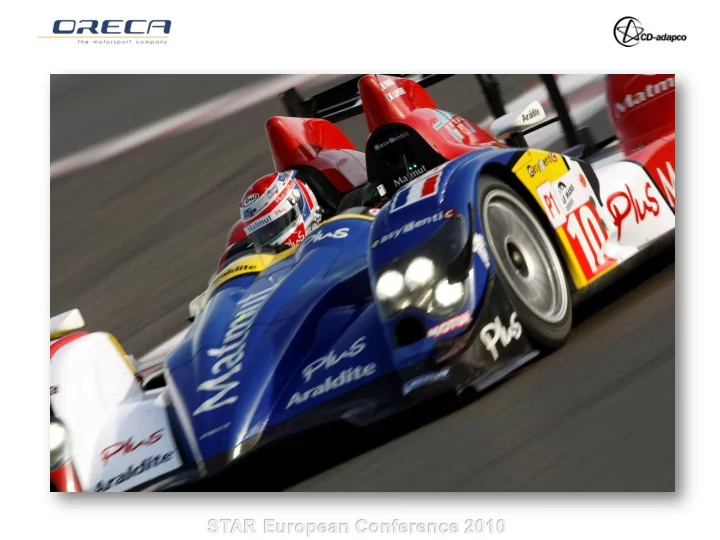
STAR European Conference 2010 AERODYNAMICS DEVELOPMENTS ON A LE - - PowerPoint PPT Presentation
STAR European Conference 2010 AERODYNAMICS DEVELOPMENTS ON A LE MANS PROTOTYPE ORECA 01 LMP1 PRESENTATION 1. ORECA Presentation 2. Why we use CFD? 2009 Aero Development 2010 Aero Development 3. Methodology Correlation
STAR European Conference 2010 AERODYNAMICS DEVELOPMENTS ON A LE MANS PROTOTYPE ORECA 01 LMP1
1. ORECA Presentation 2. Why we use CFD?
- 2009 Aero Development
- 2010 Aero Development
3. Methodology
- Correlation
- Case Studies
- Mesh
- Results
Conclusions
PRESENTATION
ORECA: Since 1972 180 People 35 to 40 Millions Euros / year 4 divisions:
Engine department (Magny-Cours) Marketing + Incentive Race parts + accessories sales Race team + Chassis Engineering
- 1. ORECA
ORECA:
RACE TEAM:
Endurance Racing (LMP1 – 2 cars) Audi R8 GT3 (French GT – 2 cars) Formula Le Mans Other projects (engineering / production)
Engineering:
11 Engineers Aero-group : 6 engineers, 4 working on Star-CCM+
- 1. ORECA
2009 CFD Development
We used CFD for :
- Comprehension of LMP aerodynamics
- Keep the development of aero-package up through the season
We chose Star-CCM+ for :
- Only one interface
- Ratio simplicity / accuracy / cost
- Evolution of the Software through the year
- 2. Why we use CFD?
2009 Aerodynamic Development:
Oreca 01 :
- Adapt to new ACO Aerodynamics rules (reduction of the rear wing dimensions)
- New aero-package for Courage LC70E LMP1
Tests : ~80% Wind tunnel, ~20% CFD
- 320 runs using a 40% scale model in ACE wind-tunnel (Magny-Cours).
- CFD development : 1 engineer (1 Workstation) working on Star-CCM+ / +80 simu.
- 2. Why we use CFD?
2009 CFD Development
History ORECA 01 V1: introduced in 1000 km Spa (May 2009) ORECA 01 V2: introduced in 1000 km Silverstone (Sept. 2009). Developped 100% using CFD. Increasing Efficiency and Downforce
95 97.5 100 102.5 105 107.5 110 112.5 115 2008 car 2008 car + 2009 wing ORECA 01 V1 ORECA 01 V2
Efficiency
- 2. Why we use CFD?
1,5 0,082
- 0,141
- 0,916
- 1
1 2 3 4 5 6 7 Race1 Barcelone Race2 Spa Race3 Algarve Race5 Silverstone
Qualifying performances Le Mans Serie 2009
ORECA 01 Position Aston Position
- 2. Why we use CFD?
2010 Aerodynamic Development:
Oreca 02 :
- New LMP1 car designed to compete for 24H of Le Mans (2011) with Peugeot Engine
Tests : ~20% Wind tunnel, ~80% CFD
- CFD development : 4 engineers on Star-CCM+
- 4 Workstations, 1 Cluster of 128cores / 130 simulations in 1,5 month
Why we use more CFD in 2010?
Ratio Cost / Efficiency Understanding the phenomena and not iterating mechanically Aero development through the year Investment : cluster and SKILL New skills = new business opportunities
- 2. Why we use CFD?
Methodology:
- Correlation
Straight-Line Test with the real Car Lift : calculated with Loadcells on each suspension + Pitot sensor Constant speed Drag : Coast-down. All the values are stored in a PI Data Analysis System:
- 4 Loads
- Aero Speed
- Ride Heights Front and Rear
- Acceleration X, Y, Z
- Ground Velocity
- 3. Methodology
Methodology:
- Case Studies
Straight-Line Half-car with different Ride Heights Yaw / Roll Full car with Yaw, Roll, Steering Angle
- 3. Methodology
Slipstream
- 3. Methodology
DRAG LIFT EFFICIENCY LEADING CAR FOLLOWING CAR BALANCE LEADING CAR FOLLOWING CAR
Front
- Mesh / Solver
Mesh : Wrapper + Trimmer + Prism Layer From 12M, up to 45M of cells Physics :
- Steady cases
- Unsteady : coming soon...
- Porous Region for Radiators
- Velocity specification on wheels and Floor
- RANS + SST K-Omega
- 3. Methodology
- 3. Methodology
- 3. Methodology
- Results
90% of the post-treatment is automated: Scenes – Starview files Analitic Results : force reports, mass-flow Force and Mass-flow reports automated by Java macros All Results compiled in Excel File
- 3. Methodology
- 3. Methodology
- Results - Starview
- 3. Methodology
- 3. Methodology
- 3. Methodology
- 3. Methodology
- 3. Methodology
- 3. Methodology
- Results – Analytic
By macros, we export analytic results: – Forces on each parts – Mass Flow : brake ducts, radiator – Flow around the underfloor : velocity, pressure, angle – Plots of Coefficient of Pressure : Rear Wing, Front Wing, Undefloor, Diffuser
- 3. Methodology
- 3. Methodology
– Forces on each parts
- 3. Methodology
23% 43% 39% 17%
- 19%
- 1%
0%
- 1%
- 30%
- 20%
- 10%
0% 10% 20% 30% 40% 50% Wing Front Splitter Flat Bottom Diffuser Bodywork Front Wheel Rear Wheel Internal
SCZ
17% 19% 9% 13% 11% 3% 8% 20%
- 30%
- 20%
- 10%
0% 10% 20% 30% 40% 50% Wing Front Splitter Flat Bottom Diffuser Bodywork Front Wheel Rear Wheel Internal
SCX
- 3. Methodology
– Flow around the underfloor : velocity, pressure, angle
- 3. Methodology