STAR CLUSTERS Lecture 3 Kinematic Properties Nora Ltzgendorf (ESA) - - PowerPoint PPT Presentation

star clusters lecture 3 kinematic properties
SMART_READER_LITE
LIVE PREVIEW

STAR CLUSTERS Lecture 3 Kinematic Properties Nora Ltzgendorf (ESA) - - PowerPoint PPT Presentation

STAR CLUSTERS Lecture 3 Kinematic Properties Nora Ltzgendorf (ESA) LECTURE 2 1. Star Formation from gas clouds, fragmentation Initial mass function (IMF): multiple power laws, changes with time 2. Multiple Stellar populations


slide-1
SLIDE 1

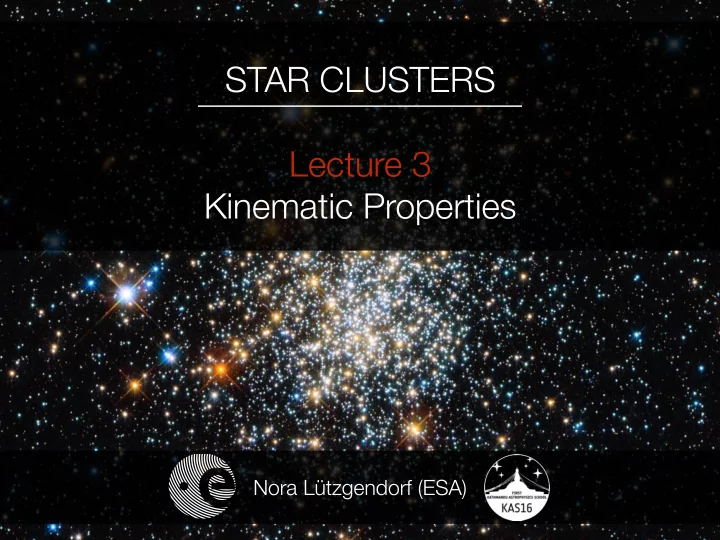
STAR CLUSTERS Lecture 3 Kinematic Properties

Nora Lützgendorf (ESA)
slide-2
SLIDE 2

Nora Lützgendorf, KAS16 / 51

  • 1. Star Formation
  • from gas clouds, fragmentation
  • Initial mass function (IMF): multiple power laws, changes

with time

  • 2. Multiple Stellar populations
  • Photometric evidence: Multiple sequences in CMD
  • Spectroscopic evidence: Na-O anti-correlation
  • Explanations:
  • 1. Polluters + 2nd Generation
  • 2. Polluters
  • Problems: Mass budget problem (must have lost 90% of

their mass??…), and many more…

2

LECTURE 2

slide-3
SLIDE 3

Nora Lützgendorf, KAS16 / 51 3

Outline

  • 1. The Gravitational N-body problem
  • 2. Dynamic Equilibrium
  • 3. Negative Heat Capacity
  • 4. Core Collapse
  • 5. Equipartition of energies
  • 6. Mass Segregation
slide-4
SLIDE 4

Nora Lützgendorf, KAS16 / 51 4

Outline

  • 1. The Gravitational N-body problem
  • 2. Dynamic Equilibrium
  • 3. Negative Heat Capacity
  • 4. Core Collapse
  • 5. Equipartition of energies
  • 6. Mass Segregation
slide-5
SLIDE 5

Nora Lützgendorf, KAS16 / 51 5

Gravitation

~ Fi =

N

X

j=1,j6=i

Gmimj ~ rj − ~ ri |~ rj − ~ ri|3

mi mj ~ r

j

− ~ r

i

mj−1 mj−2 mj+1

slide-6
SLIDE 6

Nora Lützgendorf, KAS16 / 51

¨ ~ ri = −G

N

X

j=1,j6=i

mj ~ rj − ~ ri |~ rj − ~ ri|3

6

Gravitation

mi mj ~ r

j

− ~ r

i

mj−1 mj−2 mj+1

slide-7
SLIDE 7

Nora Lützgendorf, KAS16 / 51

¨ ~ ri = −G

2

X

j=1,j6=i

mj ~ rj − ~ ri |~ rj − ~ ri|3

7

Gravitation - N = 2

mi mj ~ r

j

− ~ r

i

slide-8
SLIDE 8

Nora Lützgendorf, KAS16 / 51 8 e=0 e=0.5 e=1 e=2

Gravitation - N = 2

r(θ) = a(1 − e2) 1 + 2 cos(θ)

slide-9
SLIDE 9

Nora Lützgendorf, KAS16 / 51 9

Gravitation - N = 2

slide-10
SLIDE 10

Nora Lützgendorf, KAS16 / 51

¨ ~ ri = −G

3

X

j=1,j6=i

mj ~ rj − ~ ri |~ rj − ~ ri|3

mj−1

10

mi mj ~ r

j

− ~ r

i

Gravitation - N = 3

slide-11
SLIDE 11

Nora Lützgendorf, KAS16 / 51 11

Gravitation - N = 3

slide-12
SLIDE 12

Nora Lützgendorf, KAS16 / 51 12

Gravitation - N = 3

slide-13
SLIDE 13

Nora Lützgendorf, KAS16 / 51

¨ ~ ri = −G

3

X

j=1,j6=i

mj ~ rj − ~ ri |~ rj − ~ ri|3

mj−1

13

mi mj ~ r

j

− ~ r

i

Gravitation - N = 3

C H A O S !

BUT…

slide-14
SLIDE 14

Nora Lützgendorf, KAS16 / 51

C H A O S !

BUT…

¨ ~ ri = −G

3

X

j=1,j6=i

mj ~ rj − ~ ri |~ rj − ~ ri|3

mj−1

14

mi mj ~ r

j

− ~ r

i

Gravitation - N = 3

slide-15
SLIDE 15

Nora Lützgendorf, KAS16 / 51 15

Gravitation - N = 3

L1 L2 L3 L4 L5

slide-16
SLIDE 16

Nora Lützgendorf, KAS16 / 51 16

Explanations - Problems

L2

WIND SOHO LISA PATHFINDER HERSCHEL JWST GAIA

slide-17
SLIDE 17

Nora Lützgendorf, KAS16 / 51

¨ ~ ri = −G

N

X

j=1,j6=i

mj ~ rj − ~ ri |~ rj − ~ ri|3

17

Gravitation - N > 3

mi mj ~ r

j

− ~ r

i

mj−1 mj−2 mj+1

C H A O S !

slide-18
SLIDE 18

Nora Lützgendorf, KAS16 / 51

  • 1. The Gravitational N-body problem
  • 2. Dynamic Equilibrium
  • 3. Negative Heat Capacity
  • 4. Core Collapse
  • 5. Equipartition of energies
  • 6. Mass Segregation

18

Outline

slide-19
SLIDE 19

Nora Lützgendorf, KAS16 / 51 19

Dynamic Equilibrium

EQUILIBRIUM

slide-20
SLIDE 20

Nora Lützgendorf, KAS16 / 51 20

Dynamic Equilibrium

COLD

(v = small or 0)

slide-21
SLIDE 21

Nora Lützgendorf, KAS16 / 51 21

Dynamic Equilibrium

COLD

(v = small or 0)

slide-22
SLIDE 22

Nora Lützgendorf, KAS16 / 51 22

Dynamic Equilibrium

HOT

(v = large)

slide-23
SLIDE 23

Nora Lützgendorf, KAS16 / 51 23

Dynamic Equilibrium

HOT

(v = large)

slide-24
SLIDE 24

Nora Lützgendorf, KAS16 / 51 24

Dynamic Equilibrium - Definition

EQUILIBRIUM:

  • No EXPANSION, and

no CONTRACTION, even though all particles are in MOTION

slide-25
SLIDE 25

Nora Lützgendorf, KAS16 / 51

E = W + K = const.

W = −G1 2

N

X

i=1 N

X

i6=j

mimj |~ ri − ~ rj| K = 1 2

N

X

i=1

mi~ v2

i

25

Virial Theorem

KINETIC ENERGY POTENTIAL ENERGY VIRIAL THEOREM CONSERVATION OF ENERGY

W = −2K

slide-26
SLIDE 26

Nora Lützgendorf, KAS16 / 51

  • 1. The Gravitational N-body problem
  • 2. Dynamic Equilibrium
  • 3. Negative Heat Capacity
  • 4. Core Collapse
  • 5. Equipartition of energies
  • 6. Mass Segregation

26

Outline

slide-27
SLIDE 27

Nora Lützgendorf, KAS16 / 51 27

“Temperature”

Like in a gas:

  • Particles move fast system is HOT
  • Particles move slow system is COLD

1 2m ¯ v2 = 3 2kBT K = 3 2NkB ¯ T

slide-28
SLIDE 28

Nora Lützgendorf, KAS16 / 51 28

Heat Capacity

W = −2K

C ≡ dE d ¯ T

K = 3 2NkB ¯ T

= −3 2NkB

E = W + K = −K = −3 2NkB ¯ T

VIRIAL THEOREM

slide-29
SLIDE 29

Nora Lützgendorf, KAS16 / 51

GETS COLDER C = negative

Heat Capacity

GETS HOTTER C = positive

29

ENERGY

C ≡ dE d ¯ T = −3

2NkB

slide-30
SLIDE 30

Nora Lützgendorf, KAS16 / 51

GETS HOTTER GETS COLDER C = negative

Heat Capacity

C = positive

30

ENERGY

C ≡ dE d ¯ T = −3

2NkB

slide-31
SLIDE 31

Nora Lützgendorf, KAS16 / 51 31

C = negative C = positive

Heat Capacity

slide-32
SLIDE 32

Nora Lützgendorf, KAS16 / 51 32

Heat Capacity

ENERGY

V1 V2 V2 > V1

HOTTER COLDER

slide-33
SLIDE 33

Nora Lützgendorf, KAS16 / 51

  • 1. The Gravitational N-body problem
  • 2. Dynamic Equilibrium
  • 3. Negative Heat Capacity
  • 4. Core Collapse
  • 5. Equipartition of energies
  • 6. Mass Segregation

33

Outline

slide-34
SLIDE 34

Nora Lützgendorf, KAS16 / 51 34

Core Collapse

Cluster of stars with equal mass: Stars deeper in the potential move faster (hot)

slide-35
SLIDE 35

Nora Lützgendorf, KAS16 / 51 35

Core Collapse

Cluster of stars with equal mass: Stars deeper in the potential move faster (hot)

slide-36
SLIDE 36

Nora Lützgendorf, KAS16 / 51 36

Core Collapse

Encounters of fast and slow stars: Slow star gets faster, fast star gets slower

~ P = M1 · ~ v1 + M2 · ~ v2 = const.

ENERGY

slide-37
SLIDE 37

Nora Lützgendorf, KAS16 / 51 37

Core Collapse

Fast star: looses energy ⇒ sinks deeper in the potential well ⇒ gains speed ⇒ becomes even faster (hotter) Slow star: gains energy ⇒ climbs out of the potential well, ⇒ looses speed ⇒ becomes even slower (colder)

slide-38
SLIDE 38

Nora Lützgendorf, KAS16 / 51 38

Core Collapse

slide-39
SLIDE 39

Nora Lützgendorf, KAS16 / 51 39

Core Collapse

slide-40
SLIDE 40

Nora Lützgendorf, KAS16 / 51 40

Core Collapse

slide-41
SLIDE 41

Nora Lützgendorf, KAS16 / 51 41

Core Collapse

slide-42
SLIDE 42

Nora Lützgendorf, KAS16 / 51 42

Core Collapse

slide-43
SLIDE 43

Nora Lützgendorf, KAS16 / 51 43

Core Collapse

M15 M28

slide-44
SLIDE 44

Nora Lützgendorf, KAS16 / 51 44

Core Collapse

M15 M28

Distance Distance Surface Brightness Surface Brightness

Core Collapsed

slide-45
SLIDE 45

Nora Lützgendorf, KAS16 / 51

  • 1. The Gravitational N-body problem
  • 2. Dynamic Equilibrium
  • 3. Negative Heat Capacity
  • 4. Core Collapse
  • 5. Equipartition of energies
  • 6. Mass Segregation

45

Outline

slide-46
SLIDE 46

Nora Lützgendorf, KAS16 / 51 46

Equipartition of Energies

Cluster of stars with UN - equal mass:

slide-47
SLIDE 47

Nora Lützgendorf, KAS16 / 51 48

~ P = M1 · ~ v1 + M2 · ~ v2 = const.

ENERGY

Low-mass star gets faster, high-mass star gets slower Encounters of high-mass and low-mass stars: Kinetic energies become more equal

Equipartition of Energies

Ki ∼ Mi 2 v2

i

slide-48
SLIDE 48

Nora Lützgendorf, KAS16 / 51 49

Equipartition of Energies

When all stars (at radius R) have the same kinetic energy High-mass stars are slow, low-mass stars are fast

EQUIPARTITION V ~ 1/sqrt(M) N O E Q U I P A R T I T I O N

Anderson & van der Marel, 2010

slide-49
SLIDE 49

Nora Lützgendorf, KAS16 / 51

  • 1. The Gravitational N-body problem
  • 2. Dynamic Equilibrium
  • 3. Negative Heat Capacity
  • 4. Core Collapse
  • 5. Equipartition of energies
  • 6. Mass Segregation

50

Outline

slide-50
SLIDE 50

Nora Lützgendorf, KAS16 / 51 51

Mass Segregation

Equipartition of energies: High-mass stars sink to the center Low-mass stars rise to the outskirts

slide-51
SLIDE 51

Nora Lützgendorf, KAS16 / 51 52

Mass Segregation

Mass gradient from center to the outskirts

log N log M

Dynamical Mass Loss

slide-52
SLIDE 52

Nora Lützgendorf, KAS16 / 51 53

Summary - 1

  • 1. The Gravitational N-body problem
  • N=2: exactly solvable
  • N=3: approximately solvable
  • N>3: only numerical solvable
  • 2. Dynamic Equilibrium
  • No EXPANSION or CONTRACTION of the system
  • 3. Negative Heat Capacity
  • Remove energy —> hotter
  • Gain energy —> colder
slide-53
SLIDE 53

Nora Lützgendorf, KAS16 / 51 54

Summary - 2

  • 4. Core Collapse
  • Very condensed core, steep light profile
  • 5. Equipartition of Energies
  • All the stars (at radius R) have the same kinetic energy
  • High-mass stars: slow, low-mass stars: fast
  • 6. Mass Segregation
  • Mass gradient from center to the outskirts