GEAR: GNU Econometric Analysis with R Christine Choirat (Varese, - - PowerPoint PPT Presentation

gear gnu econometric analysis with r christine choirat
SMART_READER_LITE
LIVE PREVIEW

GEAR: GNU Econometric Analysis with R Christine Choirat (Varese, - - PowerPoint PPT Presentation

GEAR: GNU Econometric Analysis with R Christine Choirat (Varese, Italy and Pamplona, Spain) Paolo Paruolo (Varese, Italy) A first glance Raffaello Seri (Varese, Italy) useR! 2006, Vienna, 2006-06-17 1 2 Why another project? We started the


slide-1
SLIDE 1

GEAR: GNU Econometric Analysis with R Christine Choirat (Varese, Italy and Pamplona, Spain) Paolo Paruolo (Varese, Italy) Raffaello Seri (Varese, Italy) useR! 2006, Vienna, 2006-06-17

1

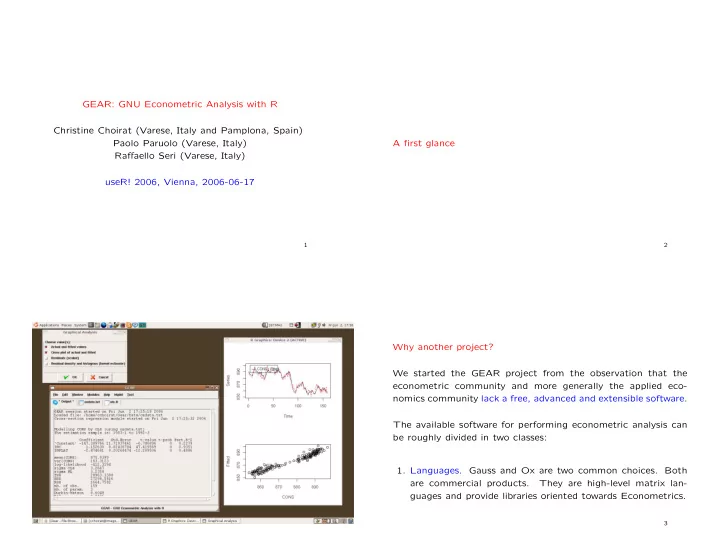
A first glance

2

Why another project? We started the GEAR project from the observation that the econometric community and more generally the applied eco- nomics community lack a free, advanced and extensible software. The available software for performing econometric analysis can be roughly divided in two classes:

  • 1. Languages. Gauss and Ox are two common choices. Both

are commercial products. They are high-level matrix lan- guages and provide libraries oriented towards Econometrics.

3

slide-2
SLIDE 2
  • 2. Environments.

Most econometric packages are commer- cial, the most popular at the moment being GiveWin (re- named OxMetrics) and its modules (PcGive in particular), and EViews . \begin{controversy} Gretl is free, cross-platform and released under the GPL. It is ready for undergraduate use, but a lot remains to be done for more advanced users and extensions are hard to implement. \end{controversy} What R already provides

  • Obviously, R can already be used for econometrics (for a

review, see Cribari-Neto and Zarkos, 1999, Racine and Hyn- dman, 2002, Farnsworth, 2006 and A. Zeileis’ CRAN task view for computational econometrics).

  • However, the econometric models are implemented in a non-

systematic way (moreover by independent authors so that many econometric methods are lacking whilst others are re- dundant).

4

Our requirements GEAR (standing for “GNU Econometric Analysis with R”) is meant to be both:

  • a program with a graphical user interface (when performing

standard tasks),

  • a set of libraries (for more advanced analysis). It would ideally

become a free and open-source alternative to EViews and GiveWin but also to Gauss and Ox. It is really cross-platform (MS Windows, Mac OSX with X11 and Aqua, several Linux and Unix flavors).

5

What has been done yet?

6

slide-3
SLIDE 3

Implementation choices

  • Underlying language.

We come from distinct econometric backgrounds (respectively 1. Ox, 2. Gauss and EViews,

  • 3. RATS). R was chosen after some discussion (C++ and

Python were other serious challengers) in late 2002 when we started the project. GEAR is entirely written in R (except for computer-intensive tasks which are coded as DLL’s).

  • GUI library. The choice was very hard and is still object of

many discussions. At the time we started: – a free (in the sense of beer) version of Qt was only avail- able for Linux,

7

– GTK was rudimentary on Windows and not available on Mac OS X, – wxWidgets (which was called wxWindows in these days...) could have been an excellent choice, but the interface with R was far from being easy (even with the Python step). – Not convinced by any type of C or C++ GUI library, we decided to use the good old Tcl/Tk and the work of Peter Dalgaard on the package tcltk (Rcmdr by John Fox was a proof that a useful and rich GUI application could be developed). We found out that more sophisticated widgets were needed, in particular the classical extensions BWidgets and TkTable. – It might change in the future, especially in favor of wxWid- gets. A modular structure

  • The basic tools provided by GEAR take the form of a stan-

dard R package gear-main (except from the requirement that the additional Tcl/Tk packages have to be installed for ex- ample using the ActiveTcl bundle and that an environment variable has to be defined under Windows).

  • Specialized tools also take the form of standard R packages

(e.g. gear-coint for cointegration analysis or gear-panel for panel data analysis) that depend on gear-main.

8

Libraries: Model-driven approach

  • An econometric model is represented as an R environment.

eModel$sFile <- ‘‘/home/user/data.csv’’ # data name on disk eModel$bModified <- FALSE # has data been modified? eModel$sMethod <- ‘‘OLS’’ # estimation method eModel$asX <- c(‘‘INC’’,‘‘INFLAT’’) # explanatory variable names eModel$sY <- ‘‘CONS’’ # dependent variable name eModel$bConstant <- TRUE # is there an intercept? eFit <- fnEstimate.OLS(eModel) # estimation fnPlot.OLS(eFit) # plots

9

slide-4
SLIDE 4
  • We have written utilities to save and load models in a human-

readable way (using the functions dput and dget)

  • The benefits of using the R.oo package will be further inves-

tigated. GUI: Tcl/Tk interface

  • Many unfruitful attempts. In particular IWidgets (problems

with portability across different Linux distributions) and the MDI proposed by mkWidgets.

  • The GUI is based on the NoteBook provided by BWidgets.

10

Output tab

11

Spreadsheet tab

12

slide-5
SLIDE 5

Viewer tab

13

Variable selection (cross-section regression)

14

A word on interactive graphics

15

What still has to be done? A realistic answer is: “a lot...”! First, more modules need to be completed (of course borrowing a lot from what is already available but not limiting ourselves to writing wrappers):

  • univariate time series,
  • simultaneous equations,
  • database interface,
  • multivariate time series,

16

slide-6
SLIDE 6
  • financial econometrics,
  • panel data.

More generally...

  • 1. From a structural viewpoint
  • More OO paradigm.
  • Website, specific documentation.
  • Translations.
  • 2. From a cosmetic viewpoint
  • Much polishing is needed (in particular extensive testing

under MS Windows).

  • Artistic material (e.g. specific icons) is lacking.
  • Tk extras: ctext for syntax highlighting, more keyboard

shorcuts.

  • Export output to HTML or L

A

T E X.