Standing Committee on Mental Health and Addictions Queens Park, - - PDF document

standing committee on mental health and addictions queens
SMART_READER_LITE
LIVE PREVIEW

Standing Committee on Mental Health and Addictions Queens Park, - - PDF document

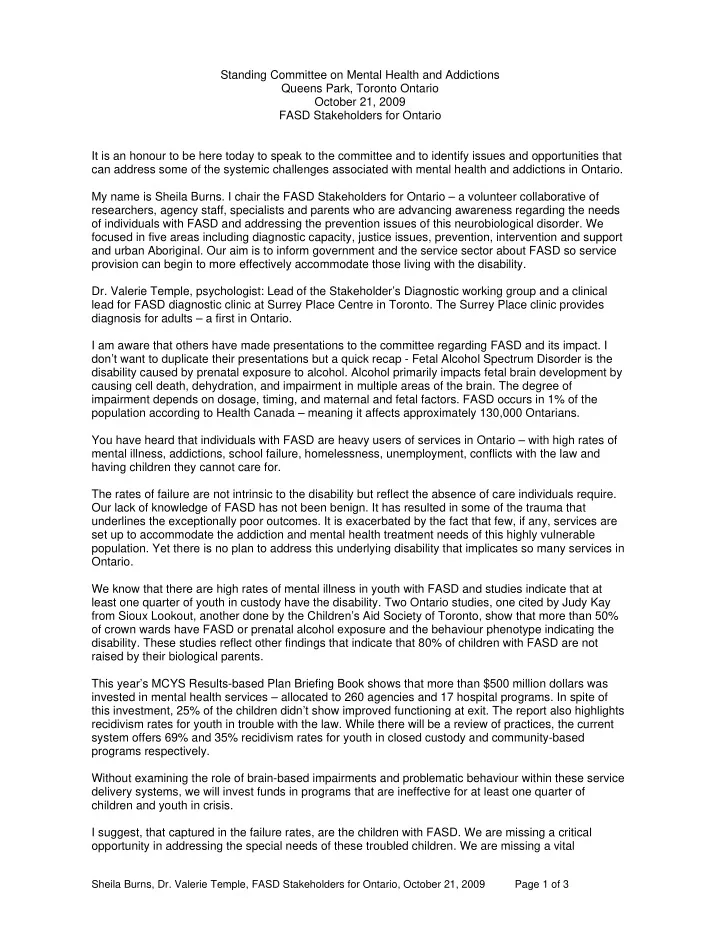
Standing Committee on Mental Health and Addictions Queens Park, Toronto Ontario October 21, 2009 FASD Stakeholders for Ontario It is an honour to be here today to speak to the committee and to identify issues and opportunities that can address


slide-1
SLIDE 1

Sheila Burns, Dr. Valerie Temple, FASD Stakeholders for Ontario, October 21, 2009 Page 1 of 3

Standing Committee on Mental Health and Addictions Queens Park, Toronto Ontario October 21, 2009 FASD Stakeholders for Ontario It is an honour to be here today to speak to the committee and to identify issues and opportunities that can address some of the systemic challenges associated with mental health and addictions in Ontario. My name is Sheila Burns. I chair the FASD Stakeholders for Ontario – a volunteer collaborative of researchers, agency staff, specialists and parents who are advancing awareness regarding the needs

  • f individuals with FASD and addressing the prevention issues of this neurobiological disorder. We

focused in five areas including diagnostic capacity, justice issues, prevention, intervention and support and urban Aboriginal. Our aim is to inform government and the service sector about FASD so service provision can begin to more effectively accommodate those living with the disability.

  • Dr. Valerie Temple, psychologist: Lead of the Stakeholder’s Diagnostic working group and a clinical

lead for FASD diagnostic clinic at Surrey Place Centre in Toronto. The Surrey Place clinic provides diagnosis for adults – a first in Ontario. I am aware that others have made presentations to the committee regarding FASD and its impact. I don’t want to duplicate their presentations but a quick recap - Fetal Alcohol Spectrum Disorder is the disability caused by prenatal exposure to alcohol. Alcohol primarily impacts fetal brain development by causing cell death, dehydration, and impairment in multiple areas of the brain. The degree of impairment depends on dosage, timing, and maternal and fetal factors. FASD occurs in 1% of the population according to Health Canada – meaning it affects approximately 130,000 Ontarians. You have heard that individuals with FASD are heavy users of services in Ontario – with high rates of mental illness, addictions, school failure, homelessness, unemployment, conflicts with the law and having children they cannot care for. The rates of failure are not intrinsic to the disability but reflect the absence of care individuals require. Our lack of knowledge of FASD has not been benign. It has resulted in some of the trauma that underlines the exceptionally poor outcomes. It is exacerbated by the fact that few, if any, services are set up to accommodate the addiction and mental health treatment needs of this highly vulnerable

  • population. Yet there is no plan to address this underlying disability that implicates so many services in

Ontario. We know that there are high rates of mental illness in youth with FASD and studies indicate that at least one quarter of youth in custody have the disability. Two Ontario studies, one cited by Judy Kay from Sioux Lookout, another done by the Children’s Aid Society of Toronto, show that more than 50%

  • f crown wards have FASD or prenatal alcohol exposure and the behaviour phenotype indicating the
  • disability. These studies reflect other findings that indicate that 80% of children with FASD are not

raised by their biological parents. This year’s MCYS Results-based Plan Briefing Book shows that more than $500 million dollars was invested in mental health services – allocated to 260 agencies and 17 hospital programs. In spite of this investment, 25% of the children didn’t show improved functioning at exit. The report also highlights recidivism rates for youth in trouble with the law. While there will be a review of practices, the current system offers 69% and 35% recidivism rates for youth in closed custody and community-based programs respectively. Without examining the role of brain-based impairments and problematic behaviour within these service delivery systems, we will invest funds in programs that are ineffective for at least one quarter of children and youth in crisis. I suggest, that captured in the failure rates, are the children with FASD. We are missing a critical

  • pportunity in addressing the special needs of these troubled children. We are missing a vital
slide-2
SLIDE 2

Sheila Burns, Dr. Valerie Temple, FASD Stakeholders for Ontario, October 21, 2009 Page 2 of 3

  • pportunity to assess and then provide supports that can best meet their developmental, learning and

social challenges. We are also failing to provide the information, training, and support to adoptive, foster, and kinship families. You have heard from parents who have struggled to find the genesis of their children’s challenges and then programs to meet their needs. You have heard from service providers who are struggling under the weight of growing demands for services and the need for funding. You have also heard about small FASD initiatives that are trying to bridge the gap – to bring information to community services so they are more effective. We know that we can prevent some of the mental health issues, substance abuse, and other poor

  • utcomes associated with FASD. Research indicates that outcomes significantly improve with 6 factors

access to early diagnosis, stable and nurturing home life, not being a victim of abuse absence of witnessing abuse appropriate education and mental health services, and access to developmental services. These factors help define the next step, the action items needed by the province and our service delivery system to begin to address the needs of this vulnerable group; individuals who makeup a significant portion of the of system’s users and clients, those the system is failing to serve in spite of the allocation of significant resources and the best intentions. During discussions in the 1990’s there was debate whether we should diagnose a disability for which there was no cure or treatment and one that implicated the mother so explicitly. By avoiding defining the problem, it would only grow and no solution would ever be found. The Stakeholders has worked toward defining the problems and exploring solutions through the advancement of awareness, diagnosis, care, support and prevention of FASD.

  • Dr. Temple: Diagnosis of FASD is not a matter of a simple blood test or CT scan, although those things

may be part of the process. It is not like Down syndrome where there is a chromosomal abnormality that can be located. Diagnosis of FASD requires detailed physical/medical evaluation, cognitive and skills testing, and investigation of prenatal, medical, and psychiatric history. It requires a team of clinicians, all with specialized training in FASD. Diagnosis also may take a great deal of time. And the fact that no Ontario Health Insurance Plan billing code for FASD diagnosis exists presents a significant challenge for physicians as their time is not recognized or recorded in the context of the broader medical system. In many regions of the province, it is also a challenge to bring together the multi- disciplinary team of clinicians necessary for FASD diagnosis. In addition to challenges, however, we also have opportunities--opportunities to recognize and utilize the resources already in place across our province. Multidisciplinary mental health teams do exist in many regions, and training these existing teams to identify and diagnosis FASD would be a valuable first step in increasing capacity. We are beginning to know what to do to address the complex needs of a significant subpopulation that are heavier users of the system of care, who are a high risk of mental health and addictions and who have thus far had their needs unmet. We know that people with FASD often receive a variety of mental health diagnoses over the course of their lives. Attention Deficit-Hyperactive disorder, Conduct disorder, Borderline personality disorder, Post Traumatic Stress Disorder, and psychosis, to mention just a few. Although there are effective treatments for many of these disorders through existing mental health systems, for people with FASD, treatment using traditional means is often ineffective. Clinicians working in these fields will tell you that individuals with a brain injury, such as FASD, require specialized interventions and accommodations in

  • rder to be successful. Sending people with FASD over and over to traditional intervention services
slide-3
SLIDE 3

Sheila Burns, Dr. Valerie Temple, FASD Stakeholders for Ontario, October 21, 2009 Page 3 of 3

leads to a sense of failure for the individual, frustration for the service provider, and despair for the

  • family. And it wastes valuable resources by applying treatments we already know are unlikely to work.

That’s why increasing access to accurate diagnosis coupled with education is key. We know what types of interventions work in FASD. We know that environmental changes and supports; educated staff, teachers, and support workers; and a comprehensive long-term support plan are what is needed. Sheila Burns: A bit about Prevention Prevention strategies need to resonate with the general population who just need information regarding the impact of alcohol on the developing fetus. Women need to know they should avoid pregnancy if they drink alcohol. FASD can be prevented. But there is a population of women who are alcohol dependent. These women need specialized supports to cope with complex issues in their lives. Toronto’s Breaking the Cycle program is geared to help these women. A dozen agencies collaborate to bring the supports and services vulnerable women need to enhance their ability to deal with drug and alcohol dependency, to address trauma and abuse, to stabilize their lives, and to learn good parenting skills. We know if we support this group of women, we can reduce the incidence of FASD and provide early intervention programming for affected children. Breaking the Cycle also identified a group of women who themselves have FASD, who have stumbled through life having experienced failure, trauma, abuse, and mental illness and an undiagnosed

  • disability. Those women need the supports offered other adults with developmental disabilities.

Both men and women with FASD need access to supportive housing, employment and daily living so they can contribute to their community to their fullest capacity. They need a lifetime of support and a continuum of care. Bill 77 – the act to provide services to persons with developmental disabilities offers an opportunity to address the needs of these vulnerable adults. It adds executive and adaptive functioning impairments to the criteria for accessing services. The flexible service provision will assist individuals to work, parent and live with respect and dignity. In a recent study, FASD is estimated to cost Canadians 5.3 billion dollars annually. In Ontario, we would see huge savings and efficiencies if we ensured that the services these individuals received were appropriate to their disability and weren’t contributing to the problem. With awareness, diagnosis and training, we can begin to align services more appropriately and see better outcomes. Ontario is the only province that does not have government staff assigned to this issue. The western provinces and territories have worked together for years exploring facets of the disability, providing training opportunities, conducting research, and defining and advancing best practices. Ontario is not at that table which leaves no one to ensure appropriate service provision for the 130,000 individuals in this province with FASD nor is there a strategy to reduce the incidence rate. We need ministry and government leadership, in a collaborative approach – as is demonstrated by this standing committee – to take the lead on this issue. It requires more than the dedication of a few dozen volunteers. Those with FASD are heavy users of our system’s mental health and addictions services. They don’t have to be. Thank you for your attention.