SLIDE 1
Ch Check out f from S SVN VN: Queens eens Exhaustive search, - - PowerPoint PPT Presentation
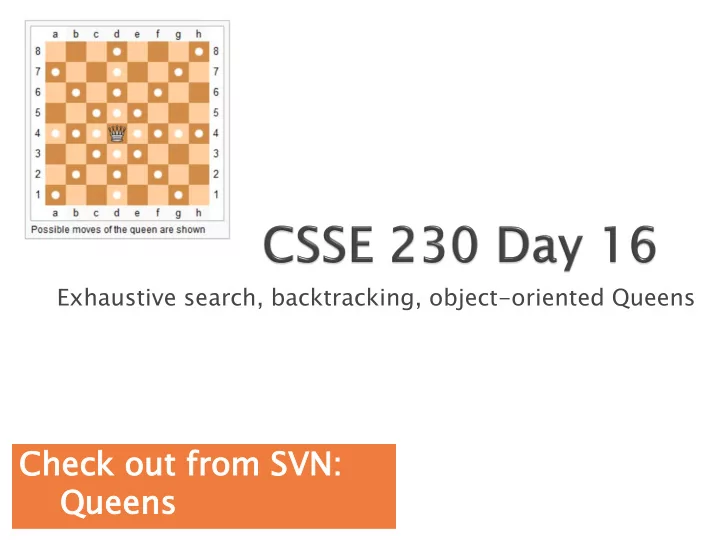
Exhaustive search, backtracking, object-oriented Queens Ch Check out f from S SVN VN: Queens eens Exhaustive search, backtracking, and object-oriented queens A taste of artificial intelligence Check out Queens from SVN Given: a
SLIDE 2
SLIDE 3
Exhaustive search, backtracking,
and object-oriented queens
SLIDE 4
A taste of artificial intelligence
Check out Queens from SVN
SLIDE 5
Given: a (large) set of possible solutions to a
problem
Goal: Find all solutions (or an optimal
solution) from that set
Questions we ask:
- How do we represent the possible solutions?
- How do we organize the search?
- Can we avoid checking some obvious non-
solutions?
The “search space”
SLIDE 6
Examples: Doublets, solving a maze,
the “15” puzzle.
Taken from:
- http://www.cis.upenn.edu/~matuszek/cit594-
2004/Lectures/38-backtracking.ppt
SLIDE 7
start ? ? dead end dead end ? ? dead end dead end ? success! dead end
http://www.cis.upenn.ed u/~matuszek/cit594- 2004/Lectures/38- backtracking.ppt
SLIDE 8
- In how many ways can N chess queens
be placed on an NxN grid, so that none
- f the queens can attack any other
queen?
- I.e. there are not two queens on the
same row, same column, or same diagonal.
There is no "formula"
for generating a solution.
The famous computer scientist Niklaus
Wirth described his approach to the problem in 1971: Pr
Program De Developm pment by by Step tepwise e Ref efinem ement t
http://sunnyday.mit.edu/16.355/wirth- refinement.html#3
http://en.wikipedia.org/wiki/Queen_(chess)
SLIDE 9
In how many ways can N chess queens be
placed on an NxN grid, so that none of the queens can attack any other queen?
- I.e. no two queens on the same row, same column,
- r same diagonal.
Two minutes No Peeking!
SLIDE 10
Ver
Very naive a e approach. Per Perhaps stupid is a bet etter word rd! There are N queens, N2 squares.
For each queen, try every possible square,
allowing the possibility of multiple queens in the same square.
- Represent each potential solution as an N-item array of
pairs of integers (a row and a column for each queen).
- Generate all such arrays (you should be able to write
code that would do this) and check to see which ones are solutions.
- Number of possibilities to try in the NxN case:
- Specific number for N=8:
281, 281,474, 474,976, 976,710, 710,656 656 1
SLIDE 11
Slig light t imp impro roveme
- ment. There are N queens, N2
- squares. For each queen, try every possible
square, notice that we can't have multiple queens on the same square.
- Represent each potential solution as an N-item
array of pairs of integers (a row and a column for each queen).
- Generate all such arrays and check to see which
- nes are solutions.
- Number of possibilities to try in NxN case:
- Specific number for N=8:
178, 178,462, 462,987, 987,637, 637,760 760 (vs. 281, 281,474, 474,976, 976,710, 710,656) 656)
SLIDE 12
Slight
htly be better appr
- approach. There are N queens, N
- columns. If two queens are in the same column, they
will attack each other. Thus there must be exactly one queen per column.
Represent a potential solution as an N-item array of
integers.
- Each array position represents the queen in one column.
- The number stored in an array position represents the row of
that column's queen.
- Show array for 4x4 solution.
Generate all such arrays and check to see which ones are solutions. Number of possibilities to try in NxN case: Specific number for N=8:
16, 16,777, 777,216 216
SLIDE 13
Still
till better er approac
- ach There must also be
exactly one queen per row.
Represent the data just as before, but notice
that the data in the array is a set!
- Generate each of these and check to see which ones
are solutions.
- How
w to g gener erat ate? e? A good thing to think about.
- Number of possibilities to try in NxN case:
- Specific number for N=8:
40, 40,320 320
SLIDE 14
Backtr
track acking s soluti tion
- n
Instead of generating all permutations of N
queens and checking to see if each is a solution, we generate "partial placements" by placing one queen at a time on the board
Once we have successfully placed k<N
queens, we try to extend the partial solution by placing a queen in the next column.
When we extend to N queens, we have a
solution.
SLIDE 15
Play the game:
- http://homepage.tinet.ie/~pdpals/8queens.htm
See the solutions:
- http://www.dcs.ed.ac.uk/home/mlj/demos/queens
SLIDE 16
>java RealQueen 5 SOLUTION: 1 3 5 2 4 SOLUTION: 1 4 2 5 3 SOLUTION: 2 4 1 3 5 SOLUTION: 2 5 3 1 4 SOLUTION: 3 1 4 2 5 SOLUTION: 3 5 2 4 1 SOLUTION: 4 1 3 5 2 SOLUTION: 4 2 5 3 1 SOLUTION: 5 2 4 1 3 SOLUTION: 5 3 1 4 2
SLIDE 17
Board configuration represented by a linked
list of Queen objects
Fields of RealQu Quee een: column row neighbor
Designed by Timothy Budd http://web.engr.oregonstate.edu/~budd/Books/oopintro3e/info/slides/chap06/java.htm
2-5
SLIDE 18
Each queen sends messages directly to its
immediate neighbor to the left (and recursively to all of its left neighbors)
Return value provides information concerning
all of the left neighbors:
Example: neighbor.canAttack(currentRow, c
col)
- Message goes to the immediate neighbor, but the
real question to be answered by this call is
- "Hey, neighbors, can any of you attack me if I place
myself on this square of the board?"
SLIDE 19
findFirst() findNext() canAttack(int row, int col)
6-10
Your job (part of WA6): Unde derstand th the job job of
- f each of
- f th
these me meth thods. Jav avadoc f from the Qu e Queen een i inter erface e can can h hel elp Fill in the (recursive) details in the RealQueen class De Debu bug More
- re de
deta tails ls on
- n next slid
lide
SLIDE 20
- 1. Queen asks its neighbors to find the first position
in which none of them attack each other
- Found? Then queen tries to position itself so that it
cannot be attacked.
- 2. If the rightmost queen is successful, then a
solution has been found! The queens cooperate in recording it.
- 3. Otherwise, the queen asks its neighbors to find
the next position in which they do not attack each other
- 4. When the queens get to the point where there is
no next non-attacking position, all solutions have been found and the algorithm terminates
SLIDE 21
I will introduce the term project at the end of
class
SLIDE 22
Brief description Meet your team
SLIDE 23
I’ll assign an overall grade to the project Grades of individuals will be adjusted up or
down based on team members’ assessments
At the end of the project each of you will:
- Rate each member of the team, including yourself
- Write a short Performance Evaluation of each team
member with evidence that backs up the rating
Positives Key negatives
SLIDE 24
Document dates and actions:
- Jan. 1, stayed after mtg. to help Bob with hashing
- Jan. 19, failed to complete UML diagram as agreed
- [this means take notes so you don’t forget]
List positives:
- The only way to help people improve!
List key
ey negatives:
- Not all
ll negatives
- Egos are too fragile for long lists, can’t fix
everything at once anyway
SLIDE 25
In general, implementation of a Data
Structure is separate from application.
Mos
- st C
CSSE 2 230 30 proj roject cts h hav ave u used exis isti ting data ta s str truct ctures to to cre create a an ap applic icati tion
- n
In this project you will create an efficient data
structure that could be used in a text editor.
But y
t you
- u w
will ill not
- t create
ate a an a applicati ation
- n t
that at uses it. it.
EditTree:
e: A height-balanced (but not AVL) binary tree with rank. Insertion and deletion are by pos
- sit
itio ion, not by natural ordering of the inserted elements.
- So is it a BST?
Lots
- ts of
- f O
O(log (log N) op ) operatio ions
Uses b
balance c code and d rank.
SLIDE 26
See sc
schedule p page age
Meet your partners to plan when you will meet to begin work. Suggesti tion:
- n: