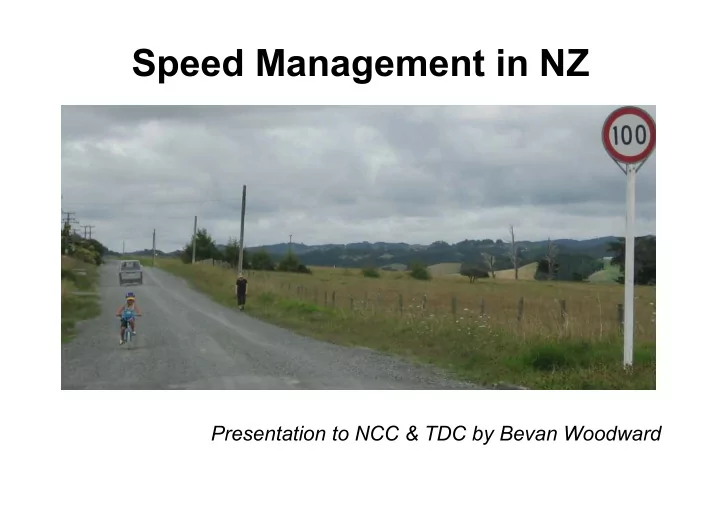
Speed Management in NZ - - PowerPoint PPT Presentation
Speed Management in NZ The agenda 1. Benefits of reduced traffic speed (10 min) 2. Speed Quiz (15 min) 3.
The agenda
- 1. Benefits of reduced traffic speed (10 min)
- 2. Speed Quiz (15 min)
- 3. Barriers to reducing speed (15 min)
- 4. Some ideas on reducing speed (15 min)
- 5. Workshop: Application for Nelson (15 min)
- 6. Conclusion (20 min)
Wellington 30 km/h: less cycle facilities needed
30 km/h feels safe
We love 30 km/h!
Better for business
(Invercargill)
Higher property valuations
(Christchurch)
Speed Quiz: 12 roads
- [Change Powerpoint slideshow, 12 photos]
- What do think the posted speed limit is for
each photo?
- Given the variety of potential users, what
do you think the speed limit should be?
- Answers for posted speed limit will then be
given, the person with most correct wins the chocolate bar!
“Safe speeds”
> 100 km/h Roads on which frontal and flank conflicts with
- ther road users are impossible
70 km/h Roads with possible frontal conflicts between cars 50 km/h Intersections with possible lateral conflicts between cars 30 km/h Roads with possible conflicts between cars and unprotected road users Safe speed
- !!"#
Barriers to reducing speeds:
- 1. Lack of practitioner willingness
- 2. Will increase journey times
- 3. Traffic calming is expensive
- 4. The rules for reducing traffic speed limits
are restrictive
- 5. Public don’t want reduced traffic speeds
- 1. Lack of practitioner willingness
“Roading Improvements”
- 2. Reduced traffic speeds will increase travel times
(Auckland)
- 3. Traffic calming is expensive
- 4. The rules for reducing traffic speed limits
are restrictive Section 3.2(5), Setting of Speed Limits allows local councils relative freedom to set appropriate speed limits
Strong support in Pt Chev, Auckland for permanently reduced speeds
- 90% agreed to 30 km speed limits around
schools
- 68% agreed with the idea of reducing the speed
limit (only 25% disagreed)
- 5. The public don’t want reduced traffic
speeds
Queen St, Auckland
- 76% of respondents to public consultation
agreed to 30 km speed limit
Residents in support
“You see more at 30 km/h”
Welcome!..
Fast driver in Fast car
- n
Fast road
driving slowly!
Ideas
- AreaEwide, lowEcost, community
enhancing traffic calming
- Access, Collector, Rural
Connecticut, USA
Seattle, USA
Connecticut
Collector Roads
Rural Roads
“2 minus 1”
Workshop
- AreaEwide, lowEcost, community
enhancing traffic calming
- Please choose an example in
Nelson/Tasman, can be Access, Collector
- r Rural roads
- Report back after 20 minutes
Conclusion
Key messages: 1) The single most costEeffective tool to reduce frequency and severity of crashes, whilst also improving safety for vulnerable road users, is to reduce the speed of traffic 2) There is strong support for reduced traffic speeds from the wider community but not certain groups, eg: AA, Trucking and other transport lobbyists 3) The Setting of Speed Limit rules rating system is inadequate and thus should generally be
- ignored. The rules do also allow reasonable freedom to the RCA to set speed limits.
4) Best practice safe speeds are:
- Possible conflicts between cars and unprotected road users: 30 km/h
- Intersections with possible lateral conflicts between cars: 50 km/h
- Roads with possible frontal conflicts between cars: 70 km/h
- Roads on which frontal and flank conflicts with other road users are impossible > 100 km/h
5)Traffic Note 43 states that the average speed limit must be within 5km/h of the posted speed
- limit. This is largely irrelevant because our key concern is the 85th percentile speed.
6) Our challenge is that we have fast cars in fast cars on fast roads 7) Suggested approach to reducing traffic speed (at lowEcost) is to implement areaEwide, psychological techniques that also beautify the streets/enhance the community. Eg: trees to reduce sightElines, removal of centreElines, narrower traffic lanes, angle parking, raised pedestrian crossings, etc.