Spectral sets and derivatives of the psd cone Mario Kummer TU - - PowerPoint PPT Presentation

spectral sets and derivatives of the psd cone
SMART_READER_LITE
LIVE PREVIEW

Spectral sets and derivatives of the psd cone Mario Kummer TU - - PowerPoint PPT Presentation

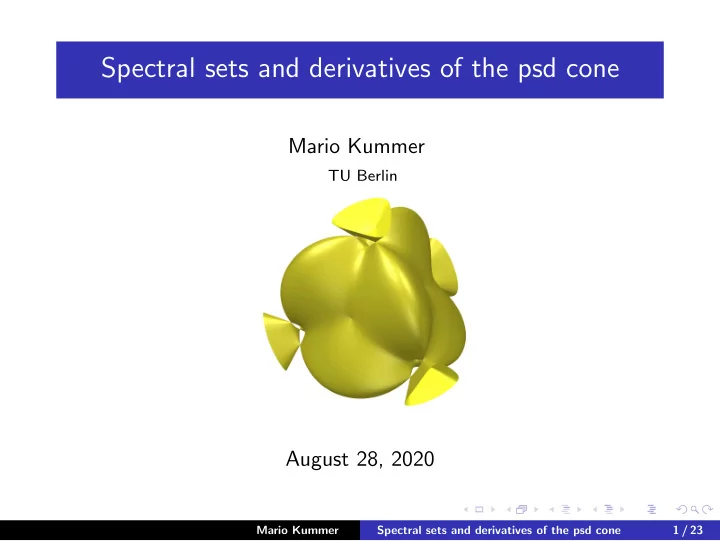
Spectral sets and derivatives of the psd cone Mario Kummer TU Berlin August 28, 2020 Mario Kummer Spectral sets and derivatives of the psd cone 1 / 23 Spectrahedral cones A spectrahedral cone is a set of the form S = { x R n : A ( x ) =

slide-1
SLIDE 1

Spectral sets and derivatives of the psd cone

Mario Kummer

TU Berlin

August 28, 2020

Mario Kummer Spectral sets and derivatives of the psd cone 1 / 23

slide-2
SLIDE 2

Spectrahedral cones

A spectrahedral cone is a set of the form S = {x ∈ Rn : A(x) = x1A1 + . . . + xnAn is positive semidefinite}, where A1, . . . , An ∈ Sym2(Rd) are real symmetric d × d matrices.

Mario Kummer Spectral sets and derivatives of the psd cone 2 / 23

slide-3
SLIDE 3

Spectrahedral cones

A spectrahedral cone is a set of the form S = {x ∈ Rn : A(x) = x1A1 + . . . + xnAn is positive semidefinite}, where A1, . . . , An ∈ Sym2(Rd) are real symmetric d × d matrices.

◮ Feasible sets of semidefinite programming.

Mario Kummer Spectral sets and derivatives of the psd cone 2 / 23

slide-4
SLIDE 4

Spectrahedral cones

A spectrahedral cone is a set of the form S = {x ∈ Rn : A(x) = x1A1 + . . . + xnAn is positive semidefinite}, where A1, . . . , An ∈ Sym2(Rd) are real symmetric d × d matrices.

◮ Feasible sets of semidefinite programming. ◮ Polyhedral cones: Take A(x) to be diagonal.

Mario Kummer Spectral sets and derivatives of the psd cone 2 / 23

slide-5
SLIDE 5

Spectrahedral cones

A spectrahedral cone is a set of the form S = {x ∈ Rn : A(x) = x1A1 + . . . + xnAn is positive semidefinite}, where A1, . . . , An ∈ Sym2(Rd) are real symmetric d × d matrices.

◮ Feasible sets of semidefinite programming. ◮ Polyhedral cones: Take A(x) to be diagonal.

Question

◮ Which sets K ⊂ Rn are spectrahedral?

Mario Kummer Spectral sets and derivatives of the psd cone 2 / 23

slide-6
SLIDE 6

Spectrahedral cones

S = {x ∈ Rn : A(x) = x1A1 + . . . + xnAn is positive semidefinite}.

◮ Fix e ∈ int(S). W.l.o.g. A(e) = Id. ◮ The polynomial det A(x) is hyperbolic in the following sense:

Mario Kummer Spectral sets and derivatives of the psd cone 3 / 23

slide-7
SLIDE 7

Spectrahedral cones

S = {x ∈ Rn : A(x) = x1A1 + . . . + xnAn is positive semidefinite}.

◮ Fix e ∈ int(S). W.l.o.g. A(e) = Id. ◮ The polynomial det A(x) is hyperbolic in the following sense:

Definition A homogeneous polynomial h ∈ R[x1, . . . , xn] is hyperbolic with respect to e ∈ Rn if h(e) = 0 and if h(te − v) has

  • nly real roots for all v ∈ Rn.

Mario Kummer Spectral sets and derivatives of the psd cone 3 / 23

slide-8
SLIDE 8

Spectrahedral cones

S = {x ∈ Rn : A(x) = x1A1 + . . . + xnAn is positive semidefinite}.

◮ Fix e ∈ int(S). W.l.o.g. A(e) = Id. ◮ The polynomial det A(x) is hyperbolic in the following sense:

Definition A homogeneous polynomial h ∈ R[x1, . . . , xn] is hyperbolic with respect to e ∈ Rn if h(e) = 0 and if h(te − v) has

  • nly real roots for all v ∈ Rn. The hyperbolicity cone is

C(h, e) = {v ∈ Rn : h(te − v) has only nonnegative roots}.

Mario Kummer Spectral sets and derivatives of the psd cone 3 / 23

slide-9
SLIDE 9

Spectrahedral cones

S = {x ∈ Rn : A(x) = x1A1 + . . . + xnAn is positive semidefinite}.

◮ Fix e ∈ int(S). W.l.o.g. A(e) = Id. ◮ The polynomial det A(x) is hyperbolic in the following sense:

Definition A homogeneous polynomial h ∈ R[x1, . . . , xn] is hyperbolic with respect to e ∈ Rn if h(e) = 0 and if h(te − v) has

  • nly real roots for all v ∈ Rn. The hyperbolicity cone is

C(h, e) = {v ∈ Rn : h(te − v) has only nonnegative roots}.

◮ det A(te − v) = det(tId − A(v)).

Mario Kummer Spectral sets and derivatives of the psd cone 3 / 23

slide-10
SLIDE 10

Spectrahedral cones

S = {x ∈ Rn : A(x) = x1A1 + . . . + xnAn is positive semidefinite}.

◮ Fix e ∈ int(S). W.l.o.g. A(e) = Id. ◮ The polynomial det A(x) is hyperbolic in the following sense:

Definition A homogeneous polynomial h ∈ R[x1, . . . , xn] is hyperbolic with respect to e ∈ Rn if h(e) = 0 and if h(te − v) has

  • nly real roots for all v ∈ Rn. The hyperbolicity cone is

C(h, e) = {v ∈ Rn : h(te − v) has only nonnegative roots}.

◮ det A(te − v) = det(tId − A(v)). ◮ S = C(det A(x), e).

Mario Kummer Spectral sets and derivatives of the psd cone 3 / 23

slide-11
SLIDE 11

The Generalized Lax Conjecture

  • Conjecture. Let h ∈ R[x1, . . . , xn] be hyperbolic with respect to

e ∈ Rn. Then C(h, e) is spectrahedral.

Mario Kummer Spectral sets and derivatives of the psd cone 4 / 23

slide-12
SLIDE 12

The Generalized Lax Conjecture

  • Conjecture. Let h ∈ R[x1, . . . , xn] be hyperbolic with respect to

e ∈ Rn. Then C(h, e) is spectrahedral. True if:

◮ deg h ≤ 2. ◮ n ≤ 3. (Helton–Vinnikov) ◮ n = 4 and deg h = 3. (Buckley–Koˇ

sir)

Mario Kummer Spectral sets and derivatives of the psd cone 4 / 23

slide-13
SLIDE 13

Constructing hyperbolic polynomials

The following polynomials are hyperbolic with respect to e:

◮ det A(x) for A(x) real symmetric matrix with linear entries

and A(e) positive definite. Includes spanning tree polynomials of graphs, bases generating polynomials of regular matroids and ternary hyperbolic polynomials.

Mario Kummer Spectral sets and derivatives of the psd cone 5 / 23

slide-14
SLIDE 14

Constructing hyperbolic polynomials

The following polynomials are hyperbolic with respect to e:

◮ det A(x) for A(x) real symmetric matrix with linear entries

and A(e) positive definite. Includes spanning tree polynomials of graphs, bases generating polynomials of regular matroids and ternary hyperbolic polynomials. Their hyperbolicity cones are clearly spectrahedral.

Mario Kummer Spectral sets and derivatives of the psd cone 5 / 23

slide-15
SLIDE 15

Constructing hyperbolic polynomials

The following polynomials are hyperbolic with respect to e:

◮ The homogeneous multivariate matching polynomial of an

undirected graph G = (V , E): µG(x, w) =

  • (−1)|M| ·
  • v∈V (M)

xv ·

  • e∈M

w2

e

where the sum is over all matchings M of G. (Heilmann–Lieb)

◮ e = (1V , 0E).

Mario Kummer Spectral sets and derivatives of the psd cone 6 / 23

slide-16
SLIDE 16

Constructing hyperbolic polynomials

The following polynomials are hyperbolic with respect to e:

◮ The homogeneous multivariate matching polynomial of an

undirected graph G = (V , E): µG(x, w) =

  • (−1)|M| ·
  • v∈V (M)

xv ·

  • e∈M

w2

e

where the sum is over all matchings M of G. (Heilmann–Lieb)

◮ e = (1V , 0E).

Their hyperbolicity cones are spectrahedral (Amini).

Mario Kummer Spectral sets and derivatives of the psd cone 6 / 23

slide-17
SLIDE 17

Constructing hyperbolic polynomials

The following polynomials are hyperbolic with respect to e:

◮ The defining polynomial of the kth secant variety of a

projectively normal M-curve with “many” pseudolines in P2k+2. (K.–Sinn) Their hyperbolicity cones are spectrahedral for rational and elliptic curves.

Mario Kummer Spectral sets and derivatives of the psd cone 7 / 23

slide-18
SLIDE 18

Operations preserving hyperbolicity

These operations preserve being hyperbolic with respect to e:

◮ Taking products. ◮ Restricting to a linear subspace containing e. ◮ Applying linear changes of coordinates (e might change).

Mario Kummer Spectral sets and derivatives of the psd cone 8 / 23

slide-19
SLIDE 19

Operations preserving hyperbolicity

These operations preserve being hyperbolic with respect to e:

◮ Taking products. ◮ Restricting to a linear subspace containing e. ◮ Applying linear changes of coordinates (e might change).

These operations also preserve spectrahedrality of the corresponding hyperbolicity cones.

Mario Kummer Spectral sets and derivatives of the psd cone 8 / 23

slide-20
SLIDE 20

Renegar derivatives

Consequence of Rolle’s Theorem:

◮ If a polynomial p ∈ R[t] has only real zeros, then its derivative

p′ has only real zeros.

Mario Kummer Spectral sets and derivatives of the psd cone 9 / 23

slide-21
SLIDE 21

Renegar derivatives

Consequence of Rolle’s Theorem:

◮ If a polynomial p ∈ R[t] has only real zeros, then its derivative

p′ has only real zeros. This implies:

◮ If a polynomial h ∈ R[x1, . . . , xn] is hyperbolic with respect to

e, then its directional derivative Deh =

n

  • i=1

ei · ∂h ∂xi is hyperbolic with respect to e as well.

Mario Kummer Spectral sets and derivatives of the psd cone 9 / 23

slide-22
SLIDE 22

Renegar derivatives

Consequence of Rolle’s Theorem:

◮ If a polynomial p ∈ R[t] has only real zeros, then its derivative

p′ has only real zeros. This implies:

◮ If a polynomial h ∈ R[x1, . . . , xn] is hyperbolic with respect to

e, then its directional derivative Deh =

n

  • i=1

ei · ∂h ∂xi is hyperbolic with respect to e as well. Question Is the hyperbolicity cone of De(det A(x)) spectrahedral?

Mario Kummer Spectral sets and derivatives of the psd cone 9 / 23

slide-23
SLIDE 23

Renegar derivatives

Consequence of Rolle’s Theorem:

◮ If a polynomial p ∈ R[t] has only real zeros, then its derivative

p′ has only real zeros. This implies:

◮ If a polynomial h ∈ R[x1, . . . , xn] is hyperbolic with respect to

e, then its directional derivative Dk

eh = n

  • i=1

ei · ∂h ∂xi is hyperbolic with respect to e as well. Question Is the hyperbolicity cone of Dk

e(det A(x)) spectrahedral?

Mario Kummer Spectral sets and derivatives of the psd cone 10 / 23

slide-24
SLIDE 24

Example

The polynomial h = x1 · · · xd is hyperbolic with respect to e = (1, . . . , 1).

Mario Kummer Spectral sets and derivatives of the psd cone 11 / 23

slide-25
SLIDE 25

Example

The polynomial h = x1 · · · xd is hyperbolic with respect to e = (1, . . . , 1).

◮ Dn−k e

h = (n − k)!σk,d where σk,d is the elementary symmetric polynomial in d variables of degree k.

Mario Kummer Spectral sets and derivatives of the psd cone 11 / 23

slide-26
SLIDE 26

Example

The polynomial h = x1 · · · xd is hyperbolic with respect to e = (1, . . . , 1).

◮ Dn−k e

h = (n − k)!σk,d where σk,d is the elementary symmetric polynomial in d variables of degree k.

◮ σk,d is hyperbolic with respect to e = (1, . . . , 1).

Mario Kummer Spectral sets and derivatives of the psd cone 11 / 23

slide-27
SLIDE 27

Example

The polynomial h = x1 · · · xd is hyperbolic with respect to e = (1, . . . , 1).

◮ Dn−k e

h = (n − k)!σk,d where σk,d is the elementary symmetric polynomial in d variables of degree k.

◮ σk,d is hyperbolic with respect to e = (1, . . . , 1). ◮ The hyperbolicity cone of σk,d is spectrahedral (Br¨

and´ en).

Mario Kummer Spectral sets and derivatives of the psd cone 11 / 23

slide-28
SLIDE 28

Renegar derivatives

Question Is the hyperbolicity cone of Dk

e(det A(x)) spectrahedral? ◮ It suffices to prove that the hyperbolicity cone of Dk I (det X) is

spectrahedral where X is the generic d × d symmetric matrix and I the d × d identity matrix.

Mario Kummer Spectral sets and derivatives of the psd cone 12 / 23

slide-29
SLIDE 29

Renegar derivatives

Question Is the hyperbolicity cone of Dk

e(det A(x)) spectrahedral? ◮ It suffices to prove that the hyperbolicity cone of Dk I (det X) is

spectrahedral where X is the generic d × d symmetric matrix and I the d × d identity matrix. Let us write det(tI − X) =

d

  • k=0

(−1)kpktd−k for suitable polynomials pk of degree k (p1 = tr(X), pd = det(X)).

Mario Kummer Spectral sets and derivatives of the psd cone 12 / 23

slide-30
SLIDE 30

Renegar derivatives

Question Is the hyperbolicity cone of Dk

e(det A(x)) spectrahedral? ◮ It suffices to prove that the hyperbolicity cone of Dk I (det X) is

spectrahedral where X is the generic d × d symmetric matrix and I the d × d identity matrix. Let us write det(tI − X) =

d

  • k=0

(−1)kpktd−k for suitable polynomials pk of degree k (p1 = tr(X), pd = det(X)).

◮ pk = 1 (d−k)!Dd−k I

(det X).

Mario Kummer Spectral sets and derivatives of the psd cone 12 / 23

slide-31
SLIDE 31

Renegar derivatives

Question Is the hyperbolicity cone of Dk

e(det A(x)) spectrahedral? ◮ It suffices to prove that the hyperbolicity cone of Dk I (det X) is

spectrahedral where X is the generic d × d symmetric matrix and I the d × d identity matrix. Let us write det(tI − X) =

d

  • k=0

(−1)kpktd−k for suitable polynomials pk of degree k (p1 = tr(X), pd = det(X)).

◮ pk = 1 (d−k)!Dd−k I

(det X).

◮ pk = σk,d(λ(X)) where σk,d is the elementary symmetric

polynomial of degree k in d variables and λ(X) the vector of eigenvalues of X.

Mario Kummer Spectral sets and derivatives of the psd cone 12 / 23

slide-32
SLIDE 32

Spectral convex sets

Theorem (Bauschke–G¨ uler–Lewis–Sendov) Let h ∈ R[x1, . . . , xn] a symmetric polynomial that is hyperbolic with respect to e = (1, . . . , 1). Consider the function H : Sym2(Rd) → R, X → h(λ(X)) where λ(X) is the vector of eigenvalues of X. a) H is a polynomial.

Mario Kummer Spectral sets and derivatives of the psd cone 13 / 23

slide-33
SLIDE 33

Spectral convex sets

Theorem (Bauschke–G¨ uler–Lewis–Sendov) Let h ∈ R[x1, . . . , xn] a symmetric polynomial that is hyperbolic with respect to e = (1, . . . , 1). Consider the function H : Sym2(Rd) → R, X → h(λ(X)) where λ(X) is the vector of eigenvalues of X. a) H is a polynomial. b) H is hyperbolic with respect to I.

Mario Kummer Spectral sets and derivatives of the psd cone 13 / 23

slide-34
SLIDE 34

Spectral convex sets

Theorem (Bauschke–G¨ uler–Lewis–Sendov) Let h ∈ R[x1, . . . , xn] a symmetric polynomial that is hyperbolic with respect to e = (1, . . . , 1). Consider the function H : Sym2(Rd) → R, X → h(λ(X)) where λ(X) is the vector of eigenvalues of X. a) H is a polynomial. b) H is hyperbolic with respect to I. c) C(H, I) = {X : λ(X) ∈ C(h, e)}.

Mario Kummer Spectral sets and derivatives of the psd cone 13 / 23

slide-35
SLIDE 35

Spectral convex sets

Definition (Sanyal–Saunderson) A spectral convex set is a set of the form {X ∈ Sym2(Rd) : λ(X) ∈ K} for some symmetric convex set K ⊂ Rd.

◮ Raman’s talk on Thursday!

Mario Kummer Spectral sets and derivatives of the psd cone 14 / 23

slide-36
SLIDE 36

Renegar derivatives

Corollary A symmetric d × d matrix A is in the hyperbolicity cone of Dd−k

I

(det X) if and only if its spectrum λ(A) is in the hyperbolicity cone of the elementary symmetric polynomial σk,d.

Mario Kummer Spectral sets and derivatives of the psd cone 15 / 23

slide-37
SLIDE 37

Renegar derivatives

Corollary A symmetric d × d matrix A is in the hyperbolicity cone of Dd−k

I

(det X) if and only if its spectrum λ(A) is in the hyperbolicity cone of the elementary symmetric polynomial σk,d.

◮ Using this and a spectrahedral representation of the

hyperbolicity cone of σd−1,d due to Sanyal, Saunderson proved that the hyperbolicity cone of D1

I (det X) is spectrahedral.

Mario Kummer Spectral sets and derivatives of the psd cone 15 / 23

slide-38
SLIDE 38

Renegar derivatives

Corollary A symmetric d × d matrix A is in the hyperbolicity cone of Dd−k

I

(det X) if and only if its spectrum λ(A) is in the hyperbolicity cone of the elementary symmetric polynomial σk,d.

◮ Using this and a spectrahedral representation of the

hyperbolicity cone of σd−1,d due to Sanyal, Saunderson proved that the hyperbolicity cone of D1

I (det X) is spectrahedral. ◮ Br¨

and´ en constructed a spectrahedral representation of the hyperbolicity cone of σk,d for all k.

Mario Kummer Spectral sets and derivatives of the psd cone 15 / 23

slide-39
SLIDE 39

Spectral sets

Question Let S ⊂ Rn be a spectrahedral cone which is symmetric under permuting the coordinates. Is the spectral convex set Λ(S) = {A ∈ Sym2(Rn) : λ(A) ∈ S} also spectrahedral?

Mario Kummer Spectral sets and derivatives of the psd cone 16 / 23

slide-40
SLIDE 40

Spectral sets

Question Let S ⊂ Rn be a spectrahedral cone which is symmetric under permuting the coordinates. Is the spectral convex set Λ(S) = {A ∈ Sym2(Rn) : λ(A) ∈ S} also spectrahedral?

◮ Λ(S) is a hyperbolicity cone. (Bauschke–G¨

uler–Lewis–Sendov)

Mario Kummer Spectral sets and derivatives of the psd cone 16 / 23

slide-41
SLIDE 41

Spectral sets

Question Let S ⊂ Rn be a spectrahedral cone which is symmetric under permuting the coordinates. Is the spectral convex set Λ(S) = {A ∈ Sym2(Rn) : λ(A) ∈ S} also spectrahedral?

◮ Λ(S) is a hyperbolicity cone. (Bauschke–G¨

uler–Lewis–Sendov)

◮ Yes, if S is a polyhedral cone. (Sanyal–Saunderson)

Mario Kummer Spectral sets and derivatives of the psd cone 16 / 23

slide-42
SLIDE 42

Some representation theory

Definition A representation of Sn is short if it consists only of such irreducible representations that correspond to partitions of length at most 2.

Mario Kummer Spectral sets and derivatives of the psd cone 17 / 23

slide-43
SLIDE 43

Some representation theory

Definition A representation of Sn is short if it consists only of such irreducible representations that correspond to partitions of length at most 2. Short: Not short:

Mario Kummer Spectral sets and derivatives of the psd cone 17 / 23

slide-44
SLIDE 44

Some representation theory

Example Let Mad,n ⊂ R[x1, . . . , xn] be the vector space of all homogeneous multiaffine polynomials of degree d. Then Mad,n is a short representation:

◮ Mad,n = IndSn Sd×Sn−d(Trv) ◮ Young’s rule: Mad,n = ⊕min(d,n−d) i=0

Vn−i,i

Mario Kummer Spectral sets and derivatives of the psd cone 18 / 23

slide-45
SLIDE 45

The main result

Theorem Let V be a short representation of Sn and ϕ : Rn → Sym2(V ) an Sn-linear map. Let S ⊂ Rn be the preimage of the positive semidefinite cone in Sym2(V ) under ϕ. Then Λ(S) ⊂ Sym2(Rn) is a spectrahedral cone.

Mario Kummer Spectral sets and derivatives of the psd cone 19 / 23

slide-46
SLIDE 46

The main result

Theorem Let V be a short representation of Sn and ϕ : Rn → Sym2(V ) an Sn-linear map. Let S ⊂ Rn be the preimage of the positive semidefinite cone in Sym2(V ) under ϕ. Then Λ(S) ⊂ Sym2(Rn) is a spectrahedral cone. Corollary The hyperbolicity cone of Dk

I (det A(x)) spectrahedral. ◮ For any fixed k, the size of this spectrahedral representation is

O(n2·(min(k,n−k)+1)) when the size n of A(x) grows.

Mario Kummer Spectral sets and derivatives of the psd cone 19 / 23

slide-47
SLIDE 47

Idea of the proof

Theorem Let V be a short representation of Sn and ϕ : Rn → Sym2(V ) an Sn-linear map. Then there is a representation W of O(n) and an O(n)-linear map map Φ : Sym2(Rn) → Sym2(W ) such that Φ(A) is positive semidefinite if and only ϕ(λ(A)) is positive semidefinite.

Mario Kummer Spectral sets and derivatives of the psd cone 20 / 23

slide-48
SLIDE 48

Idea of the proof

Let 0 ≤ 2d ≤ n. We have Mad,n = ⊕d

i=0Vn−i,i. More precisely: ◮ Vn−i,i = ker(Dd−i+1 e

) ∩ ker(Dd−i

e

)⊥

Mario Kummer Spectral sets and derivatives of the psd cone 21 / 23

slide-49
SLIDE 49

Idea of the proof

Let 0 ≤ 2d ≤ n. We have Mad,n = ⊕d

i=0Vn−i,i. More precisely: ◮ Vn−i,i = ker(Dd−i+1 e

) ∩ ker(Dd−i

e

)⊥ Let Mind,n the vector space spanned by the d × d minors of the generic symmetric n × n matrix.

Mario Kummer Spectral sets and derivatives of the psd cone 21 / 23

slide-50
SLIDE 50

Idea of the proof

Let 0 ≤ 2d ≤ n. We have Mad,n = ⊕d

i=0Vn−i,i. More precisely: ◮ Vn−i,i = ker(Dd−i+1 e

) ∩ ker(Dd−i

e

)⊥ Let Mind,n the vector space spanned by the d × d minors of the generic symmetric n × n matrix.Then:

◮ The decomposition of the O(n)-module Mind,n into

irreducibles is Mind,n = ⊕d

i=0E (i,i)′.

Mario Kummer Spectral sets and derivatives of the psd cone 21 / 23

slide-51
SLIDE 51

Idea of the proof

Let 0 ≤ 2d ≤ n. We have Mad,n = ⊕d

i=0Vn−i,i. More precisely: ◮ Vn−i,i = ker(Dd−i+1 e

) ∩ ker(Dd−i

e

)⊥ Let Mind,n the vector space spanned by the d × d minors of the generic symmetric n × n matrix.Then:

◮ The decomposition of the O(n)-module Mind,n into

irreducibles is Mind,n = ⊕d

i=0E (i,i)′. ◮ Here E (i,i)′ = ker(Dd−i+1 I

) ∩ ker(Dd−i

I

)⊥.

Mario Kummer Spectral sets and derivatives of the psd cone 21 / 23

slide-52
SLIDE 52

Idea of the proof

Let 0 ≤ 2d ≤ n. We have Mad,n = ⊕d

i=0Vn−i,i. More precisely: ◮ Vn−i,i = ker(Dd−i+1 e

) ∩ ker(Dd−i

e

)⊥ Let Mind,n the vector space spanned by the d × d minors of the generic symmetric n × n matrix.Then:

◮ The decomposition of the O(n)-module Mind,n into

irreducibles is Mind,n = ⊕d

i=0E (i,i)′. ◮ Here E (i,i)′ = ker(Dd−i+1 I

) ∩ ker(Dd−i

I

)⊥. To obtain W replace each Vn−i,i in V by E (i,i)′.

Mario Kummer Spectral sets and derivatives of the psd cone 21 / 23

slide-53
SLIDE 53

Newton’s inequalities and sums of squares

Theorem (Newton) The function Nk : Sym2(Rn) → R, X → (k(n − k)σ2

k,n − (k + 1)(n − k + 1)σk−1,n · σk+1,n)(λ(X))

is nonnegative.

Mario Kummer Spectral sets and derivatives of the psd cone 22 / 23

slide-54
SLIDE 54

Newton’s inequalities and sums of squares

Theorem (Newton) The function Nk : Sym2(Rn) → R, X → (k(n − k)σ2

k,n − (k + 1)(n − k + 1)σk−1,n · σk+1,n)(λ(X))

is nonnegative. Theorem The function Nk is a sum of squares of polynomials (in the entries of X).

Mario Kummer Spectral sets and derivatives of the psd cone 22 / 23

slide-55
SLIDE 55

Thanks!

Mario Kummer Spectral sets and derivatives of the psd cone 23 / 23