Special Needs Planning in Personal Injury Claim Settlements - - PowerPoint PPT Presentation

special needs planning in personal injury claim
SMART_READER_LITE
LIVE PREVIEW

Special Needs Planning in Personal Injury Claim Settlements - - PowerPoint PPT Presentation

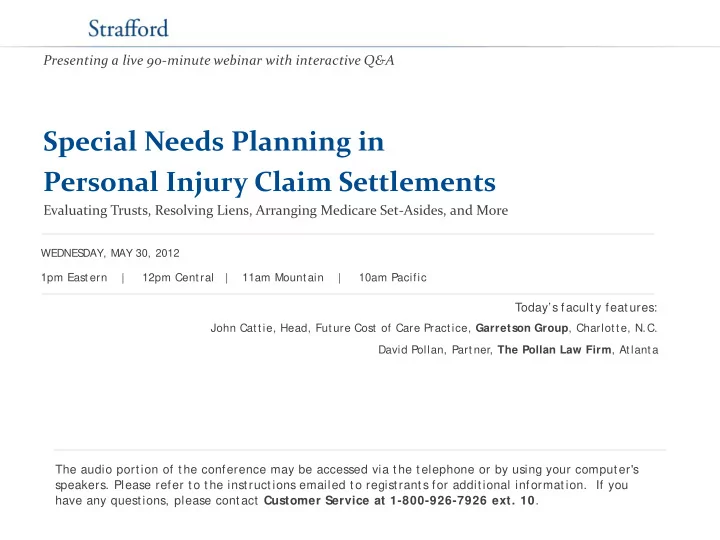
Presenting a live 90-minute webinar with interactive Q&A Special Needs Planning in Personal Injury Claim Settlements Evaluating Trusts, Resolving Liens, Arranging Medicare Set-Asides, and More WEDNES DAY, MAY 30, 2012 1pm East ern |


slide-1
SLIDE 1

Special Needs Planning in Personal Injury Claim Settlements

Evaluating Trusts, Resolving Liens, Arranging Medicare Set-Asides, and More

Today’s faculty features:

1pm East ern | 12pm Cent ral | 11am Mount ain | 10am Pacific

The audio portion of the conference may be accessed via the telephone or by using your computer's

  • speakers. Please refer to the instructions emailed to registrants for additional information. If you

have any questions, please contact Customer Service at 1-800-926-7926 ext. 10.

WEDNES DAY, MAY 30, 2012

Presenting a live 90-minute webinar with interactive Q&A

John Cat t ie, Head, Fut ure Cost of Care Pract ice, Garretson Group, Charlot t e, N.C. David Pollan, Part ner, The Pollan Law Firm, At lant a

slide-2
SLIDE 2

Conference Materials

If you have not printed the conference materials for this program, please complete the following steps:

  • Click on the + sign next to “ Conference Materials” in the middle of the left-

hand column on your screen.

  • Click on the tab labeled “ Handouts” that appears, and there you will see a

PDF of the slides for today's program.

  • Double click on the PDF and a separate page will open.
  • Print the slides by clicking on the printer icon.
slide-3
SLIDE 3

Continuing Education Credits

For CLE purposes, please let us know how many people are listening at your location by completing each of the following steps:

  • In the chat box, type (1) your company name and (2) the number of

attendees at your location

  • Click the S

END button beside the box

FOR LIVE EVENT ONLY

slide-4
SLIDE 4

Tips for Optimal Quality

S

  • und Qualit y

If you are listening via your computer speakers, please note that the quality of your sound will vary depending on the speed and quality of your internet connection. If the sound quality is not satisfactory and you are listening via your computer speakers, you may listen via the phone: dial 1-866-869-6667 and enter your PIN -when prompted. Otherwise, please send us a chat or e-mail sound@ straffordpub.com immediately so we can address the problem. If you dialed in and have any difficulties during the call, press *0 for assistance. Viewing Qualit y To maximize your screen, press the F11 key on your keyboard. To exit full screen, press the F11 key again.

slide-5
SLIDE 5
slide-6
SLIDE 6

Special Needs Planning in Personal Injury Claims

Strafford Publications

May 30, 2012

slide-7
SLIDE 7

7

1. Resolving Medicare & Medicaid liens

  • 2. Medicare Set-Asides
  • 3. Preserving Eligibility for Public Assistance Benefits
  • 4. Structure Settlements
  • 5. Special Needs Trusts

Agenda

slide-8
SLIDE 8

Resolving Medicare & Medicaid Liens

slide-9
SLIDE 9

9

The Settlement Continuum

defendant plaintiff

Date of Injury (DOI) Case Intake/Retainer Send Demand/File Lawsuit Negotiations Date of Settlement (DOS) Receipt of Funds Distribution of Proceeds (DOP)

GRG Resolution & Compliance Program

Question: What’s my MSP obligation re: medical expenses?

slide-10
SLIDE 10

10

What About Past Payments?

Q: What’s my MSP obligation re: past payments? A: Verify, resolve and satisfy any conditional payments made by Medicare from date of injury to date of settlement.

MSP Reimbursement for Past Medicals

MEDICARE REIMBURSEMENT CLAIM MEDICARE SET ASIDE?

2000 ---------------------------------------- 2011 2011 2012 2017 2022 2027 2032 2037 2042 2047 2052

10

slide-11
SLIDE 11

11

What About Past Payments?

Q: What’s my MSP obligation re: past payments? A: Verify, resolve and satisfy any conditional payments made by Medicare from date of injury to date of settlement.

MSP Reimbursement for Past Medicals

MEDICARE REIMBURSEMENT CLAIM MEDICARE SET ASIDE?

2000 ---------------------------------------- 2011 2011 2012 2017 2022 2027 2032 2037 2042 2047 2052

Early Verification = Key to Shortening Resolution Timeline.

11

slide-12
SLIDE 12

12

Medicare’s Conditional Payment System…

slide-13
SLIDE 13

13

Non-Compliance Penalties and Minimizing Liability

Non-compliance penalties (failure to reimburse) may be double

damages plus interest.

U.S. v. Harris, 2009 U.S. App. LEXIS 23394 (Oct. 23, 2009) U.S. v. Stricker, 2010 WL 6599489 (Sept. 30, 2010)

slide-14
SLIDE 14

14

What About Medicaid Liens?

Obligations re: Medicaid lien resolution are separate from Medicare

under MSP Act

Generally easier to handle Behind Medicare in terms of priority Vary from state to state

slide-15
SLIDE 15

Medicare Set Asides

slide-16
SLIDE 16

16

What About Future Payments? (Do I need one of those set asides?)

Q: What’s my MSP obligation re: future medicals? A: Determine IF a Medicare Set Aside (MSA) is appropriate under your case/claim specific facts and DOCUMENT THE FILE accordingly.

MSP Reimbursement for Future Medicals

MEDICARE REIMBURSEMENT CLAIM MEDICARE SET ASIDE?

2000 ---------------------------------------- 2010 2011 2012 2017 2022 2027 2032 2037 2042 2047 2052

slide-17
SLIDE 17

17

Lump-sum compromise settlement: Effect on payment for services furnished after the date of settlement— 42 C.F.R. §411.46(d)(1) & (2)

ALL settlements must “adequately consider” Medicare’s interest, no shifting of Medicare to be primary payer for past & future medical care.

  • Medicare will not pay for any medical expenses related to an

injury after settlement until the time the portion of the settlement allocated to future medical expenses covered by Medicare is fully exhausted.

slide-18
SLIDE 18

18

Lump-sum compromise settlement: Effect on payment for services furnished after the date of settlement— 42 C.F.R. §411.46(d)(1) & (2)

ALL settlements must “adequately consider” Medicare’s interest, no shifting of Medicare to be primary payer for past & future medical care.

  • Medicare will not pay for any medical expenses related to an

injury after settlement until the time the portion of the settlement allocated to future medical expenses covered by Medicare is fully exhausted. REMEMBER – the basic rule is that Medicare will pay for future injury-related care EXCEPT WHEN proceeds allocated to future medical expenses.

slide-19
SLIDE 19

19

Determining amount of compromise settlement considered as a payment for medical expenses. “If a compromise settlement allocates a portion of the payment for medical expenses and also gives reasonable recognition to the income replacement element, that apportionment may be accepted as a basis for determining Medicare payments.”

  • Since WC matters have 3 “buckets” of recovery (indemnity/wage loss,

past medicals & future medicals), if you know the wage loss component and the WC lien/CP amount, then the balance is the allocated amount to future medicals.

  • MSA amounts should be capped at the amount allocated to future

medicals, IF your case passes this test.

42 C.F.R. §411.47(a)(1)

slide-20
SLIDE 20

20

Determining amount of compromise settlement considered as a payment for medical expenses. “If a compromise settlement allocates a portion of the payment for medical expenses and also gives reasonable recognition to the income replacement element, that apportionment may be accepted as a basis for determining Medicare payments.”

  • Since WC matters have 3 “buckets” of recovery (indemnity/wage loss,

past medicals & future medicals), if you know the wage loss component and the WC lien/CP amount, then the balance is the allocated amount to future medicals.

  • MSA amounts should be capped at the amount allocated to future

medicals, IF your case passes this test.

42 C.F.R. §411.47(a)(1)

REMEMBER – while CMS has provided regulations in WC context, it HAS NOT provided any regulations in the liability context.

slide-21
SLIDE 21

21

Big R Towing, 2011 WL 43219 (2011)

– LMSA Appropriate

Finke, 2009 WL 6326944 (2009)

– LMSA Not Appropriate

Schexnayder, 2011 LEXIS 83687 (2011)

– CMS Approval of LMSA Not Necessary

Guidry, 2011 LEXIS 148942 (2011)

– Court approves MSA proposal “based on sound methodology”

Bruton, 2012 LEXIS 64416 (May 2, 2012)

– Medicare Provisions ≠ MSA Warranted

LMSA Case Law

slide-22
SLIDE 22

22

MSP Act is vague/ambiguous about how to address future medicals No regulations promulgated re: future medicals in liability cases

– 42 U.S.C. §1395hh(a)(2) says “No rule, requirement or other statement of policy that establishes a substantive legal standard … shall take effect unless it is promulgated by the secretary by regulation …” – However, WC regs say Medicare will pay future medicals except when allocation exists within award for future medicals plus gives guidance on how to determine the amount owed for medicals from an award

16 WCMSA Memos Versus 1 LMSA Memo plus 1 “Handout” (“Each attorney is going to have to decide … whether or not there is funding for future medicals”)

Deference

slide-23
SLIDE 23

23

MSP Act is vague/ambiguous about how to address future medicals No regulations promulgated re: future medicals in liability cases

– 42 U.S.C. §1395hh(a)(2) says “No rule, requirement or other statement of policy that establishes a substantive legal standard … shall take effect unless it is promulgated by the secretary by regulation …” – However, WC regs say Medicare will pay future medicals except when allocation exists within award for future medicals plus gives guidance on how to determine the amount owed for medicals from an award

16 WCMSA Memos Versus 1 LMSA Memo plus 1 “Handout” (“Each attorney is going to have to decide … whether or not there is funding for future medicals”)

Deference

Based on statute, regulations and administrative guidance, how much deference is owed to CMS at this time?

slide-24
SLIDE 24

24

Current Standard

“Reasonable good faith effort at compliance”

The public is entitled to receive fair notice of an administrative agency’s statutory interpretation of the statute it administers and regulations it promulgates…if no fair notice and parties act reasonably then parties can’t be punished, GE v. U.S. EPA, (53 F.3d 1324, 1333-1334 (D.C. Cir. 1995)) Fair notice is not policy memos, policy manuals, statements on websites, etc… absent regulations promulgated by an administrative agency, Christiansen v. Harris County, 529 U.S. 576, 587 (2000) Consequently, until such time as CMS promulgates regulations specific to the topic of future medical expenses in liability insurance matters under the MSP Act, its statutory interpretation of its rights of recovery to future medical expenses under the MSP Act will not receive Chevron-style deference from the judiciary – “Chevron” standard = federal administrative agencies are accorded “deference” so long as their interpretation of the regulations in question are reasonable

slide-25
SLIDE 25

25

WHAT DOES ALL THIS MEAN? WHERE ARE WE? To comply with the MSP Act (statute, regulations, guidance AND CASE LAW), parties must meet the following standard: REASONABLE GOOD FAITH EFFORT AT COMPLIANCE 2 steps to meet this standard:

1. Determine IF an LMSA is appropriate under your case specific facts; and 2. DOCUMENT THE FILE accordingly.

Proper Standard for Parties to Meet

slide-26
SLIDE 26

26

MSP Reimbursement – Future Interest KEY CONSIDERATIONS

1. Medicare’s past and future interest are considered/protected appropriately. 2. The parties are MSP compliant (based on statute, regulations, guidance and case law). 3. The claimant’s Medicare benefits are protected going forward.

How a formalized approach to MSP issues yields MSP compliant results

slide-27
SLIDE 27

27

MSA Process

Screen Assess Damages

Valuing Future Cost of Care

Educating

slide-28
SLIDE 28

28

MSP Reimbursement – Future Interest Relative to future medicals, settling parties should take four steps to “SAVE” a claimant’s Medicare card and the Medicare program (relative to future medicals):

1. Screen to validate candidacy for MSA. 2. Assess damages to determine future medical allocation. 3. Value future medicals for candidate case. 4. Educate & Administer MSA (when appropriate)

The Need to SAVE

slide-29
SLIDE 29

29

MSA Decision Making – Pre-Screening

Pre-screening:

– Is the Claimant enrolled in Medicare? – Has the Claimant applied for SSDI? – Is the Claimant 62 ½ or older? – Is the Claimant end stage renal?

If NO to all…

slide-30
SLIDE 30

30

MSA Decision Making– Pre-screen, MSA Not Needed

Document File Accordingly

slide-31
SLIDE 31

31

MSA Decision Making – Pre-Screening

Pre-screening:

– Is Claimant Medicare enrolled? – Has Claimant applied for SSDI? – Is Claimant 62 ½ or older? – Is Claimant end stage renal?

If YES to a single question…

slide-32
SLIDE 32

32

After Screening … Assess Damages Damage Assessment = Critical issue in MSA analysis

Assessing damages as compared to the gross recovery to determine if an allocation (express or implied) for future medicals exists.

– Absent an allocation for future medical expenses, an MSA would not be warranted following the standards under 42 C.F.R. §411.46(d)(2). – However, liability proceeds are rarely allocated in a specific manner for line item damages (future medicals or otherwise) and apportionment is difficult as recognized by the courts (Zinman v. Shalala, 67 F.3d 841, 846 (9th Cir. 1995)).

slide-33
SLIDE 33

33

Key Take Away Points

There is no requirement for set asides in liability settlements… Often times, the issue/debate “just won’t go away” between the parties as they are settling a case By no means is a Medicare Set Aside appropriate in every case… Perhaps the analysis is appropriate in every case…. When good faith analysis is completed, they may be the exception and not the rule Therefore, good faith effort at compliance means determining IF an MSA is appropriate under the case/claim specific facts AND then document the file

slide-34
SLIDE 34

34

Medicare Set-Aside (MSA) Decision Engine: New Tool

MSA Decision Engine

– Web based “self-service” technology – 24/7 accessibility – Utilizes a formalized approach to ensure that Medicare’s future interest is appropriately considered – Develops:

  • Claimant profile
  • Claims/injury profile
  • Healthcare profile
  • Litigation profile

– Provides guidance to whether an MSA is appropriate based on case specific facts

slide-35
SLIDE 35

35

Questions?

35

slide-36
SLIDE 36

36

Thank you! Please keep in touch…

slide-37
SLIDE 37

Supplemental Security Income and Medicaid – the Basics

David Paul Pollan, Esq.

The POLLAN Law Firm 1801 Peachtree Street Suite 125 Atlanta, Georgia 30309 678-510-1358 david@pollanlawfirm.com www.pollanlawfirm.com

slide-38
SLIDE 38

Two Genres of Public Benefits

  • Insurance Based Benefits
  • Welfare Based Benefits

38

slide-39
SLIDE 39

Insurance Based Benefits

  • Eligibility is based on an individual’s work

record

  • Financial status is not relevant in making

an eligibility determination

  • Social Security Disability Insurance (SSDI)
  • Medicare

39

slide-40
SLIDE 40

Social Security Disability Insurance (SSDI)

  • Eligibility is based on an individual’s

insured status – quarters of coverage

  • The required number of quarters of

coverage is tied to the age of the worker at the time the disability occurs

40

slide-41
SLIDE 41

SSDI (continued)

  • A child who became disabled prior to

turning 22 years old can draw SSDI on a parent’s work record at such time as the parent dies, retires or becomes disabled

  • After receiving SSDI for 2 years, an

individual is eligible for Medicare benefits

41

slide-42
SLIDE 42

Welfare Based Benefits

  • Eligibility is based in part upon an

individual’s financial status

  • Both income and assets are relevant
  • Supplemental Security Income (SSI)
  • Medicaid

42

slide-43
SLIDE 43

Source of Law for SSI

  • Federal Law: 42 U.S.C. § 1381 et seq.
  • Regulations: 24 C.F.R. 416
  • Operating Procedures: POMS SI

https://secure.ssa.gov/apps10/poms.nsf/cha pterlist!openview&restricttocategory=05

43

slide-44
SLIDE 44

Supplemental Security Income (SSI)

  • Monthly income benefit to individuals who

are aged, blind or disabled and are impoverished

  • Provides monthly income of up to $698

(2012 figure)

  • In GA, SSI comes with automatic Medicaid

eligibility

44

slide-45
SLIDE 45

Aged, Blind or Disabled

  • Aged
  • 65 or older
  • Blind
  • Visual acuity of no better than 20/200 in the

better eye, with corrective lenses; or

  • Visual field in the better eye of 20 degrees

45

slide-46
SLIDE 46

“Disability”

  • Age 18 or older
  • Inability to engage in substantial gainful

activity (“SGA”)

  • By reason of any medically determinable

physical or mental impairment

  • Which can be expected to result in death or

to last for a continuous period of not less than 12 months

46

slide-47
SLIDE 47

Substantial Gainful Activity

  • Based on an individual’s ability to earn

income

  • Amount of income determined to be SGA

depends on the nature of the individual’s disability

  • 2012 SGA Amounts: $1,690 for statutorily

blind individuals; $1,010 for non-blind individuals

47

slide-48
SLIDE 48

Rebutting the Presumption of SGA

  • Earnings include a subsidy (true value of

the work performed v. same or similar work performed by unimpaired person)

  • Work activity involves special

circumstances (extra assistance; rest periods; lower standards; family business; relationship with past employer)

48

slide-49
SLIDE 49

Rebutting the Presumption of SGA (cont.)

  • Impairment forces individual to stop work

within 3-6 months (unsuccessful work attempt)

  • Impairment-related work expenses

49

slide-50
SLIDE 50

Financial Eligibility for SSI

  • Income
  • Countable resources

50

slide-51
SLIDE 51

Asset Eligibility

  • Countable resources of no more than

$2,000 for an individual

  • Countable resources of no more than

$3,000 for a couple

51

slide-52
SLIDE 52

Countable Resources

  • Cash on hand or other personal property,
  • r real property than an individual:
  • owns or has an ownership interest in;
  • has the legal right, authority or power to

dispose of or to liquidate and convert to cash; and

  • is not legally restricted from using for

support and maintenance

52

slide-53
SLIDE 53

Countable Resources (cont.)

  • Value determined as of the first moment of

the first day of each month

53

slide-54
SLIDE 54

Examples of Countable Resources

  • Cash (other than current month’s income)
  • Stocks and bonds
  • CDs
  • Land/property on which the individual does not

reside

  • Life insurance policies with a face value of
  • ver $1,500
  • Certain trusts

54

slide-55
SLIDE 55

Examples of Excluded Resources

  • Home in which the individual resides, and

contiguous land

  • One car, regardless of value if used for

transportation of the individual or household

  • Household goods in or near the home and

used on a regular basis or needed for household maintenance

55

slide-56
SLIDE 56

Excluded Resources (cont.)

  • Personal effects ordinarily worn or carried

by the individual

  • Personal effects which have an intimate

relationship to the individual (not held/acquired because of value)

  • Back-payments of SSI/SSDI for 9 months
  • Burial funds up to $1,500

56

slide-57
SLIDE 57

Excluded Resources (cont.)

  • Burial plots or spaces
  • Property used for self-support
  • Proceeds from the sale of a home if used

within three months to purchase another primary residence

  • Resources necessary to fulfill a Plan to

Achieve Self Support (PASS)

57

slide-58
SLIDE 58

Excluded Resources (cont.)

  • Real property listed for sale (for up to nine

months)

  • Real property, the sale of which would

cause an undue hardship

  • Any grant, scholarship, fellowship or gift for

the cost of tuition or fees, for nine months

58

slide-59
SLIDE 59

Deeming

Under its “deeming” rules, the Social Security Administration “deems” or treats the countable resources (and income) of SSI ineligible parents, spouses or alien sponsors as if they were available to the SSI recipient , even if the resources are not actually available

59

slide-60
SLIDE 60

Deeming (cont.)

  • Usual resource exclusions apply
  • Additionally, funds in retirement accounts

belonging to an ineligible parent or spouse are excluded

60

slide-61
SLIDE 61

Income Eligibility

  • Definition of income: anything received in

cash or in kind that can be used to meet the need for food or shelter

  • Countable income limit of $698 for an

individual; $1,048 for a couple

  • Income is counted on a monthly basis, in

the month of receipt; if retained into the next month it becomes a resource

61

slide-62
SLIDE 62

Income Eligibility (cont.)

  • Virtually all income is countable, though

there are certain exclusions and deductions

  • Countable income reduces the maximum

monthly SSI benefit – possibly to $0, making the individual financially ineligible for SSI

62

slide-63
SLIDE 63

Types of Income for SSI

  • Unearned Income
  • Alimony, child support, pensions,

annuities, rent, interest, SS benefits, VA benefits, workers comp benefits, unemployment, prizes, gifts, awards, inheritances

  • Earned Income
  • Income from work – wages, salary, tips,

commission, bonuses

  • In-Kind Income

63

slide-64
SLIDE 64

Examples of Excluded Income

  • Income tax refunds
  • proceeds of a loan
  • bills paid by others directly to the vendor for

goods or services that are not food or shelter

  • weatherization assistance
  • grant/scholarship/fellowship funds used for

paying necessary education expenses

  • ne-third of child support paid by an absent

parent

64

slide-65
SLIDE 65

Excluded Income (cont.)

  • assistance based on need from a state or

local government, including rent subsidies

  • in-kind income based on need provided

by nonprofit organizations

  • impairment-related work expenses
  • domestic commercial airline tickets

received as gifts, as long as they are not cashed-in

65

slide-66
SLIDE 66

Excluded Income (cont.)

  • certain income earned by a blind or disabled

student regularly attending school

  • food stamps
  • interest and dividend income earned on

countable resources

  • $30 per quarter of infrequent, irregular

earned income

  • $60 per quarter in infrequent, irregular

unearned income

66

slide-67
SLIDE 67

Income Deductions

  • Applied after all exclusions have been

applied

  • “the monthly disregard”
  • General/Unearned Income Deduction
  • Deduct $20 per month of unearned

income (or of earned to the extent there is not unearned income)

67

slide-68
SLIDE 68

Income Deductions (cont.)

  • Earned Income Deduction
  • Deduct $65 + ½ the remainder of gross

monthly earned income

68

slide-69
SLIDE 69

In-Kind Income

  • Receiving food or shelter for free or at a

reduced charge

  • Living with parents free of charge; having

rent paid by a special needs trust)

  • Known as “in-kind support and

maintenance” or “ISM”

  • Considered by SSA in determining the

individual SSI award

69

slide-70
SLIDE 70

Determining the Amount of ISM to be Counted as Income

  • One-Third Reduction rule
  • Presumed Maximum Value (“PMV”) rule

70

slide-71
SLIDE 71

One-Third Reduction Rule

  • Applies when SSI recipient lives in the

household of a person who suppies both food and shelter without charge

  • SSI benefit is reduced by 1/3 of the federal

benefit rate

  • For 2012, the decrease in benefits for ISM

under this rule is $233

71

slide-72
SLIDE 72

Presumed Maximum Value

  • Applies any time the One-Third Reduction

rule does not

  • SSA reduces the SSI recipient’s benefit

dollar-for-dollar by the actual value of the ISM, or 1/3 of the federal benefit rate – whichever is less

72

slide-73
SLIDE 73

Advocacy Tip

  • Flat fee agreement for Rent, Food and

Utilities

  • Rental Liability as Living Arrangement (LA)

Basis (SI 00835-120)

73

slide-74
SLIDE 74

Deeming of Income

  • SSI Income deeming applies:
  • From ineligible spouse to recipient spouse
  • From ineligible parent to eligible child in the

same household

  • From sponsor to eligible alien
  • Appropriate exclusions and deductions from

the deemor’s income apply

  • Deeming rules vary by relationship

74

slide-75
SLIDE 75

Gifts and Transfer Penalties

  • Foster Care Independence Act of 1999
  • Imposes penalties for SSI purposes when

assets are transferred for less than fair market value

  • Where an SSI recipient or his/her spouse a

penalty is calculated by dividing the uncompensated value of the transfer by the maximum monthly benefit payable ($698 in GA for 2012)

75

slide-76
SLIDE 76

Foster Care Independence Act of 1999 (cont.)

  • Maximum 36 month penalty for transfers
  • Effective date for a transfer is the first day
  • f the month following the transfer

76

slide-77
SLIDE 77

Exceptions to Transfer Penalties

  • Disposed of the resource exclusively for a

purpose other than qualifying for benefits

  • Intended to dispose of the asset for fair

market value

  • Transferred assets have all been returned
  • Denial of SSI eligibility would result in undue

hardship

  • Transfers to Special Needs Trusts
  • Irrevocable Special Needs Trust
  • “Grantor”-type
  • NOT “Third-party” Special Needs Trust

77

slide-78
SLIDE 78

Medicaid

  • In Georgia, an SSI recipient is

automatically eligible to receive Medicaid benefits

  • Medicaid is not limited only to SSI

recipients

  • Georgia has multiple Medicaid programs,

each with differing eligibility requirements and varying levels of healthcare coverage

78

slide-79
SLIDE 79

Understanding Structured Settlements

slide-80
SLIDE 80

What is a Structured Settlement?

A structured settlement is an insurance product that guarantees monthly distributions to the plaintiff on a tax-free basis. The Periodic Payment Settlement Act of 1982 provided changes to tax rules for the express purpose

  • f

ensuring disabled individuals’ independence from government assistance for as long as possible.

80

slide-81
SLIDE 81

Benefits of Structured Settlements

  • financial security through guaranteed long-term income

rather than on an investment strategy

  • structured settlements are 100% tax exempt
  • reduced risk of unnecessary waste through mismanagement

(most people do not have the necessary experience to manage a large sum of money)

  • payments may be guaranteed for a specific period of time, or

for as long as the plaintiff lives

81

slide-82
SLIDE 82

Considerations When Evaluating the Use of Structures

  • Choose wisely- an individual cannot accept settlement

proceeds in a lump sum and then elect to structure the settlement at a later date.

  • Payment streams are fixed- once a plan is established,

changes to the income stream cannot be made without

82

slide-83
SLIDE 83

Structured Settlements and Government Benefits

Income generated by a structured settlement is completely disregarded for purposes of Medicaid eligibility when it is directed to a qualifying irrevocable special needs trust. Advisability of income stream payments directly to the individual with a disability depends

  • n such individual’s other sources of income and their respective class of government

benefits. For example, an individual on “hospital” Medicaid has no cost share. If the income cap for this class of Medicaid is $2,094, as long as her combined sources of income do not exceed this income cap, she remains Medicaid eligible without the necessity of a special needs trust. State must be designated as the remainder beneficiary for the structured settlement unless she has minor children or a spouse, in which case the State is the remainder beneficiary after the minor children and the spouse.

83

slide-84
SLIDE 84

Special Needs Trusts:

Not All Trusts Should Be Created Equally

slide-85
SLIDE 85

Special Needs Trusts

  • Designed to allow a disabled individual to continue

to receive governmental assistance

  • Enjoy benefit of assets
  • Held in trust and administered under prescribed rules
  • Will enhance their quality and enjoyment of life

85

slide-86
SLIDE 86

Without Proper Planning

  • Loss of Medicaid Benefits
  • Inheritance
  • Uniform Gift to Minor’s Trust Account
  • Individual Retirement Account (IRA)
  • Left for benefit of disabled child
  • Loss of thousands or tens of thousands of dollars
  • Use of SNT protects an inheritance by allowing continuing

eligibility for benefits programs

  • Medicaid is often only way disabled individual can obtain

medical care/treatment

86

slide-87
SLIDE 87

Omnibus Reconciliation Act of 1993

  • OBRA ‘93 limits the use of trusts for Medicaid planning

purposes.

  • Was in response to perceived abuses by the elderly and

disabled

  • Expanded the scope of transfer of asset penalties
  • New rules created enhanced penalties for transfers of assets

for eligibility purposes

  • Extended the “look back” period from 30 months to 36

months for outright transfers, and to 60 months for transfers to irrevocable trusts

  • Created exception to transfer of assets penalty including

transfers to a “d4” trust.

87

slide-88
SLIDE 88

Post OBRA ‘93 Exemptions for Transfers of Assets and Medicaid Eligibility

  • Transfers exempt from assessment of a penalty period

include:

  • transfers for fair market value or other valuable consideration
  • transfers for a purpose other than to qualify for Medicaid
  • transfers which would result in the imposition of undue hardship

from the assessment of a penalty

  • transfers between spouses or to another for the sole benefit of

the spouse

  • transfers to a blind or disabled child, or to a trust created for the

sole benefit of the child, regardless of the child’s financial need

  • transfers of non-countable resources (with exceptions)
  • transfers to a newly created “d4” or payback trust

88

slide-89
SLIDE 89

The Foster Care Independence Act

  • f 1999 and SSI Eligibility Issues
  • It radically altered how assets may be preserved for purposes of SSI

eligibility

  • Includes new SSI “anti-fraud” provisions to pay for increased foster

care spending

  • Reinstated the SSI transfer of assets penalty, previously abolished in

1988, and changed SSI rules regarding treatment of trusts as a resource for eligibility purposes

  • SSI and Medicaid rules governing third-party trusts, such as

testamentary trusts or inter vivos trusts remain unchanged

  • Trusts established on or after January 1, 2000 are considered for

eligibility purposes regardless of whether they are irrevocable or revocable, regardless of the reasons for which they were established, and regardless of whether or not the trustees have discretion on distributions.

89

slide-90
SLIDE 90

SSI Transfer of Assets Penalty

  • Foster Care Independence Act of 1999 provides for 36 month

look back period starting with the later of the SSI application date or the date of the application for SSI benefits or the date

  • f transfer.
  • The penalty is calculated based on the value of the asset

transferred or gifted divided by the SSI federal based rate.

  • SSI rules, however, provide for a maximum 36 month penalty

period.

90

slide-91
SLIDE 91

Exceptions to the General Treatment of Trusts for SSI Eligibility Purposes

  • Section 206 of the Foster Care Independence Act of 1999

clarifies that trusts established with assets of an eligible individual are exempt for the SSI transfer of assets rules.

  • Like OBRA ‘93, exceptions to the revised treatment of trusts

exist and exempt:

  • trusts established for a disabled individual under age 65 by a

parent, grandparent, legal guardian, or a court of competent jurisdiction (provided that the State will receive amounts remaining in trust, up to the amount of medical assistance provided to the disabled individual from the creation of the trust upon the beneficiary’s death)

  • non-profit “pooled” trusts, regardless of the beneficiary’s age

91

slide-92
SLIDE 92

Exceptions to the General Treatment of Trusts for SSI Eligibility Purposes- cont.

  • Similar to the OBRA ‘93 exceptions, an SSI transfer of asset

penalty will not be assessed if:

  • the assets transferred to an OBRA ‘93(d)(4)(A) individual trust for

the sole benefit of the individual, or, a non-profit, pooled trust.

92

slide-93
SLIDE 93

OBRA ‘03 Special Needs Trusts Opportunities to Preserve Medicaid and SSI Eligibility

  • OBRA ‘93 d4 special needs trust:
  • irrevocable
  • assets held in trust are no longer available to the disabled

individual for eligibility purposes

  • makes provision for a Medicaid lien against the trust assets to

recover costs expended on behalf of the beneficiary

  • requires that the trust be for the sole benefit of the disabled

individual

  • when properly drafted and administered, it can complement

benefits derived from Medicaid, and often, SSI

93

slide-94
SLIDE 94

The d4C Trust:

  • also known as the “Pooled Asset Trust”
  • contains the assets of an individual who is disabled (as defined

in section 1614(a)(3)) that meets the following conditions:

  • (1) it is established by a non-profit association
  • (2) a separate account is maintained for each beneficiary of the trust,

but for purposes of investment and management, the trust pools these accounts

  • (3) accounts in the trust are established by the parent, grandparent,

legal guardian, by the individual, or by a court solely for the benefit of individual who is disabled

  • (4) upon the beneficiary’s death, amounts equal to the total paid out
  • n behalf of the beneficiary for medical assistance is paid to the

State.

94

slide-95
SLIDE 95

Considerations

  • A d4 OBRA ‘03 trust will NOT allow eligibility for SSI and

Medicaid unless the individual is disabled

  • Both the individual and non-profit trusts refer to the assets of an

individual who is “disabled” as defined in Section 1614(a)(3) [42 U.S.C. §1382(c)(a)(3)]

  • If the individual is expected to be restored from their disability, or

the disability is temporary, careful consideration must be given to the advisability of the trust

  • OBRA ’93 clearly restricts the use of d4A trusts to individuals

who are “under age 65” at the time the trust is established

  • consideration should be paid toward classes of medical

assistance that are income-based only when considering the advisability of such a trust.

95

slide-96
SLIDE 96

Considerations, cont.

  • The OBRA ‘03 trust must include a lien provision requiring reimbursement

to the state Medicaid agency for any amounts paid out on behalf of the beneficiary subsequent to the establishment of the trust

  • Prior to the establishment of the trust, any pre-existing Medicaid liens must

be satisfied. If the trust is prematurely funded without repayment of the pre- existing Medicaid lien, the assets remain reachable by the State.

  • Exempt OBRA ‘93 trusts must be irrevocable.
  • The trust must name a residual beneficiary to receive the trust assets once

the Medicaid lien is satisfied following the death of the disabled beneficiary.

96

slide-97
SLIDE 97

Historic Case Law

42 U.S.C. § 1396(p)(d)(4)(A) seems to suggest that the pre-recovery Medicaid lien is deferred until the death of the disabled beneficiary. So reasoned a line of several New York lower court rulings beginning with Matter of Link, 616 N.Y.S. 2d 171 (Sup., 1994), reargued 620 N.Y.S. 2d 729 (Sup.1994), which held that 42 U.S.C. § 1396(p)(d)(4)(A) and (C) required that all Medicaid liens be deferred until an OBRA 93 trust terminates at the death of the beneficiary. The Link court determined that Congress did not intend to require that pre- recovery Medicaid expenditures be immediately reimbursed upon recovery but instead to permit deferral of post-recovery expenditures.

97

slide-98
SLIDE 98

Historic Case Law, cont.

However, the New York Court of Appeals subsequently overturned Matter of Link in the far reaching twin decisions of Cricchio v. Pennisi, 683 N.E.2d 301 (N.Y. 1997) and Link v. Town of Smithtown, 670 N.Y.S.2d 692 (N.Y. Sup. Ct. 1997), which held that liens for Medicaid expenditures advanced prior to receipt of a personal injury award or settlement must be satisfied before an OBRA 93 trust can be funded. The Court reasoned that 42 U.S.C. § 1396a(a(25)(A) and (B) require states to seek to recover Medicaid expenditures from potentially liable third parties, while 42 U.S.C. § 1396k(a) conditions Medicaid eligibility upon a Medicaid recipient’s assignment to the state of any claims they may have against third parties for their medical care paid for by Medicaid.

98

slide-99
SLIDE 99

Administration of a d4 OBRA ‘93 Trust

  • A d4 OBRA ‘93 trust can be used in a myriad of ways to

enhance the quality of life for a disabled individual; for example:

  • it can be used to supplement the Medicaid reimbursement for a

semi-private room, allowing the beneficiary to enjoy a private room;

  • it can cover experimental or restorative therapies not covered by

Medicaid, such as massage therapy or accupuncture

  • it covers certain purchases, such as a computer, customized van,
  • r real estate serving as the primary residence for the

beneficiary; however, payments for food, clothing, or shelter could terminate or reduce their benefits

99

slide-100
SLIDE 100

Administration of a d4 OBRA ‘93 Trust, cont.

  • Depending upon the size of the settlement, a corporate fiduciary

may not be available and the beneficiary may choose a family member or a friend to serve as Trustee

  • Careful drafting of the trust could provide for mandatory

reporting to a named “trust protector”

  • Consideration should always be given to the non-profit Georgia

Community Trust

  • Regardless of whomever is ultimately selected as the Trustee,

there must always be monitoring for changes in the rules governing the disabled individual’s benefits programs/

  • An annual trust inventory and accounting must be provided to

the State Medicaid agency.

100

slide-101
SLIDE 101

Treatment of Income

SI 00815.050 Medical and Social Services, Related Cash, and In-Kind Items

  • A. General
  • Policy Principle: Medical and social services are not income for purposes of the

supplemental security income (SSI) program. Under the circumstances specified in this section, cash and in-kind items received in conjunction with medical and social services are also not income for SSI purposes.

  • When applying the guidelines in this section, be alert to the possibility that broad

categories of assistance (e.g., adoption assistance, foster care, noninstitutional care of the type provided in group homes or halfway houses) may in some cases include medical and social services as part of their overall program. Therefore, when an item which is otherwise income is provided in connection with a broad category of assistance, extensive development may be required as outlined below to determine whether this section is applicable (i.e., to determine whether

  • r not the item is income).

101

slide-102
SLIDE 102
  • Assume that governmental medical and social service programs

which provide cash or in-kind items are authorized to provide such items only in order to provide a medical or social service. Therefore, when an individual alleges receiving cash or in-kind items from a governmental medical or social service program, develop only for the source of the item, not its purpose.

  • Do not assume, however, that cash or in-kind items provided by a

nongovernmental medical or social service organization can only be for medical or social service purposes. When a nongovernmental medical or social service organization is involved, develop both the source and the purpose of the cash or in-kind item. Subsections SI 00815.050B. through SI 00815.050E. explain the guidelines for determining whether or not the cash or item is income.

Treatment of Income, cont.

102

slide-103
SLIDE 103
  • Do not apply the rules in this section to two kinds of payments which,

although commonly associated with medical or social services, are income, regardless of the source of payment:

  • Remuneration for work or for activities performed as a participant in a

program conducted by a sheltered workshop or work activities center is earned income. See SI 00820.300.

  • Incentive payments to encourage individuals to utilize specified

facilities or to participate in specified medical or social service programs are unearned income, to the extent that these payments are unrestricted as to use and are not reimbursement for medical or social services already received. Accept the individual's allegation as to the purpose and the amount of the payment; however, if the person does not know this information or if there is reason to question his statement, verify the information by obtaining documentary evidence or by contacting the source of the payment.

Treatment of Income, cont.

103

slide-104
SLIDE 104

While SNT forms are widely available through various sources, SNTs are not a “one size fits all” solution. One must take into account the disabled individual’s level of care, their living arrangements, and what the income and asset rules are for their respective class

  • f Medicaid prior to concluding that a SNT is

advisable.

104

slide-105
SLIDE 105

David Paul Pollan, Esq.

The POLLAN Law Firm 1801 Peachtree Street, Suite 125 Atlanta, Georgia 30309 678-510-1358 david@pollanlawfirm.com www.pollanlawfirm.com David Paul Pollan has been practicing exclusively in the area of elder law and special needs issues

affecting the disabled community since 1990. He is a member of the National Academy of Elder Law Attorneys and has served the elder and disabled communities through his work with AARP, Atlanta Regional Committee Aging Services Board, the Senior Citizens' Law Project, the Elder Law Committee

  • f the State Bar of Georgia, the Georgia Community Trust and Weinstein Hospice. He is also a member
  • f the Georgia ElderCare Network, a statewide alliance of professionals assisting Georgia families to

plan and deal with the issues of aging. He is rated AV Preeminent by Martindale-Hubbell.

Special Needs Trusts:

Not All Trusts Should Be Created Equally