
SLIDE 1
SPE 555
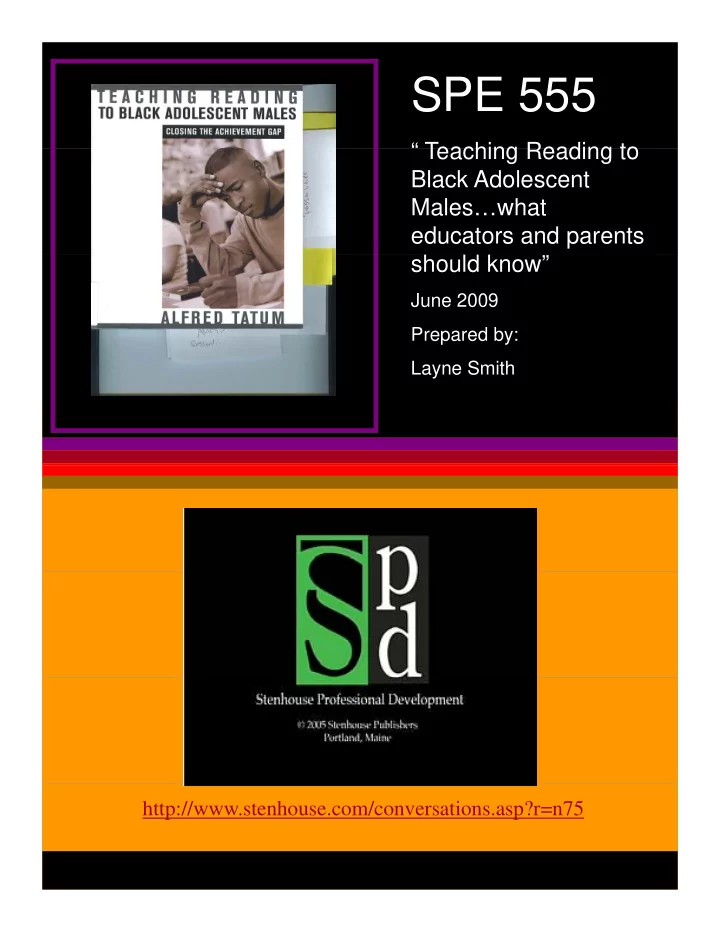
“ Teaching Reading to Teaching Reading to Black Adolescent Males…what educators and parents should know”
June 2009 Prepared by: Layne Smith
http://www.stenhouse.com/conversations.asp?r=n75
SPE 555 Teaching Reading to Teaching Reading to Black Adolescent - - PDF document
SPE 555 Teaching Reading to Teaching Reading to Black Adolescent Maleswhat educators and parents should know June 2009 Prepared by: Layne Smith http://www.stenhouse.com/conversations.asp?r=n75 How can teachers use
“ Teaching Reading to Teaching Reading to Black Adolescent Males…what educators and parents should know”
June 2009 Prepared by: Layne Smith
http://www.stenhouse.com/conversations.asp?r=n75
“How can teachers use assessments to ensure students are being provided with i t ti th t t k i t t instruction that takes into account their strengths and weaknesses?” –Dr Tatum on weaknesses? Dr. Tatum on “Critical Questions”
D t t f Lit Ed ti t N th Department of Literacy Education at Northern Illinois University. Before joining NIU’s faculty, he was an assistant professor of reading in the Department of Curriculum and Instruction at the University of Maryland. He began his career as an 8th grade teacher on the South Side of Chicago where he taught for five years.
Literacy Development in Black Adolescent Males Turmoil and the Promise of Reading Black Males and the Reading Achievement Gap Reconceptualizing the Role of Literacy Instruction
Structuring Curriculum Orientations that Empower Students
Culturally Responsive Teaching Literacy Instruction Cognitive Close-ups Methods of Professional Development for Teachers Anticipatory Set of Questions Participant Evaluation
Chapters 1,2,and 3
Classroom environments often alienate the black male. Peer culture becomes more relevant culture becomes more relevant and meaningful than the school environment.
These students often fail to see the relevancy in the school experience. Some are exposed to violence and exposed to violence and gang activity at a young age, and are too consumed with and are too consumed with fear and a need for personal safety to actively engage in a curriculum that is not related to this primary need.
male characters.
engage boys emotionally engage boys emotionally with the characters.
Expose boys to non fiction that involves learning something new.
male experience and support boys’ view of themselves. boys view of themselves.
appropriate level of app op ate e e o challenge.
g included.
immediate.
Many urban communities are populated with low-skill laborers with little
multinational corporations grow multinational corporations grow larger, urban economic neglect and the scarcity of job opportunities have led to a decline in the overall quality q y
the 1980’s and 1990’s. This has led to higher levels of drug-related crime and violence and violence.
“I read about an anxious J i h b i young Jewish boy preparing for his Bar Mitzvah. I concluded that something g was missing in my life. What was my rite of passage? As I compared my life to those compared my life to those characters in the books I was reading, I came to feel as though my development was being charted in insignificant waters ” waters…
In their book Black Man Emerging, J h Whit d J C Joseph White and James Cones assert that the story of black men in America has three beginnings: g g
Years of oppression and stereotyping in the media set up barriers to black in the media set up barriers to black males in a subservient role in society.
The “Cool Pose” is ritualized form The Cool Pose is ritualized form
behaviors, scripts, physical , p , p y posturing, and carefully crafted performance to convey a strong f d h d impression of pride, strength, and
invisibility, and marginality.
t h d t h t d toughness, detachment, and style. Maintain a balance between
his inner life and his social environment. environment.
anxiety. y
empower him.
in the face of discrimination and prejudice.
i hi lif in his life.
Although adopting the cool pose as a coping mechanism can be in some ways p g y positive, it can have some negative consequences.
understanding of the coping mechanism. L k f lf di l th t k
him difficult to “reach” Avoidance of institutions that are
“uncool” (school, museums, churches, etc.) churches, etc.)
violence.
Institutional responses to black male turmoil vary. Some are designed to help black males move beyond black males move beyond their turmoil. Other are punitive in nature, their punitive in nature, their intent being to stamp out the black males’ response to turmoil.
According to the study Cellblocks or Classrooms? The Funding of Higher Education and Corrections Higher Education and Corrections and Its Impact on African American Men, spending on ti t l t i ti corrections grew at least six times the rate of state spending on education between 1980-2000.
During this time, the number
United states quadrupled from 500 000 to 2 million from 500,000 to 2 million. Although only 13% of the total population are black total population are black males, they make up 50% of the prison population.
This increase in spending came as a result of the War on Drugs w hich targeted Drugs, w hich targeted young black males w ho had turned to drug g dealing as a response to turmoil, as a w ay out
To remedy black males’ underachievement some underachievement, some educators have established school and community programs specifically to programs specifically to educate black males. Some examples: D t it’ M l l X A d
These schools offer an These schools offer an Africentric curriculum and “rites
specifically for black males. specifically for black males.
Traditional schools inadvertently create difficulties for black males create difficulties for black males in turmoil in several ways:
This includes minor things teachers say or do on a day-to-day basis that may anger their black male students For example: “If male students. For, example: If you practiced your math as much as you practiced basketball, you as you practiced basketball, you wouldn’t be failing.” Statements like this project stereotypical images of black males.
Assessments such as IQ Tests often become a simplistic approach to d fi i t d t biliti d defining students abilities and
historical truths and cultural historical truths and cultural principles.
Bl k l l Black males are very rarely found in gifted programs. This may be a result of lower This may be a result of lower expectations of teachers, brought on by heavy reliance g y y
history and culture.
Poor black young people often Poor black young people often must attend schools characterized by poorly prepared teachers, y p y p p , inadequate educational facilities, low teacher expectations, and ff d ineffective administrators.
The expulsion and suspension rates of black males are disproportionately higher than all
school district, black males make up only 12% of the population, but up only 12% of the population, but
district is far from being unique.
Social Literacy—The ability to navigate a
variety of settings with people with similar or variety of settings with people with similar or dissimilar view.
Academic Literacy—Skills and strategies that
can be applied independently to handle cognitively demanding tasks.
Cultural Literacy—A consciousness of historical Cultural Literacy
A consciousness of historical and current events that shapes one’s identity as an African American.
Emotional Literacy
The ability to manage
Emotional Literacy—The ability to manage
Chapters 4,5, and 6
is to help teachers and administrators create classrooms h bl k l i lit where black males receive literacy instruction that both promotes academic excellence and nurtures a positive identity of who they are and what they can become – classrooms that are nesting classrooms that are nesting grounds for literacy development.
Steps in making one’s classroom a nesting ground for Black Male students should focus on:
development
identity and masculinity identity and masculinity
man in America?
despised because of the color of your skin?
misunderstood?
d l stereotyped as a criminal?
invisible? invisible?
suggest why a high percentage
undereducated or miseducated in many of America’s schools many of America s schools.
is, how is this meaningful for those being taught? those being taught?
teaching this?
should be addressed when examining curriculum materials examining curriculum materials,
schooling.
curriculum orientation for black males teachers must evaluate males, teachers must evaluate present curricula and select quality materials that will engage their black male students and maximize the potential for improved academic, social, and improved academic, social, and economic outcomes.
Th l h b t th i Th
Bible
The Emancipation Proclamation
Frederick Douglass, An American Slave by Frederick Douglass Slave by Frederick Douglass
Washington
The Miseducation of the Negro by Carter G. Woodson
by Alex Haley and Malcolm X by Alex Haley and Malcolm X
The Fire Next Time by James Baldwin
Native Son and Black Boy by Richard Wright
perspective and we can find relevance in these books today.
turned off by long books is to have black males read more texts that address their concerns and texts that address their concerns and texts that can help shape their ideas and their
l d b i d if th males read can be increased if they are given text that matters to them.
y p pp teachers’ using their students’ culture as an important source of the students’ education.
teaching is:
heritage as it affects their dispositions, attitudes and approaches to learning attitudes, and approaches to learning, and recognizes that it contains content worthy to be included in the curriculum.
home and school experiences as well as “school stuff” and the students’ lived realities. ed ea t es
strategies.
students’ own cultural heritage as well as that of others.
information, resources, and materials in the subjects and skills routinely taught in schools taught in schools.
C l ll i d
has been effective for addressing the literacy needs addressing the literacy needs
policy makers, school d i i d l administrators, and classroom teachers have not called for its widespread implementation as widespread implementation as a way to promote the reading achievement of black males.
Chapter 7
When teachers give their students skills and e teac e s g e t e stude ts s s a d strategies without showing them the transformative possibilities associated with those skills and strategies, the students will g , find them to be useless tools. This is what happens, for example, when teachers use test prep in an attempt to improve students' reading scores. Students ask: "Why are we doing this?“ or complain, "We did this already." If teachers are unable to make the k ll d h h l skills and strategies they teach relate in some way to their students' lives, the students will not see the need to use the skills and t t i strategies.
Chapter 7
Why are Black male students different? According to Tatum it is because…
Teaching a black male student that reading fluently, making inferences, improving vocabulary and writing does matter These vocabulary, and writing does matter. These literacy goals have to be embedded in texts that mean something to these young men. By the time black male students reach By the time black male students reach middle school and high school, they want to know how improved literacy will benefit them personally them personally.
Tatum makes an interesting analogy of comparing d h h soccer to reading. Both require commitment in the process, and a certain amount of pain is endured in the process. With both activities, you must do the following: g Make yourself comfortable beforehand by setting expectations, or a purpose. In reading, you might scan the text for difficult vocabulary or words that you the text for difficult vocabulary, or words that you could say might cause pain. Practice or use the skills and knowledge you already possess to help you succeed in the case of reading possess to help you succeed—in the case of reading, your aim would be to understand text. Be willing to do something different when you b l encounter obstacles.
Setting a purpose for reading is Setting a purpose for reading is necessary, not unlike coaching strategy for an upcoming soccer game game
Constructing meaning of the text using lti l i t multiple cueing systems; Becoming actively engaged with text by monito ing comp ehension as the ead monitoring comprehension as they read; Assessing their understanding after the reading reading.
Chapter 7
Put text in their own words to check
comprehension;
Understand that reading is more than
answering questions correctly; answering questions correctly;
Use multiple cueing systems (visual,
structural, meaning, and background knowledge);
Understand reading as a meaning-
making process; making process;
Read fast enough to make sure they
connect the beginning of the text with the end of the text end of the text.
Chapter 8 Wh d d t t th t t Why do we need to strengthen text discussions with Black Male students?
There is a urgent need to help black male students break the “underachieving” cycle students break the underachieving cycle.
Discussing texts with black males cannot be separated from the role of literacy instruction, the importance of i l i i d h d f l ll curriculum orientation, and the need for a culturally responsive approach to literacy teaching. Discussing texts with these—or any—students is not possible if they do not have the skills and strategies that possible if they do not have the skills and strategies that anchor a comprehensive approach to literacy teaching. Discussing texts with black male students cannot be done effectively without an awareness of their identity and their effectively without an awareness of their identity and their definition of mas-culinity, as pointed out in the research
Discussing texts with black male students cannot be Discussing texts with black male students cannot be separated from the turmoil they are forced to endure.
Tatum believes that text for Black Males should be authentic to strengthen their black male identity. For text discussions with black males to be effective, teachers must take into account the turmoil in their students' lives. Ideally, the texts that are selected should have multiple functions. For each text being considered, ask the following questions:
identity?
reading strategies needed to comprehend text reading strategies needed to comprehend text independently?
In addition, the texts need to be , discussed in culturally responsive
in the class profoundly affects black in the class profoundly affects black males' engagement or disengagement as readers. Literature h ld h l th should help these young men understand history, substantiate their existence, and give them a chance to g examine possible political, social, and cultural undertakings that may present themselves in the future present themselves in the future.
Tatum’s findings suggests that his students’ problem with comprehension were more related to fluency than decoding. Planned fluency and word study instruction (such as decoding by analogy) using text that the students were required to read in order to respond to students' needs at the word level was
p g word study instruction and not teach words in
word level did not require more phonics instruction; instead they needed word study instruction that instead, they needed word study instruction that would help them quickly recognize phonogram patterns in multi-syllable words.
Chapter 9
Fluency and Multi-Syllabic Words Tatum’s conclusion
“Without a careful and thorough assessment profile of students' assessment profile of students decoding abilities, a teacher might give his/her students more g g phonics instruction, which would have resulted in misdirected d ff t ” energy and effort.”
Several years ago
Tatum’s ll i f d t th t h colleagues informed a parent that her son had a reading problem. The mother asked the teacher how she might best help her son at home The teacher replied that the son at home. The teacher replied that the youngster simply needed to read more. The mother persisted: "Are there certain things I should help him with?" The things I should help him with? The teacher responded, "Just have him read more and he should be okay." Then the mother asked the teacher to suggest mother asked the teacher to suggest some readings for her son. The teacher responded, "It does not matter what he reads as long as he is reading." g g
Chapter 9
Getting a complete picture “What Tatum does not like to hear from teachers”
This exchange troubled Tatum on several g levels. Can anyone guess why Dr. Tatum found this disturbing coming from a teacher?
Class response activity.
Chapter 9
Getting a complete picture “What Tatum does not like to hear from other teachers”
’ Tatum’s response: First, the teacher did not have a sense of h t i th ' diffi lt what was causing the young man's difficulty with reading. Just saying that a student has a "reading problem" is too open-ended. Second, the teacher did not give the mother specific suggestions on how to support her son at home and help him improve his son at home and help him improve his reading.
Third, the teacher told the mother "it does not matter" what her son reads "as long as not matter what her son reads as long as he is reading." This communicates the message that text does not matter and the young man's interests do not matter The young man s interests do not matter. The
to read without actually reading the text.
Chapter 9 This is what Tatum would have suggested to the parent:
Support the young man's reading of multi-syllable words because he was having difficulty with them, and this was slowing him down. H l hi l tt ti t th i f th t t Help him pay close attention to the meaning of the text as he goes from paragraph to paragraph because he has not been monitoring his comprehension. Help him set a purpose for his reading by turning headings Help him set a purpose for his reading by turning headings and sub-headings into questions. Have him form visual representations of what is occurring in the text perhaps by having him draw a picture to in the text, perhaps by having him draw a picture to demonstrate his understanding of the text. Encourage him to complete graphic organizers.
Cognitive close may include some of the following: A profile of the student's strengths and weaknesses at the word level: Is the student having difficulty decoding? Is the student having difficulty decoding words quickly? Does the student have a limited q y vocabulary? A profile at the text level: Does the student monitor his comprehension? Does the student monitor his comprehension? Does the student make meaning-changing miscues? Does the student lack reading fluency? Does the student attempt to use the same strategies for ll t t? all text? Notes on difficulties at the conceptual level: Does the student have a strong concept of reading? Does the student have a hard time figuring out why he cannot comprehend the text?
Pedagogical close-up may include: Does the student have choice during instructional time? I th t d t i i i t ti i i d Is the student receiving instruction in a caring and supportive environment? Does the student have the opportunity to fail and recover? Is the student's culture considered during instruction and instructional planning? p g Is the student's identity as an adolescent considered during instruction and instructional planning?
Psychological close-ups may include some of th f ll i h t i ti the following characteristics: Self-efficacy:
Does the student attribute difficulties to ability or Does the student attribute difficulties to ability or effort?
Failure prevention:
Is the student's goal to pass, not necessarily to learn?
Emotional overload:
Does the student feel stupid? Does the student feel stupid? Does the student experience frustration in class? Does the student suffer from a fear of embarrassment?
Ph i l i l l i th Physiological close-ups may require the evaluation of an expert outside of the classroom to determine whether the student has any of the following: student has any of the following:
Difficulty retaining information. A specific medical condition. Vision problems. Becoming a real
problem with students not having their eyes corrected or refusing to wear their y g glasses in the classroom
Cloze activities can help students to monitor their comprehension and help them use multiple cueing systems to construct a text that makes sense using d b k f th t t d word banks from the text read.
I have presented Dr. Tatum’s theoretical and p instructional guidelines needed to advance the literacy of black males. However, teachers need assistance to incorporate these ideas and goals into their
and support; they need ongoing professional development.
Chapters 10 and 11
Teachers are more likely to h th i b h i h change their behavior when:
understand the change and understand the change and can modify the ideas to work in their own classrooms.
evidence that it will work with their students with their students.
affected: time, energy, , gy, rewards.
classrooms analyze one another’s classrooms, analyze one another s data, and report successes and failures to their professional-development group. L d b l t f i l
journals, discuss interesting innovations at meetings, and are explicit in what is expected from p p teachers.
grounded in the teachers’ own work and in research on best practices and and in research on best practices, and provides teachers with opportunities to experiment and evaluate new ideas in the classroom.
together?
t ki l i ti ? taking place in practice?
having on students? having on students?
the professional the professional development?
to encourage ownership.
l l regularly.
framework.
members of the community must be well defined. well defined.
support.
wonderings
based on new d t di understandings
S G l
classroom problem. EXPAND th t h ’
professional knowledge in a specific discipline specific discipline.
practice, SOLVE a problem, p , p , INSTITUTE change, or ENHANCE development.
disability in reading, that he needs to be in a resource room? Can you tell me something about this?
very below his grade level. What should I do?
help in math. But at home he is reading all the time. The teacher tells him that if he wants to go to a different reading class, he will have to take a test. What g test is the teacher talking about?
reading tutor comes into the classroom to give him one-
p anxiety?
would like for him to become a lawyer someday?
tell he is not reading at all. What am I doing wrong?
does not seem to have friends anymore. What can you suggest?
But really dislikes his science teacher. He says that she ignores him in class and will not give him extra time to finish his tests. Is this typical for science classes? yp
social studies class. He says that his teacher thinks it is important to know these words before the test. I thought social studies was about memorization, g , studying about wars and coloring maps? Since when is knowing the meaning of words important in social studies?
g g p prepare for it, if anything?
Workshop Evaluation: Learning Disabilities Workshop
Location: GCU Date: May 17, 2009
Participant Evaluation of questions p
q
Circle the appropriate rating. Explain if possible in the area under the statement. Excellent 5 -Above average 4 – Average 3- Basic 2- Poor 1 Excellent 5 Above average 4 Average 3 Basic 2 Poor 1
The content of the workshop was relevant.
Explain: 5 4 3 2 1
The pace of the workshop was appropriate.
Explain: 5 4 3 2 1 Explain:
The time allotted for the workshop was appropriate.
Explain: 5 4 3 2 1
The presentation was clear and to the point.
5 4 3 2 1
The presentation was clear and to the point.
Explain: 5 4 3 2 1
The presenter was responsive to participants.
Explain: 5 4 3 2 1
The presenter demonstrated thorough knowledge and understanding of the topic.
Explain: 5 4 3 2 1
Any suggestions to better the presentation?