Spatial Navigation in Machines Recap division of labor suggested by - - PDF document

spatial navigation in machines
SMART_READER_LITE
LIVE PREVIEW

Spatial Navigation in Machines Recap division of labor suggested by - - PDF document

3/2/17 Spatial Navigation in Machines Recap division of labor suggested by neuroscience role of different brain areas: PPA, RSC, MTL different cell types: place, grid, boundary, head direction RatSLAM biologically inspired navigation


slide-1
SLIDE 1

3/2/17 1

Spatial Navigation in Machines

Recap division of labor suggested by neuroscience

  • role of different brain areas: PPA, RSC, MTL
  • different cell types: place, grid, boundary,

head direction RatSLAM biologically inspired navigation system

  • mapping the environment for navigation
  • mobile robots and autonomous vehicles

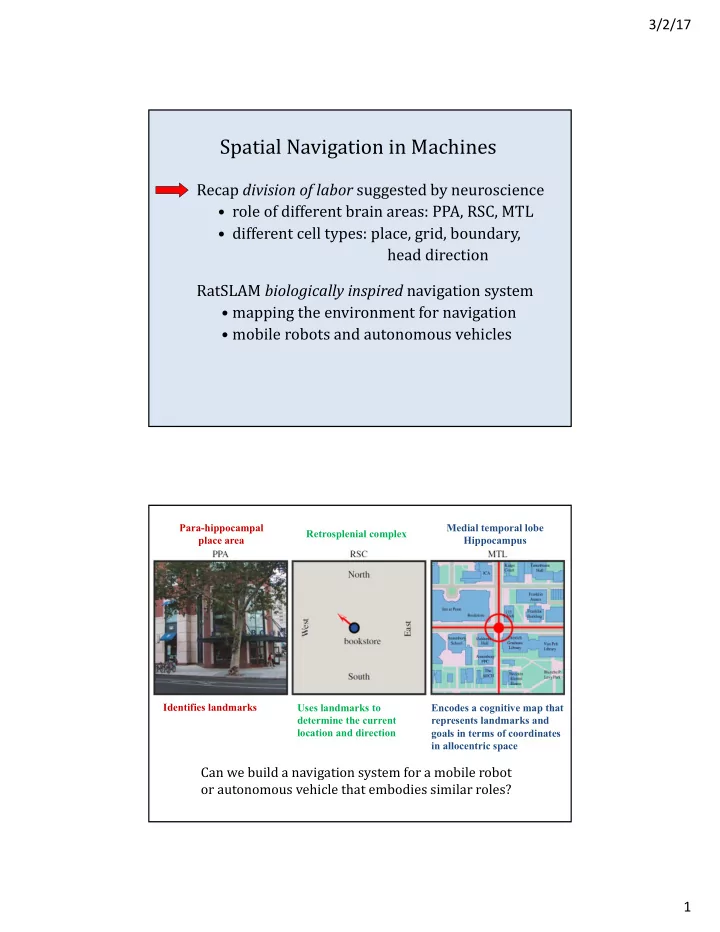
Identifies landmarks Uses landmarks to determine the current location and direction Encodes a cognitive map that represents landmarks and goals in terms of coordinates in allocentric space Para-hippocampal place area Retrosplenial complex Medial temporal lobe Hippocampus

Can we build a navigation system for a mobile robot

  • r autonomous vehicle that embodies similar roles?
slide-2
SLIDE 2

3/2/17 2

3

place cells (hippocampus) head direction cells (e.g. entorhinal and retrosplenial cortex) grid cells (entorhinal cortex) boundary cells (e.g. entorhinal cortex)

Can we build a navigation system for a mobile robot

  • r autonomous vehicle that uses analogous units?

Spatial Navigation in Machines

Recap division of labor suggested by neuroscience

  • role of different brain areas: PPA, RSC, MTL
  • different cell types: place, grid, boundary,

head direction RatSLAM biologically inspired navigation system

  • mapping the environment for navigation
  • mobile robots and autonomous vehicles
slide-3
SLIDE 3

3/2/17 3

RatSLAM biologically inspired navigation system

Milford & Wyeth

https://www.youtube.com/watch?v=-0XSUi69Yvs

SLAM = Simultaneous Localization And Mapping

At a large scale, over long time, in a changing environment

Sensory input from vision

  • A. Visual landmarks – local views
  • B. Sense rotation of car

from the shift of visual texture to the left or right

  • C. Sense translation of car

from shift of visual texture along ground Uses methods for measuring image motion and recognizing remembered scenes based on mean absolute difference

slide-4
SLIDE 4

3/2/17 4

Representing head direction in RatSLAM v1

e.g. vehicle rotation, translation

Attractor network of head direction units

Excitatory connections between nearby head direction units Inhibitory connections between distant head direction units Stable configuration of the network

slide-5
SLIDE 5

3/2/17 5

Local view (LV) units encode the head direction experienced when the scene was viewed previously Suppose the network thinks the head direction is 240◦ when the system encounters this familiar view…

Updating the head direction network

Local view units increase activity around the head direction associated with previous experience… … which moves the network toward a new (corrected) head direction Sensory input indicating rotation of the car also shifts the network activity to new head directions

slide-6
SLIDE 6

3/2/17 6

2D attractor network of place units

Local view (LV) units also encode the place experienced when the scene was viewed previously, and inject activity into a new (corrected) place in the network

Each location on the grid represents a place unit that is active when the agent is at a particular location on a 2D grid (ground or floor) Bulls’ eye pattern of activation shows a stable state of the place network

Sensory input indicating small translations shifts activity of the network to a new location

Testing RatSLAM v1

Could robot keep track of its location in a 2m x 2m arena with colored “landmarks”?

Localization was successful in the short term, but performance

  • f the simple place and head direction networks failed over

the long term Why?? stay tuned…

(Milford & Wyeth, 2003)