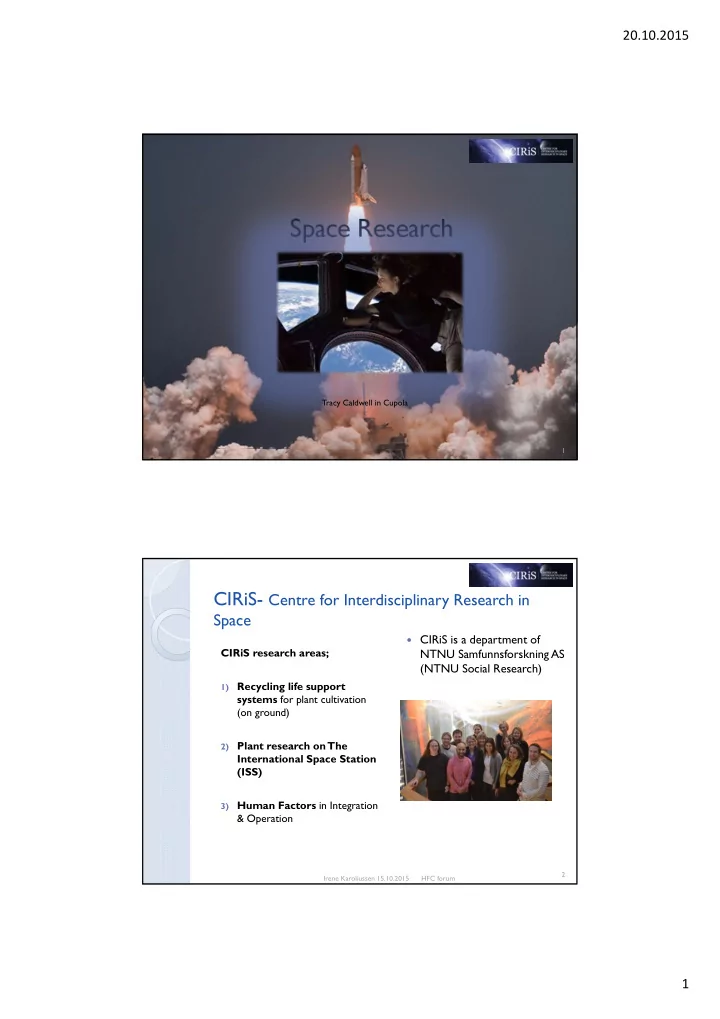
Space Research Tracy Caldwell in Cupola 1 CIRiS- Centre for - - PDF document

space research
SMART_READER_LITE
LIVE PREVIEW

Space Research Tracy Caldwell in Cupola 1 CIRiS- Centre for - - PDF document

20.10.2015 Space Research Tracy Caldwell in Cupola 1 CIRiS- Centre for Interdisciplinary Research in Space CIRiS is a department of CIRiS research areas; NTNU Samfunnsforskning AS (NTNU Social Research) 1) Recycling life support systems


slide-1
SLIDE 1

20.10.2015 1

Space Research

1

Tracy Caldwell in Cupola

CIRiS- Centre for Interdisciplinary Research in

Space

 CIRiS is a department of

NTNU Samfunnsforskning AS (NTNU Social Research)

CIRiS research areas;

1) Recycling life support

systems for plant cultivation (on ground)

2) Plant research on The

International Space Station (ISS)

3) Human Factors in Integration

& Operation

Irene Karoliussen 15.10.2015 HFC forum 2

slide-2
SLIDE 2

20.10.2015 2

N-USOC - The Norwegian User Support & Operation Centre

In 2005 we became one of ESAs User Support and Operation Centres for ISS N-USOCs activities; Integration and operation of the payloads EMCS and AIS

3 Irene Karoliussen 15.10.2015 HFC forum

Control Centres operating for ISS:

NASA, ESA, Roscosmos, JAXA and CSA

4 Irene Karoliussen 15.10.2015 HFC forum

slide-3
SLIDE 3

20.10.2015 3

The International Space Station (ISS)

FACTS

A laboratory and observatory with research within biology, physics, meteorology and astronomy.

4500 ton, 72 x 108 meter, 837 m3

400 km above Earth

88 minutes on one orbit (16 cycles/day)

27000 km/h (7,66 km/s)

The most expensive construction made (100 billion Euro in 10 years, where ESA paid 8 billion Euros)  NASA started planning in

1982, later came ESA, Roscosmos, Jaxa and CSA

1998 the building started

 2011 ISS was finished after

30 space shuttle deliveries

 ESA has their own module:

Columbus (2008)

5

1 euro per European inhabitant/year

Irene Karoliussen 15.10.2015 HFC forum

Traffic to and from ISS

6 Irene Karoliussen 15.10.2015 HFC forum

slide-4
SLIDE 4

20.10.2015 4

Columbus module – launched on Atlantis (STS-22) February 2008

7

EMCS AIS

Irene Karoliussen 15.10.2015 HFC forum

Colombus based AIS (COLAIS)

Automated Identification System

 Every ship identified with type of

cargo, position, course etc.

 Signals are sent on 2 frequencies in

the maritime VHF band

 Signals detected by ships nearby

and radar stations along the coast

8 Irene Karoliussen 15.10.2015 HFC forum

 In 2006 ESA , FFI (Forsvarets

Forsknings Institutt) and Kongsberg Seatex decided to develop and test AIS on ISS

 COLAIS (NORAIS1) was

launched in May 2010 and has been collecting data since

 N-USOC monitor and control AIS

from our controle room during week days (Mon-Fri)

slide-5
SLIDE 5

20.10.2015 5

European Modular Cultivation System (EMCS)

9 Irene Karoliussen 15.10.2015 HFC forum

What is EMCS?

EMCS is a small cultivation system (“greenhouse”) with exchangeable experiment containers (ECs)

In EMCS you can;

 Study gravitational signals in plants or small animals  Study tropisms in plants

EMCS characteristics;

 Automated system for water, temperature, humidity and gas mixtures  Gravitational level from 0-2 g (two centrifuges for 600 mm in diameter)

During experiments N-USOC monitor and control EMCS from our control room 24/7

10 Irene Karoliussen 15.10.2015 HFC forum

slide-6
SLIDE 6

20.10.2015 6

History N-USOC Real Time Operations:

2006: EMCS Commissioning in the US Laboratory ”Destiny” 2006: Tropi in EMCS – 3x6 days long US experiment 2007: Gravi in EMCS – 2x30 hours long ESA experiment 2008: Multigen-1 in EMCS – a 75 days long ESA experiment 2008: EMCS Relocation to the European Lab Module ”Columbus” 2008: Cell Wall/Resist Wall (CW/RW) in EMCS–50 days long Japanese experiment 2010: Tropi2 – 2X6 days long US experiment, replicating Tropi 2010: Vessel ID System Install and Commissioning (NORAIS 1) 2010: Genara A – 12 days long ESA experiment 2011: Plant Signaling 2013: Seedling growth 1 2014: Gravi2 2014: Seedling growth 2 2015: NORAIS 2 installed Planned for 2016:

  • Plant RNA Regulation
  • Seedling Growth 3

Tropi and Tropi2 Image developed from 90.000 AIS messages. Courtesy of FFI 11 Irene Karoliussen 15.10.2015 HFC forum

Flight Experiments

 Seed setup in the EC  The EC is sealed  The EC is transported to

launch-site (Kennedy Space Center in Florida, or Bajkonur in Kazakhstan)

12 Irene Karoliussen 15.10.2015 HFC forum

slide-7
SLIDE 7

20.10.2015 7

Launch

Launched in Space-X, Progress or Soyuz

13 Irene Karoliussen 15.10.2015 HFC forum

A robotarm grabs and dock the capsule

On the Space Station

1) After docking the astronauts unpack the ECs (8) and install them in EMCS

14

2) Experiment start and execution; N-USOC are monitoring 24/7 from our control room 3) Experiment stop; samples are fixed/frozen and brought back to Earth

Irene Karoliussen 15.10.2015 HFC forum

slide-8
SLIDE 8

20.10.2015 8

Life on ISS

Videos; Life on ISS (Suni, 25 min) https://www.youtube.com/watch?v=hyn1We0wOT8 Life on ISS, only music (ca. 4 min)

https://www.youtube.com/watch?v=tgRMAVoHRbk

  • Hadfield; water(3 min)

https://www.youtube.com/watch?v=lMtXfwk7PXg

  • Williams tour of ISS(bedroom, kitchen, bathroom) 8,41 min

https://www.youtube.com/watch?v=XkM_04Ch76E

  • Hadfield brush teeth

https://www.youtube.com/watch?v=3bCoGC532p8  How to wash your hair https://www.youtube.com/watch?v=kOIj7AgonHM

  • Hadfield sleep

https://www.youtube.com/watch?v=T1hWJfsoiKw

  • Fuglesang godis (0,48 min)

https://www.youtube.com/watch?v=aVdfXkHJ8zk

Irene Karoliussen 15.10.2015 HFC forum 15

Backup-slides

Kitchen

16 Irene Karoliussen 15.10.2015 HFC forum

slide-9
SLIDE 9

20.10.2015 9

Life on ISS

Work out; astronauts work out minimum 2 hours a day. Still they experience loss of muscles and bonemass

Irene Karoliussen 15.10.2015 HFC forum 17

Life on ISS

Food and drink; there is no fridge and seldom re-supplies. The diet is mainly freeze-dried food. Magnets and straps «holds» the food in place so it doesnt float away. Urine and sweat is recycled to drinking water!

Irene Karoliussen 15.10.2015 HFC forum 18

slide-10
SLIDE 10

20.10.2015 10

Life on ISS

T

  • ilet and personal hygiene; astronauts strap themselves to the toilet

which is a kind of «vacuum-cleaner». Instead of showering they use wet wipes and dry-shampoo.

Irene Karoliussen 15.10.2015 HFC forum 19

Hear cut

20 Irene Karoliussen 15.10.2015 HFC forum

slide-11
SLIDE 11

20.10.2015 11

Mounting AIS outside Columbus

21 Irene Karoliussen 15.10.2015 HFC forum