
SLIDE 1
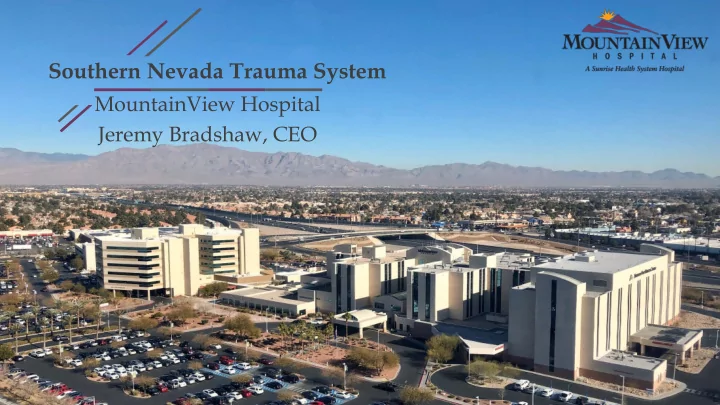
Southern Nevada Trauma System MountainView Hospital Jeremy - - PowerPoint PPT Presentation
Southern Nevada Trauma System MountainView Hospital Jeremy Bradshaw, CEO Comparing Regional Trauma Centers per 1 Million Population 3 2.1 2.1 2 1.7 1.7 1.7 1.6 1.5 1.4 1.4 1.4 2 0.9 1 0.8 1 0 St. Louis Sacramento Pittsburg
2
2.1 1.7 1.7 1.5 1.4 0.9 2.1 1.6 1.7 1.4 1.4 0.8 1 1 2 2 3
Sacramento Pittsburg San Diego Baltimore Las Vegas 2017 2025
Source: www.FACS.org; US Census Bureau/Fact Finder; American Business Journal
Poor access to a trauma center is linked to higher death rates in the US (Source: American College of Surgeons) The American College of Surgeons recommends 1-2 trauma centers per 1 million people Adding a Level III trauma center would move the Southern Nevada Trauma System from 0.9 to 1.36 trauma centers per 1 million people, closer to the US average Nevada ranks last among U.S. states in preparedness for health disasters (Source: National Health Security
Preparedness Index)
3
The Las Vegas Valley population increased an average of 3.6% per year 2000-2016, compared to 4.9% average annual growth in the NW region. (TNAT
1A-B – Source: US Census Bureau, City-Data)
The Las Vegas Valley population is expected to increase an average of 1.5% per year through 2023, compared to 1.8% average annual growth in the NW region. (TNAT 1C-D – Source: US
Census Bureau, City-Data; Intellimed)
Northwest Region Growing Faster than Las Vegas Valley
3.6% 4.9%
2.0% 2.5% 3.0% 3.5% 4.0% 4.5% 5.0% 5.5% Las Vegas Valley Northwest Region Average Annual Growth Rate 2000-2016
1.5% 1.8%
1.0% 1.2% 1.4% 1.6% 1.8% 2.0% Las Vegas Valley Northwest Region Projected Annual Growth Rate 2018-2023
Source: US Census Bureau, City-Data Source: US Census Bureau, City-Data; Intellimed
4
The senior population (65+ years) in Las Vegas is growing faster than the general population (6.7% annual growth compared to 3.6%). The senior population in the Northwest region is growing faster than the general population in the Northwest region (7.7% annual growth compared to 4.9%).
Senior Population Growing Faster than General Population
3.6% 4.9% 6.7% 7.7%
0.0% 1.0% 2.0% 3.0% 4.0% 5.0% 6.0% 7.0% 8.0% 9.0%
Las Vegas Valley - All Ages NW Region - All Ages Las Vegas Valley - Ages 65+ NW Region - Ages 65+
Average Annual Growth Rate 2000-2016
Source: US Census Bureau, City-Data Source: US Census Bureau, City-Data; Intellimed
5
TFTC incidents in the Las Vegas Valley increased 141% from 2010-2018 (TNAT
1E – Source: SNHD TFTC Transports, RTAB Jan 2019)
TFTC incidents for Step III and Step IV patients in the Las Vegas Valley increased 101% from 2015-2017 (TNAT
1F – Source: SNHD TFTC)
Incidents of patients meeting trauma criteria for Step III and Step IV at MountainView Hospital increased 33% from 2017-2018 (TNAT 1G – Source:
MountainView Trauma Registry)
TFTC Incidents are Increasing in the Las Vegas Valley
4,771 5,462 5,222 5,848 5,975 6,109 6,770 11,060 11,498
2,000 4,000 6,000 8,000 10,000 12,000 14,000 2010 2011 2012 2013 2014 2015 2016 2017 2018 TFTC Incidents in Las Vegas 2010-2018
Source: SNHD TFTC
6
The Las Vegas Valley demonstrated average transport times of 17.8 minutes from 2013-2018 (TNAT 2A) Transport times for Step III and Step IV averaged 16 minutes in 2017 (TNAT 2B) Transport times for the Northwest Region are above average (18.3 minutes in 2018) and increasing (TNAT
2C)
Transport Times are Increasing in the Las Vegas Valley
15.9 16.5 16.8 17.9 18.3 11.3 11.8 11.7 12.8 12.7
11 13 15 17 19 2014 2015 2016 2017 2018 Transport Response Times 2014-2018
NW Metro Goal 15% increase 2014-2018
Source: SNHD TFTC
7
8
Metro Northwest Northeast Southeast Southwest
1,680 trauma patients originated from the Northwest region in 2017, more than any non-urban area, including the Southeast 75% more trauma patients
region than from the Southeast region (St. Rose – Siena)
Northwest Region is Underserved for Trauma
2 Trauma Centers 1 Trauma Center No Trauma Centers
Source: NV Annual Trauma Report
9
Quicker transport tim es Low-acuity patients treated locally Appropriately resource UMC and Sunrise for high-acuity cases EMS crews return to service faster Enhanced disaster response Im proved
patients in the NW region
10
Costs include: physician call panel, medical directorships, staffing, education, equipment, infrastructure, etc.
Costs
Pre-hospital notification must
transport or transfer
Criteria
Insurance companies cannot deny coverage, regardless
adjustments are allowed
Patient Responsibility
Will mirror existing Level III trauma center in the market
Amount
11
Southwest Summerlin Northwest Aliante Southern Highlands Henderson North Las Vegas Sunrise
7
MountainView Hospital Sunrise Hospital
MountainView Hospital Current Trauma Center
Dignity - Sienna UMC
center
region of the valley
expected to outpace Las Vegas growth
Center requirements met
12
13
MountainView Hospital meets all ACS Trauma Requirements
14
Jan 9-10, 2019 13 key strengths identified ACS Consultative Team:
ACS Consultative Site Visit – MountainView Strengths
10.Robust FAST exam system 11.Strong rehabilitation 12.Participation in regional trauma system meetings and prevention 13.Strong partnership with other trauma centers
15