Southern California Salinity Coalition TDS Trends Study Update for - - PowerPoint PPT Presentation

southern california salinity coalition tds trends study
SMART_READER_LITE
LIVE PREVIEW

Southern California Salinity Coalition TDS Trends Study Update for - - PowerPoint PPT Presentation

Southern California Salinity Coalition TDS Trends Study Update for the Basin Monitoring Program Task Force October 18, 2017 Daniel B. Stephens & Associates, Inc. Problem Statement 1. Evaluate the long-term trends for salinity in wastewater


slide-1
SLIDE 1

Daniel B. Stephens & Associates, Inc.
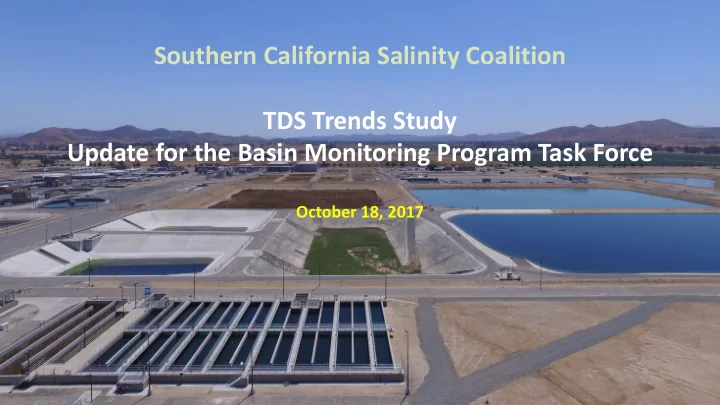
Southern California Salinity Coalition TDS Trends Study Update for the Basin Monitoring Program Task Force

October 18, 2017

slide-2
SLIDE 2

Daniel B. Stephens & Associates, Inc.

Problem Statement

  • 1. Evaluate the long-term trends for salinity in wastewater and

recycled water

  • 2. Assess how periodic droughts and various conservation

measures may influence these trends

  • 3. Primary Research Questions:
  • a. What portion of the increment from use (IFU) can be attributed to

water conservation measures?

  • b. If trends of conservation measures continue, what portion of the

IFU can be attributed to water conservation measures

slide-3
SLIDE 3

Daniel B. Stephens & Associates, Inc.

100 200 300 400 500 600 700 800 900 1,000

2007 2008 2009 2011 2012 2013 2015 2016 2017

TDS Concentration (Mg/L)

Temecula Valley Sewershed

Source Effluent Influent Temecula Valley Discharge Limit: 750 mg/L

Problem Statement

  • Increment from use (IFU)

typically ranges from 200 to 250 mg/L.

  • IFU can drive effluent

TDS above the discharge limit.

  • How much of IFU is due

to conservation measures?

slide-4
SLIDE 4

Daniel B. Stephens & Associates, Inc.

50 100 150 200 250 300 350 400 450 500 40 45 50 55 60 65 70 75 80 85 Increment from Use TDS (mg/L) Indoor Water Use (gpcd)

Salt Load = 0.17 pounds per capita per day Salt Load = 0.15 pounds per capita per day

1980 Indoor Water Use (77 gcpd) 2016 Indoor Water Use (52 gcpd)

Increase in TDS from MSLs from Indoor Use

slide-5
SLIDE 5

Daniel B. Stephens & Associates, Inc.

Regression Tree Analysis for Influent TDS

  • Indicates important explanatory

variables:

– Population (POP) – Source TDS (STDS) – Source Flow (SFLOW)

slide-6
SLIDE 6

Daniel B. Stephens & Associates, Inc.

Principal Component Analysis

PCA indicates an initial EMWD multiple regression model:

  • ITDS ˜ POP + STDS + SFLOW + PMDI +

IFLOW Backward stepping from the initial model resulted in removal of first SFLOW and second PMDI:

  • ITDS ˜ POP + STDS + IFLOW
slide-7
SLIDE 7

Daniel B. Stephens & Associates, Inc.

EMWD Multiple Regression Analysis

500 550 600 650 700 750 800 10/10/06 02/22/08 07/06/09 11/18/10 04/01/12 08/14/13 12/27/14 05/10/16 09/22/17

mg/L

ITDS Model

  • Variables:

– STDS: Source TDS – IGPCD: Influent per capita water use

  • R -squared = 0.979
  • Relative Importance

– STDS: 88.2 – IGPCD: 11.8

slide-8
SLIDE 8

Daniel B. Stephens & Associates, Inc.

EMWD Multiple Regression Analysis

500 550 600 650 700 750 800 10/10/06 02/22/08 07/06/09 11/18/10 04/01/12 08/14/13 12/27/14 05/10/16 09/22/17

mg/L

ITDS Model

500 550 600 650 700 750 800 10/10/06 02/22/08 07/06/09 11/18/10 04/01/12 08/14/13 12/27/14 05/10/16 09/22/17

mg/L

ITDS Model C_gpcd

  • Variables:

– STDS: Source TDS – IGPCD: Influent per capita water use

  • C_gpcd: Constant

water use of 66 gpcd (no conservation)

– IFU Difference: ~18mg/L

55 gpcd 66 gpcd

slide-9
SLIDE 9

Daniel B. Stephens & Associates, Inc.

IEUA Multiple Regression Analysis

500 550 600 650 700 750 800 10/10/06 02/22/08 07/06/09 11/18/10 04/01/12 08/14/13 12/27/14 05/10/16 09/22/17

mg/L

ITDS Model

  • Variables:

– STDS: Source TDS – IGPCD: Influent per capita water use

  • R -squared = 0.75
  • Relative Importance

– STDS: 67.2 – IGPCD: 32.8

400 420 440 460 480 500 520 540 560 07/24/98 04/19/01 01/14/04 10/10/06 07/06/09 04/01/12 12/27/14 09/22/17

mg/L ITDS Model

slide-10
SLIDE 10

Daniel B. Stephens & Associates, Inc.

IEUA Multiple Regression Analysis

500 550 600 650 700 750 800 10/10/06 02/22/08 07/06/09 11/18/10 04/01/12 08/14/13 12/27/14 05/10/16 09/22/17

mg/L

ITDS Model

400 420 440 460 480 500 520 540 560 07/24/98 04/19/01 01/14/04 10/10/06 07/06/09 04/01/12 12/27/14 09/22/17

mg/L ITDS Model

  • Variables:

– STDS: Source TDS – IGPCD: Influent per capita water use

  • C_gpcd: Constant

water use of 95 gpcd (no conservation)

– IFU Difference: ~20mg/L

400 420 440 460 480 500 520 540 560 07/24/98 04/19/01 01/14/04 10/10/06 07/06/09 04/01/12 12/27/14 09/22/17

mg/L ITDS Model C_pgcd

70 gpcd 95 gpcd

slide-11
SLIDE 11

Daniel B. Stephens & Associates, Inc.

Source TDS Indoor per capita water use Influent TDS

Source Flow Drought Index State Mandate % SPW Allocation Local Conservation State Mandate

Seasonal trends Long term conservation trends = Effluent TDS

Technology enhancements

slide-12
SLIDE 12

Daniel B. Stephens & Associates, Inc.

Summary

  • Unintended consequences from water conservation measures

– lower water quality (higher TDS) – less quantity of recycled water – less revenue – infrastructure O&M

  • Observation data from groups of sewering agencies rather than

individual WWTP is more reliable due to the following factors

– Population (city boundaries, sewershed boundaries) – Operations can divert flows from plant to plant

slide-13
SLIDE 13

Daniel B. Stephens & Associates, Inc.

Summary

  • Drought impacts both source water quality

and an agency’s source(s) of supply.

  • “...drought, and the conservation strategies

that are often enacted in response to it, both likely limit the role reuse may play in improving local water supply reliability.”