Sorting networks using a different architecture? Yep. 2. Spaghetti - - PowerPoint PPT Presentation

sorting networks
SMART_READER_LITE
LIVE PREVIEW

Sorting networks using a different architecture? Yep. 2. Spaghetti - - PowerPoint PPT Presentation

NEW CS 473: Theory II, Fall 2015 Model of Computation 1. Q: Perform a computational task considerably faster by Sorting networks using a different architecture? Yep. 2. Spaghetti sort ! Lecture 24 November 19, 2015 1/52 2/52 Spaghetti


slide-1
SLIDE 1

NEW CS 473: Theory II, Fall 2015

Sorting networks

Lecture 24

November 19, 2015

1/52

Model of Computation

  • 1. Q: Perform a computational task considerably faster by

using a different architecture? Yep.

  • 2. Spaghetti sort!

2/52

Spaghetti

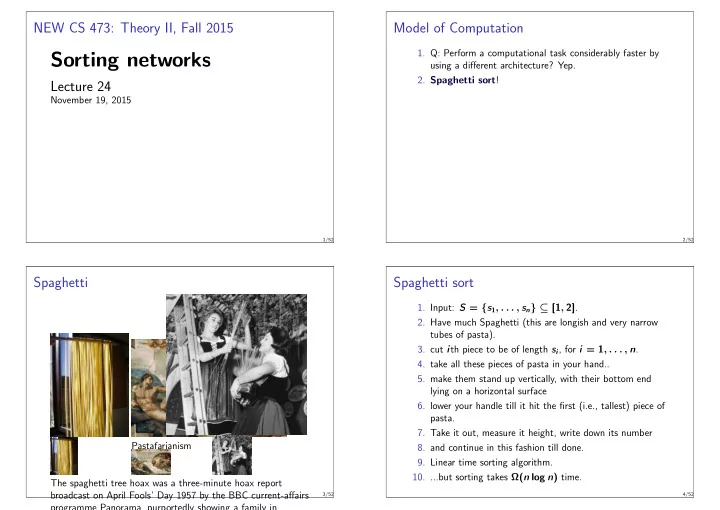
Pastafarianism The spaghetti tree hoax was a three-minute hoax report broadcast on April Fools’ Day 1957 by the BBC current-affairs programme Panorama, purportedly showing a family in

3/52

Spaghetti sort

  • 1. Input: S = {s1, . . . , sn} ⊆ [1, 2].
  • 2. Have much Spaghetti (this are longish and very narrow

tubes of pasta).

  • 3. cut ith piece to be of length si, for i = 1, . . . , n.
  • 4. take all these pieces of pasta in your hand..
  • 5. make them stand up vertically, with their bottom end

lying on a horizontal surface

  • 6. lower your handle till it hit the first (i.e., tallest) piece of

pasta.

  • 7. Take it out, measure it height, write down its number
  • 8. and continue in this fashion till done.
  • 9. Linear time sorting algorithm.
  • 10. ...but sorting takes Ω(n log n) time.

4/52

slide-2
SLIDE 2

What is going on?

  • 1. Faster algorithm achieved by changing the computation

model.

  • 2. allowed new “strange” operations

(cutting a piece of pasta into a certain length, picking the longest one in constant time, and measuring the length of a pasta piece in constant time)

  • 3. Using these operations we can sort in linear time.
  • 4. So, are there other useful computation models?

5/52

Circuits are fast...

  • 1. Computing the following circuit naively takes

8 units of time.

  • 2. Use parallelism!

4 time units!

  • 3. Circuits are really parallel...
  • 4. Sorting numbers with circuits?
  • 5. Q: Can sort in sublinear time by allowing parallel

comparisons?

6/52

Sorting with a circuit – a naive solution

  • 1. comparator gate:

Comparator

x y y′ = max(x, y) x′ = min(x, y)

  • 2. Draw it as:

y x′ = min(x, y) y′ = max(x, y) x

7/52

Sorting network - an example

8/52

slide-3
SLIDE 3

How to draw a circuit...

  • 1. wires: horizontal lines
  • 2. gates: vertical segments (i.e.,

gates) connecting lines.

  • 3. Inputs arrive the wires from left.
  • 4. Output on the right side of

wires.

  • 5. largest number is output on the

bottom line.

  • 6. Sorting algorithms =

⇒ sorting circuits.

9/52

Definitions

Definition

A comparison network is a DAG, with n inputs and n

  • utputs, where each gate has two inputs and two outputs.

Definition

depth of a wire is 0 at input. For gate with two inputs of depth d1 and d2 the depth on the output wire is 1 + max(d1, d2). depth of comparison network is maximum depth of an output wire.

Definition

sorting network: comparison network such that for any input, the output is monotonically sorted. size: sorting network is number of gates. running time of sorting network is its depth.

10/52

Sorting network based on insertion sort

  • 1. Inner loop of insertion sort is:
  • 2. Insertion sort as a network:

11/52

Sorting network based on insertion sort

1 2 3 4 5 6 7 8 9

(i) (ii)

Lemma

The sorting network based on insertion sort has O(n2) gates, and requires 2n − 1 time units to sort n numbers.

12/52

slide-4
SLIDE 4

Converting a sequence into a binary sequence

2 4 6 8 10 A B C D E F G H I x 2 4 6 8 10 A B C D E F G H I x 2 4 6 8 10 A B C

13/52

The Zero-One Principle

Definition

zero-one principle states that if a comparison network sort correctly all binary inputs (∀ input is 0 or 1) then it sorts correctly all inputs (input is real number). Need to prove the zero-one principle.

Lemma

A comparison network transforms input sequence a = a1, a2, . . . , an = ⇒ b = b1, b2, . . . , bn Then for any monotonically increasing function f , the network transforms f (a) =

  • f (a1), . . . , f (an)
  • =

⇒ f (b) =

  • f (b1), . . . , f (bn)
  • 14/52

Proof

  • 1. Induction on number of comparators.
  • 2. Consider a comparator with inputs x and y, and outputs

x′ = min(x, y) and y ′ = max(x, y).

  • 3. If f (x) = f (y) then the claim trivially holds.
  • 4. If f (x) < f (y) then clearly

max(f (x), f (y)) = f (max(x, y)) and min(f (x), f (y)) = f (min(x, y)), since f (·) is monotonically increasing.

  • 5. x, y, for x < y, we have output x, y.
  • 6. Input: f (x), f (y) =

⇒ output is f (x), f (y).

  • 7. Similarly, if x > y, the output is y, x. In this case, for

the input f (x), f (y) the output is f (y), f (x). This establish the claim for a single comparator.

15/52

Proof continued

  • 1. Claim: if a wire carry a value ai, when the sorting

network get input a1, . . . , an, then for input f (a1), . . . , f (an) this wire would carry the value f (ai).

  • 2. Proof by induction on the depth on the wire at each

point.

  • 3. If point has depth 0, then its input and claim trivially

hold.

  • 4. Assume holds for all points in circuit of depth ≤ qi, and

consider a point p on a wire of depth i + 1.

  • 5. G: gate which this wire is an output of.
  • 6. By induction, claim holds for inputs of G.

Now, the claim holds for the gate G itself. Apply above single gate proof for G. = ⇒ claim holds at p.

16/52

slide-5
SLIDE 5

0/1 sorting implies real sorting

Theorem

If a comparison network with n inputs sorts all 2n binary strings of length n correctly, then it sorts all sequences correctly.

17/52

Proof: 0/1 sorting implies real sorting

  • 1. Assume for contradiction that fails for input a1, . . . , an.

Let b1, . . . bn be the output sequence for this input.

  • 2. Let ai < ak be the two numbers that are output in

incorrect order (i.e. ak appears before ai in output).

  • 3. f (x) =
  • x ≤ ai

1 x > ai.

  • 4. By lemma for input f (a1), . . . , f (an),

circuit would output f (b1), . . . , f (bn).

  • 5. This sequence looks like:

000..0????f (ak)????f (ai)??1111

  • 6. but f (ai) = 0 and f (aj) = 1. Namely, the output is a

sequence of the form ????1????0????, which is not sorted.

  • 7. bin. input f (b1), . . . , f (bn) sorting net’ fails. A

contradiction.

18/52

Bitonic sorting network

Definition

A bitonic sequence is a sequence which is first increasing and then decreasing, or can be circularly shifted to become so.

example

The sequences (1, 2, 3, π, 4, 5, 4, 3, 2, 1) and (4, 5, 4, 3, 2, 1, 1, 2, 3) are bitonic, while the sequence (1, 2, 1, 2) is not bitonic.

19/52

Binary bitonic sequences

Observation

binary bitonic sequence is either of the form 0i1j0k or of the form 1i0j1k, where 0i (resp, 1i) denote a sequence of i zeros (resp., ones).

20/52

slide-6
SLIDE 6

Bitonic sorting network

Definition

A bitonic sorter is a comparison network that sorts all bitonic sequences correctly.

21/52

Half cleaner...

Definition

half-cleaner: a comparison network, connecting line i with line i + n/2. Half-Cleaner[n] denote half-cleaner with n inputs. Depth of Half-Cleaner[n] is one.

22/52

Half cleaner on bitonic sequence...

111..111 000..000 000..000 000..000 111..111 111..111 111 000..000 000..000 111..111 111 000..000 000..000 111 000..000 half− cleaner

  • 1. What a half-cleaner do to an input which is a (binary)

bitonic sequence?

  • 2. In example... left half size is clean and all equal to 0.
  • 3. Right side of the output is bitonic.
  • 4. Specifically, one can prove by simple (but tedious) case

analysis that the following lemma holds.

23/52

Half cleaner half sorts a bitonic sequence...

Lemma

If the input to a half-cleaner (of size n) is a binary bitonic sequence then for the output sequence we have that (i) the elements in the top half are smaller than the elements in bottom half, and (ii) one of the halves is clean, and the other is bitonic.

24/52

slide-7
SLIDE 7

Proof

Proof.

If the sequence is of the form 0i1j0k and the block of ones is completely on the left side (i.e., its part of the first n/2 bits)

  • r the right side, the claim trivially holds. So, assume that the

block of ones starts at position n/2 − β and ends at n/2 + α.

00 . . . 00 111 . . . 111 000 . . . 000 11 . . . 11 HalfCleaner 00 . . . 00 00 . . . 00 11 111 . . . 111

α

  • β

If n/2 − α ≥ β then this is exactly the case depicted above and claim holds. If n/2 − α < β then the second half is going to be all ones, as depicted on the right. Implying the claim for this case. A similar analysis holds if the sequence is of the form 1i0j1k.

25/52

Bitonic sorter - sorts bitonic sequences...

✂✁☎✄✝✆✟✞✠✁☛✡ ☞ ✌ ✆✎✍✎✄✝✏✑✍✓✒✕✔ ✖✘✗ ☞ ✡✚✙✛✏✢✜✣✞✤✏✥✍✧✦★✞✪✩ ✫✬✜✭✙✯✮ ☞ ✌ ✆✎✍✎✄✝✏✑✍ ✒✕✔ ✖✘✗ ✂✁☎✄✰✆✎✞✠✁☛✡ ☞ ✌ ✆✎✍✎✄✝✏✥✍✱✦★✞✲✩ ✂✁☎✄✝✆✟✞✠✁☛✡
  • ✁✄✂✆☎✞✝✠✟✡☎☞☛✍✌✎✟✑✏
✒ ✝✓✂✕✔

(i) (ii) (iii) (i) recursive construction of BitonicSorter[n], (ii) opening up the recursive construction, and (iii) the resulting comparison network.

26/52

Bitonic sorter... the result

Lemma

BitonicSorter[n] sorts bitonic sequences of length n = 2k, it uses (n/2)k = (n/2) lg n gates, and it is of depth k = lg n.

27/52

Merging sequence

  • 1. Merging question: Given two sorted sequences of length

n/2, how do we merge them into a single sorted sequence?

  • 2. Concatenate the two sequences...
  • 3. ... second sequence is being flipped (i.e., reversed).
  • 4. Easy to verify that the resulting sequence is bitonic, and

as such we can sort it using the BitonicSorter[n].

  • 5. Given two sorted sequences a1 ≤ a2 ≤ . . . ≤ an and

b1 ≤ b2 ≤ . . . ≤ bn, observe that the sequence a1, a2, . . . , an, bn, bn−1, bn−2, . . . , b2, b1 is bitonic.

28/52

slide-8
SLIDE 8

Merger[n]: Using a bitonic sorter

Merging two sorted sequences into a sorted sequence

✂✁☎✄✝✆✟✞✠✁☛✡ ☞ ✌ ✆✎✍✏✄✝✑✒✍✔✓✕✞✗✖ ✘ ✑✒✍✎✙✚✑✒✍✛✓✜✞✗✖

(i) (ii) (iii) (iv) (i) Merger via flipping the lines of bitonic sorter. (ii) BitonicSorter. (iii) Merger after we “physically” flip the lines. (iv) Equivalent drawing of the resulting Merger.

29/52

Merger[n] described using FlipCleaner

  • ✁✄✂✆☎✞✝✠✟✡☎☞☛✍✌✎✟✑✏
✒ ✂✔✓✖✕ ✗ ✓✙✘✛✚✜✟✢✓✣✁
✚✥☛✥✘✛☎✦☛★✧✪✩ ✫✭✬
✚✥☛✥✘✛☎✦☛ ✧✪✩ ✫✭✬ ✗ ✓✙✘✛✚✜✟✢✓✣✁

(i) (ii) (i) FlipCleaner[n], and (ii) Merger[n] described using FlipCleaner.

30/52

What Merger[n] does...

Lemma

The circuit Merger[n] gets as input two sorted sequences of length n/2 = 2k−1, it uses (n/2)k = (n/2) lg n gates, and it is of depth k = lg n, and it outputs a sorted sequence.

31/52

Sorting Network

Finally...

Implement merge sort using Merger[n]. Sorter[n]:

  • ✁✄✂✆☎✝✁✄✂✟✞✡✠☞☛
✌✎✍✏✂✒✑✓✁✄✂✕✔✗✖ ✘✒✙ ✌✎✍✏✂✒✑✓✁✄✂ ✔✗✖ ✘✒✙

Lemma

The circuit Sorter[n] is a sorting network (i.e., it sorts any n numbers) using G(n) = O(n log2 n) gates. It has depth O(log2 n). Namely, Sorter[n] sorts n numbers in O(log2 n) time.

32/52

slide-9
SLIDE 9

Proof

Proof.

The number of gates is G(n) = 2G(n/2) + Gates(Merger[n]). Which is G(n) = 2G(n/2) + O(n log n) = O(n log2 n). As for the depth, we have that D(n) = D(n/2) + Depth(Merger[n]) = D(n/2) + O(log(n)), and thus D(n) = O(log2 n), as claimed.

33/52

Resulting sorted

Figure: Sorter[8].

34/52

Faster sorting networks

  • 1. Known: sorting network of logarithmic depth

Ajtai et al. [1983].

  • 2. Known as the AKS sorting network.
  • 3. Construction is complicated.
  • 4. Ajtai et al. [1983] is better than bitonic sort for n

larger than 28046.

35/52

  • M. Ajtai, J. Koml´
  • s, and E. Szemer´
  • edi. An O(n log n) sorting
  • network. In Proc. 15th Annu. ACM Sympos. Theory
  • Comput. (STOC), pages 1–9, 1983.

35/52