SOME EXAMPLES NUTRITION IN FRUIT AND VEGETABLES Table 1 average - - PDF document

some examples
SMART_READER_LITE
LIVE PREVIEW

SOME EXAMPLES NUTRITION IN FRUIT AND VEGETABLES Table 1 average - - PDF document

9/06/2014 REFERANCES Dr Elaine Ingam Soil Food Web Dr Arden Andersen Gary Zimmer, Gerry Bernetti USA Biological Farmers A MICROBIAL APPROACH TO SOIL MANAGEMENT Graeme Sait NTS Ltd SOME EXAMPLES NUTRITION IN FRUIT AND VEGETABLES


slide-1
SLIDE 1

9/06/2014 1

A MICROBIAL APPROACH TO SOIL MANAGEMENT

REFERANCES

  • Dr Elaine Ingam Soil Food Web
  • Dr Arden Andersen
  • Gary Zimmer, Gerry Bernetti USA Biological Farmers
  • Graeme Sait

NTS Ltd

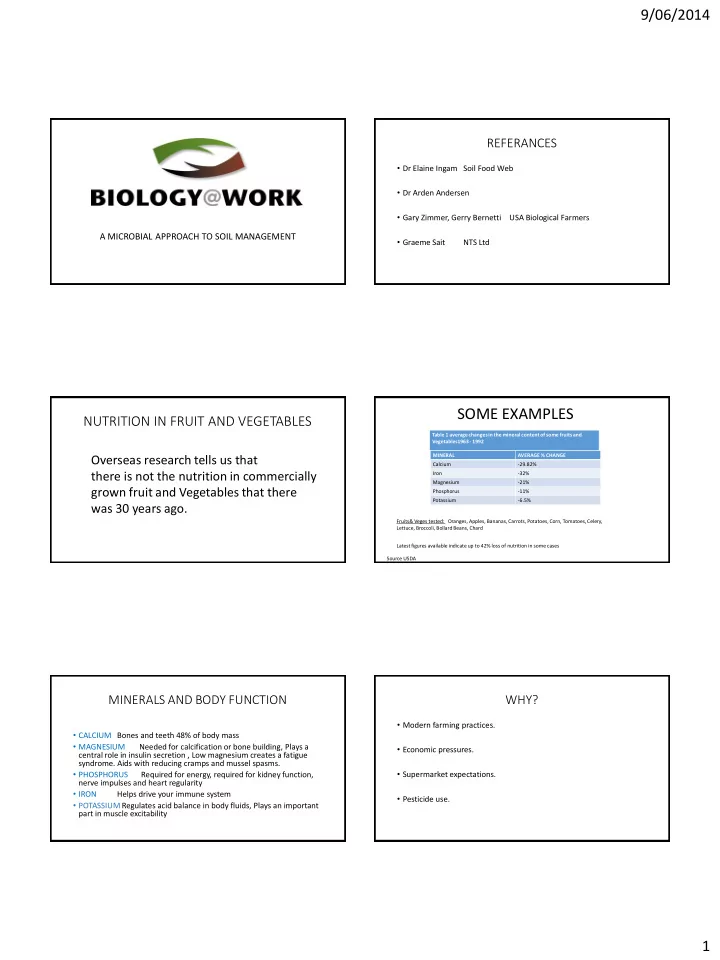
NUTRITION IN FRUIT AND VEGETABLES

Overseas research tells us that there is not the nutrition in commercially grown fruit and Vegetables that there was 30 years ago.

SOME EXAMPLES

Table 1 average changes in the mineral content of some fruits and Vegetables1963 - 1992 MINERAL AVERAGE % CHANGE Calcium

  • 29.82%

Iron

  • 32%

Magnesium

  • 21%

Phosphorus

  • 11%

Potassium

  • 6.5%

Source USDA Fruits& Veges tested: Oranges, Apples, Bananas, Carrots, Potatoes, Corn, Tomatoes, Celery, Lettuce, Broccoli, Bollard Beans, Chard Latest figures available indicate up to 42% loss of nutrition in some cases

MINERALS AND BODY FUNCTION

  • CALCIUM Bones and teeth 48% of body mass
  • MAGNESIUM

Needed for calcification or bone building, Plays a central role in insulin secretion , Low magnesium creates a fatigue

  • syndrome. Aids with reducing cramps and mussel spasms.
  • PHOSPHORUS

Required for energy, required for kidney function, nerve impulses and heart regularity

  • IRON

Helps drive your immune system

  • POTASSIUM Regulates acid balance in body fluids, Plays an important

part in muscle excitability

WHY?

  • Modern farming practices.
  • Economic pressures.
  • Supermarket expectations.
  • Pesticide use.
slide-2
SLIDE 2

9/06/2014 2 Nature’s cycle

Nutrient Pathways

  • Chemical Or Acid Reaction
  • The nutrient combines with

water and Hydrogen to enable it to become plant available

  • Biological
  • The nutrient is consumed by

microbes, usually Bacteria, which in turn die and release the nutrients

MICROBE FUNCTIONS

  • FUNGI
  • Primary digesters Organic matter manufacturers
  • Saporiphic fungi
  • Disease management functions
  • Trichoderma
  • Calcium and nutrient Storehouses
  • Mycorrhiza
slide-3
SLIDE 3

9/06/2014 3

NUTRIENT TRANSFER BUILD SOIL STRUCTURE

  • AIRATION
  • Worms
  • Bacteria
  • Carbon
  • Organic matter
  • THE CARBON PATHWAY

BACTERIA

  • Soil mixers secondary digesters
  • Convert wastes into nutrients
  • Nutrient storehouses
  • Create soil structure

Viruses

  • Kill predatory Bacteria
  • Aid in the release of plant available nutrients
slide-4
SLIDE 4

9/06/2014 4

PROTOZOA

  • Consume Bacteria
  • Release Nitrogen and other nutrients into the soil in plant available

form

Nematodes

  • Not generally found in garden soils
  • Good and Bad nematodes
  • Consume Fungi and Bacteria to release plant nutrients

Worms

Begin the decay process Mix soils Add to soil nutrition Aid in soil drainage

MID GRASSES AND VEGES

RATIO FUNGI TO BACTERIA 0.75

MYCORRHIZAL VEGES Asparagus, Beans, Onions, corn, carrot, parsnip, celery, cucumber peppers, squash, leek, lettuce, peas, potato, tomato, yam NON MYCORRHIZAL VEGES Brassicas like cabbage, caulis, sprouts, kale Radishes Turnips

slide-5
SLIDE 5

9/06/2014 5

Visual Soil Assessment

  • SIGHT
  • SMELL
  • FEEL
  • COMPACTION
  • MOISTURE
  • ORGANIC MATTER

REPLACING THE MISSING MICROBES

  • Composts
  • Vermcastes
  • Compost Teas ( Microbial inoculums)
  • Single species Microbes

Nature’s Cycles

  • Carbon Cycle CO2 available from the atmosphere
  • Carbon loss through harvesting and decomposition
  • Nitrogen Cycle Provides up to 20% of plant’s Nitrogen requirements

through nitrogen fixing

  • Nitrogen loss through volatising as ammonia gas

Microbe Foods and Beneficial Soil Additives

  • Humates – Feed fungi, support nutrients, add carbon to the soil, help

retain soil moisture

  • Fish Hydrolysate – Contain oil and protein, feed fungi and bacteria

contain micro nutrients, aid in soil structure.

  • Seaweeds – Contain micronutrients, feed micro organisms especially

bacteria

  • Molasses – Carbohydrate as microbe food
  • Fertilisers - In moderation. Foliar feeding 60% more efficient than soil

application for micronutrients. NPK for soils.

BIOLOGICAL SOIL and COMPOST ANALYSIS

  • Soil Food Web NZ
  • 32 Braxholm ST
  • Roxburgh.
  • www.soilfoodweb.co.nz
  • Download sample submission form and sampling instructions