Some Basic Stuff on Empirical Work Master en Economa Industrial - - PDF document

some basic stuff on empirical work
SMART_READER_LITE
LIVE PREVIEW

Some Basic Stuff on Empirical Work Master en Economa Industrial - - PDF document

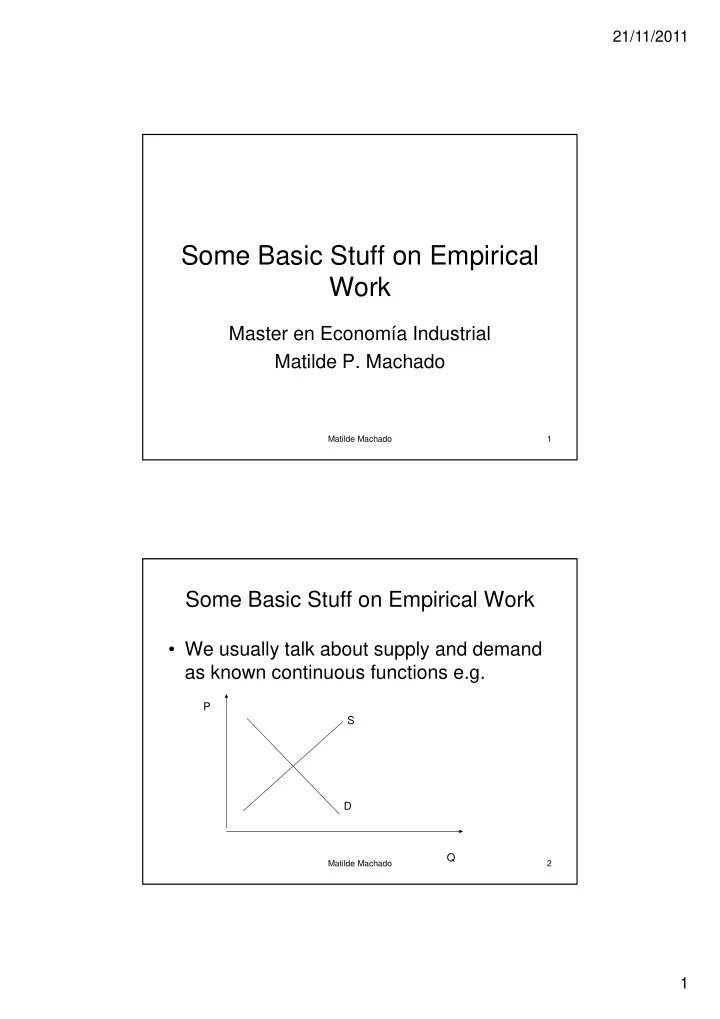
21/11/2011 Some Basic Stuff on Empirical Work Master en Economa Industrial Matilde P. Machado Matilde Machado 1 Some Basic Stuff on Empirical Work We usually talk about supply and demand as known continuous functions e.g. P S D Q


slide-1
SLIDE 1

21/11/2011 1

1

Some Basic Stuff on Empirical Work

Master en Economía Industrial Matilde P. Machado

Matilde Machado 2

Some Basic Stuff on Empirical Work

  • We usually talk about supply and demand

as known continuous functions e.g.

D S P Q

Matilde Machado

slide-2
SLIDE 2

21/11/2011 2

3

Some Basic Stuff on Empirical Work

  • However, researchers do not know these
  • relationships. They must be estimated

using data.

  • If data on price and quantity are available

we may have a picture like:

P Q

Matilde Machado 4

Some Basic Stuff on Empirical Work

  • These dots are equilibrium prices and

quantities and therefore represent the crossing of (different) aggregate demand and supply functions.

  • For example in the next figure we have

three points corresponding to three different equilibria resulting from three different demand and supply functions (D1,S1), (D2,S2), and (D3,S3).

Matilde Machado

slide-3
SLIDE 3

21/11/2011 3

5

Some Basic Stuff on Empirical Work

Price

  • D1

D2 D3 S3 S2 S1

Matilde Machado 6

Some Basic Stuff on Empirical Work

  • if we mistakenly take the three points as

realizations of a single demand function instead

  • f realizations of three different demand and

supply functions, for example by running an OLS regression of quantity against price, we estimate the demand with a bias

D ˆ

Matilde Machado

slide-4
SLIDE 4

21/11/2011 4

7

Some Basic Stuff on Empirical Work

Price

  • D

ˆ

D1 D2 D3 S3 S2 S1

Matilde Machado 8

Some Basic Stuff on Empirical Work

  • Clearly we need to account for demand shifters

i.e. other variables that may shift the demand

  • function. For example, population (N), prices of

related goods (Pr) and income (M) may explain the shifts in demand in different points in time (D1, D2, and D3).

  • So suppose we estimate an equation as the

following, would we obtain unbiased demand estimates?

  • d

d

e N b b M b P b b Q + + + + + =

4 3 2 1

Pr

Matilde Machado

slide-5
SLIDE 5

21/11/2011 5

9

Some Basic Stuff on Empirical Work

  • The answer is NO! Because of what is called the

simultaneity problem.

  • Equilibrium prices and quantities are

simultaneously determined by supply and

  • demand. But what does that mean? and what

does that imply?

  • It means that ed (which is correlated with Qd) is

also correlated with P

d d

e N b Pr b M b P b b Q + + + + + =

4 3 2 1

Matilde Machado 10

Some Basic Stuff on Empirical Work

  • Any shock to the demand or unobservable variable

shifting the demand (ed) will cause a change in price. For example, an increase in ed leads to a price increase for a given supply function:

D P Q P’ Q’

Matilde Machado

slide-6
SLIDE 6

21/11/2011 6

11

Some Basic Stuff on Empirical Work

  • Therefore, OLS estimates of the demand

function are biased because the assumption of independence between the error term ed and the explanatory variables is violated.

  • Alternatives:

– 1) estimate the demand function using Instrumental variables for the variable P. – 2) estimate a reduced form equation

Matilde Machado 12

Some Basic Stuff on Empirical Work

Alternative 1), Instrumental Variables

  • Instruments for price must be:

– (strongly) Correlated with price (P) – Uncorrelated with the demand shock ed

  • Candidates for instruments are supply shifters that

do not enter the demand functions such as cost determinants (e.g. W in the supply equation).

s s

e W c P c c Q + + + =

2 1

Matilde Machado

slide-7
SLIDE 7

21/11/2011 7

13

Some Basic Stuff on Empirical Work

Alternative 2) Reduced form equation: Putting the demand and supply equations together, we obtain the system: Q only depends on exogenous variables, therefore no simultaneity problem, no bias. However, not possible to estimate demand- price elasticities.

e W d N d d M d d Q Q Q Q e N b b M b P b b Q e W c P c c Q

s d d d s s

+ + + + + = ⇔      = = + + + + + = + + + =

4 3 2 1 4 3 2 1 2 1

Pr quantity m equilibriu Pr

Matilde Machado 14

Some Basic Stuff on Empirical Work

Cases where there is no simultaneity problem are cases where price may be considered exogenous.

  • 1. Individual demand functions – individuals

take prices as given

  • 2. Price-taking firms’ demand functions

Matilde Machado

slide-8
SLIDE 8

21/11/2011 8

15

Some Basic Stuff on Empirical Work

Example: Suppose we want to estimate the demand for doctors visits and we have prices and number of visits per person during a year. Suppose the demand for visits depends on price but also on the individuals’ level of exercise, for which there is no data and therefore is unobservable to the researcher.

exercise

  • f

level average the is E and visit a

  • f

price the is P where ) , (

− −

= E P f Q

Matilde Machado 16

Some Basic Stuff on Empirical Work

For the estimation take: If u and P are not correlated then α is estimated without bias. However, since the level of exercise is in the error term it is likely that corr(E,P)=corr(u,P)<0 higher level of exercise, less demand of visits, lower price. This leads to a downward bias on the estimated α. error term an is u where u P E P Q + = + = α β α

Matilde Machado

slide-9
SLIDE 9

21/11/2011 9

17

Some Basic Stuff on Empirical Work

A simple example: α = -1; β = 15 Getafe Leganés P = 40 E = 3.5 Q =-1(40)+15(3)= 5 P = 30 E = 4 Q =-1(30)+15(4)=30

The estimated α is downward bias because it incorporates part of the effect of the physical exercise.

1 5 . 2 10 25 40 30 5 30 ˆ − < − = − = − − = α

Matilde Machado 18

Some Basic Stuff on Empirical Work

Graphically: α = -1; β = 15

P Q 40 30 5 30 G L Q=-2.5P+105 Q=-P+15*4=-P+60 Q=-P+15*3.5

Matilde Machado