Solving Proportions MPM2D: Principles of Mathematics Recap Explain - - PDF document

solving proportions
SMART_READER_LITE
LIVE PREVIEW

Solving Proportions MPM2D: Principles of Mathematics Recap Explain - - PDF document

s i m i l a r i t y & p r o p o r t i o n a l i t y s i m i l a r i t y & p r o p o r t i o n a l i t y Solving Proportions MPM2D: Principles of Mathematics Recap Explain why ABC DEF . Properties of Similar Triangles J.


slide-1
SLIDE 1

s i m i l a r i t y & p r o p o r t i o n a l i t y

MPM2D: Principles of Mathematics

Properties of Similar Triangles

  • J. Garvin

Slide 1/15

s i m i l a r i t y & p r o p o r t i o n a l i t y

Solving Proportions

Recap

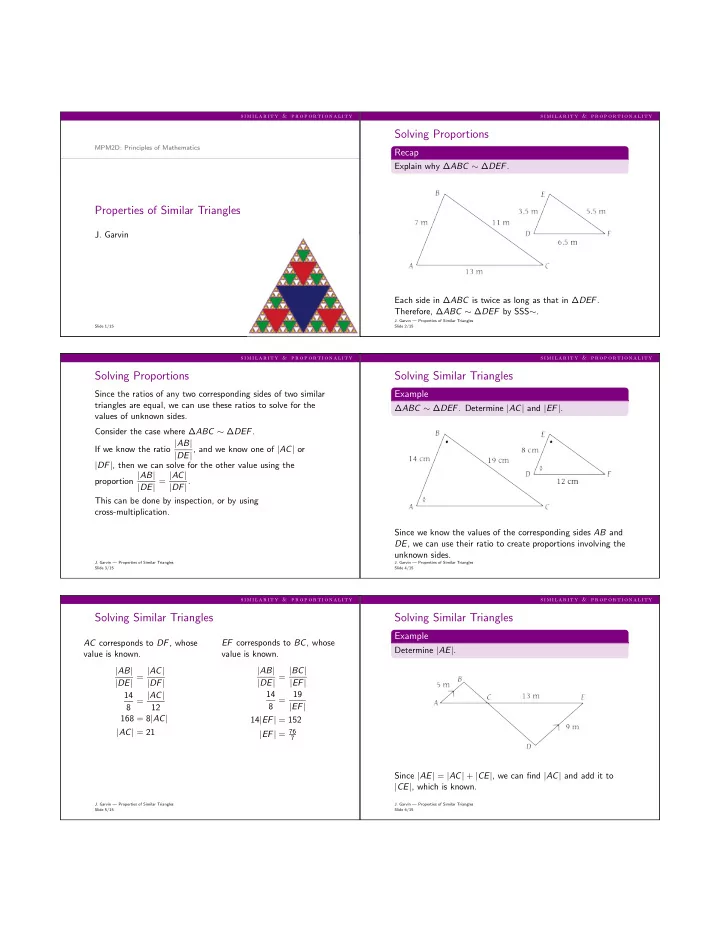
Explain why ∆ABC ∼ ∆DEF. Each side in ∆ABC is twice as long as that in ∆DEF. Therefore, ∆ABC ∼ ∆DEF by SSS∼.

  • J. Garvin — Properties of Similar Triangles

Slide 2/15

s i m i l a r i t y & p r o p o r t i o n a l i t y

Solving Proportions

Since the ratios of any two corresponding sides of two similar triangles are equal, we can use these ratios to solve for the values of unknown sides. Consider the case where ∆ABC ∼ ∆DEF. If we know the ratio |AB| |DE|, and we know one of |AC| or |DF|, then we can solve for the other value using the proportion |AB| |DE| = |AC| |DF|. This can be done by inspection, or by using cross-multiplication.

  • J. Garvin — Properties of Similar Triangles

Slide 3/15

s i m i l a r i t y & p r o p o r t i o n a l i t y

Solving Similar Triangles

Example

∆ABC ∼ ∆DEF. Determine |AC| and |EF|. Since we know the values of the corresponding sides AB and DE, we can use their ratio to create proportions involving the unknown sides.

  • J. Garvin — Properties of Similar Triangles

Slide 4/15

s i m i l a r i t y & p r o p o r t i o n a l i t y

Solving Similar Triangles

AC corresponds to DF, whose value is known. |AB| |DE| = |AC| |DF| 14 8 = |AC| 12 168 = 8|AC| |AC| = 21 EF corresponds to BC, whose value is known. |AB| |DE| = |BC| |EF| 14 8 = 19 |EF| 14|EF| = 152 |EF| = 76

7

  • J. Garvin — Properties of Similar Triangles

Slide 5/15

s i m i l a r i t y & p r o p o r t i o n a l i t y

Solving Similar Triangles

Example

Determine |AE|. Since |AE| = |AC| + |CE|, we can find |AC| and add it to |CE|, which is known.

  • J. Garvin — Properties of Similar Triangles

Slide 6/15

slide-2
SLIDE 2

s i m i l a r i t y & p r o p o r t i o n a l i t y

Solving Similar Triangles

AB corresponds with DE, while AC corresponds with CE. |AB| |DE| = |AC| |CE| 5 9 = |AC| 13 65 = 9|AC| |AC| = 65

9

Therefore, |AE| = 13 + 65

9 = 182 9

m.

  • J. Garvin — Properties of Similar Triangles

Slide 7/15

s i m i l a r i t y & p r o p o r t i o n a l i t y

Solving Similar Triangles

Example

Determine |BD|. Since BD is part of a trapezoid rather than a triangle, we cannot use it directly in a proportion.

  • J. Garvin — Properties of Similar Triangles

Slide 8/15

s i m i l a r i t y & p r o p o r t i o n a l i t y

Solving Similar Triangles

Since |BD| = |AD| − |AB|, we can first find |AD| and subtract |AB|, which is known. |AD| |AB| = |DE| |BC| |AD| 14 = 20 12 |AD| 14 = 5 3 3|AD| = 70 |AD| = 70

3

Therefore, |BD| = 70

3 − 14 = 28 3 in.

  • J. Garvin — Properties of Similar Triangles

Slide 9/15

s i m i l a r i t y & p r o p o r t i o n a l i t y

Areas of Similar Triangles

What happens to the area of a triangle when its dimensions are doubled? When the dimensions are doubled, the area is quadrupled.

  • J. Garvin — Properties of Similar Triangles

Slide 10/15

s i m i l a r i t y & p r o p o r t i o n a l i t y

Areas of Similar Triangles

What happens to the area of a triangle when its dimensions are tripled? When the dimensions are tripled, the area increases by a factor of nine.

  • J. Garvin — Properties of Similar Triangles

Slide 11/15

s i m i l a r i t y & p r o p o r t i o n a l i t y

Areas of Similar Triangles

In general, a triangle whose dimensions are enlarged by a factor of k will have an area k2 times greater.

Areas of Similar Triangles

If ∆ABC ∼ ∆DEF, and if |AB| = k|DE|, then AreaABC = k2 · AreaDEF. Any ratio of corresponding sides can be used, so choose the

  • ne that is easiest to work with.
  • J. Garvin — Properties of Similar Triangles

Slide 12/15

slide-3
SLIDE 3

s i m i l a r i t y & p r o p o r t i o n a l i t y

Areas of Similar Triangles

Example

∆ABC ∼ ∆DEF. Determine AreaDEF.

  • J. Garvin — Properties of Similar Triangles

Slide 13/15

s i m i l a r i t y & p r o p o r t i o n a l i t y

Areas of Similar Triangles

Determine the scale factor, k, of ∆DEF. 12k = 8 k = 2

3

The area of ∆DEF will be k2 = 2

3

2 = 4

9 the size of ∆ABC.

Therefore, the area of ∆DEF is 90 × 4

9 = 40 cm2.

  • J. Garvin — Properties of Similar Triangles

Slide 14/15

s i m i l a r i t y & p r o p o r t i o n a l i t y

Questions?

  • J. Garvin — Properties of Similar Triangles

Slide 15/15