Solar Surface Anisotropy effect on the Magnetic Field Vronique - - PowerPoint PPT Presentation

solar surface anisotropy effect on the magnetic field
SMART_READER_LITE
LIVE PREVIEW

Solar Surface Anisotropy effect on the Magnetic Field Vronique - - PowerPoint PPT Presentation

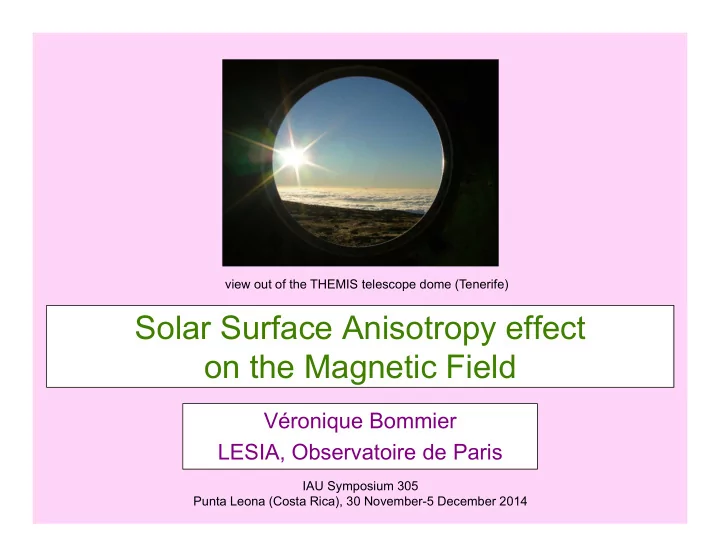
view out of the THEMIS telescope dome (Tenerife) Solar Surface Anisotropy effect on the Magnetic Field Vronique Bommier LESIA, Observatoire de Paris IAU Symposium 305 Punta Leona (Costa Rica), 30 November-5 December 2014 NOAA 10953 VECTOR


slide-1
SLIDE 1

Solar Surface Anisotropy effect

  • n the Magnetic Field

Véronique Bommier LESIA, Observatoire de Paris

IAU Symposium 305 Punta Leona (Costa Rica), 30 November-5 December 2014 view out of the THEMIS telescope dome (Tenerife)

slide-2
SLIDE 2

VECTOR MAGNETIC FIELD MAPS 2 lines: Fe I 6301.5 and 6302.5 Å independent ME inversion

(UNNOFIT code, Bommier et al. 2007)

lines of the same multiplet: constant ΔH

(simulation quiet Sun & AR by Khomenko & Collados 2007)

formation depth difference: 98 km ambiguity removed by |divB|+|Jz| minimization

(DIVB2, modified ME0 code of Leka et al., simulated annealing)

119 maps available 96 THEMIS 2010-2013 campaigns & 23 HINODE http://lesia.obspm.fr/perso/veronique-bommier Véronique Bommier's homepage

NOAA 10953 Hinode 1 May 2007 vector current density vector Lorentz force

slide-3
SLIDE 3

Fe I 6301.5 Å and 6302.5 Å are 2 lines of the same multiplet 816  parallelism

from Khomenko, E., & Collados, M., 2007, ApJ 659, 1726

Direct measurement of ∆h by phase shift method (cross-spectral analysis): quiet Sun, HINODE data: ∆h = 63.2 ± 0.9 km (Faurobert et al., 2009, A&A 507, L29) confirmed by 3D simulations of solar magneto-convection: ∆h = 69 km Stein & Nordlund's + Uitenbroek's codes (Grec et al., 2009, A&A 514, A91)

slide-4
SLIDE 4

THEMIS observation

  • f a

double sunspot (δ-spot)

  • n 13 September 2005

MULTILINE divB divB scaled by the aspect ratio

plot of BX X  BY Y  BZ Z plot of 10BX X 10BY Y  BZ Z

color scale: scaled to the measurement inaccuracy level (including inversion)

slide-5
SLIDE 5

vertical gradient dBz/dz: 3 G/km horizontal gradient dBx/dx+dBy/dy: 0.3 G/km

  • Westendorp Plaza et al., 2001, ApJ 547, 1130

2 lines Fe I 6301.5 & 6302.5 Å

  • bserved with ASP (Sac Peak)

SIR inversion, provides also d/dz result: 1.5-2 G/km (4 G/km in a previous analysis)

  • Balthasar & Schmidt, 1993, A&A 279, 243

3 lines Fe I 6302.5 & 6842.7 Å & Fe II 6149.2 Å spectropolarimetry with the VTT (Izaña, Tenerife) inversion by comparison with theoretical profiles by Grossmann-Doerth et al. (1988), G-D (1994) Unno-Rachkovsky sol. in a model atmosphere d/dz is derived result: 2.5 to 3 G/km

  • Pahlke & Wiehr, 1990, A&A 228, 246

6 lines Si I 6142.9, Zr I 6143.2, Fe II 6149.2, Ti I 6149.7, Fe I 6151.6, Na I 6154.2 Å circular polarization

  • bserved with the Gregory-Coudé telescope (Tenerife)

direct field measurement in umbra by Zeeman splitting best agreement between the 6 lines if a gradient of 2 G/km is assumed.

  • Bruls, Solanki, Rutten & Carlsson, 1995, A&A 293, 225

reanalyze FTS (Kitt Peak) observations by Hewagama et al. (1993) 2 infrared lines Mg I 12.22 & 12.32 m (formed in the upper photosphere) MULTI code (non-LTE multilevel, Carlsson 1986) + DELO Stokes profile synthesis (Rees et al., 1989, Murphy, 1990, Murphy & Rees, 1990) result: 2-3 G/km

  • Balthasar, 2006, A&A 449, 1169

3 lines Fe I 15648, 15452 & 10896 Å

  • bserved with the TIP mounted on the VTT (Tenerife)

8 sunspots SIR inversion result: 0.5 G/km

  • Hagyard et al., 1983, Sol. Phys. 84, 13

1 highly sensitive line Fe I 5250.2 Å MSFC magnetograph (Hunstville, Alabama) 1 sunspot result: 0.1-0.3 G/km

  • suppose a regular sunspot diameter 10,000 km

suppose that Bx varies from –1500 G to + 1500 G from one penumbra side to the other penumbra side the mean horizontal gradient results into 0.3 G/km

  • Eibe, Aulanier, Faurobert, Mein, Malherbe, 2002,

A&A 381, 290, report a factor of 10 between

  • observations: longitudinal field

Na I D1 observed with THEMIS/MSDP depth probing along the highly resolved line profile via response functions computed with the MULTI code (Carlsson 1986)

  • theory: force-free extrapolation (Démoulin, Bagala,

Mandrini, Hénoux, Rovira, 1997, A&A 325, 305)

  • Pizzo, 1986, ApJ 302, 785

magnetostatic equilibrium modelling (not force-free) result: 0.2-0.4 G/km (Fig. 15, for large tube radii that model sunspots)

models
slide-6
SLIDE 6

This cannot be ascribed to the lack of resolution

Demonstration in the spatial Fourier space

real space Fourier transform spatial Fourier space f (x)  ˆ f (kx)  eikxx f (x)d x

derivation:  x f (x)  multiplication: kx ˆ f (kx) filtering: convolution product  normal product F(x)  (x   x ) f (  x )d  x

 ˆ F(kx)  ˆ (kx) ˆ f (kx)

slide-7
SLIDE 7

What is measured: H or B ? I

slide-8
SLIDE 8

What is measured: H or B ? II

slide-9
SLIDE 9

Anisotropic Debye shielding (local dynamo)

Open Access paper by Bommier in Physics Research International http://www.hindawi.com/journals/physri/2013/195403/ + Bommier, 2014, Comptes Rendus Physique, 15, 430 (available from the ADS)

slide-10
SLIDE 10

The photosphere: a strongly stratified medium viscosity-affected

From Brethouwer, Billant, Lindborg, Chomaz, J. of Fluid Mechanics, 585, 343:

 The horizontal Froude number in the photosphere is found F

h  0.02 ฀ 1

 the photosphere is a strongly stratified medium (not the solar Corona, having F

h  3)

The Reynolds number is Re  500 ฀ 1, but the buoyancy Reynolds number is Rb  ReF

h 2  0.1 ฀ 1

 the photosphere lies in the "viscosity-affected flow regime": no inertial cascade can develop  the typical horizontal/vertical length ratio ("aspect ratio") is Re  20  the horizontal/vertical velocities and then Debye lengths are different: anisotropy

Temporary conclusion

slide-11
SLIDE 11

An experimental proof ?

Physical conditions of the experiment taken from Van Compernolle, Bortnik, Pribyl, Gekelman, et al., 2014,Phys. Rev. Letters 112, 145006 Description of the experiment in Gekelman et al., 1991, Rev. Sci. Instrum. 62, 2875

slide-12
SLIDE 12

NOAA 10808 observed on 13 September 2005 with THEMIS

THEMIS

slide-13
SLIDE 13

NOAA 10808 observed on 13 September 2005 with THEMIS magnetic field vector

THEMIS