Soire Immunothrapie ROHLim 21 septembre 2016 Introduction - - PDF document

soir e immunoth rapie rohlim 21 septembre 2016
SMART_READER_LITE
LIVE PREVIEW

Soire Immunothrapie ROHLim 21 septembre 2016 Introduction - - PDF document

Soire Immunothrapie ROHLim 21 septembre 2016 Introduction Nivolumab Versus Investigators Choice (IC) for Patients with platinum-refractory R/M SCCHN have a dismal prognosis, Recurrent or Metastatic (R/M) Head and Neck with median


slide-1
SLIDE 1

Soirée Immunothérapie 21 septembre 2016 ROHLim Présentation du Dr Xavier ZASADNY Polyclinique Limoges – Chénieux 1

AACR 2016

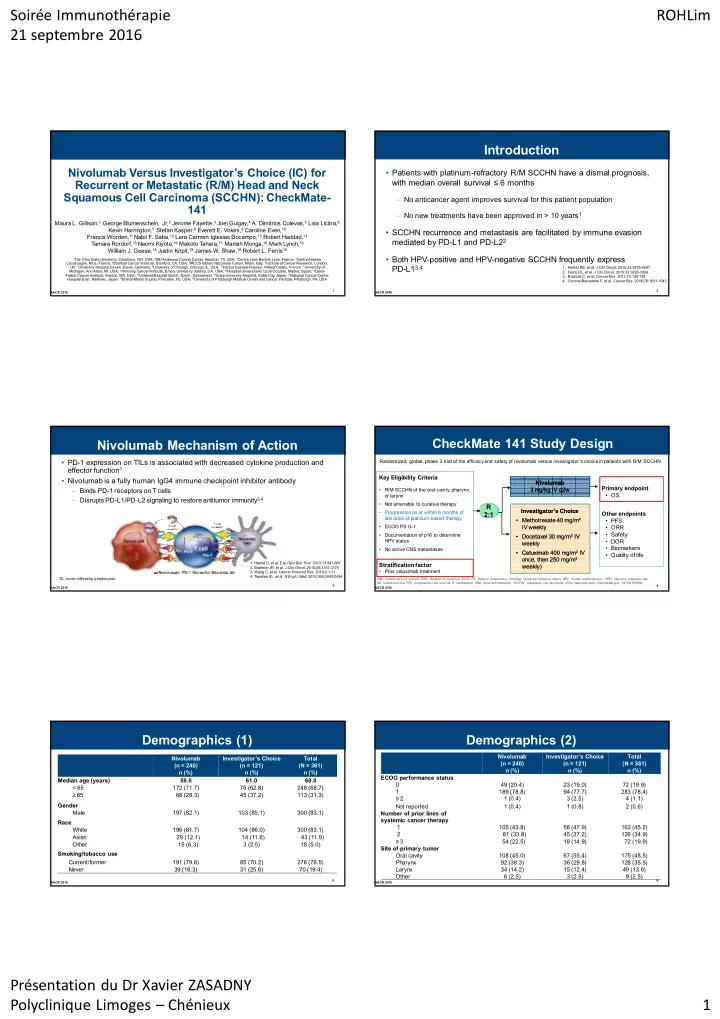
Nivolumab Versus Investigator’s Choice (IC) for Recurrent or Metastatic (R/M) Head and Neck Squamous Cell Carcinoma (SCCHN): CheckMate- 141

1The Ohio State University, Columbus, OH, USA; 2MD Anderson Cancer Center, Houston, TX, USA; 3Centre Leon Berard, Lyon, France; 4Centre Antoine

Lacassagne, Nice, France; 5Stanford Cancer Institute, Stanford, CA, USA; 6IRCCS Istituto Nazionale Tumori, Milan, Italy; 7Institute of Cancer Research, London, UK; 8University Hospital Essen, Essen, Germany; 9University of Chicago, Chicago, IL, USA; 10Institut Gustave Roussy, Villejuif Cedex, France; 1

1University of

Michigan, Ann Arbor, MI, USA; 12Winship Cancer Institute, Emory University, Atlanta, GA, USA; 13Hospital Universitario 12 de Octubre, Madrid, Spain; 14Dana- Farber Cancer Institute, Boston, MA, USA; 15Universitätsspital Zurich, Zurich, Switzerland; 16Kobe University Hospital, Kobe-City, Japan; 17National Cancer Center Hospital East, Kashiwa, Japan; 18Bristol-Myers Squibb, Princeton, NJ, USA; 19University of Pittsburgh Medical Center and Cancer Institute, Pittsburgh, PA, USA

Maura L. Gillison,1 George Blumenschein, Jr,2 Jerome Fayette,3 Joel Guigay,4 A. Dimitrios Colevas,5 Lisa Licitra,6 Kevin Harrington,7 Stefan Kasper,8 Everett E. Vokes,9 Caroline Even,10 Francis Worden,11 Nabil F. Saba,12 Lara Carmen Iglesias Docampo,13 Robert Haddad,14 Tamara Rordorf,15 Naomi Kiyota,16 Makoto Tahara,17 Manish Monga,18 Mark Lynch,18 William J. Geese,18 Justin Kopit,18 James W. Shaw,18 Robert L. Ferris19

1 AACR 2016

Introduction

  • Patients with platinum-refractory R/M SCCHN have a dismal prognosis,

with median overall survival ≤ 6 months

– No anticancer agent improves survival for this patient population – No new treatments have been approved in > 10 years1

  • SCCHN recurrence and metastasis are facilitated by immune evasion

mediated by PD-L1 and PD-L22

  • Both HPV-positive and HPV-negative SCCHN frequently express

PD-L13,4

  • 1. Herbst RS, et al. J Clin Oncol. 2015;23:5578-5587
  • 2. Ferris RL, et al. J Clin Oncol. 2015;33:3293-3304
  • 3. Badoual C, et al. Cancer Res. 2013;73:128-138
  • 4. Concha-Benavente F, et al. Cancer Res. 2016;76:1031-1043

2 AACR 2016

Nivolumab Mechanism of Action

  • PD-1 expression on TILs is associated with decreased cytokine production and

effector function1

  • Nivolumab is a fully human IgG4 immune checkpoint inhibitor antibody

– Binds PD-1 receptors on T cells – Disrupts PD-L1/PD-L2 signaling to restore antitumor immunity2-4

  • 1. Hamid O, et al. Exp Opin Biol Ther. 2013;13:847-861
  • 2. Brahmer JR, et al. J Clin Oncol. 2010;28:3167-3175
  • 3. Wang C, et al. Cancer Immunol Res. 2014;2:1-11
  • 4. T
  • palian SL, et al. N Engl J Med. 2012;366:2443-2454

TIL, tumor-infiltrating lymphocytes 3 AACR 2016

CheckMate 141 Study Design

R 2:1 R 2:1

Nivolumab 3 mg/kg IV q2w Nivolumab 3 mg/kg IV q2w Investigator’s Choice

  • Methotrexate 40 mg/m²

IV weekly

  • Docetaxel 30 mg/m² IV

weekly

  • Cetuximab 400 mg/m² IV
  • nce, then 250 mg/m²

weekly) Investigator’s Choice

  • Methotrexate 40 mg/m²

IV weekly

  • Docetaxel 30 mg/m² IV

weekly

  • Cetuximab 400 mg/m² IV
  • nce, then 250 mg/m²

weekly) Key Eligibility Criteria

  • R/M SCCHN of the oral cavity, pharynx,
  • r larynx
  • Not amenable to curative therapy
  • Progression on or within 6 months of

last dose of platinum-based therapy

  • ECOG PS 0–1
  • Documentation of p16 to determine

HPV status

  • No active CNS metastases

Stratification factor

  • Prior cetuximab treatment

CNS, central nervous system; DOR, duration of response; ECOG PS, Eastern Cooperative Oncology Group performance status; HPV, human papillomavirus; ORR, objective response rate; OS, overall survival; PFS, progression-free survival; R, randomized; R/M, recurrent/metastatic; SCCHN, squamous cell carcinoma of the head and neck; Clinicaltrials.gov. NCT02105636.

Primary endpoint

  • OS

Other endpoints

  • PFS
  • ORR
  • Safety
  • DOR
  • Biomarkers
  • Quality of life

Randomized, global, phase 3 trial of the efficacy and safety of nivolumab versus investigator’s choice in patients with R/M SCCHN

4 AACR 2016

Nivolumab (n = 240) n (%) Investigator’s Choice (n = 121) n (%) Total (N = 361) n (%) Median age (years) 59.0 61.0 60.0 < 65 172 (71.7) 76 (62.8) 248 (68.7) ≥ 65 68 (28.3) 45 (37.2) 113 (31.3) Gender Male 197 (82.1) 103 (85.1) 300 (83.1) Race White 196 (81.7) 104 (86.0) 300 (83.1) Asian 29 (12.1) 14 (11.6) 43 (11.9) Other 15 (6.3) 3 (2.5) 18 (5.0) Smoking/tobacco use Current/former 191 (79.6) 85 (70.2) 276 (76.5) Never 39 (16.3) 31 (25.6) 70 (19.4)

Demographics (1)

5 AACR 2016

Nivolumab (n = 240) n (%) Investigator’s Choice (n = 121) n (%) Total (N = 361) n (%) ECOG performance status 49 (20.4) 23 (19.0) 72 (19.9) 1 189 (78.8) 94 (77.7) 283 (78.4) ≥ 2 1 (0.4) 3 (2.5) 4 (1.1) Not reported 1 (0.4) 1 (0.8) 2 (0.6) Number of prior lines of systemic cancer therapy 1 105 (43.8) 58 (47.9) 163 (45.2) 2 81 (33.8) 45 (37.2) 126 (34.9) ≥ 3 54 (22.5) 18 (14.9) 72 (19.9) Site of primary tumor Oral cavity 108 (45.0) 67 (55.4) 175 (48.5) Pharynx 92 (38.3) 36 (29.8) 128 (35.5) Larynx 34 (14.2) 15 (12.4) 49 (13.6) Other 6 (2.5) 3 (2.5) 9 (2.5)

Demographics (2)

6

slide-2
SLIDE 2

Soirée Immunothérapie 21 septembre 2016 ROHLim Présentation du Dr Xavier ZASADNY Polyclinique Limoges – Chénieux 2

AACR 2016

Nivolumab (n = 240) Investigator’s Choice (n = 121) Total (N = 361) Patients receiving ≥ 1 dose, n (%) 236 (98.3) 111 (91.7) 347 (96.1) Investigator’s choice therapy, n (%) Methotrexate – 46 (38.0) – Docetaxel – 52 (43.0) – Cetuximab – 13 (10.7) – Median time on therapy, mo (95% CI) 1.9 (1.6–2.3) 1.9 (1.6–2.0) – Median duration of follow-up, mo (range) 5.3 (0–16.8) 4.6 (0–15.2) – Number of deaths, n (%) 133 (55.4) 85 (70.2) 218 (60.4) Ongoing treatment, n (%) 41 (17.4) 3 (2.7) 44 (12.7)

Treatment Administration

7 AACR 2016

3 6 9 12 15 18 Median OS, mo (95% CI) HR (97.73% CI) p-value Nivolumab (n = 240) 7.5 (5.5–9.1) 0.70 (0.51–0.96) 0.0101 Investigator’s Choice (n = 121) 5.1 (4.0–6.0)

Overall Survival

Months

Nivolumab 240 167 109 52 24 7 Investigator’s Choice 121 87 42 17 5 1

  • No. at Risk

10 20 30 40 50 60 70 80 90 100

Overall Survival (% of patients)

1-year OS rate (95% CI) 36.0% (28.5–43.4) 16.6% (8.6–26.8)

8 ASCO 2016

Progression-Free Survival

Nivolumab in R/M SCCHN After Platinum Therapy

9

Months

Nivolumab 240

79 32 12 4 1

Investigator’s Choice

121 43 9 2

  • No. at Risk

Progression-Free Survival (% of patients) 3 6 9 12 15 18 10 20 30 40 50 60 70 80 90 100

6-month PFS rate (95% CI) 19.7% (14.6, 25.4) 9.9% (5.0, 16.9)

Median OS, mo (95% CI) HR (97.73% CI) P-value Nivolumab (n = 240) 2.0 (1.9, 2.1) 0.89 (0.70, 1.1) 0.3236 Investigator’s Choice (n = 121) 2.3 (1.9, 3.1)

ASCO 2016

Objective Response Rate

Nivolumab in R/M SCCHN After Platinum Therapy

10

Nivolumab (n = 240) Investigator’s Choice (n = 121) Objective response rate, n (%) 32 (13.3) 7 (5.8) 95% CI 9.3, 18.3 2.4, 11.6 Best overall response, n (%) Complete response 6 (2.5) 1 (0.8) Partial response 26 (10.8) 6 (5.0) Stable disease 55 (22.9) 43 (35.5) Progressive disease 100 (41.7) 42 (34.7) Not determined 53 (22.1) 29 (24.0) Time to response, mo Median (range) 2.1 (1.8–7.4) 2.0 (1.9–4.6)

ASCO 2016

  • No. of patients

Overall Survival Subgroupsa Nivolumab IC Unstratified Hazard Ratio (95% CI) Overall 240 121 0.69 (0.53, 0.91) Age category , years <65 172 76 0.64 (0.45, 0.89) ≥65 to <75 56 39 0.93 (0.56, 1.54) ≥75 12 6 ECOG performance status 49 23 0.60 (0.30, 1.23) ≥1 190 97 0.71 (0.53, 0.96) Tobacco use Current/Former 191 85 0.71 (0.52, 0.99) Never 39 31 0.58 (0.32, 1.06) Prior lines of systemic therapy , n 1 106 58 0.72 (0.48, 1.07) 2 80 45 0.64 (0.40, 1.00) ≥3 54 18 0.77 (0.38, 1.57) Intended IC therapy Methotrexate 119 52 0.64 (0.43, 0.96) Docetaxel 88 54 0.82 (0.53, 1.28) Cetuximab 33 15 0.47 (0.22, 1.01) Favors Nivolumab Favors IC 0.125 0.25 0.5 1 2

aHazard ratios w ere not calculated for subgroups

w ith few er than 20 patients across both arms 11 AACR 2016

Baseline PD-L1 Expression and p16 Status

Nivolumab (n = 240) n (%) Investigator’s Choice (n = 121) n (%) Total (N = 361) n (%) PD-L1 quantifiable 161 (67.1) 99 (81.8) 260 (72.0) ≥ 1% 88 (54.7) 61 (61.6) 149 (57.3) < 1% 73 (45.3) 38 (38.4) 111 (42.7) PD-L1 not evaluable 79 (32.9) 22 (18.2) 101 (28.0) p16 statusa,b Positive 63 (26.3) 29 (24.0) 92 (25.5) Negative 50 (20.8) 36 (29.8) 86 (23.8) Not tested 127 (52.9) 56 (46.3) 183 (50.7)

aRequired from oropharyngeal cancer patients only. bDetermined via p16 immunohistochemistry. 12

slide-3
SLIDE 3

Soirée Immunothérapie 21 septembre 2016 ROHLim Présentation du Dr Xavier ZASADNY Polyclinique Limoges – Chénieux 3

AACR 2016

Overall Survival by PD-L1 Expression

PD-L1 Expression < 1%

Median OS, mo (95% CI) HR (95% CI) Nivolumab (n = 73) 5.7 (4.4–12.7) 0.89 (0.54–1.45) Investigator’s Choice (n = 38) 5.8 (4.0–9.8)

PD-L1 Expression ≥ 1%

Median OS, mo (95% CI) HR (95% CI) Nivolumab (n = 88) 8.7 (5.7–9.1) 0.55 (0.36–0.83) Investigator’s Choice (n = 61) 4.6 (3.8–5.8) 88 67 44 18 6 61 42 20 6 2 73 52 33 17 8 3 38 29 14 6 2 Nivolumab Investigator’s Choice Nivolumab Investigator’s Choice

  • No. at Risk

Overall Survival (% of patients)

Nivolumab Investigator’s Choice

Months 3 6 9 12 15 18 10 20 30 40 50 60 70 80 90 100 Months 3 6 9 12 15 18 10 20 30 40 50 60 70 80 90 100

13 AACR 2016

Overall Survival by p16 Status

p16-Negative

Median OS, mo (95% CI) HR (95% CI) Nivolumab (n = 50) 7.5 (3.0–NA) 0.73 (0.42–1.25) Investigator’s Choice (n = 36) 5.8 (3.8–9.5)

p16-Positive

Median OS, mo (95% CI) HR (95% CI) Nivolumab (n = 63) 9.1 (7.2–10.0) 0.56 (0.32–0.99) Investigator’s Choice (n = 29) 4.4 (3.0–9.8) Nivolumab Investigator’s Choice

  • No. at Risk

63 49 35 18 10 3 29 20 11 4 1 Nivolumab Investigator’s Choice 50 32 25 12 1 36 26 13 7 6 3 1 Nivolumab Investigator’s Choice Overall Survival (% of patients) Months 3 6 9 12 15 18 10 20 30 40 50 60 70 80 90 100 Months 3 6 9 12 15 18 10 20 30 40 50 60 70 80 90 100 14 AACR 2016

Overall Survival Summary

Nivolumab Investigator’s Choice Comparison of Nivolumab to Investigator’s Choice n Median, mo n Median, mo HR (95% CI) All patients 240 7.5 121 5.1 0.70 (0.51–0.96)a PD-L1 ≥1% 88 8.7 61 4.6 0.55 (0.36–0.83) PD-L1 <1% 73 5.7 38 5.8 0.89 (0.54–1.45) p16-positive 63 9.1 29 4.4 0.56 (0.32–0.99) p16-negative 50 7.5 36 5.8 0.73 (0.42–1.25)

aHR and 97.73% CI 15 AACR 2016

Treatment-Related AEs in ≥ 10% of Patients

Event Nivolumab (n = 236) Investigator’s Choice (n = 111) Any grade n (%) Grade 3–4 n (%) Any grade n (%) Grade 3–4 n (%) Anya 139 (58.9) 31 (13.1) 86 (77.5) 39 (35.1) Fatigue 33 (14.0) 5 (2.1) 19 (17.1) 3 (2.7) Nausea 20 (8.5) 23 (20.7) 1 (0.9) Diarrhea 16 (6.8) 15 (13.5) 2 (1.8) Anemia 12 (5.1) 3 (1.3) 18 (16.2) 5 (4.5) Asthenia 10 (4.2) 1 (0.4) 16 (14.4) 2 (1.8) Mucosal inflammation 3 (1.3) 14 (12.6) 2 (1.8) Alopecia 14 (12.6) 3 (2.7)

aOne Grade 5 event (hypercalcemia) in the nivolumab arm and one Grade 5 event (lung infection) in the investigator’s

choice arm were reported. A second death occurred in the nivolumab arm subsequent to pneumonitis.

16 AACR 2016

Treatment-Related Select AEs

Event Nivolumab (n = 236) Investigator’s Choice (n = 111) Any grade n (%) Grade 3–4 n (%) Any grade n (%) Grade 3–4 n (%) Skin 37 (15.7) 14 (12.6) 2 (1.8) Endocrine 18 (7.6) 1 (0.4) 1 (0.9) Gastrointestinal 16 (6.8) 16 (14.4) 2 (1.8) Hepatic 5 (2.1) 2 (0.8) 4 (3.6) 1 (0.9) Pulmonary 5 (2.1) 2 (0.8) 1 (0.9) Hypersensitivity/Infusion reaction 3 (1.3) 2 (1.8) 1 (0.9) Renal 1 (0.4) 2 (1.8) 1 (0.9)

Select AEs: AEs with potential immunologic etiology that requires monitoring/intervention

17 ASCO 2016

Patient Reported Outcome Measures

Nivolumab in R/M SCCHN After Platinum Therapy

  • Higher global health and functional scale scores = better QoL
  • Higher symptom scale scores = higher symptom burden
  • MID = 10 points
  • Higher symptom scale scores = higher symptom burden
  • MID = 10 points

18

EORTC QLQ-H&N352

Seven multi-question symptom scales

  • Social contact trouble (5 items)
  • Pain (4 items)
  • Swallowing (4 items)
  • Social eating trouble (4 items)
  • Speech problems (3 items)
  • Senses problems (2 items)
  • Less sexuality (2 items)

Eleven single items

  • Nutritional supplements
  • Opening mouth
  • Teeth problems
  • Coughing
  • Pain killers
  • Weight loss
  • Weight gain
  • Sticky saliva
  • Feeding tube
  • Dry mouth
  • Felt ill

EORTC QLQ-C301

Global health status/QoL scale

  • (2 items)

Five functional scales

  • Physical (5 items)
  • Role (2 items)
  • Emotional (4 items)
  • Cognitive (2 items)
  • Social (2 items)

Three symptom scales

  • Fatigue (3 items)
  • Nausea and vomiting (2 items)
  • Pain (2 items)

Six single items

  • Dyspnea
  • Insomnia
  • Appetite loss
  • Constipation
  • Diarrhea
  • Financial difficulties
  • 1. Aaronson NK, et al. J Natl Cancer Inst 1993;85:365–76; 2. Bjordal K, et al. Acta Oncol 1994;33:879–85.

MID = minimally important difference

slide-4
SLIDE 4

Soirée Immunothérapie 21 septembre 2016 ROHLim Présentation du Dr Xavier ZASADNY Polyclinique Limoges – Chénieux 4

ASCO 2016

Quality of Life and Symptom Burden

Nivolumab in R/M SCCHN After Platinum Therapy

  • Nivolumab

stabilized PROs while investigator’s choice led to meaningful declines in function and worsening of symptoms

19

Nivolumab Investigator's Choice EORTC QLQ-C30 Physical Function

Week 9 15 21

  • 30
  • 20
  • 10

10 Mean Change From Baseline Better Worse

EORTC QLQ-C30 Social Function

9 15 21

  • 30
  • 20
  • 10

10 Week Mean Change From Baseline Better Worse

EORTC QLQ-H&N35 Absence

  • f Sensory Problems

9 15 21

  • 30
  • 20
  • 10

10 Week Mean Change From Baseline Better Worse

EORTC QLQ-H&N35 Absence

  • f Trouble With Social Contact

9 15 21

  • 30
  • 20
  • 10

10 Week Mean Change From Baseline Better Worse ASCO 2016

Conclusions

Nivolumab in R/M SCCHN After Platinum Therapy

  • Nivolumab is the first agent to demonstrate a significant improvement in survival

in patients with SCCHN who progress after platinum-based therapy in a global, phase 3 comparative trial

– Nivolumab doubled the 1-year survival rate: 36% with nivolumab compared to 17% for investigator’s choice therapy

  • Nivolumab demonstrated a survival benefit in the overall study population regardless
  • f PD-L1 expression or p16 status
  • Magnitude of OS benefit of nivolumab vs investigator’s choice was greater in patients

expressing PD-L1, and increasing PD-L1 expression did not result in further benefit

  • There were fewer treatment-related adverse events with nivolumab vs investigator’s

choice therapy

  • Nivolumab stabilized PROs while investigator’s choice led to meaningful declines in

function and worsening of symptoms

  • Nivolumab is a new standard-of-care option for patients with R/M SCCHN after

platinum-based therapy

20 ASCO 2016

Merci au

Dr Florence VIDEAU Médecin Régional Région Sud-Ouest – La Réunion Direction Médicale - Division Immuno-Oncologie florence.videau@bms.com

21