Immunothrapie Immunothrapie Pembrolizumab Pembrolizumab (PD (PD-1 - - PDF document

immunoth rapie immunoth rapie pembrolizumab
SMART_READER_LITE
LIVE PREVIEW

Immunothrapie Immunothrapie Pembrolizumab Pembrolizumab (PD (PD-1 - - PDF document

Soire Immunothrapie ROHLim 21 septembre 2016 Immunothrapie Immunothrapie Pembrolizumab Pembrolizumab (PD (PD-1 Antibody) 1 Antibody) et et indiqu en monothrapie dans le traitement des patients adultes atteints d'un mlanome


slide-1
SLIDE 1

Soirée Immunothérapie 21 septembre 2016 ROHLim Présentation du Dr Xavier ZASADNY Polyclinique Limoges – Chénieux 1

Immunothérapie Immunothérapie et et cancers ORL cancers ORL

Dr Dr Xavier Xavier Zasadny Zasadny Réunion Réunion du du 21 21 septembre septembre 2016 2016

Pembrolizumab Pembrolizumab (PD

(PD-1 Antibody) 1 Antibody)

indiqué en monothérapie dans le traitement des patients adultes atteints d'un mélanome avancé (non résécable ou métastatique)

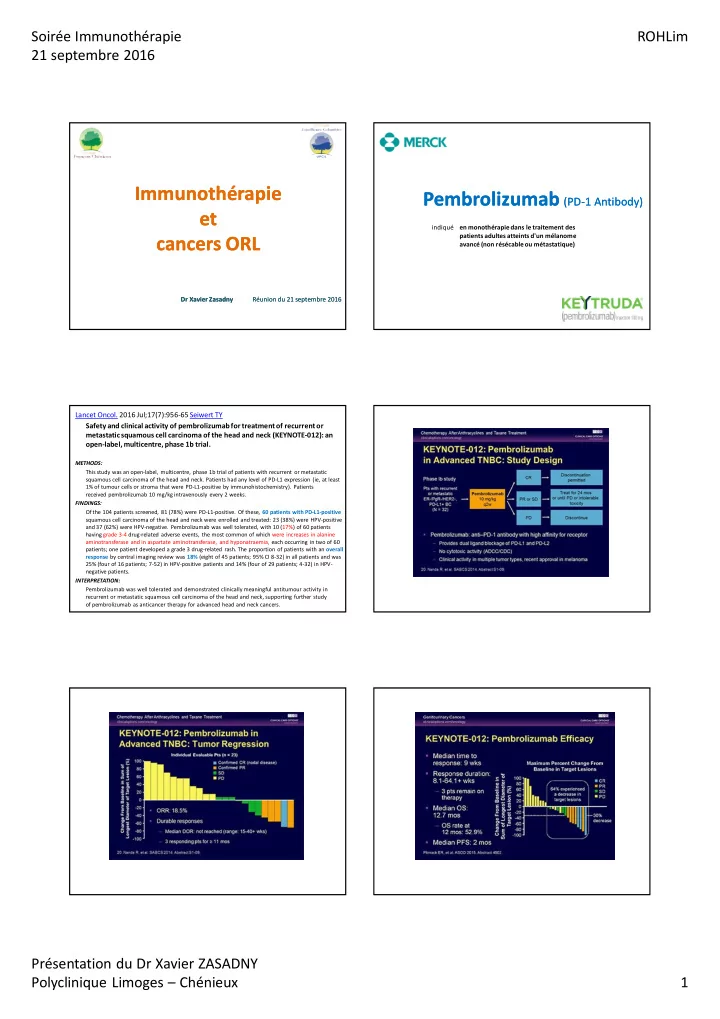
Lancet Oncol. 2016 Jul;17(7):956-65 Seiwert TY Safety and clinical activity of pembrolizumabfor treatment of recurrent or metastatic squamous cell carcinoma of the head and neck (KEYNOTE-012): an

  • pen-label, multicentre, phase 1b trial.

METHODS: This study was an open-label, multicentre, phase 1b trial of patients with recurrent or metastatic squamous cell carcinoma of the head and neck. Patients had any level of PD-L1 expression (ie, at least 1% of tumour cells or stroma that were PD-L1-positive by immunohistochemistry). Patients received pembrolizumab 10 mg/kg intravenously every 2 weeks. FINDINGS: Of the 104 patients screened, 81 (78%) were PD-L1-positive. Of these, 60 patients with PD-L1-positive squamous cell carcinoma of the head and neck were enrolled and treated: 23 (38%) were HPV-positive and 37 (62%) were HPV-negative. Pembrolizumab was well tolerated, with 10 (17%) of 60 patients having grade 3-4 drug-related adverse events, the most common of which were increases in alanine aminotransferase and in aspartate aminotransferase, and hyponatraemia, each occurring in two of 60 patients; one patient developed a grade 3 drug-related rash. The proportion of patients with an overall response by central imaging review was 18% (eight of 45 patients; 95% CI 8-32) in all patients and was 25% (four of 16 patients; 7-52) in HPV-positive patients and 14% (four of 29 patients; 4-32) in HPV- negative patients. INTERPRETATION: Pembrolizumab was well tolerated and demonstrated clinically meaningful antitumour activity in recurrent or metastatic squamous cell carcinoma of the head and neck, supporting further study

  • f pembrolizumab as anticancer therapy for advanced head and neck cancers.
slide-2
SLIDE 2

Soirée Immunothérapie 21 septembre 2016 ROHLim Présentation du Dr Xavier ZASADNY Polyclinique Limoges – Chénieux 2

The expansion cohort of KEYNOTE 012

  • included 132 patients who were unselected for PD-L1 expression and

received a fixed dose of pembrolizumab(infusion of 200 mg every 3 weeks)

  • Approximately 59% of the patients had received ≥2 previous therapies
  • The overall objective response rate was 24.8%, and was 26.3% in HPV-

negative patients and 20.6% in HPV-positive patients. Approximately 25% of patients had stable disease, for a disease control rate of approximately 50%

  • 60% of patients having any adverse event, and 15% reporting fatigue. Other

side effects included hypothyroidism (9.1%), decreased appetite (7.6%), and rash (7.6%)

  • Serious side effects occurred in <10% of patients. A total of 4 patients

experienced serious immune-related adverse events that included 2 patients with pneumonitis and 2 with swelling of the face

Essais en cours = M+

Phase 3 Pembrolizumabfor First Line Treatment of Recurrent or Metastatic Squamous Cell Cancer of the Head and Neck (KEYNOTE-048)

Participants with recurrent or metastatic squamous cell cancer of the head and neck will be randomly assigned to receive pembrolizumabalone, or pembrolizumab+ a platinum- based drug (cisplatin or carboplatin) + 5-Fluorouracil (5-FU), or cetuximab + a platinum- based drug (cisplatin or carboplatin) + 5-FU

Phase 3 PembrolizumabVersus Standard Treatment for Recurrent or Metastatic Head and Neck Cancer After Treatment With Platinum-based and Therapy (KEYNOTE-040)

This is a study of pembrolizumabversus standard treatment (methotrexate, docetaxel or cetuximab) for the treatment of recurrent or metastatic head and neck squamous cell

  • cancer. Participants will be randomly assigned to receive either pembrolizumabor

Investigator's choice of standard treatment

Phase 2 Study of Pembrolizumabin Recurrent or Metastatic Head and Neck Squamous Cell Carcinoma After Treatment With Platinum-based and Cetuximab Therapy (KEYNOTE-055)

This is a study of single-agent pembrolizumabin participants with recurrent and/or metastatic head and neck squamous cell carcinoma who have progressed on platinum- based and cetuximab therapy

Phases 2 en cours = Ass RXTH

Radiation Therapy and Pembrolizumabin Treating Patients with Head and Neck Squamous Cell Carcinoma That Is Recurrent or Cannot Be Removed by Surger Pembrolizumaband Radiation Therapy in Treating patients with Squamous Cell Cancer of the Head and Neck Pembrolizumab, Cisplatin, and Intensity Modulated Radiation Therapy in Treating Patients with Previously Untreated Stage III-IVb Head and Neck Cancer

Adjuvant Cisplatin and Radiation With Pembrolizumabin ResectedHead and Neck

Squamous Cell Carcinoma The purpose of this research study is to test the safety and the benefit of adding pembrolizumabto standard of care treatment for head and neck cancer. The standard of care treatment will include surgery followed by radiation for 6 weeks. Some patients may also receive cisplatin as standard of care once a week for 6 weeks if the cancer is found to be "high risk"

Durvalumab Durvalumab (PD

(PD-L1 Antibody) L1 Antibody) et et

Tremelimumab Tremelimumab (CTLA

(CTLA-4 Antibody) 4 Antibody)

Phase 3 en cours = M+

Durvalumab (MEDI4736): A PD-L1 Antibody +/- Tremelimumab: A CTLA-4 Antibody Phase III Open Label Study of MEDI 4736 With/Without Tremelimumab Versus Standard of Care (SOC) in Recurrent/Metastatic Head and Neck Cancer (KESTREL) This is a randomized, open-label, multi-center, 3-arm, global Phase III study to determine the efficacy and safety of MEDI4736 + tremelimumab combination or MEDI4736 monotherapy versus SoC (EXTREME regimen) in the treatment of patients with SCCHN who have not received prior systemic chemotherapy for recurrent or metastatic disease.

Nivolumab Nivolumab (PD

(PD-1 Antibody) 1 Antibody)

indiqué en monothérapie dans le traitement des patients adultes atteints d'un mélanome avancé (non résécable ou métastatique) indiqué dans le traitement des patients adultes atteints d'un cancer bronchique non à petites cellules (CBNPC) de type épidermoïdelocalement avancé ou métastatique après une chimiothérapie antérieure

slide-3
SLIDE 3

Soirée Immunothérapie 21 septembre 2016 ROHLim Présentation du Dr Xavier ZASADNY Polyclinique Limoges – Chénieux 3

Phase 2 en cours = M+

Memorial Sloan Kettering Cancer Center Screening Trial of NivolumabWith Image Guided, Stereotactic Body Radiotherapy (SBRT) Versus NivolumabAlone in Patients With Metastatic Head and Neck Squamous Cell Carcinoma(HNSCC)