Socio-economics Results from Focus Group LTM plan for Horse - - PDF document

socio economics
SMART_READER_LITE
LIVE PREVIEW

Socio-economics Results from Focus Group LTM plan for Horse - - PDF document

Contents Introduction to the pelagic fleet Socio-economics Results from Focus Group LTM plan for Horse mackerel LTM plan for Mackerel What the Pelagic RAC did (not) accomplish North Sea herring TAC revision NWWRAC


slide-1
SLIDE 1

1

Socio-economics

What the Pelagic RAC did (not) accomplish

NWWRAC meeting, 28-10-2010, Dublin

Contents

  • Introduction to the pelagic fleet
  • Results from Focus Group
  • LTM plan for Horse mackerel
  • LTM plan for Mackerel
  • North Sea herring TAC revision
  • Concluding remarks

The pelagic fleet

  • Individual transferrable

quota in most countries;

  • Few but large vessels;
  • No economic over-

capacity in the fleet;

  • Single species, and thus

relatively clean fishery.

The pelagic fleet

  • NEA Mackerel
  • North sea herring
  • Atlanto-Scandian herring
  • Blue whiting
  • Western horse mackerel
  • Four Western herring stocks
  • Western Baltic herring
  • North sea and Southern horse mackerel
  • North sea sprat

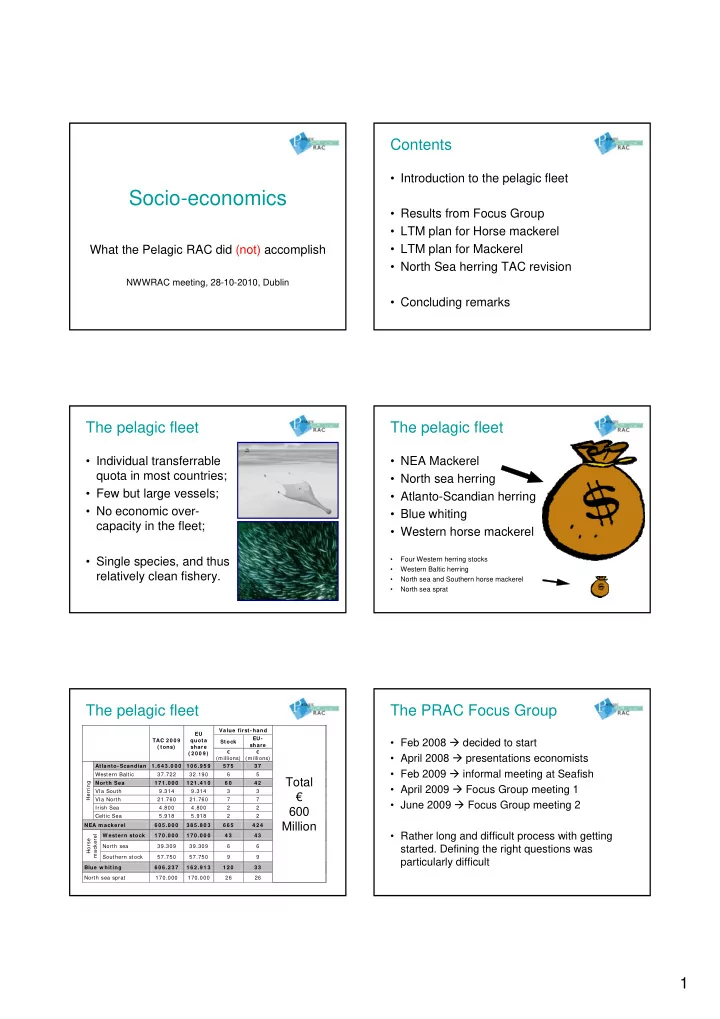
The pelagic fleet

Value first- hand Stock EU- share TAC 2 0 0 9 ( tons) EU quota share ( 2 0 0 9 ) € (millions) € (millions) S / A ( Jointly) exploited by Atlanto- Scandian 1 .6 4 3 .0 0 0 1 0 6 .9 5 9 5 7 5 3 7 S 1 ,2 ,3 ,4 ,5 Western Baltic 37.722 32.190 6 5 S 1,2 North Sea 1 7 1 .0 0 0 1 2 1 .4 1 0 6 0 4 2 S 1 ,2 VIa South 9.314 9.314 3 3 A 1 VIa North 21.760 21.760 7 7 A 1 Irish Sea 4.800 4.800 2 2 A 1 Herring Celtic Sea 5.918 5.918 2 2 A 1 NEA m ackerel 6 0 5 .0 0 0 3 8 5 .8 0 3 6 6 5 4 2 4 S 1 ,2 ,3 W estern stock 1 7 0 .0 0 0 1 7 0 .0 0 0 4 3 4 3 A/ S* 1 ,2 North sea 39.309 39.309 6 6 A 1 Horse mackerel Southern stock 57.750 57.750 9 9 A 1 Blue w hiting 6 0 6 .2 3 7 1 6 2 .9 1 3 1 2 0 3 3 S 1 ,2 ,3 ,4 North sea sprat 170.000 170.000 26 26 A 1

Total € 600 Million

The PRAC Focus Group

  • Feb 2008  decided to start
  • April 2008  presentations economists
  • Feb 2009  informal meeting at Seafish
  • April 2009  Focus Group meeting 1
  • June 2009  Focus Group meeting 2
  • Rather long and difficult process with getting
  • started. Defining the right questions was

particularly difficult

slide-2
SLIDE 2

2 The PRAC Focus Group

Main questions to focus on:

  • What socio-economic issues can be

addressed by Pelagic RAC in isolation?

  • How can Pelagic RAC integrate socio-

economic aspects into its advice based

  • n biological science?

The PRAC Focus Group

Additional (sub) questions:

  • What data is needed and where is it

available (DCR)?

  • What parameters should be measured?
  • What practical input can the Pelagic RAC

have on data supply?

The PRAC Focus Group

  • At the same time, PRAC was consulted by the EC to provide input
  • n design of Impact Assessment for Celtic Sea herring LTM plan.

Therefore, PRAC chose this as a case study.

– catches and the value of those catches; – fishing effort, in terms of vessel numbers, activity and kWh deployed, – and the costs (both fixed and variable) of deploying such effort; – employment associated with this activity – net revenue from the resource – if possible, additional incidental impacts on populations of other marine organisms.

  • PRAC unfortunately did not get clear what they meant, if they

were from a standard format or who had identified them. Some were not suitable for pelagic fisheries in our opinion.

The PRAC Focus Group

  • Conclusions from the Focus Group:

– The Economics Unit of the EC should be (more) involved when preparing for IA for LTM plans. – We have to recognize that economic data is not readily available, we could urge the members, but

  • therwise there is not much else we can do.

– We could produce socio-economic picture of the pelagic fleet for ourselves. Even if only descriptive, this might provide some clarity to the RAC members during discussions.

LTM plan for horse mackerel

  • Motivation for industry to initiate plan:

– Feeling that stock was being underexploited – SALY’s from ICES and roll-over of TACs because there was no scientific basis for an alternative

LTM plan for horse mackerel

  • HCR:
  • 50% constant

(75.000 tons)

  • 50% changed

based on slope of last three egg surveys

500 1000 1500 2000 1980 1985 1990 1995 2000 2005 2010

Egg survey index

slide-3
SLIDE 3

3 LTM plan for horse mackerel LTM plan for mackerel

  • LTM plan in place since 1999
  • LTM plan re-evaluated in 2008
  • John Simmonds (FRS Marine Lab) was

running MSEs and attended a number of PRAC meetings

  • At the end of the process, a

recommendation was made to the Commission

LTM plan for mackerel

Rule Parameters Outcomes Other Information Method Perc Targ Trig Cmean IAV 7+ F SSB Nchange Nup Ndown Cup Cdown Risk TargC 12.5 550 2500 559 3.5 0.45 0.172 3385 4.3 2.6 1.7 38.4

  • 47.1

4.9 TargC 15 550 2400 562 3.5 0.45 0.173 3369 3.9 2.3 1.6 43.1

  • 52.5

4.5 TargC 10 560 2600 564 3.7 0.45 0.178 3318 5.3 3.2 2.1 34.4

  • 41.1

4.5 TargC 10 570 2600 569 3.8 0.44 0.184 3285 5.5 3.3 2.2 33.9

  • 41.1

4.5 TargC 12.5 570 2600 572 4.3 0.44 0.181 3286 5.2 3.1 2.1 40.7

  • 49.1

4.7 TargC 15 570 2600 574 4.7 0.45 0.177 3336 4.9 2.9 2 46.6

  • 57

4.1 TargC 12.5 590 2700 583 5 0.44 0.189 3239 6 3.5 2.5 42.6

  • 50.9

4.8 TargC 10 620 3100 588 6 0.43 0.192 3205 8.1 4.7 3.4 39.4

  • 45.3

4.8 TargC 12.5 610 2900 593 6.1 0.43 0.192 3206 7 4.1 3 45.1

  • 53.8

4.4 TargC 10 670 3500 599 7.3 0.43 0.197 3166 9.6 5.5 4.1 42.4

  • 47.9

5 TargC 12.5 640 3100 601 7.4 0.42 0.206 3133 8.2 4.7 3.5 48.2

  • 56.2

4.4 TargC 10 690 3500 610 7.5 0.42 0.201 3122 9.8 5.6 4.1 43.7

  • 49.3

4.6 TargC 12.5 700 3500 614 9 0.42 0.205 3087 9.7 5.5 4.2 52.3

  • 60.1

4.8 TargC 15 700 3400 623 9.9 0.41 0.213 3029 9.5 5.4 4.1 59.4

  • 70.3

4.1 TargHR 10 0.2 2800 623 9.1 0.42 0.206 3089 11 6.4 4.6 50.4

  • 56.1

4.4 TargHR 12.5 0.2 2900 624 11.2 0.42 0.207 3081 11 6.2 4.8 61.2

  • 69.2

4.8 TargHR 15 0.2 2400 634 12.7 0.41 0.22 2970 11 6 5 71.2

  • 79.3

5 TargHR 17.5 0.2 2500 635 14.5 0.41 0.213 3017 11 6.1 4.9 80.1

  • 92

3.9 TargHR 17.5 0.21 2900 641 15 0.4 0.219 2988 11 6.1 4.9 82.8

  • 97.6

4.7 TargHR 20 0.21 2800 642 16.5 0.4 0.221 2966 11 6.1 4.9 91.1

  • 107.3

4.5 TargHR 25 0.21 2100 646 18.7 0.38 0.234 2829 11 6 5 104.1

  • 122.5

4.9 TargHR 25 0.21 2700 647 19.5 0.4 0.221 2971 11 6.1 4.9 107

  • 128.2

4.2

LTM plan for mackerel

200 400 600 800 1000 1200 1 2 3 4 5 6 7 8 9 10 11 12 13 14 15 16 17 18 19 20 21 200 400 600 800 1000 1200 1 2 3 4 5 6 7 8 9 10 11 12 13 14 15 16 17 18 19 20 21

Always Only above B trig

NS herring TAC revision

  • LTM plan in place since 1995
  • Low recruitment since 2002
  • TAC reduced from 535 - 164 kt in 5 years
  • LTM plan revised in 2008 to adjust to low

recruitment regime

  • Perception of SSB was changed this year:

– ICES missed 2006 year class – Fish grew faster in 2009 then expected – Assumed overshoot of TAC did not happen

NS herring TAC revision

  • 2010 TAC 4%

lower then 2009

  • 15% IAV rule

prevents TAC increase back to HCR

  • Asked STECF to

recalculate 2010 TAC based on new information

slide-4
SLIDE 4

4 NS herring TAC revision

  • EC replied not to

want to ask STECF

  • For some reason

STECF makes calculations anyway (July), and concludes that TAC 2010 could be 20% higher

NS herring TAC revision

  • PRAC recommends

that EC revises the TAC for 2010 accordingly

  • EC replies not to

want to, with awkward biological arguments

NS herring TAC revision

0,1 0,2 0,3 0,4 0,0 0,5 1,0 1,5 2,0

SSB (MLN tons) Fbar

HCR Realised F Projection based on LTM plan Projection based on PRAC proposal

2002 2009 2010 2011 2011

This is a purely socio- economic discussion. There simply are no biological arguments to claim that the correction could not be made. The resistance that the PRAC met from the EC

  • n this, first surprised

us, then slowly started to worry us, but over the course of this year has become a huge frustration to the industry members of the PRAC. They just not feel that they are being taken seriously

Concluding remarks

  • Pelagic RAC has made considerable attempts to

include socio-economics in its recommendations unfortunately with only limited results

  • Probably, dealing with socio-economics as an

isolated issue is more difficult than trying to recognise ad-hoc opportunities where it may be dealt with integrally (this might mean focussing

  • n details, rather then on the big picture).
  • Surprisingly, with some of the more successful

cases (mackerel) support came from an unexpected corner: biological scientists.

Concluding remarks

  • EC seems reluctant to accept socio-

economically driven advice

  • Even when based on analysis by STECF and

without compromising biological sustainability

  • bjectives
  • As long as EC and Council do not clearly show

that they are receptive to socio-economic arguments, what is the point for the RACs to be going at great lengths to find them?