Society is nothing but the combination of individuals for - - PowerPoint PPT Presentation

society is nothing but the
SMART_READER_LITE
LIVE PREVIEW

Society is nothing but the combination of individuals for - - PowerPoint PPT Presentation

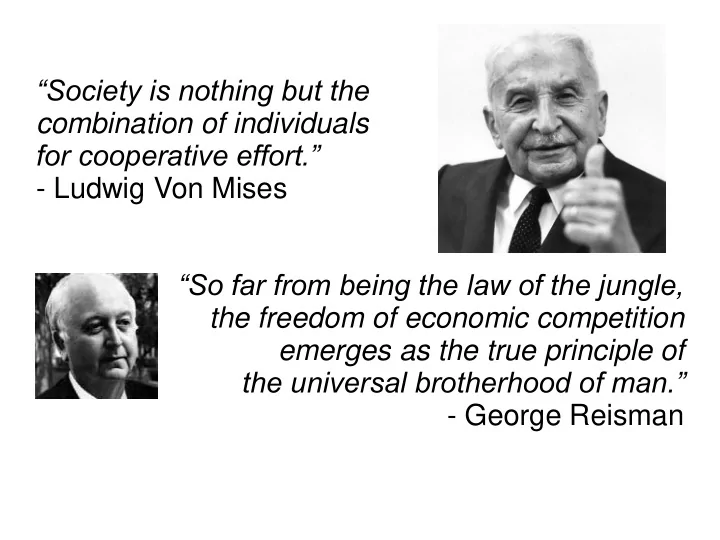
Society is nothing but the combination of individuals for cooperative effort. - Ludwig Von Mises So far from being the law of the jungle, the freedom of economic competition emerges as the true principle of the universal brotherhood of


slide-1
SLIDE 1

“Society is nothing but the combination of individuals for cooperative effort.”

  • Ludwig Von Mises

“So far from being the law of the jungle, the freedom of economic competition emerges as the true principle of the universal brotherhood of man.”

  • George Reisman
slide-2
SLIDE 2

“The purpose of division of labour is to make a smaller quantity of labour produce a greater quantity of work.”

  • Adam Smith
  • 1. The Multiplication of Knowledge
  • 2. The Benefit from Geniuses
  • 3. Concentration on the Individual's Advantages
  • 4. Geographical Specialisation

5.Economies of Learning & Motion

  • 6. The Use of Machinery

Reminder from last week...

slide-3
SLIDE 3

Leading implications of the Division

  • f Labour
  • 1. The Origins of Society
  • 2. The Nature & Importance of Exchange
  • 3. The Law of Comparative Advantage
  • 4. The Pyramid of Human Ability
  • 5. The Nature of Competition
  • 6. The General Gain from the Existence of Others
  • 7. The Population Question
  • 8. A warning…
slide-4
SLIDE 4

ECONOMIC HARMONIES II: The General Benefit from the Existence of Others

slide-5
SLIDE 5

http://www.youtube.com/watch?v=LfpXpD6isK4&feature=related http://www.youtube.com/watch?v=LfpXpD6isK4&feature=related

slide-6
SLIDE 6

Reality confronts us … WANTS SATISFACTIONS EFFORTS OBSTACLES

slide-7
SLIDE 7

Q: What is society? Q: How does society originate?

  • 1. The Origins of Society
slide-8
SLIDE 8

Q: What is society? “Society is nothing but the combination of individuals for cooperative effort.”

  • Ludwig Von Mises

Q: How does society originate? A: ?

slide-9
SLIDE 9

“In the state of isolation, our wants exceed our productive capacities. By virtue of exchange, our productive capacities come to exceed our immediate wants. Implicit in exchange is division of labour…” “The total number of satisfactions that each member of society enjoys is far greater than the number each member could secure on their own.”

  • Frederic Bastiat
slide-10
SLIDE 10

Q: What is Society? The individual lives and acts within

  • society. But society is nothing but

the combination of individuals for cooperative effort. It exists nowhere else than in the actions of individual men.

  • Ludwig Von Mises
slide-11
SLIDE 11

“We hold these truths to be self- evident, that all men are created equal…” Are we? It doesn't work that way at weddings or funerals!

  • 2. The Nature & Importance of

Exchange

slide-12
SLIDE 12

Remember these 6 good things?

1.The Multiplication of Knowledge; 2.The Benefits of Genius; 3.Concentration on the Individual's Advantages

  • 4. Geographical Specialisation

5.Economies of Motion and Learning; and 6.The Use of Machinery.

slide-13
SLIDE 13

“The very fact that an exchange takes place is proof that there must necessarily be profit in it for both the contracting parties; otherwise it would not be made. Hence, every exchange represents two gains for humanity.”

  • Etienne Bonnot de Condillac (1714-

1780)

Exchange is proof of …

slide-14
SLIDE 14

Absolute Advantage...

slide-15
SLIDE 15
  • 3. Law of Comparative Advantage

“This law holds that human cooperation in a division of labor is mutually advantageous even when one party is productively superior to the other in every way; because it allows the superior party to concentrate on those areas of his superiority which are greater and more important—i.e., on his areas of comparative advantage. By the same token, the inferior party concentrates on those areas in which his inferiority is less or less important, which represents his comparative advantage.”

  • George Reisman
slide-16
SLIDE 16

J.K. Rowling & Lady Gaga spend equal time writing and composing

THRILLERS SONGS B.S. PRODUCTION John Grisham 50.0 + 25.0 = 75 Lady Gaga .5 + 2.5 = 3 78 B.S.

J.K Rowling spends all her time bashing his laptop keyboard and Gaga spends all her time annoying cats

THRILLERS SONGS B.S. PRODUCTION John Grisham 100.0 + 0 = 100 Lady Gaga 0 + 5 = 5 105 B.S.

slide-17
SLIDE 17

THE LAW OF ASSOCIATION:

“The Law of Association makes us

comprehend the tendencies which resulted in the progressive intensification of human cooperation. We conceive what incentive induced people not to consider themselves rivals in a struggle

  • f the limited supply of means of subsistence

made available by nature. We realise what has impelled them and permanently impels them to consort with one another for the sake of cooperation. Every step forward on the way to a more developed mode of the division of labour serves the interests of all participants.”

  • Ludwig Von Mises
slide-18
SLIDE 18

THE LAW OF ASSOCIATION: Boss Personal Assistant Boss Janitor Surgeon Surgical Instrument Cleaner Physician X-Ray Technician Architect Draughtsman Engineer Mechanic Inventor Technician Steve Jobs His Cleaning Lady

slide-19
SLIDE 19

THE PYRAMID-OF-ABILITY PRINCIPLE “To the degree that those who are more able occupy the higher positions in a division-of-labour society, the productivity of those in the lower positions is increased.”

  • George Reisman
  • 4. The Pyramid of Human Ability
slide-20
SLIDE 20

“When you live in a rational society, where men are free to trade, you receive an incalculable bonus: the material value of your work is determined not only by your effort, but by the effort of the best productive minds who exist in the world around you. When you work in a modern factory, you are paid, not only for your labor, but for all the productive genius which has made that factory possible…”

  • Ayn Rand
slide-21
SLIDE 21

“Economic competition is … ?”

  • 5. The Nature of Economic

Competition

slide-22
SLIDE 22
  • 5. The Nature of Economic Competition

“Economic competition is not a process by which the success of the biologically fit brings about the extermination of the biologically weak. On the contrary, it is a process by which the success of better products and more efficient methods of production promotes the survival and well- being of all. “It is a process in which the success of the more able raises the productivity and improves the standard of living of the less able.”

  • George Reisman
slide-23
SLIDE 23

“The pyramid-of-ability principle and the law of comparative advantage can be integrated into a wider principle that subsumes them both. Namely, that each person gains from the existence

  • f other people who participate with

him in the division of labour... “The great precondition of his gain is the freedom of competition...”

  • George Reisman
  • 6. The General Gain from the

Existence of Others

slide-24
SLIDE 24
  • 7. The Population Question

“...the division of labour is limited only by the market.”

  • Adam Smith
slide-25
SLIDE 25

“In a division-of-labour society, a larger

population means a greater, more intensive division of labour.”

The “Dismal Science” of Malthus & Ricardo “true

  • nly for a stagnant, non-division-of labour

economy...”

Consider...

slide-26
SLIDE 26

From the beginning, in making his case for free trade, Richard Cobden saw the breaking down of trade barriers as a powerful avenue for depoliticizing human relationships. By privatizing all market transactions between individuals of different countries, he said, free trade would assist in removing many of the causes of war. "As little intercourse as possible between Governments," Cobden declared, "as much connection as possible between the nations of the world." To emphasize this, the slogan of the Anti- Corn Law League became "Free Trade, Peace and Good-Will Among Nations."

  • Richard Ebeling on Richard Cobden (1804-1865)

"… Free Trade, Peace and Good-Will Among Nations."

slide-27
SLIDE 27
  • 8. However...

WANTS SATISFACTIONS EFFORTS OBSTACLES

  • r

PLUNDER !

slide-28
SLIDE 28

“We may see demonstrated that all the social harmonies are contained in germ in these two principles:

PROPERTY and LIBERTY.

We shall see that all the social discords are merely the extension

  • f these two contrary principles:

PLUNDER and OPPRESSION.”

  • Frederic Bastiat
slide-29
SLIDE 29

General Gain from the Existence of Others?

Either PROPERTY LIBERTY Or PLUNDER OPPRESSION