SOCIAL SCIENCE RESEARCH RELEVANT TO THE HOUSING-SCHOOL NEXUS 1 - - PDF document

social science research relevant to the
SMART_READER_LITE
LIVE PREVIEW

SOCIAL SCIENCE RESEARCH RELEVANT TO THE HOUSING-SCHOOL NEXUS 1 - - PDF document

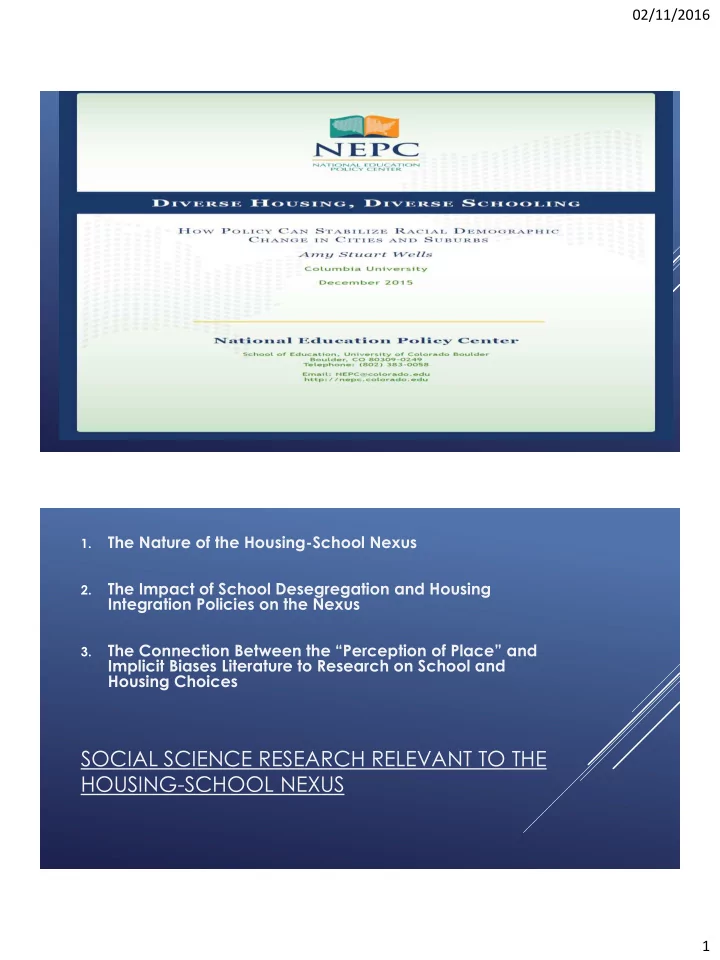
02/11/2016 The Nature of the Housing-School Nexus 1. The Impact of School Desegregation and Housing 2. Integration Policies on the Nexus The Connection Between the Perception of Place and 3. Implicit Biases Literature to Research on


slide-1
SLIDE 1

02/11/2016 1

SOCIAL SCIENCE RESEARCH RELEVANT TO THE HOUSING-SCHOOL NEXUS

1.

The Nature of the Housing-School Nexus

2.

The Impact of School Desegregation and Housing Integration Policies on the Nexus

3.

The Connection Between the “Perception of Place” and Implicit Biases Literature to Research on School and Housing Choices

slide-2
SLIDE 2

02/11/2016 2

  • 1. THE NATURE OF THE HOUSING-SCHOOL

NEXUS

 Mutually Reinforcing, Dual-Directional Relationship Between

Housing/Property Values and Perceptions of School Quality

 Varies by Region and Race: County-wide districts have less

segregated schools and Black students are the most segregated in housing and schools

 Harms of Segregation for both housing and schools

  • 2. THE IMPACT OF SCHOOL

DESEGREGATION AND HOUSING INTEGRATION POLICIES ON THE NEXUS

 Despite Coleman’s White Flight argument, school desegregation

plans often helped sever the relationship between housing and schools, leading to greater neighborhood diversity

 Housing integration plans can have positive impact on schools

slide-3
SLIDE 3

02/11/2016 3

THE CONNECTION BETWEEN THE “PERCEPTION OF PLACE” AND IMPLICIT BIASES LITERATURE TO RESEARCH ON SCHOOL AND HOUSING CHOICES

 “Implicit bias” = “relatively unconscious and relatively automatic

features of prejudiced judgment” that affect social behavior

 White home-buyers devaluing houses and schools in

communities that are becoming more racially and ethnically diverse even, when there are no tangible differences between those places and others with more White residents

Why is this a good time to address segregation in housing and schools?

METRO O MIGRATION ONS: S: Changing ng Suburbs; s; Changin ging g Citi ties

  • Federal, state, and local housing/development policies have supported

new construction/enterprise zones in gentrifying and greater home

  • wnership via high-risk mortgages in the suburbs.
slide-4
SLIDE 4

02/11/2016 4

The Conseq seque uences nces of Met etro

  • Migr

grat ations

  • ns
  • It

can create te spaces for more divers erse citie ies and suburb rbs

OR OR

  • It can lead

d to highly hly segreg egat ated, ed, separate e and unequal al pockets ts within hin both

  • th cities

ties and suburbs. bs.

slide-5
SLIDE 5

02/11/2016 5

The Cycle of Resegregation amid Migrations

  • The PROCESS of community and school segregation repeats itself

through the relationship between district reputation and WHO lives where and the implicit biases at play as demographics change: Concentrated poverty Racial segregation Educators responsible to accountability mandates Tangible differences across district boundaries Intangible Differences : Implicit Bias Metro migration, changing demographics

POLICY RECOMMENDATIONS

 1. Policymakers should embrace and capitalize on changing racial

attitudes in the U.S., particularly among the younger generations, to promote and stabilize diverse communities and public schools

 2 Policymakers must consider how current accountability policies in

the field of education exacerbate segregation and inequality

 3 Addressing implicit bias: local leaders and their constituents must

embrace the new demographics of their communities and promote them as places forward-thinking people want to “be” not “flee” in both suburban and urban contexts.