Social Justice Rhetoric of the Women Nobel Peace Laureates Dr. - - PowerPoint PPT Presentation

social justice rhetoric of the women
SMART_READER_LITE
LIVE PREVIEW

Social Justice Rhetoric of the Women Nobel Peace Laureates Dr. - - PowerPoint PPT Presentation

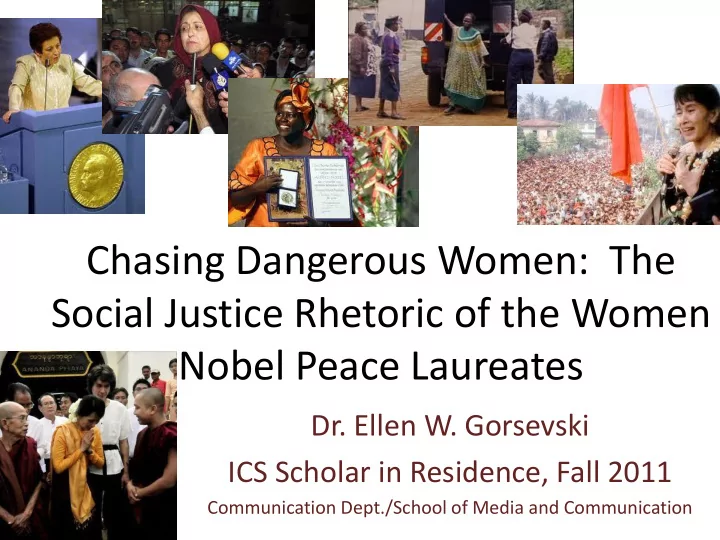
Chasing Dangerous Women: The Social Justice Rhetoric of the Women Nobel Peace Laureates Dr. Ellen W. Gorsevski ICS Scholar in Residence, Fall 2011 Communication Dept./School of Media and Communication Key Points Rationale : Rhetoric,


slide-1
SLIDE 1

Chasing Dangerous Women: The Social Justice Rhetoric of the Women Nobel Peace Laureates

  • Dr. Ellen W. Gorsevski

ICS Scholar in Residence, Fall 2011

Communication Dept./School of Media and Communication

slide-2
SLIDE 2

Key Points

  • Rationale: Rhetoric, Cultural Studies, Peace &

Conflict/Justice Studies

  • 3 Case Studies: Aung San Suu Kyi, Wangari

Maathai, Shirin Ebadi

  • Conclusion & Directions of Future Research
slide-3
SLIDE 3

Introduction

  • What is shared by

A) Rhetoric [persuasive

  • comm. arts/sciences],

B) Cultural Studies, and C) Peace and Conflict/Justice Studies?

  • What can we learn

from women peacebuilders?

slide-4
SLIDE 4

Aung San Suu Kyi

  • f Burma/Myanmar
  • Nobel Peace Prize

in 1991 for her non-violent struggle for democracy and human rights.

slide-5
SLIDE 5

Wangari Maathai

  • f Kenya
  • Nobel Peace Prize in 2004

for her contribution to sustainable development, democracy and peace.

slide-6
SLIDE 6

Shirin Ebadi

  • f lran
  • Nobel Peace Prize in

2003 for human rights legal advocacy, especially for women and children.

slide-7
SLIDE 7

Bertha von Suttner

  • f Austrian Empire/now Czech

Republic

  • Nobel Peace Prize in 1905

for organizing and expanding the European based international Peace Movement; she persuaded Alfred Nobel to create a Peace Prize.

slide-8
SLIDE 8

Jane Addams

  • f USA
  • Nobel Peace Prize in

1931 for her role as International President, Women's International League for Peace and Freedom (WILPF) and Hull House as part of her larger Peace Movement activism

Addams is on right

slide-9
SLIDE 9

Emily Greene Balch

  • f USA
  • Nobel Peace Prize in

1946 for leadership in Women's International League for Peace and Freedom (WILPF) as part of her larger Peace Movement activism

slide-10
SLIDE 10

Betty Williams & Mairead Corrigan

  • f Northern Ireland [UK]
  • Jointly awarded Nobel Peace Prize, 1976; led ‘Peace

People’ movement advancing N. Irish Peace Process to the Good Friday Agreement. Agreement.

Betty Williams Mairead Corrigan

slide-11
SLIDE 11

Mother Teresa

  • f Macedonia
  • Nobel Peace Prize, 1979, for

activism promoting international recognition of individual human worth and dignity, regardless of race, ethnicity, caste, religion, class, etc.

slide-12
SLIDE 12
slide-13
SLIDE 13

Alva Myrdal

  • f Sweden
  • Nobel Peace Prize, 1982 for

leading UN efforts to initiate regulation/control of the international use and proliferation of nuclear weapons.

slide-14
SLIDE 14

Rigoberta Menchu Tum

  • f Guatemala
  • Nobel Peace Prize,

1992, led social justice and ethnocultural reconciliation based on respect for the rights of indigenous peoples.

slide-15
SLIDE 15

Jody Williams

  • f USA
  • Nobel Peace Prize,

1997, for leadership of International Campaign to Ban Landmines (ICBL)

slide-16
SLIDE 16
slide-17
SLIDE 17

Positive Peace

c

Nobel Peace Prize

slide-18
SLIDE 18

Aung San Suu Kyi

  • f Myanmar [Burma]

http://www.belfasttelegraph.co.uk/news/world-news/suu-kyi-meets-son-in-countryside-16019682.html

slide-19
SLIDE 19

Aung San Suu Kyi of Myanmar [Burma]

  • Hlaing (2007)

reports, “Suu Kyi was very hard-headed … she did not like to listen to the advice

  • f veteran politicians

and retired military

  • fficers” (p. 365).
slide-20
SLIDE 20

Suu Kyi, Culture, Nonviolence in Action: Enacting a Feminist Ethic of Care

slide-21
SLIDE 21
slide-22
SLIDE 22

Wangari Maathai

  • f Kenya
slide-23
SLIDE 23

Wangari Maathai

April 1999: Wangari Maathai challenged security in Karura Forest outside Kenya’s capitol, Nairobi. (Photo: Simon Maina/AFP/Getty Images)

slide-24
SLIDE 24

Wangari Maathai

  • When Maathai won the Nobel

Peace Prize, “she already knew what she wanted to do: continue planting trees.… Requests from local elementary schools to come plant trees were given equal weight to invitations to speak at Oxford University” (Ramanathan, 2006).

slide-25
SLIDE 25

Wangari Maathai

Julian Bond, actress Rosario Dawson, politician Al Gore and Dr. Wangari Maathai during the 40th NAACP Image Awards on February 12, 2009 in Los Angeles, California. Photo by Vince Bucci/Getty Images North America)

slide-26
SLIDE 26

Shirin Ebadi

  • f lran
  • Exiled from Iran (escalated death

threats), Ebadi opens her new book, The Golden Cage, with: “If you can’t eliminate injustice, at least tell everyone about it.”

slide-27
SLIDE 27

Shirin Ebadi

The Dalai Lama with fellow Nobel Peace Prize Laureates (L-R) former IAEA Director General Mohamed ElBaradei, Mairead Corrigan, Jody Williams of the US, Iranian lawyer Shirin Ebadi and former South African President Frederik Willem de Klerk lay a wreath at the cenotaph for atomic-bomb victims, during the 11th World Summit of Nobel Peace Laureates at the Peace Memorial Park in Hiroshima western Japan on 14 November 2010.Reuters/Kyodo/Japan http://www.tibetsun.com/archive/2010/11/15/dalai-lama-exile- parliament-hails-suu-kyis-release/

slide-28
SLIDE 28

Shirin Ebadi

Shirin Ebadi at the Nobel Peace Prize concert, 2003, co-hosted by Catherine Zeta-Jones & Michael Douglas.

slide-29
SLIDE 29

Preliminary Conclusions

Women’s peacebuilding rhetoric is: – rooted in a place and culture, – collaborative, – confrontative, – creative, and – networked.

slide-30
SLIDE 30

Rhetoric of Women Nobel Peace Laureates

To convey their messages, women Nobel Peace laureates use – visual and activist rhetorical forms,

Jody Williams and Mairead Corrigan demonstrating against Iraq war, Washington, DC, 2003 http://www.peacecouncil.org/maguirenews.html

slide-31
SLIDE 31

Rhetoric of Women Nobel Peace Laureates

Rhetoric includes, –traditional, text-based communication

  • speeches, essays, books,

faxes;

– new, e-based communication

  • web, tweets, youtube,

texting, email, etc.

Jodi Williams, Shirin Ebadi and Mairead Maguire join forces to fight use of rape in war. http://www.scoop.it/t/women-of-the- revolution?page=4

slide-32
SLIDE 32

Preliminary Conclusions

  • Women focus on

local/national issues;

  • Local/national issues
  • f interest to

women often transcend localities to appeal to a globalized public sphere.

Jody Williams demonstrating against Iraq war, Washington, DC, 2003 Photo: Linda Panetta, Optical Realities Photography

http://apps.nlm.nih.gov/againsttheodds/get_involved/conversation5.ht ml

slide-33
SLIDE 33

Directions for Ongoing Research

What is shared or different comparing early with recent women Nobel Peace Prize winners?

– i.e., communication practices to foment cultural change?

slide-34
SLIDE 34

Ongoing Research, cont’d.

What theoretical contributions emerge from studies of women peace leaders’ communication and their role in promoting a shift to social justice in:

  • local,
  • regional, and
  • global cultural spheres?

http://www.nobelwomensinitiative.org/

slide-35
SLIDE 35

Thank You!

  • Any questions?