Small Intervention, Big Impact: Health Care Cost Reductions Related - - PowerPoint PPT Presentation

small intervention big impact
SMART_READER_LITE
LIVE PREVIEW

Small Intervention, Big Impact: Health Care Cost Reductions Related - - PowerPoint PPT Presentation

In partnership with Small Intervention, Big Impact: Health Care Cost Reductions Related to Medically Tailored Nutrition ProjectAngelHeart.org/Impact #foodismedicine Rachael Robinson, Director of Strategic Partnerships


slide-1
SLIDE 1

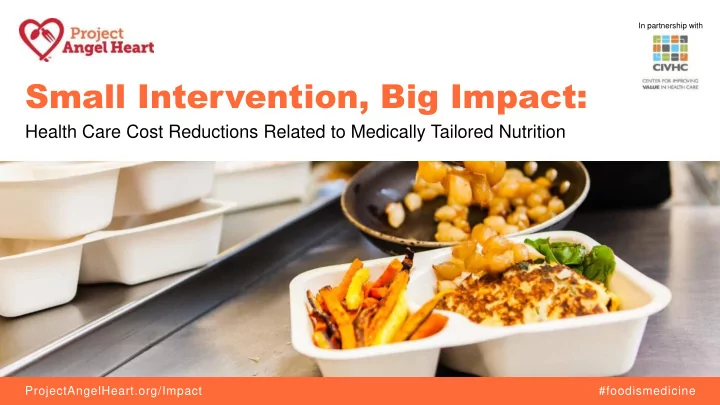
Small Intervention, Big Impact:

Health Care Cost Reductions Related to Medically Tailored Nutrition

In partnership with

ProjectAngelHeart.org/Impact #foodismedicine
slide-2
SLIDE 2

Rachael Robinson, Director of Strategic Partnerships rrobinson@projectangelheart.org @proj_angelheart

ProjectAngelHeart.org/Impact #foodismedicine

slide-3
SLIDE 3

Preparing and delivering medically tailored meals since 1991

ProjectAngelHeart.org/Impact #foodismedicine

slide-4
SLIDE 4
  • 69% report improved adherence to their health plan
  • 72% report better able to afford their basic needs
  • 70% report able to remain independent in their home
  • 72% report improved quality of life

Nutrition impacts health…but what about costs?

ProjectAngelHeart.org/Impact #foodismedicine

slide-5
SLIDE 5

From there to here…

  • How can we quantify the impact of medically tailored

meals?

  • How to fund a large-scale study?

…with the right partners

  • Center for Improving Value in Health Care (CIVHC)
  • Scholarship to access CO All Payer Claims

Database

  • Colorado’s Medicare QIO
  • …and many other partners!
slide-6
SLIDE 6

Does providing medically tailored meals impact health care costs for chronically ill individuals?

ProjectAngelHeart.org/Impact #foodismedicine

slide-7
SLIDE 7

Do chronically ill individuals who receive medically tailored meals have lower health care costs than those who do not receive meals?

ProjectAngelHeart.org/Impact #foodismedicine

slide-8
SLIDE 8
  • Retrospective analysis examining costs and utilization using the Colorado All Payer

Claims Database (CO APCD)

  • Time series analysis (6 mos before meals, during meals, and 6 mos after meals)
  • Two study phases (intervention group analysis and intervention vs. control)

Stu Study dy Des Design ign

ProjectAngelHeart.org/Impact #foodismedicine

slide-9
SLIDE 9

Creating an intervention group

  • Project Angel Heart clients, age 18+
  • Received meals for ≥3 weeks of any month

January 2010-June 2013

  • Diagnosed with one or more:
  • cancer
  • congestive heart failure
  • chronic obstructive pulmonary disease
  • diabetes
  • end stage renal disease
  • HIV/AIDS
  • multiple sclerosis
  • Not on hospice and/or did not pass away

while receiving meals

slide-10
SLIDE 10

Intervention Group Demographics

N=708, Average of 7 comorbidities

ProjectAngelHeart.org/Impact #foodismedicine

slide-11
SLIDE 11

Phase 1 Analysis – Time Series, Intervention

  • Rate of 30-day, all-cause hospital readmissions
  • Per-member-per-month (PMPM) total medical costs

segmented by diagnosis and payer

  • PMPM cost analysis segmented by diagnosis and line of

service

ProjectAngelHeart.org/Impact #foodismedicine

slide-12
SLIDE 12

Phase 1: Overall trend toward decreased health care costs

ProjectAngelHeart.org/Impact #foodismedicine

slide-13
SLIDE 13

Phase 1: 13% decrease in rate of hospital readmissions

ProjectAngelHeart.org/Impact #foodismedicine

slide-14
SLIDE 14

Phase 1: Significant cost reductions for CHF, COPD, diabetes

ProjectAngelHeart.org/Impact #foodismedicine

slide-15
SLIDE 15

ProjectAngelHeart.org/Impact #foodismedicine

So, what about the control group?

  • Segmentation led to smaller sample sizes and fewer

statistically significant findings

  • Similar to what we learned in Phase 1, data trends from

Phase 2 indicated the greatest impact was for clients living with CHF, COPD, and diabetes.

slide-16
SLIDE 16

Medically tailored meals work.

ProjectAngelHeart.org/Impact #foodismedicine

  • 13% reduction in the rate of 30-day, all-cause hospital

readmissions

  • Significant reductions in total medical costs for people living with

congestive heart failure, chronic obstructive pulmonary disease, and diabetes

  • Reduced inpatient costs for people with congestive heart failure,

chronic obstructive pulmonary disease, diabetes, and end-stage renal disease

slide-17
SLIDE 17

Ne Next xt St Steps eps: : Health Health Car Care Inte e Integration tion

Broaden HDM benefits in CO to Medicaid HCBS waivers Capitalize on CMS supplemental benefits ruling for Medicare Advantage Plans Integrate medically tailored, home-delivered meals into health care delivery and payment models

ProjectAngelHeart.org/Impact #foodismedicine

slide-18
SLIDE 18

Download the white paper or a 2-pg study summary: www.ProjectAngelHeart.org/impact

ProjectAngelHeart.org/Impact #foodismedicine