
Eric Roberts Handout #55 CS 106A February 26, 2010
Slides for Data-Driven Programs Data-Driven Programs
Eric Roberts CS 106A February 26, 2010
Computing and the Counterculture
Two recent books argue that the personal computing revolution
- wes as much to the counterculture of the 1960s as it does to the
technological strength and entrepreneurial spirit of Silicon Valley.
Ted Nelson’s Cyberspace Dreams
The countercultural vision comes across particularly clearly in the two-sided book Computer Lib/Dream Machines which was written by cyberspace visionary Ted Nelson in 1974.
Data-Driven Programs
- In most programming languages, data structures are easier to
manipulate than code. As a result, it is often useful to design applications so that as much of their behavior as possible is represented as data rather than in the form of methods. Programs that work this way are said to be data driven.
- In a data-driven system, the actual program (which is called a
driver) is usually very small. Such driver programs operate in two phases: Read data from a file into a suitable internal data structure. 1. Use the data structure to control the flow of the program. 2.
- To illustrate the idea of a data-driven system, we’re going to
spend most of this lecture building a programmed-instruction “teaching machine” of the sort that Ted Nelson discusses (mostly critically) in Dream Machines.
The Course Data File
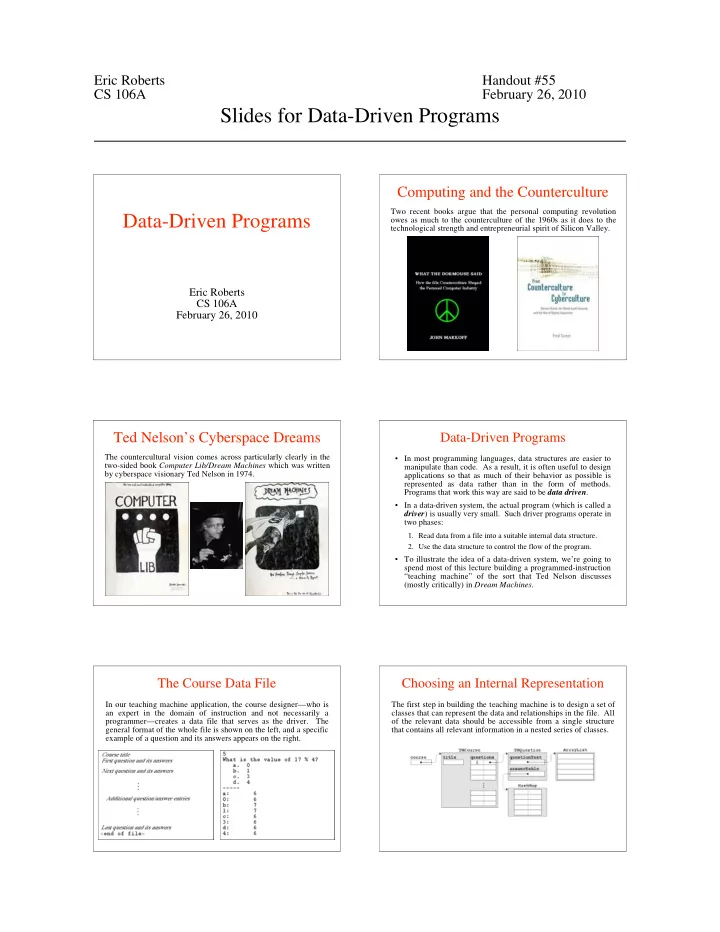
In our teaching machine application, the course designer—who is an expert in the domain of instruction and not necessarily a programmer—creates a data file that serves as the driver. The general format of the whole file is shown on the left, and a specific example of a question and its answers appears on the right.
Choosing an Internal Representation
The first step in building the teaching machine is to design a set of classes that can represent the data and relationships in the file. All
- f the relevant data should be accessible from a single structure
that contains all relevant information in a nested series of classes.