Slide 41 In addition, the components listed here Maximizing Success - - PDF document

slide 41 in addition the components listed here
SMART_READER_LITE
LIVE PREVIEW

Slide 41 In addition, the components listed here Maximizing Success - - PDF document

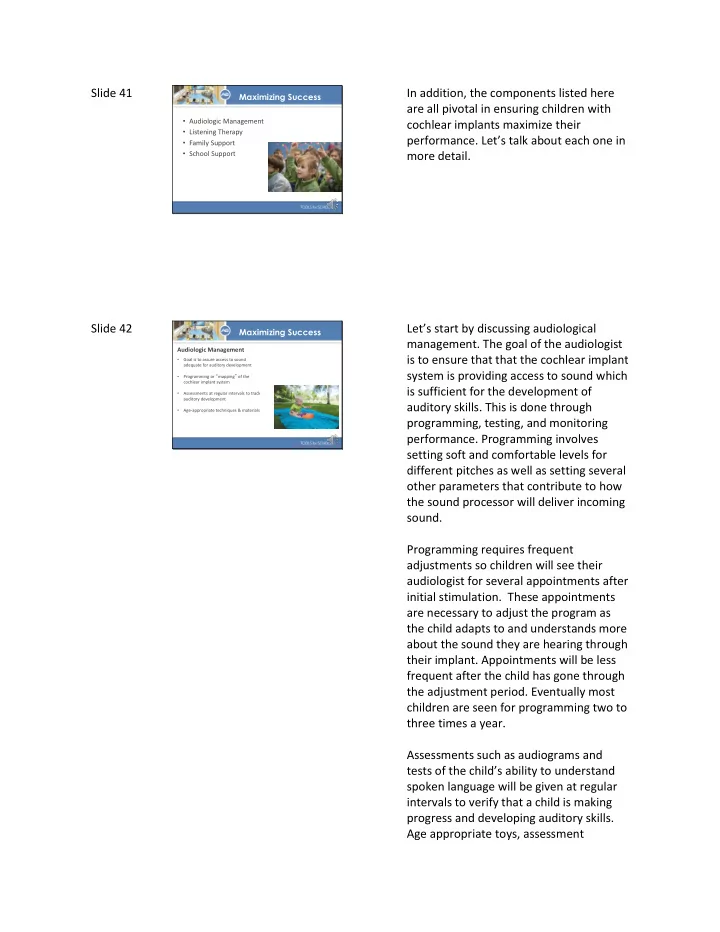
Slide 41 In addition, the components listed here Maximizing Success are all pivotal in ensuring children with Audiologic Management cochlear implants maximize their Listening Therapy performance. Lets talk about each one in


slide-1
SLIDE 1

Slide 41

Maximizing Success

  • Audiologic Management
  • Listening Therapy
  • Family Support
  • School Support

In addition, the components listed here are all pivotal in ensuring children with cochlear implants maximize their

  • performance. Let’s talk about each one in

more detail. Slide 42

Audiologic Management

  • Goal is to assure access to sound

adequate for auditory development

  • Programming or “mapping” of the

cochlear implant system

  • Assessments at regular intervals to track

auditory development

  • Age-appropriate techniques & materials

Maximizing Success Maximizing Success

Let’s start by discussing audiological

  • management. The goal of the audiologist

is to ensure that that the cochlear implant system is providing access to sound which is sufficient for the development of auditory skills. This is done through programming, testing, and monitoring

  • performance. Programming involves

setting soft and comfortable levels for different pitches as well as setting several

  • ther parameters that contribute to how

the sound processor will deliver incoming sound. Programming requires frequent adjustments so children will see their audiologist for several appointments after initial stimulation. These appointments are necessary to adjust the program as the child adapts to and understands more about the sound they are hearing through their implant. Appointments will be less frequent after the child has gone through the adjustment period. Eventually most children are seen for programming two to three times a year. Assessments such as audiograms and tests of the child’s ability to understand spoken language will be given at regular intervals to verify that a child is making progress and developing auditory skills. Age appropriate toys, assessment

slide-2
SLIDE 2

techniques, and evaluation materials are utilized. Slide 43

Audiologic Management

CI CI CI CI CI

Maximizing Success

Included in audiologic assessment is a measure of the child’s response in the sound booth to tones and speech. Slide 44

Listening Therapy Maximizing Success

Listening Therapy also known as Aural Rehabilitation teaches children how to listen with their cochlear implant and teaches parents how to help their child learn to listen and communicate. Just as you had to learn to hear, your child will need to learn to hear. Therapists that specialize in Listening Therapy understand how hearing, speech, and language evolve and will create an appropriate therapy plan to help your child develop these skills. For example, a therapist working with a 12-month-old who has just had their initial stimulation may spend a therapy session helping the child become aware of the presence versus the absence of sound. It is important to keep in mind that it takes time, practice, and

slide-3
SLIDE 3

full time use of the device during all waking hours to hear with cochlear

  • implants. It is a process, not an instant fix.

Young children who have not yet developed auditory skills and oral language have some catching up to do. Language is not created overnight, nor is awareness and comprehension of sound. That being said, most children who obtain a cochlear implant will be able to hear sounds they were never able to hear with hearing aids . Slide 45

Parent Commitment

Maximizing Success

Parents are an integral component of a child’s success following the cochlear

  • implant. Families require the support of

professionals to meet the needs of their

  • child. It is important to realize that

parents and caregivers must become involved in the therapy process. Therapists should provide parents with guidance on how to help their child strengthen his or her hearing and language every day. Parents can also find free articles and activities that help children learn to listen online at websites such as The Listening Room. These activities are appropriate for all children with hearing loss, even if they wear hearing aids, so get started today!

slide-4
SLIDE 4

Slide 46

  • Understand what a cochlear implant is and how

to complete equipment troubleshooting

  • Provide an environment where there are strong

expectations for listening and spoken language

  • Perform behavioral listening checks on a daily

basis

  • Know where to find support and resource

materials

  • Maintain communication between the student’s

parents, teachers and cochlear implant center

School Support

Maximizing Success

Once the child begins school, the teacher, hearing itinerant teacher, educational audiologist, therapists, and audiologist work together to assure that the child has

  • ptimal access to sound.

Recommendations for School professionals to ensure success include understanding what a cochlear implant is and how to troubleshoot, having strong expectations for listening and spoken language, performing daily behavioral listening checks, knowing where to find support and resources, and maintaining communication between all team members. Slide 47

Why AB?

Let’s end our discussion today with a short video that brings a lot of what we have discussed together. Slide 48

Companion Materials

Find information from today’s presentation in an easy to print format in the companion materials section in e-Learning on the Tools for Schools webpage www.advancedbioincs.com/tfs

You can find information from today’s presentation in an easy to print format in the companion materials section in e- Learning on the Tools for Schools website.

slide-5
SLIDE 5

Slide 49 FREE RESOURCES

  • Help children with cochlear implants succeed in the classroom.
  • Ease your workload and save time.
  • Learn about CI technology.
  • Provide support for effective teaming between schools, CI

centers and home.

Visit www.advancedbionics./tfs to learn more.

Contact Advanced Bionics today at HEAR@advancedbionics.com or 866.844.4327

Finally, I encourage you to check out all of the support materials available from both

  • ur Tools for Schools and Tools for

Toddlers programs. And if you would like to contact us directly for any information email Hear@advancedbionics.com or call us at the number provided. Thanks for joining us today.