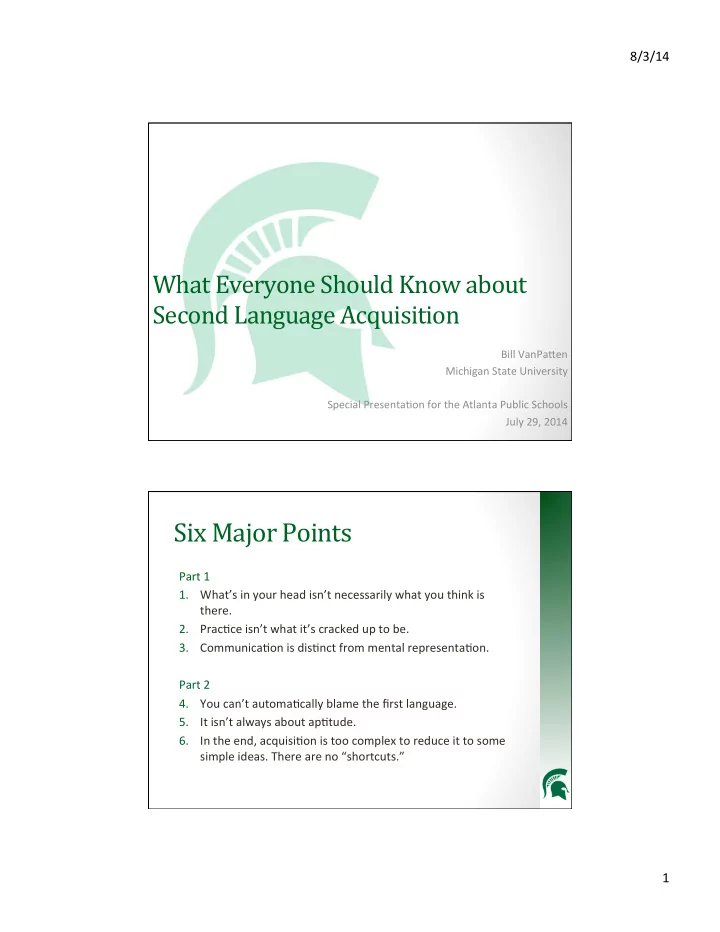
Six Major Points Part 1 1. Whats in your head isnt - - PDF document

six major points
SMART_READER_LITE
LIVE PREVIEW

Six Major Points Part 1 1. Whats in your head isnt - - PDF document

8/3/14 What Everyone Should Know about Second Language Acquisition Bill VanPa.en Michigan State University Special Presenta<on for the Atlanta Public


slide-1
SLIDE 1

8/3/14 ¡ 1 ¡

What ¡Everyone ¡Should ¡Know ¡about ¡ Second ¡Language ¡Acquisition ¡

Bill ¡VanPa.en ¡ Michigan ¡State ¡University ¡ ¡ Special ¡Presenta<on ¡for ¡the ¡Atlanta ¡Public ¡Schools ¡ July ¡29, ¡2014 ¡

Six ¡Major ¡Points ¡

Part ¡1 ¡

  • 1. What’s ¡in ¡your ¡head ¡isn’t ¡necessarily ¡what ¡you ¡think ¡is ¡
  • there. ¡
  • 2. Prac<ce ¡isn’t ¡what ¡it’s ¡cracked ¡up ¡to ¡be. ¡
  • 3. Communica<on ¡is ¡dis<nct ¡from ¡mental ¡representa<on. ¡

¡ Part ¡2 ¡

  • 4. You ¡can’t ¡automa<cally ¡blame ¡the ¡first ¡language. ¡
  • 5. It ¡isn’t ¡always ¡about ¡ap<tude. ¡
  • 6. In ¡the ¡end, ¡acquisi<on ¡is ¡too ¡complex ¡to ¡reduce ¡it ¡to ¡some ¡

simple ¡ideas. ¡There ¡are ¡no ¡“shortcuts.” ¡

slide-2
SLIDE 2

8/3/14 ¡ 2 ¡

Point ¡#1 ¡

What’s ¡in ¡your ¡head ¡isn’t ¡necessarily ¡what ¡you ¡think ¡is ¡there. ¡

  • Let’s ¡take ¡a ¡quick ¡test. ¡“Re” ¡can ¡be ¡added ¡to ¡verbs ¡to ¡mean ¡

“do ¡again” ¡(e.g., ¡rerecord, ¡remake). ¡Which ¡of ¡the ¡following ¡ sentences ¡are ¡possible ¡in ¡English? ¡

  • Barack ¡didn’t ¡like ¡the ¡color ¡of ¡the ¡walls ¡so ¡he ¡repainted ¡the ¡office. ¡
  • Michelle ¡ripped ¡up ¡the ¡parquet ¡in ¡order ¡to ¡resurface ¡the ¡floor. ¡ ¡
  • Malia ¡was ¡<red ¡when ¡she ¡woke ¡up ¡so ¡she ¡reslept ¡a ¡bit. ¡
  • Sasha ¡pe.ed ¡the ¡dog, ¡and ¡when ¡it ¡wagged ¡its ¡tail ¡she ¡repe.ed ¡it. ¡ ¡
  • So, ¡what’s ¡the ¡“rule” ¡for ¡the ¡use ¡of ¡re-­‑? ¡

Point ¡#1 ¡

  • Here’s ¡another. ¡You’ve ¡probably ¡learned ¡that ¡“ain’t” ¡isn’t ¡

good ¡English ¡and ¡that ¡double ¡nega<ves ¡are ¡out. ¡Tell ¡me ¡which ¡

  • f ¡the ¡following ¡sounds ¡be.er ¡to ¡you. ¡
  • I ¡ain’t ¡got ¡none. ¡
  • I ¡ain’t ¡have ¡any. ¡ ¡
  • What’s ¡the ¡“rule” ¡for ¡the ¡correct ¡use ¡of ¡“ain’t”? ¡
slide-3
SLIDE 3

8/3/14 ¡ 3 ¡

Point ¡#1 ¡

  • One ¡final ¡test. ¡Which ¡of ¡the ¡following ¡are ¡permissible ¡

sentences ¡in ¡English? ¡

  • Does ¡Bill ¡study ¡second ¡language ¡acquisi<on? ¡
  • Does ¡study ¡Bill ¡second ¡language ¡acquisi<on? ¡
  • Studies ¡Bill ¡second ¡language ¡acquisi<on? ¡
  • So ¡what’s ¡the ¡“rule” ¡for ¡yes/no ¡ques<on ¡forma<on ¡in ¡English ¡

and ¡what ¡about ¡Spanish? ¡

  • ¿Estudia ¡Bill ¡adquisición ¡de ¡lenguaje? ¡
  • ¿Hace ¡Bill ¡estudiar ¡adquisición ¡de ¡lenguaje? ¡

Point ¡#1 ¡

  • What ¡every ¡speaker/knower ¡of ¡a ¡language ¡creates ¡in ¡the ¡

mind/brain, ¡is ¡an ¡implicit, ¡abstract ¡representa<on ¡of ¡

  • language. ¡ ¡This ¡abstract ¡representa<on ¡bears ¡no ¡resemblance ¡

to ¡“rules” ¡as ¡we ¡commonly ¡talk ¡about ¡them, ¡and ¡it ¡bears ¡no ¡ resemblance ¡to ¡textbook ¡gramma<cal ¡rules. ¡ ¡

  • In ¡short, ¡there ¡are ¡no ¡rules ¡to ¡be ¡learned. ¡So, ¡what’s ¡in ¡the ¡

head ¡and ¡how ¡does ¡it ¡get ¡there? ¡Let’s ¡look ¡at ¡yes/no ¡ ques<ons. ¡

slide-4
SLIDE 4

8/3/14 ¡ 4 ¡

Point ¡#1 ¡ Point ¡#1 ¡

slide-5
SLIDE 5

8/3/14 ¡ 5 ¡

Point ¡#1 ¡

  • So, ¡what ¡people ¡have ¡in ¡their ¡heads ¡are ¡not ¡rules ¡per ¡se ¡

but ¡an ¡abstract ¡system ¡consis<ng ¡of ¡features ¡and ¡

  • pera<ons ¡that ¡are ¡used ¡to ¡sa<sfy ¡features, ¡plus ¡

constraints ¡on ¡how ¡those ¡opera<ons ¡can ¡happen. ¡Much ¡

  • f ¡gramma<cal ¡informa<on ¡is ¡stored ¡in ¡lexical ¡entries. ¡
  • does: ¡<Q>, ¡<T> ¡<+V> ¡<-­‑N> ¡<+present> ¡<-­‑past> ¡<3rd ¡person> ¡ ¡ ¡ ¡

<sing> ¡

  • do: ¡<Q>, ¡<T> ¡<+V> ¡<-­‑N> ¡ ¡
  • did: ¡<Q> ¡<T> ¡<+V> ¡<-­‑N> ¡<-­‑present> ¡<+past> ¡
  • studies: ¡<meaning> ¡<+present> ¡<-­‑past> ¡<3rd ¡person> ¡ ¡ ¡ ¡<sing> ¡
  • estudia: ¡<meaning> ¡<Q>, ¡<T> ¡<+V> ¡<-­‑N> ¡<+present> ¡<-­‑past> ¡<3rd ¡

person> ¡<sing> ¡

  • estudias: ¡< ¡meaning> ¡<Q>, ¡<T> ¡<+V> ¡<-­‑N> ¡<+present> ¡<-­‑past> ¡

<2rd ¡person> ¡<sing> ¡

¡

Point ¡#1 ¡

  • This ¡scenario ¡also ¡ques<ons ¡the ¡reality ¡of ¡paradigms ¡for ¡verbs, ¡

declensions, ¡and ¡so ¡on. ¡What ¡do ¡people ¡have ¡in ¡their ¡heads ¡ for ¡such ¡things? ¡

  • A ¡vast ¡interconnected ¡network ¡of ¡words ¡along ¡with ¡their ¡

meanings, ¡inflec<ons, ¡and ¡gramma<cal ¡informa<on. ¡ ¡

tomo ¡ tomas ¡ como ¡ comes ¡ café ¡ almuerzo ¡

slide-6
SLIDE 6

8/3/14 ¡ 6 ¡

Point ¡#1 ¡

  • So, ¡what ¡people ¡have ¡in ¡their ¡heads ¡is ¡ ¡

1. an ¡abstract ¡system ¡that ¡governs ¡not ¡only ¡what ¡is ¡possible ¡in ¡a ¡ language, ¡but ¡what ¡is ¡not ¡possible; ¡ 2. a ¡network ¡of ¡lexical ¡entries ¡that ¡encode ¡both ¡meaning ¡and ¡ gramma<cal ¡informa<on. ¡

  • There ¡are ¡no ¡rules ¡or ¡paradigms ¡in ¡the ¡classic ¡or ¡

tradi<onal ¡sense. ¡

  • How ¡does ¡this ¡mental ¡representa<on ¡get ¡there? ¡

Point ¡#2 ¡

Prac<ce ¡isn’t ¡what ¡it’s ¡cracked ¡up ¡to ¡be. ¡

  • Does ¡this ¡look ¡familiar ¡to ¡you? ¡ ¡
  • “Restate ¡the ¡ques<on ¡using ¡inversion.” ¡

1. Est-­‑ce ¡que ¡vous ¡parlez ¡espagnol? ¡ 2. Est-­‑ce ¡qu’il ¡étudie ¡à ¡Paris? ¡ 3. Est-­‑ce ¡qu’ils ¡voyagent ¡avec ¡des ¡amis? ¡ 4. Est-­‑ce ¡que ¡tu ¡aimes ¡les ¡cours ¡de ¡langues? ¡

  • What ¡does ¡the ¡above ¡suggest ¡about ¡language ¡learning ¡to ¡

teachers ¡and ¡students? ¡

slide-7
SLIDE 7

8/3/14 ¡ 7 ¡

Point ¡#2 ¡

  • Arer ¡four ¡decades ¡of ¡L2 ¡research, ¡what ¡has ¡become ¡crystal ¡

clear ¡is ¡that ¡language ¡in ¡the ¡mind/brain ¡is ¡not ¡built ¡up ¡from ¡ prac<ce ¡but ¡from… ¡

  • …consistent ¡and ¡constant ¡exposure ¡to ¡input. ¡What’s ¡input? ¡
  • Input ¡is ¡language ¡that ¡learners ¡hear ¡(or ¡read) ¡in ¡some ¡

communica<ve ¡context. ¡It ¡is ¡language ¡that ¡learners ¡respond ¡ to ¡for ¡its ¡meaning; ¡not ¡for ¡its ¡form ¡or ¡structure. ¡ ¡

  • Input ¡is ¡indispensable ¡in ¡language ¡acquisi<on. ¡There ¡are ¡no ¡
  • shortcuts. ¡That ¡is, ¡prac<ce ¡is ¡not ¡a ¡subs<tute ¡for ¡exposure ¡to ¡
  • input. ¡

Point ¡#2 ¡

  • Does ¡the ¡indispensability ¡of ¡input ¡mean ¡that ¡input ¡guarantees ¡

acquisi<on? ¡No. ¡In ¡fact, ¡non-­‑na<veness ¡in ¡SLA ¡is ¡the ¡norm. ¡ ¡

  • What ¡the ¡indispensability ¡of ¡input ¡means ¡is ¡that ¡real ¡

acquisi<on ¡does ¡not ¡happen ¡in ¡its ¡absence. ¡Tradi<onal ¡ “prac<ce” ¡may ¡result ¡in ¡language-­‑like ¡behavior, ¡but ¡not ¡ acquisi<on. ¡

  • Keep ¡in ¡mind ¡we ¡are ¡referring ¡here ¡to ¡the ¡acquisi<on ¡of ¡a ¡

mental ¡representa<on, ¡which ¡is ¡essen<al ¡for ¡acquisi<on. ¡

slide-8
SLIDE 8

8/3/14 ¡ 8 ¡

Point ¡#2 ¡

  • Almost ¡every ¡aspect ¡of ¡language ¡is ¡acquired ¡through ¡

interac<on ¡with ¡input. ¡Syntax, ¡phonology, ¡morphology, ¡ lexicon, ¡pragma<cs, ¡and ¡so ¡on. ¡Any ¡excep<ons? ¡

  • One ¡excep<on ¡are ¡those ¡aspects ¡of ¡language ¡that ¡are ¡

universal ¡and ¡built ¡in ¡prior ¡to ¡exposure. ¡These ¡are ¡universal ¡ features ¡and ¡constraints ¡on ¡language ¡that ¡all ¡languages ¡must ¡

  • bey. ¡ ¡
  • Example: ¡sentences ¡have ¡underlying ¡hierarchical ¡structure, ¡

consis<ng ¡of ¡phrases. ¡These ¡phrases ¡in ¡turn ¡require ¡a ¡head ¡and ¡a ¡

  • complement. ¡
  • noun ¡phrase ¡= ¡noun ¡(head) ¡+ ¡complement ¡professor ¡of ¡linguis<cs ¡
  • verb ¡phrase ¡= ¡verb ¡(head) ¡+ ¡complement ¡teaches ¡linguis<cs ¡
  • preposi<onal ¡phrase ¡= ¡preposi<on ¡(head) ¡+ ¡complement ¡at ¡MSU ¡

Point ¡#2 ¡

  • So, ¡ ¡learners ¡don’t ¡need ¡input ¡to ¡know ¡that ¡language ¡is ¡

hierarchical ¡and ¡consists ¡of ¡phrases. ¡This ¡comes ¡automa<cally ¡ because ¡such ¡informa<on ¡is ¡“built ¡in” ¡to ¡the ¡universal ¡ proper<es ¡of ¡languages ¡(“Universal ¡Grammar”). ¡

  • But ¡they ¡do ¡need ¡input ¡to ¡know ¡which ¡of ¡the ¡two ¡varia<ons ¡

for ¡languages ¡corresponds ¡to ¡the ¡language ¡they ¡are ¡learning. ¡

  • Example: ¡English ¡is ¡head ¡ini<al; ¡Japanese ¡is ¡head ¡final ¡

ENGLISH ¡ JAPANESE ¡

slide-9
SLIDE 9

8/3/14 ¡ 9 ¡

Point ¡#2 ¡ Point ¡#2 ¡

  • These ¡“parametric ¡varia<ons” ¡are ¡set ¡based ¡on ¡input ¡data. ¡But ¡

note ¡that ¡learners ¡do ¡not ¡need ¡exposure ¡to ¡all ¡of ¡the ¡input ¡to ¡ set ¡a ¡new ¡parameter. ¡Example: ¡recent ¡study ¡on ¡Japanese ¡L2. ¡

  • Arer ¡exposure ¡to ¡just ¡100 ¡SOV ¡sentences ¡in ¡Japanese ¡(e.g., ¡

Taro ¡apple ¡eats), ¡our ¡subjects ¡demonstrated ¡sensi<vity ¡to ¡ viola<ons ¡of ¡word ¡order ¡they ¡hadn’t ¡been ¡exposed ¡to: ¡

  • Ka ¡Taro ¡apple ¡eats?/ ¡Taro ¡apple ¡eats ¡ka? ¡
  • Mishu ¡Taro ¡apple ¡eats ¡toh ¡said/Mishu ¡toh ¡Taro ¡apple ¡eats. ¡
  • In ¡short, ¡they’d ¡reset ¡the ¡phrase ¡word ¡order ¡parameter ¡even ¡

though ¡they’d ¡only ¡had ¡exposure ¡to ¡basic ¡sentences. ¡ ¡

slide-10
SLIDE 10

8/3/14 ¡ 10 ¡

Point ¡#2 ¡

  • From ¡VanPa.en ¡and ¡Rothman ¡(2013) ¡
  • Learners ¡do ¡not ¡acquire ¡rules ¡from ¡the ¡input. ¡Instead, ¡learners ¡

process ¡surface ¡morpho-­‑phonological ¡units ¡(e.g., ¡lexical ¡form, ¡ morphological ¡form) ¡and ¡internalize ¡these ¡units ¡along ¡with ¡ underlying ¡features ¡or ¡specifica<ons. ¡These ¡units ¡interact ¡with ¡ informa<on ¡provided ¡by ¡[Universal ¡Grammar] ¡and ¡the ¡language ¡ making ¡mechanisms ¡of ¡the ¡human ¡language ¡faculty ¡such ¡that ¡ anything ¡that ¡resembles ¡rules ¡(from ¡an ¡outside ¡perspec<ve) ¡ evolves ¡over ¡<me ¡ ¡

Point ¡#2 ¡

  • What ¡else ¡do ¡we ¡know ¡about ¡input ¡and ¡the ¡development ¡of ¡

mental ¡representa<on? ¡

  • Some ¡aspects ¡of ¡the ¡the ¡representa<on ¡are ¡“triggered” ¡rather ¡
  • soon. ¡
  • Some ¡take ¡longer. ¡
  • Stuff ¡like ¡lexicon ¡(words ¡and ¡everything ¡they ¡contain), ¡

morphology ¡(inflec<ons, ¡and ¡so ¡on), ¡phonology, ¡and ¡other ¡ aspects ¡take ¡a ¡long ¡<me. ¡ ¡

  • There ¡is ¡staged ¡development ¡over ¡<me, ¡which ¡we ¡will ¡get ¡to ¡
  • later. ¡
slide-11
SLIDE 11

8/3/14 ¡ 11 ¡

Point ¡#2 ¡

  • So, ¡if ¡input ¡is ¡so ¡important, ¡what ¡does ¡tradi<onal ¡prac<ce ¡do? ¡
  • Essen<ally, ¡very ¡li.le ¡if ¡anything. ¡It ¡does ¡not ¡help ¡mental ¡

representa<on. ¡It ¡is ¡not ¡clear ¡it ¡helps ¡skill, ¡which ¡we ¡will ¡touch ¡

  • n ¡later. ¡ ¡

Point ¡#3 ¡

Communica<on ¡is ¡dis<nct ¡from ¡mental ¡representa<on. ¡

  • Let’s ¡begin ¡with ¡a ¡defini<on. ¡Working ¡with ¡someone ¡next ¡to ¡

you, ¡complete ¡the ¡following ¡defini<on: ¡“Communica<on ¡is…” ¡

  • Communica<on ¡is ¡the ¡expression, ¡interpreta<on, ¡and ¡

nego<a<on ¡of ¡meaning ¡in ¡a ¡given ¡context. ¡ ¡

  • meaning ¡= ¡informa<on, ¡proposi<onal ¡content, ¡intent ¡
  • expression ¡= ¡produc<on ¡
  • interpreta<on ¡= ¡comprehension ¡
  • context ¡= ¡par<cipants, ¡sezng, ¡purpose ¡
  • nego<a<on ¡= ¡clarifica<on, ¡confirma<on, ¡co-­‑construc<on ¡of ¡

discourse ¡

slide-12
SLIDE 12

8/3/14 ¡ 12 ¡

Point ¡#3 ¡

  • How ¡is ¡communica<on ¡context-­‑dependent? ¡
  • [talking ¡with ¡his ¡best ¡friend ¡at ¡lunch] ¡
  • Jake: ¡Hey. ¡Here’s ¡a ¡ques<on ¡only ¡you ¡can ¡answer. ¡ ¡
  • Friend: ¡Shoot. ¡

¡ ¡

  • [in ¡a ¡poli<cal ¡science ¡class] ¡
  • Jake ¡[raising ¡his ¡hand]: ¡Excuse ¡me, ¡Professor. ¡I ¡have ¡a ¡ques<on. ¡
  • Professor: ¡Go ¡ahead, ¡Jake. ¡
  • [with ¡his ¡roman<c ¡partner ¡while ¡watching ¡a ¡dvd ¡at ¡home] ¡
  • Jake ¡[leaning ¡in ¡close, ¡lowering ¡his ¡voice]: ¡I ¡have ¡to ¡ask ¡you ¡
  • something. ¡
  • Partner: ¡Hmmmm? ¡

Point ¡#3 ¡

  • Note ¡that ¡although ¡context ¡influences ¡how ¡people ¡use ¡

language ¡to ¡communicate, ¡context ¡does ¡not ¡influence ¡the ¡ nature ¡of ¡language ¡itself. ¡For ¡example, ¡the ¡syntax ¡of ¡English ¡is ¡ s<ll ¡the ¡syntax ¡of ¡English ¡no ¡ma.er ¡who ¡Jake ¡communicates ¡ to ¡with ¡English. ¡ ¡

  • Jake ¡does ¡not ¡switch ¡from ¡SVO ¡to ¡SOV ¡depending ¡on ¡context. ¡
  • Jake ¡does ¡not ¡switch ¡from ¡an ¡inflec<onally ¡weak ¡English ¡to ¡an ¡

inflec<onally ¡strong ¡English ¡depending ¡on ¡context. ¡

  • Jake ¡does ¡not ¡switch ¡from ¡English’s ¡11 ¡vowels ¡to ¡only ¡5 ¡vowels ¡

depending ¡on ¡context. ¡ ¡

  • ¡In ¡short, ¡mental ¡representa<on ¡does ¡not ¡change ¡because ¡of ¡
  • context. ¡ ¡
slide-13
SLIDE 13

8/3/14 ¡ 13 ¡

Point ¡#3 ¡

  • Communica<on ¡has ¡a ¡purpose ¡
  • Psycho-­‑social: ¡‘How’s ¡it ¡going?’ ¡‘See ¡you ¡later?’ ¡ ¡‘I ¡said ¡NO. ¡N.O.’ ¡
  • Informa<onal-­‑cogni<ve: ¡‘What ¡would ¡you ¡like ¡as ¡a ¡side?’ ¡

‘Where’re ¡you ¡headed, ¡sir?’ ¡[Me ¡talking, ¡right ¡now.] ¡

Point ¡#3 ¡

  • How ¡does ¡communica<on ¡develop? ¡
  • Communica<on ¡develops ¡only ¡through ¡acts ¡of ¡

communica<on. ¡That ¡is, ¡learners ¡learn ¡to ¡communicate ¡by ¡ engaging ¡in ¡contextualized ¡acts ¡of ¡expression, ¡interpreta<on, ¡ and ¡nego<a<on ¡of ¡meaning. ¡ ¡

  • Communica<on ¡does ¡not ¡develop ¡because ¡of ¡prac<ce ¡of ¡
  • language. ¡ ¡
  • “transfer ¡appropriate ¡behavior” ¡
slide-14
SLIDE 14

8/3/14 ¡ 14 ¡

Point ¡#3 ¡

  • Note ¡that ¡classrooms ¡are ¡fixed ¡contexts ¡for ¡communica<on: ¡
  • sezng ¡is ¡always ¡the ¡same ¡
  • par<cipants ¡are ¡always ¡the ¡same ¡
  • Role ¡play ¡and ¡“ac<ng” ¡do ¡not ¡obviate ¡the ¡constraints ¡on ¡

classroom ¡context. ¡That ¡is, ¡role ¡play ¡and ¡ac<ng ¡are ¡not ¡ communica<ve ¡in ¡the ¡sense ¡it ¡is ¡used ¡here. ¡ ¡

Point ¡#3 ¡

  • Interes<ngly, ¡underlying ¡mental ¡representa<on ¡may ¡grow ¡

during ¡communica<ve ¡interac<ons? ¡Why? ¡Because ¡part ¡of ¡ interac<ons ¡includes ¡“interpreta<on ¡of ¡meaning.” ¡

  • Interpreta<on ¡of ¡meaning ¡implies ¡input ¡as ¡previously ¡defined. ¡
slide-15
SLIDE 15

8/3/14 ¡ 15 ¡

Wrap-­‑up ¡Part ¡1 ¡

  • Learners ¡create ¡an ¡abstract ¡mental ¡representa<on, ¡similar ¡to ¡

the ¡way ¡in ¡which ¡L1 ¡learners ¡do. ¡ ¡

  • This ¡representa<on ¡bears ¡li.le ¡to ¡no ¡resemblance ¡to ¡what ¡is ¡

tradi<onally ¡taught ¡and ¡prac<ced. ¡ ¡

  • This ¡representa<on ¡builds ¡up ¡over ¡<me ¡due ¡to ¡consistent ¡and ¡

constant ¡exposure ¡to ¡input ¡data. ¡Prac<ce, ¡as ¡tradi<onally ¡ conceived, ¡does ¡li.le ¡to ¡foster ¡the ¡development ¡of ¡ representa<on. ¡

Wrap-­‑up ¡Part ¡1 ¡

  • Communica<on ¡is ¡about ¡language ¡use. ¡ ¡
  • Communica<on ¡is ¡context ¡dependent. ¡ ¡
  • Communica<on ¡assumes ¡some ¡kind ¡of ¡underlying ¡

representa<on, ¡no ¡ma.er ¡its ¡shape ¡or ¡nature. ¡

  • Communica<on ¡develops ¡only ¡by ¡engaging ¡in ¡communica<on. ¡

Communica<on ¡can’t ¡really ¡be ¡“prac<ced” ¡in ¡the ¡tradi<onal ¡

  • sense. ¡ ¡
  • Communica<on ¡has ¡a ¡purpose. ¡ ¡
slide-16
SLIDE 16

8/3/14 ¡ 16 ¡

Wrap-­‑up ¡for ¡Part ¡1 ¡

  • So, ¡what ¡implica<ons ¡are ¡there ¡for ¡language ¡teaching ¡so ¡far? ¡

Point ¡#4 ¡

Don’t ¡automa<cally ¡blame ¡the ¡first ¡language. ¡

  • Is ¡the ¡following ¡first ¡language ¡interference? ¡
  • Je ¡suis ¡vingt ¡ans/ ¡Yo ¡soy ¡veinte ¡años. ¡= ¡I’m ¡twenty ¡(years ¡old). ¡
  • There’s ¡a ¡difference ¡between ¡the ¡first ¡language ¡influencing ¡

development ¡(mental ¡representa<on ¡over ¡<me) ¡and ¡the ¡first ¡ language ¡influencing ¡communica<on ¡(strategies ¡for ¡gezng ¡an ¡ idea ¡across). ¡

  • Let’s ¡look ¡at ¡development. ¡
slide-17
SLIDE 17

8/3/14 ¡ 17 ¡

Point ¡#4 ¡

  • It’s ¡a ¡well-­‑known ¡fact ¡now ¡that ¡learners ¡of ¡languages ¡go ¡

through ¡transi<onal ¡stages ¡of ¡development ¡that ¡are ¡similar ¡to ¡ all ¡learners ¡regardless ¡of ¡their ¡first ¡language. ¡Example ¡from ¡ English ¡nega<on. ¡

  • Stage ¡1: ¡no ¡+ ¡X, ¡‘no ¡drink ¡beer’ ¡
  • Stage ¡2: ¡S ¡+ ¡no ¡+ ¡X, ¡‘I ¡no ¡drink ¡beer’ ¡
  • Stage ¡3: ¡don’t ¡alternates ¡with ¡no, ¡‘He ¡no/don’t ¡drink ¡beer’ ¡
  • Stage ¡4: ¡emergence ¡of ¡modals, ¡‘I ¡can’t ¡drink ¡beer’ ¡
  • Stage ¡5: ¡emergence ¡of ¡analyzed ¡do, ¡‘He ¡doesn’t ¡drink ¡beer’ ¡ ¡
  • Not ¡only ¡does ¡the ¡L1 ¡not ¡alter ¡these ¡stages, ¡instruc<on ¡does ¡

not ¡alter ¡these ¡stages ¡either. ¡

Point ¡#4 ¡

  • It’s ¡a ¡well ¡known ¡fact ¡that ¡leaners ¡of ¡languages ¡acquire ¡

par<cular ¡inflec<ons ¡and ¡morphemes ¡over ¡<me ¡in ¡a ¡certain ¡

  • rder ¡regardless ¡of ¡their ¡first ¡language. ¡Example ¡from ¡English ¡

verbal ¡inflec<ons: ¡

  • ­‑ing ¡ ¡(He ¡walking) ¡

ê ¡

  • ­‑ed ¡ ¡(He ¡walked) ¡

ê ¡

  • ­‑s ¡ ¡(He ¡walks) ¡

¡

  • Not ¡only ¡does ¡the ¡L1 ¡not ¡alter ¡this ¡order ¡of ¡acquisi<on, ¡

instruc<on ¡does ¡not ¡alter ¡the ¡order ¡either. ¡ ¡

¡

slide-18
SLIDE 18

8/3/14 ¡ 18 ¡

Point ¡#4 ¡

  • To ¡be ¡sure, ¡there ¡may ¡be ¡first ¡language ¡influence ¡in ¡terms ¡of ¡

how ¡long ¡it ¡takes ¡to ¡move ¡from ¡one ¡stage ¡to ¡another. ¡ ¡

  • Stage ¡1: ¡no ¡+ ¡X, ¡no ¡drink ¡beer ¡(Spanish/Mandarin ¡vs. ¡French) ¡
  • Stage ¡2: ¡S ¡+ ¡no ¡+ ¡X, ¡I ¡no ¡drink ¡beer ¡(Spanish/Mandarin ¡vs. ¡French) ¡
  • Stage ¡3: ¡don’t ¡alternates ¡with ¡no, ¡He ¡no/don’t ¡drink ¡beer ¡
  • But ¡the ¡L1 ¡is ¡not ¡responsible ¡for ¡the ¡crea<on ¡of ¡stages ¡nor ¡for ¡

what ¡those ¡stages ¡look ¡like. ¡ ¡

Point ¡#4 ¡

  • There ¡is ¡some ¡evidence ¡that ¡the ¡L1 ¡may ¡affect ¡very ¡subtle ¡proper<es ¡
  • f ¡language, ¡what ¡are ¡called ¡“interfaces” ¡between ¡components ¡of ¡
  • language. ¡At ¡the ¡same ¡<me, ¡some ¡of ¡these ¡proper<es ¡are ¡also ¡those ¡

that ¡take ¡a ¡very ¡long ¡<me ¡to ¡learn ¡in ¡the ¡L1 ¡situa<on. ¡

  • Juan ¡vio ¡a ¡Roberto ¡después ¡que ¡regresó ¡de ¡Francia. ¡
  • Juan ¡vio ¡a ¡Roberto ¡después ¡que ¡él ¡regresó ¡de ¡Francia. ¡
  • Ques<on: ¡Who ¡returned ¡from ¡France? ¡Robert ¡or ¡John? ¡
  • In ¡sum, ¡the ¡influence ¡of ¡the ¡L1 ¡seems ¡to ¡be… ¡
  • selec<ve; ¡
  • subtle. ¡
  • Many ¡“mistakes” ¡teachers ¡point ¡to ¡are ¡not ¡L1 ¡influence ¡in ¡learning ¡

but ¡the ¡result ¡of ¡a ¡produc<on ¡strategy. ¡ ¡

slide-19
SLIDE 19

8/3/14 ¡ 19 ¡

Point ¡#4 ¡

  • The ¡one ¡area ¡where ¡we ¡do ¡see ¡consistent ¡problems ¡in ¡L1 ¡is ¡

the ¡development ¡of ¡phonology ¡(the ¡sound ¡system) ¡and ¡ pronuncia<on ¡(how ¡sounds ¡are ¡realized ¡when ¡spoken). ¡ ¡

Point ¡#5 ¡

It ¡isn’t ¡always ¡about ¡ap<tude, ¡either. ¡

  • “Certain ¡people ¡are ¡be.er ¡at ¡learning ¡languages ¡than ¡others.” ¡

True ¡or ¡false? ¡

slide-20
SLIDE 20

8/3/14 ¡ 20 ¡

Point ¡#5 ¡

  • The ¡construct ¡of ¡language ¡learning ¡ap<tude ¡has ¡been ¡around ¡

since ¡the ¡1950s. ¡

  • There ¡is ¡consensus ¡in ¡the ¡research ¡(prior ¡to ¡summer ¡2013) ¡

that ¡ap<tude ¡is ¡a ¡significant ¡factor ¡in ¡language ¡acquisi<on. ¡ That ¡is, ¡language ¡learning ¡ap<tude ¡test ¡scores ¡tend ¡to ¡ correlate ¡significantly ¡with ¡tests ¡of ¡knowledge ¡and ¡ability. ¡

  • But, ¡recent ¡research ¡suggests ¡otherwise. ¡ ¡

¡

Point ¡# ¡5 ¡

  • VanPa.en ¡et ¡al ¡(2013) ¡
  • A ¡large ¡scale ¡study ¡in ¡Spanish, ¡German, ¡French ¡and ¡Russian ¡
  • When ¡it ¡comes ¡to ¡when ¡learners ¡begin ¡to ¡process ¡sentences ¡

correctly, ¡ap<tude ¡is ¡not ¡a ¡factor ¡at ¡all. ¡

  • VanPa.en ¡and ¡Smith ¡(submi.ed) ¡
  • A ¡study ¡of ¡44 ¡learners ¡of ¡Japanese ¡ ¡
  • When ¡it ¡comes ¡to ¡parameter ¡resezng ¡(word ¡order) ¡and ¡

acquisi<on ¡of ¡case ¡marking, ¡ap<tude ¡is ¡not ¡a ¡factor ¡at ¡all. ¡

slide-21
SLIDE 21

8/3/14 ¡ 21 ¡

Point ¡#5 ¡

  • So, ¡what’s ¡going ¡on ¡here? ¡
  • Ap<tude ¡very ¡clearly ¡correlates ¡with ¡outcome ¡measures ¡related ¡

to ¡the ¡explicit ¡learning ¡of ¡“rules” ¡(prior ¡research) ¡

  • Ap<tude ¡does ¡not ¡correlate ¡with ¡outcome ¡measures ¡related ¡to ¡

implicit ¡measures ¡of ¡representa<on ¡or ¡processing ¡of ¡language ¡ (more ¡recent ¡research) ¡

  • In ¡short, ¡ap<tude ¡correlates ¡largely ¡with ¡explicit ¡learning ¡and ¡

not ¡acquisi<on. ¡It ¡correlates ¡with ¡people’s ¡ability ¡to ¡ consciously ¡learn ¡externally ¡defined ¡rules. ¡It ¡does ¡not ¡ correlate ¡with ¡or ¡emerge ¡as ¡a ¡factor ¡in ¡acquisi<on ¡defined ¡as ¡ the ¡evolu<on ¡of ¡a ¡mental ¡representa<on ¡over ¡<me ¡(and ¡the ¡ processes ¡that ¡bring ¡this ¡evolu<on ¡about). ¡ ¡

Point ¡#5 ¡

  • Does ¡this ¡mean ¡there ¡are ¡no ¡individual ¡differences ¡in ¡language ¡

acquisi<on? ¡Clearly ¡not. ¡

  • People ¡differ ¡as ¡to ¡rate ¡of ¡acquisi<on ¡and ¡how ¡quickly ¡they ¡

progress ¡through ¡stages ¡(remember ¡nega<on ¡in ¡English?) ¡

  • People ¡differ ¡as ¡to ¡how ¡far ¡they ¡get ¡(there ¡is ¡a ¡lot ¡of ¡varia<on ¡

regarding ¡non-­‑na<veness) ¡

  • In ¡our ¡own ¡research ¡(VanPa.en ¡et ¡al., ¡2013; ¡VanPa.en ¡& ¡Smith, ¡

submi.ed) ¡we ¡see ¡varia<on ¡in ¡performance ¡on ¡our ¡measures. ¡ ¡

slide-22
SLIDE 22

8/3/14 ¡ 22 ¡

Point ¡#5 ¡

  • To ¡what ¡are ¡owed ¡such ¡differences ¡in ¡rate ¡of ¡acquisi<on ¡and ¡

ul<mate ¡a.ainment? ¡

  • mo<va<on? ¡
  • working ¡memory? ¡
  • ?? ¡
  • In ¡the ¡end, ¡we ¡have ¡a ¡fact ¡about ¡acquisi<on ¡(i.e., ¡that ¡learners ¡

vary ¡from ¡one ¡to ¡another) ¡but ¡it’s ¡not ¡clear ¡what ¡the ¡ explana<on ¡for ¡that ¡fact ¡is. ¡What ¡is ¡emerging ¡is ¡that ¡ap<tude ¡ plays ¡a ¡minimal ¡role ¡in ¡the ¡acquisi<on ¡of ¡language ¡(as ¡defined ¡ here). ¡

Point ¡#6 ¡

In ¡the ¡end, ¡acquisi<on ¡is ¡too ¡complex ¡of ¡an ¡endeavor ¡to ¡reduce ¡ it ¡to ¡some ¡simple ¡ideas. ¡

  • With ¡someone ¡else, ¡decide ¡whether ¡you’ve ¡said ¡the ¡following ¡
  • r ¡heard ¡someone ¡else ¡say ¡it. ¡
  • “Theory ¡and ¡all ¡that ¡is ¡nice ¡but ¡I ¡don’t ¡have ¡the ¡luxury ¡or ¡<me. ¡So, ¡

I ¡need ¡to ¡teach ¡students ¡grammar ¡(and ¡vocabulary) ¡so ¡they ¡get ¡ it.” ¡

slide-23
SLIDE 23

8/3/14 ¡ 23 ¡

Point ¡#6 ¡

  • What ¡does ¡this ¡kind ¡of ¡statement ¡reveal? ¡
  • That ¡the ¡person ¡believes ¡there ¡are ¡shortcuts, ¡or ¡some ¡way ¡to ¡get ¡

around ¡the ¡basic ¡and ¡natural ¡processes ¡involved ¡in ¡acquisi<on. ¡

  • That ¡there ¡are ¡rules ¡to ¡be ¡learned ¡and ¡those ¡rules ¡are ¡found ¡in ¡
  • textbooks. ¡ ¡
  • But ¡there ¡are ¡no ¡shortcuts. ¡Acquisi<on ¡is ¡too ¡complex ¡to ¡

reduce ¡it ¡to ¡something ¡simple. ¡ ¡

  • But ¡there ¡are ¡no ¡rules ¡to ¡be ¡learned ¡as ¡such. ¡ ¡
  • Let’s ¡look ¡at ¡the ¡complex ¡endeavor ¡of ¡acquisi<on. ¡

Point ¡#6 ¡

  • At ¡any ¡given ¡point ¡in ¡<me, ¡what ¡is ¡building ¡up ¡in ¡a ¡learner’s ¡

mind/brain? ¡Simultaneously… ¡

  • lexicon ¡and ¡morphology ¡
  • phonology ¡
  • syntac<c ¡features ¡and ¡constraints ¡
  • pragma<cs ¡and ¡discourse ¡
  • interfaces ¡between ¡various ¡components ¡
  • communica<ve ¡competence ¡ ¡
  • skill ¡
  • ?? ¡
  • Again, ¡these ¡happen ¡all ¡at ¡once. ¡They ¡are ¡almost ¡impossible ¡to ¡

isolate ¡and ¡prac<ce ¡one ¡at ¡a ¡<me ¡because ¡they ¡don’t ¡operate ¡

  • ne ¡at ¡a ¡<me. ¡ ¡
slide-24
SLIDE 24

8/3/14 ¡ 24 ¡

Point ¡#6 ¡

  • What ¡about ¡the ¡processes? ¡
  • input ¡processing: ¡gezng ¡appropriate ¡data ¡from ¡the ¡environment ¡
  • restructuring: ¡the ¡workings ¡of ¡the ¡internal ¡language ¡making ¡

mechanisms ¡

  • output ¡processing: ¡lineariza<on ¡of ¡words ¡in ¡real ¡<me ¡speech ¡

produc<on ¡

  • What ¡about ¡the ¡context? ¡
  • how ¡ ¡much ¡communica<ve ¡language ¡is ¡the ¡learner ¡exposed ¡to? ¡
  • what ¡demands ¡are ¡made ¡on ¡the ¡learner ¡at ¡a ¡given ¡<me? ¡
  • what ¡incen<vizes ¡the ¡learner ¡to ¡actually ¡acquire ¡(not ¡explicitly ¡

learn) ¡language? ¡

Wrap-­‑up ¡

  • List ¡at ¡least ¡two ¡things ¡you ¡learned ¡today ¡that ¡were ¡new ¡or ¡

semi-­‑new ¡or ¡made ¡you ¡think ¡or ¡you ¡would ¡like ¡to ¡learn ¡more ¡

  • about. ¡
  • What ¡does ¡L2 ¡research ¡suggest ¡for ¡language ¡instruc<on, ¡if ¡

anything? ¡

slide-25
SLIDE 25

8/3/14 ¡ 25 ¡

Read ¡More ¡About ¡it ¡

  • Lee, ¡J. ¡F. ¡& ¡VanPa.en, ¡B. ¡(2003). ¡Making ¡communica<ve ¡language ¡

teaching ¡happen. ¡New ¡York: ¡McGraw-­‑Hill. ¡

  • Pinker, ¡S. ¡(2007). ¡The ¡language ¡ins<nct: ¡How ¡the ¡mind ¡creates ¡
  • language. ¡New ¡York: ¡Harper ¡Perennial. ¡
  • VanPa.en, ¡B. ¡(2003). ¡From ¡input ¡to ¡output: ¡A ¡teacher’s ¡guide ¡to ¡

second ¡language ¡acquisi<on. ¡New ¡York: ¡McGraw-­‑Hill. ¡

  • VanPa.en, ¡B. ¡& ¡Bena<, ¡A. ¡(2010). ¡Key ¡terms ¡in ¡second ¡language ¡

acquisi<on. ¡London: ¡Con<nuum ¡Press. ¡

  • VanPa.en, ¡B. ¡& ¡Rothman, ¡J. ¡(2013). ¡Against ¡“Rules.” ¡In ¡A. ¡Bena<, ¡C. ¡

Lavale, ¡& ¡M. ¡Arche ¡(Eds.), ¡The ¡grammar ¡dimension ¡in ¡instructed ¡ second ¡language ¡acquisi<on. ¡London: ¡Bloomsbury ¡Publishing. ¡ ¡