Situational Awareness in pilotage operations VesCo Systems, Remote - - PowerPoint PPT Presentation

situational
SMART_READER_LITE
LIVE PREVIEW

Situational Awareness in pilotage operations VesCo Systems, Remote - - PowerPoint PPT Presentation

Drones an aid to increased Situational Awareness in pilotage operations VesCo Systems, Remote Pilot supported by the Danish Maritime Fond Roadmap of this presentation The Vision for the The process of using How far have we use of

slide-1
SLIDE 1

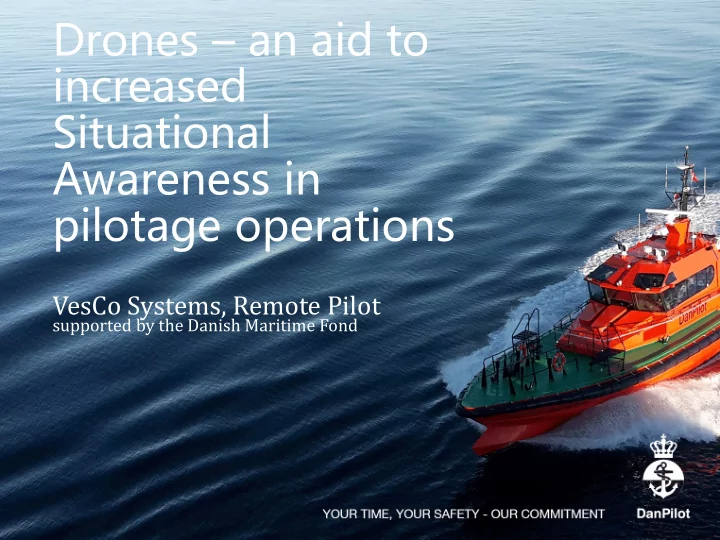
Drones – an aid to increased Situational Awareness in pilotage operations

VesCo Systems, Remote Pilot

supported by the Danish Maritime Fond

slide-2
SLIDE 2

Roadmap of this presentation

The Vision for the use of Drones

  • Who are VesCo

Systems

  • COWI report 2014
  • Piloting as a control

problem

  • Vision for shore based

pilotage

The process of using new technologies

  • Graduating Situational

awareness

  • Redundancy and

stability

How far have we come?

  • Thoughts and

visualization

  • Will the ships buy

shore based pilotage?

slide-3
SLIDE 3

The Vision for the use of Drones

VesCo Systems – a joint venture between:

Blue Oceans Robotics Third Element Aviation DanPilot

Supported by the Danish Maritime Fond

slide-4
SLIDE 4

The Vision for the use of Drones

COWI concluded in 2014 that the best potential for shore based pilotage would be for sea pilotage relating to specific areas in Danish waters based on safety assessment

Safety assessment of shore based pilotage in the three scenarios

Source: COWI, November 2014, DMA. Technological Assessment ofthe possibility of shore based pilotage in Danish Waters.

slide-5
SLIDE 5

The Vision for the use of Drones

”If everything else remains unchanged remote pilotage will always lead to less efficient control of the systems”

(Karl Bruno & Margareta Lützhöft)

Source: Karl Bruno & Margerate Lützhöft, Shore based Pilotage: Pilot or Autopilot? Piloting as a control problem, Journal of Navigator, 2009

Conviction: ”That the issue of remote pilotage is best discussed in the context of Control and not in the context of Technology”

(Karl Bruno & Margareta Lützhöft)

slide-6
SLIDE 6

The Vision for the use of Drones

Our goal is to take advantage of the increased potential in new technologies and thereby increase the control i.e. Situational Awareness focusing on the marine harbor pilotage

  • perations.

Thus the vision for shores based pilotage is that a harbor pilotage operation is to be performed at least to the same level of quality as if the pilot were on board the vessel ensuring:

  • Increased safety for marine pilots
  • Making harbor pilotage available for more

ships

  • More efficient pilotage operations
slide-7
SLIDE 7

The process of using new technologies

Control = Situational Awareness (SA)

Autonomy levels (AL) adapted from Lloyds Register

We need to define the Situational Awareness Level (SAL) in relation to Shores Based Pilotage

slide-8
SLIDE 8

The process of using new technologies

This means:

  • Working with experienced experts
  • A Safety ll approach – why does it work?
  • Securing communication stability and redundancy
  • Making sure that perception and communication

is supported visually on board and ashore (the pilot), bird eye view, helm position, engine orders i.e. the requirement to the HMI interface

  • Make an effort to mitigate the fact that the

Captain of a ship and the marine pilot is not standing besides each other

slide-9
SLIDE 9

How far have we come?

System 1: Aerial overview of entrance and berth areas RemotePilot consists of two systems. System 1 is a fleet of drones dedicated to only provide an aerial overview to the pilot of the entrance and berth areas during port pilotage operations, and possibly to verify/calibrate the positioning of the SafePilot system in combination with an overlay on top of the real-time videofeed.

slide-10
SLIDE 10

How far have we come?

System 2: Delivery of equipment package enabling shore-based piloting RemotePilot consists of two systems. System 2 is a fleet of drones dedicated to only carry out an equipment package (iPad, communication, GNSS, cameras etc.) for enabling shore-based piloting to vessels requesting pilotage.

slide-11
SLIDE 11

How far have we come?

slide-12
SLIDE 12

How far have we come?

Visualization on the Portable Pilot Unit (PPU)

slide-13
SLIDE 13

How far have we come?

  • Still testing – Issues like, perception, visibility,

weather, language skills, batteries etc.

  • Will it work?
  • Legislation?
  • Will the ships use the product?
  • If it works in port, it will also be at path to

shore based pilotage for sea pilotage

  • Increased safety for marine pilots
  • Increased pilotage availability for more ships

due to lower cost

  • More reliant and efficient operation
slide-14
SLIDE 14

The future was here Thank you 