Hopfield Network
- !
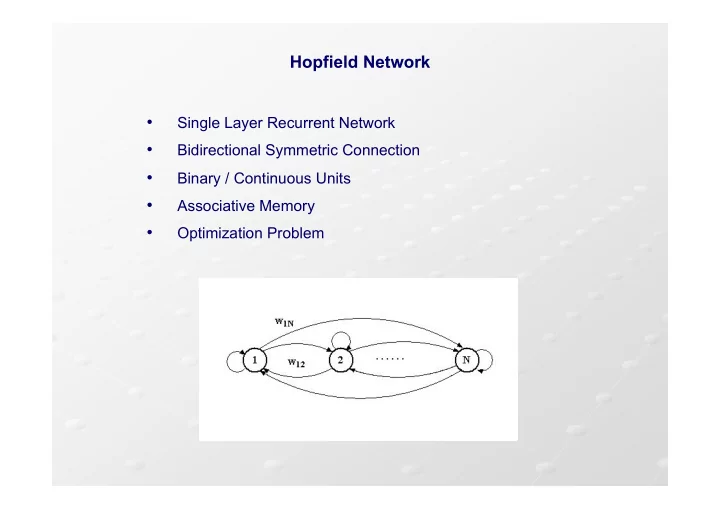
Single Layer Recurrent Network
- !
Bidirectional Symmetric Connection
- !
Binary / Continuous Units
- !
Associative Memory
- !
Optimization Problem
! Single Layer Recurrent Network ! Bidirectional Symmetric - - PowerPoint PPT Presentation
Hopfield Network ! Single Layer Recurrent Network ! Bidirectional Symmetric Connection ! Binary / Continuous Units ! Associative Memory ! Optimization Problem Hopfield Model Discrete Case Recurrent neural network that
Hopfield Network
Single Layer Recurrent Network
Bidirectional Symmetric Connection
Binary / Continuous Units
Associative Memory
Optimization Problem
Hopfield Model – Discrete Case
Recurrent neural network that uses McCulloch and Pitt’s (binary) neurons. Update rule is stochastic. Eeach neuron has two “states” : Vi
L , Vi H Vi L = -1 , Vi H = 1
Usually : Vi
L = 0 , Vi H = 1
Input to neuron i is : Where:
wij = strength of the connection from j to i
Vj = state (or output) of neuron j
Ii = external input to neuron i
Hopfield Model – Discrete Case
Each neuron updates its state in an asynchronous way, using the following rule: The updating of states is a stochastic process: To select the to-be-updated neurons we can proceed in either of two ways:
At each time step select at random a unit i to be updated (useful for simulation)
Let each unit independently choose to update itself with some constant probability per unit time (useful for modeling and hardware implementation)
Dynamics of Hopfield Model
In contrast to feed-forward networks (wich are “static”) Hopfield networks are dynamical system. The network starts from an initial state V(0) = ( V1(0), ….. ,Vn(0) )T and evolves in state space following a trajectory: Until it reaches a fixed point: V(t+1) = V(t)
Dynamics of Hopfield Networks
What is the dynamical behavior of a Hopfield network ? Does it coverge ? Does it produce cycles ? Examples (a) (b)
Dynamics of Hopfield Networks
To study the dynamical behavior of Hopfield networks we make the following assumption: In other words, if W = (wij) is the weight matrix we assume: In this case the network always converges to a fixed point. In this case the system posseses a Liapunov (or energy) function that is minimized as the process evolves.
The Energy Function – Discrete Case
Consider the following real function: and let Assuming that neuron h has changed its state, we have: But and have the same sign. Hence (provided that )
Schematic configuration space
model with three attractors
Hopfield Net As Associative Memory
Store a set of p patterns x!, ! = 1,…,p ,in such a way that when presented with a new pattern x, the network responds by producing that stored pattern which most closely resembles x.
N binary units, with outputs s1,…,sN
Stored patterns and test patterns are binary (0/1,±1)
Connection weights (Hebb Rule) Hebb suggested changes in synaptic strengths proportional to the correlation between the firing of the pre and post-synaptic neurons.
Recall mechanism Synchronous / Asynchronous updating
Pattern information is stored in equilibrium states of the network
Example With Two Patterns
Two patterns X1 = (-1,-1,-1,+1) X2 = (+1,+1,+1,+1)
Compute weights
Weight matrix
Recall
Input (-1,-1,-1,+1) ! (-1,-1,-1,+1) stable
Input (-1,+1,+1,+1) ! (+1,+1,+1,+1) stable
Input (-1,-1,-1,-1) ! (-1,-1,-1,-1) spurious
Associative Memory Examples
An example of the behavior of a Hopfield net when used as a content-addressable
pattern for the digit “3” was corrupted by randomly reversing each bit with a proba- bility of 0.25 and then applied to the net at time zero. Outputs at time zero and after the first seven iterations are shown in (B).
Associative Memory Examples
Example of how an associative memory can reconstruct images. These are binary images with 130 x 180 pixels. The images
after presentation of the corrupted images shown on the left. The middle column shows some intermediate states. A sparsely connected Hopfield network with seven stored images was used.
Storage Capacity of Hopfield Network
There is a maximum limit on the number of random patterns that a Hopfield network can store Pmax " 0.15N If p < 0.15N, almost perfect recall
If memory patterns are orthogonal vectors instead of random patterns, then more patterns can be stored. However, this is not useful.
Evoked memory is not necessarily the memory pattern that is most similar to the input pattern
All patterns are not remembered with equal emphasis, some are evoked inappropriately often
Sometimes the network evokes spurious states
Hopfield Model – Continuous Case
The Hopfield model can be generalized using continuous activation functions. More plausible model. In this case: where is a continuous, increasing, non linear function. Examples
Funzione di attivazione
+1
Updating Rules
Several possible choices for updating the units : Asynchronous updating: one unit at a time is selected to have its output set Synchronous updating: at each time step all units have their output set Continuous updating: all units continuously and simultaneously change their outputs
Continuous Hopfield Models
Using the continuous updating rule, the network evolves according to the following set of (coupled) differential equations: where are suitable time constants ( > 0). Note When the system reaches a fixed point ( / = 0 ) we get Indeed, we study a very similar dynamics
The Energy Function
As the discrete model, the continuous Hopfield network has an “energy” function, provided that W = WT : Easy to prove that with equality iff the net reaches a fixed point.
Modello di Hopfield continuo (energia)
Perché è monotona crescente e . N.B. cioè è un punto di equilibrio
Modello di Hopfield continuo (relazione con il modello discreto)
Esiste una relazione stretta tra il modello continuo e quello discreto. Si noti che : quindi : Il 2o termine in E diventa : L’integrale è positivo (0 se Vi=0). Per il termine diventa trascurabile, quindi la funzione E del modello continuo diventa identica a quello del modello discreto
Optimization Using Hopfield Network
!!
Energy function of Hopfield network
!!
The network will evolve into a (locally / globally) minimum energy state
!!
Any quadratic cost function can be rewritten as the Hopfield network Energy
!!
Classical Traveling Salesperson Problem (TSP)
!!
Many other applications
2-D, 3-D object recognition
Image restoration
Stereo matching
Computing optical flow
The Traveling Salesman Problem
Problem statement: A travelling salesman must visit every city in his territory exactly
!!
NP-Complete Problem
!!
Exhaustive Enumeration: nodes, enumerations, distinct enumerations distinct undirected enumerations Example: n = 10, 19!/2 = 1.2 x 10¹⁸
The Traveling Salesman Problem
TSP: find the shortest tour connecting a set of cities. Following Hopfield & Tank (1985) a tour can be represented by a permutation matrix:
The Traveling Salesman Problem
The TSP, showing a good (a) and a bad (b) solution to the same problem Network to solve a four-city TSP. Solid and open circles denote units that are
representing the tour 3-2-4-1. The connections are shown only for unit n22; solid lines are inhibitory connections
form inhibitory connections of strength –#. All connections are symmetric. Thresholds are not shown.
Artificial Neural Network Solution
Solution to n-city problem is presented in an n x n permutation matrix V X = city i = stop at wich the city is visited Voltage output: VX,i Connection weights: TXi,Yj
n2 neurons
VX,i = 1 if city X is visited at stop i dXY = distance between city X and city Y
Artificial Neural Network Solution
Data term: We want to minimize the total distance
Constraint terms: Each city must be visited once Each stop must contain one city The matrix must contain n entries
Artificial Neural Network Solution
A, B, C, and D are positive constants
Indici modulo n Total cost function La funzione energia della rete di Hopfield è:
Network Weights
The coefficients of the quadratic terms in the cost function define the weights
{Inhibitory connection in each row}
{Inhibitory connection in each column} {Global inhibition} {Data term} {External current}
Experiments
10-city problem, 100 neurons
Locations of the 10 cities are chosen randomly with uniform p.d.f. in unit square
Parameters: A = B = 500, C = 200, D = 500
The size of the squares correspond to the value of the voltage output at the corresponding neurons.
Path: D-H-I-F-G-E-A-J-C-B
TSP – A Second Formulation
Another way of formulating the TSP constraints (i.e., permutation matrix) is the following row constraint column constraint The energy function becomes : Advantage : less parameters (A,B,D)
The N-queen Problem
Build an n x n network whose neuron ( i, j ) is active if and only if a queen occupies position ( i, j ) There are 4 constraints :
1.!
Only one queen on each row
2.!
Only one queen on each column
3.!
Only one queen on each diagonal
4.!
Exactly n queens on the chessboard
Network Weights
Following Hopfield’s idea for the TSP, the weights become: A $ inhibitory connection on each row B $ inhibitory connection on each column C $ “global” inhibitory connection D $ inhibitory connection on each diagonal
"Ti j,k l = A 1"# jl
B # jl 1"#i k
C + D #i+ j,k+l +#i" j,k"l
Hopfield’s Networks for Optimization
Shortcomings of the original formulation : 1) number of connection is O(n4) and number of units O(n2) 2) not clear how to determine the parameters A, B, C, D 3) no theoretically guarantee that the solutons obtained are indeed “permutation matrices” 4) not clear how to avoid local minima 5) the relation between the original (discrete) problem and the continuous one holds only in one direction (that is, although each “discrete” solution corresponds to a solution in the continuous space, the converse needs not be true)
The Maximum Clique Problem (MCP)
You are given:
An undirected graph G = (V,E) , where
and are asked to
Find the largest complete subgraph (clique) of G The problem is known to be NP-hard, and so is problem of determining just the size of the maximum clique. Pardalos and Xue (1994) provide a review
Some Notation
Given an arbitrary graph G = (V,E) with n nodes:
If C V, xc will denote its characteristic vector which is defined as
Sn is the standard simplex in Rn :
A=(aij) is the adjacency matrix of G:
The Lagrangian of a graph
Consider the following “Lagrangian” of graph G: Where a prime (‘) denotes transposition and A is the adjacency matrix of G. Example:
The Motzkin-Straus Theorem
Spurious Solutions
All points on the segment joining x’ and x’’ are “spurious” solutions. Solution: add ! over the main diagonal of A
The regularized Motzkin-Straus Theorem
THEOREM (Bomze, 1997) Given C V with characteristic vector xc we have:
vector of some subset of vertices (that is, no spurious solutions)
Evolutionary Games
Developed in evolutionary game theory to model the evolution of behavior in animal conflicts. Assumptions
A large population of individuals belonging to the same species which compete for a particular limited resource
This kind of conflict is modeled as a game, the players being pairs of randomly selected population members
Players do not behave “rationally” but act according to a pre-programmed behavioral pattern, or pure strategy
Reproduction is assumed to be asexual
Utility is measured in terms of Darwinian fitness, or reproductive success
Notations
is the set of pure strategies
is the proportion of population members playing strategy at time
The state of population at a given instant is the vector
Given a population state , the support of , denoted , is defined as the set of positive components of , i.e.,
Payoffs
Let be the payoff (or fitness) matrix. represents the payoff of an individual playing strategy against an opponent playing strategy . If the population is in state , the expected payoff earnt by an – strategist is: while the mean payoff over the entire population is:
Replicator Equations
Developed in evolutionary game theory to model the evolution of behavior in animal conflicts (Hofbauer & Sigmund, 1998; Weibull, 1995). Let be a non-negative real-valued matrix, and let Continuous-time version: Discrete-time version:
Replicator Equations & Fundamental Theorem of Selection
is invariant under both dynamics, and they have the same stationary points. Theorem: If , then the function is strictly increasing along any non-constant trajectory of both continuous-time and discrete-time replicator dynamics
Mapping MCP’s onto Relaxation Nets
To (approximately) solve a MCP by relaxation, simply construct a net having units, and a -weight matrix given by where A is the adjacency matrix of G. Example: The system starting from x(0) will maximize the Motzkin-Straus function and will converge to a fixed point x* which corresponds to a (local) maximum of the Lagrangian.
Experimental Setup
Experiments were conducted over random graphs having:
size: = 10, 25, 50, 75, 100
density: = 0.10, 0.25, 0.50, 0.75, 0.90 Comparison with Bron-Kerbosch (BK) clique-finding algorithm (1974). For each pair ( , ) 100 graphs generated randomly with size and density