
SLIDE 1
Marisa Brienza
Raffaella Morganti et al.
Single-dish observations for the study of the AGN life cycle
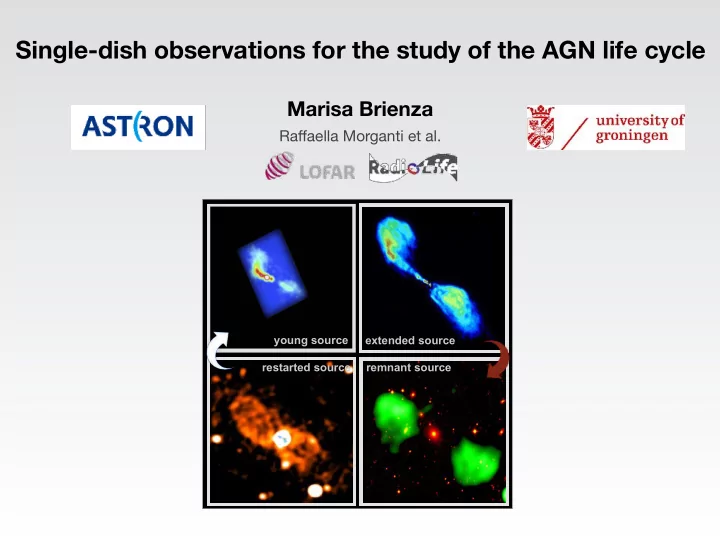
young source extended source remnant source restarted source
Single-dish observations for the study of the AGN life cycle Marisa - - PowerPoint PPT Presentation
Single-dish observations for the study of the AGN life cycle Marisa Brienza Ra ff aella Morganti et al. young source extended source restarted source remnant source WHY? Radio galaxy evolution (radiative and dynamical) Timescales of
Marisa Brienza
Raffaella Morganti et al.
young source extended source remnant source restarted source
Radio spectrum SYNCHROTRON + INVERSE COMPTON + EXPANSION
courtesy of M. Murgia
LOW FREQUENCY HIGH SENSITIVITY RESOLUTION
6” @ 150 MHz
100 uJy/beam @ 6” @ 150 MHz
LOFAR discovery of a 700-kpc remnant radio galaxy at low redshift
Brienza+2017,A&A,606,A98
interacting early type galaxies outside cluster!
~15’ 4 mJy arcmin-1 at 1.4 GHz
LOFAR discovery of a 700-kpc remnant radio galaxy at low redshift
100 1000 10000
Frequency (MHz)
10 100 1000
Flux Density (m Jy)
LOFAR WENSS WSRT GB6
Brienza+2017,A&A,606,A98
α=0.5
no ultra-steep spectral index at MHz frequencies but sudden steepening above 1.4 GHz! r a d i a t i v e e v
u t i
m
e l s ( K
i s s a r
& G u b a n
1 9 9 4 ) 1 5 M y r O N + 6 M y r O F F
α=0.9 α=1.6
Brienza+2018 submitted A&A
CSS, Giroletti+05
Shulevski+2012
1.4 mJy arcmin-1 at 1.4 GHz
α150-1400=0.48
LOFAR HBA 150 MHz @ 1.2’
α150-1400=0.48 α1400-6600=0.69
Sardinia radio telescope 6.6 GHz @ 2.9’ LOFAR HBA 150 MHz @ 1.2’
α150-1400=0.48 α1400-6600=0.69
Sardinia radio telescope 6.6 GHz @ 2.9’ LOFAR HBA 150 MHz @ 1.2’
The large scale jets are still active or they have switched
acceleration processes can also play a role
α150-1400=0.48 α1400-6600=0.69
Sardinia radio telescope 6.6 GHz @ 2.9’ LOFAR HBA 150 MHz @ 1.2’
C H A L L A N G E d u e t
i g h d y n a m i c r a n g e q u e s t ! D e c
v
u t i
r e q u i r e d !
The large scale jets are still active or they have switched
acceleration processes can also play a role
35 deg^2 14”x18” 0.75 mJy/beam Mahony+2016
Remnant radio galaxy selected with different methods:
ultra-steep spectral index spectral curvature morphology core prominence
By using low frequency and multiple selection criteria the fraction of remnant radio galaxies remains low!
Brienza+2017, A&A, 606, A98
Restarted radio galaxies search in progress!! (Jurlin et al. in prep)
The LOFAR Two-metre Sky Survey (LOTSS)
HETDEX Spring Field , 161 < RA < 231 degrees and 45.5 < DEC < 57 degrees 6” - 20” resolution with 0.1-1 mJy/beam noise (Shimwell et al. in prep)
more remnant and restarted RG to be selected soon!
Observations at MHz frequencies are ideal to identify remnant plasma from past jet activity phases both in remnant and restarted radio galaxies BUT Observations at frequencies higher than 1.4 GHz with high sensitivity to large scale emission are essential to study the physics of the remnant plasma SINGLE DISH OBSERVATIONS!! deconvolution algorithms important for the study of restarted sources where diffuse lobes are associated to compact bright cores!