
SLIDE 1
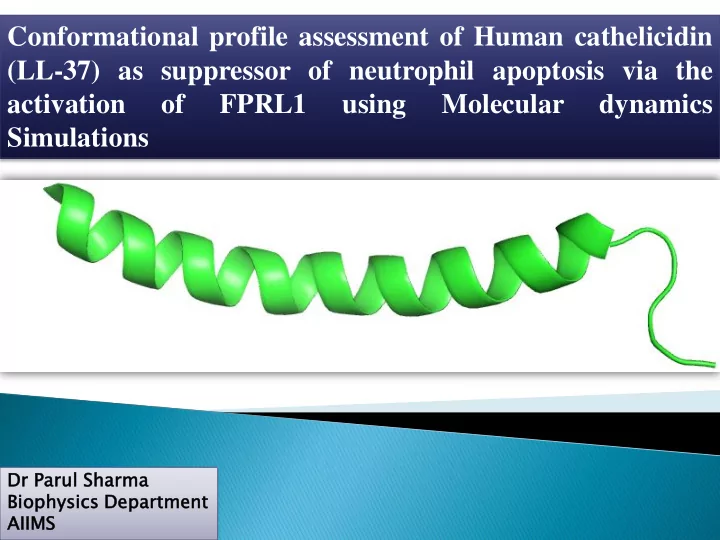
Conformational profile assessment of Human cathelicidin (LL-37) as suppressor of neutrophil apoptosis via the activation
- f
Simulations Dr Dr Parul Sharma Biophysics ics Department ment - - PowerPoint PPT Presentation
Conformational profile assessment of Human cathelicidin (LL-37) as suppressor of neutrophil apoptosis via the activation of FPRL1 using Molecular dynamics Simulations Dr Dr Parul Sharma Biophysics ics Department ment AIIMS conserved
cationic, frequently α-helical, amphipathic antimicrobial peptides (AMP). conserved pro- peptide sequences and a N-terminal “cathelin” domain. first-line of defense against infection by serving as “natural antibiotics”. broad range of chemotactic and immunostimulator y/ modulatory effects
innovative drugs: infection
immune response.
70 ns 90ns 100ns
310 helix from ASP4 –SER9 . π helix towards C- terminal from residue ASP26 - ASN30 α-helix from ASP4- LYS8 towards N- terminal
α- helical region is more
prominent in Arg23-Leu31
RANK PDB Hit TM-SCORE RMSD IDEN COV. 1 4mbsa 0.821 0.83 0.264 0.832 2 4yay 0.755 1.06 0.268 0.858 3 3oduA 0.727 2.24 0.279 0.792 4 4ea3B 0.717 2.97 0.277 0.806 5 2ksaA 0.708 3.53 0.207 0.823 6 4ib4A 0.695 3.02 0.179 0.798 7 1gzmB 0.694 3.47 0.179 0.812 8 4djhA 0.690 2.99 0.284 0.786 9 1kpnA 0.687 3.61 0.150 0.809 10 1kadA 0.681 4.06 0.183 0.832
TM-SITE and S-SITE programs PDB: 4YAY; Human Angiotensin receptor with its selective antagonist ZD7155 PDB: 4MBS; CCR5 chemokine receptor with marketed HIV drug maraviroc
Comp mplex ex ---
metho hod FPRL1-LL37 LL37 (ff96 96) FPRL1 L1-LL37 LL37(ff (ff99S 9SB) B) FPRL1-2K60 2K60 GENERALI LIZED ED BORN N (at 1ns)
.461 617(K (Kcal cal/m /mol)
.821 217(K (Kcal cal/m /mol)
8715 15 (Kcal al/m /mol) (at 5ns)
.289 894(K (Kcal cal/mol)
.381 812(K (Kcal cal/mol)
7816 16(Kc (Kcal al/mol) POISSON BOLTZ TZMA MANN NN (at 1ns)
.003 037(K (Kcal cal/m /mol)
.733 338(K (Kcal cal/m /mol)
.290 902(K (Kcal cal/m /mol) (at 5ns)
.054 543(K (Kcal cal/m /mol)
.642 425(K (Kcal cal/m /mol)
.432 324(K (Kcal cal/m /mol)
The results demonstrate that the LL-37 has a tendency to attain folded and unfolded conformations, probably due to the low energy barrier between the states accounting for the high level of flexibility of the peptide.
Analysis of the MD trajectories of LL-37 depicts the propensity of this peptide to attain α-helices and β-turns under the influence of force fields AMBER ff96 and AMBER ff99SB.
With AMBER ff96, conformation of LL37 changed from linear helix to two small helices with kink as proposed by NMR structure (Porcelli, 2008)
With AMBER ff99SB force field the peptide attains a stable helical structure with the N and C-terminals being extended and flexible.
Docked conformations of peptide by MD using ff99SB with FPRL1 was having maximum interactions and free binding energy as compared to NMR structure. This could further give new insight into the neutrophil apoptosis role of LL-37
Additionaly, the functional diversity of cathelicidin makes it a relevant and lucrative target to investigate.